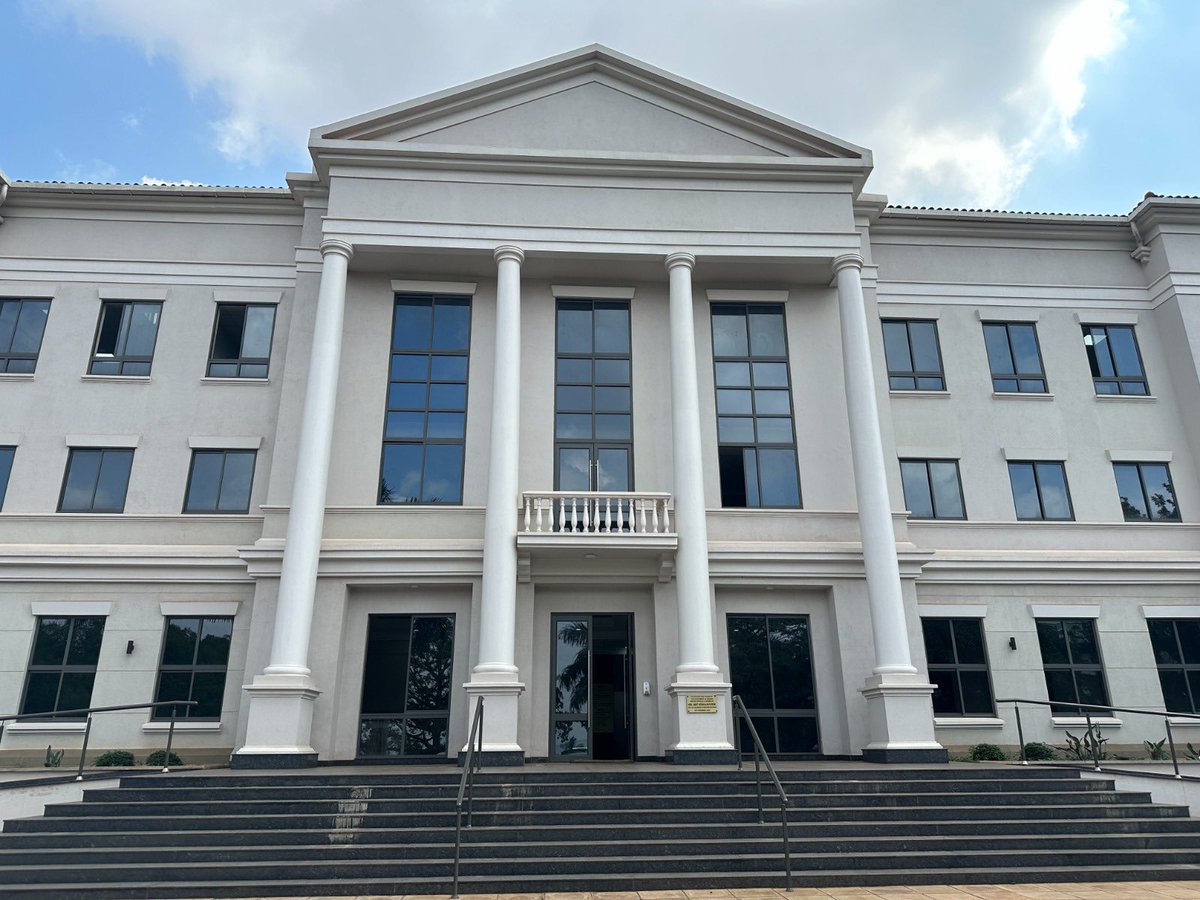
On 12th June 2026, the High Court Civil Division delivered a landmark judgement that categorically advanced and reinforced students’ rights.
I thank God, for granting this overwhelming victory. To my family and friends who stood by me throughout this journey, thank you for your unwavering support.
My deepest gratitude to my lawyers at @KAAdvocates where you can truly consider it solved. @elisonk and @FERDINANDIUS your knowledge and articulation of the law is unmatched.
Thank you to my UCU alumnus @TumukundeTT for your support and encouragement.
This is not my victory alone. I share it with all the students that have been unfairly treated by the administrators entrusted to help them. I share it with those who have endured the painful battle of missing marks, credit transfer disputes and unfair grading.
I conclude with the following message:
Whatever unimaginable odds you find yourself facing, remember: if God is for you, who can be against.
Romans 8:31
Purchased as a copy in 1946, but digitized and identified in 2023, an original Magna Carta owned by the Harvard Law Library was hiding in plain sight. https://t.co/8BoekQeita
There are lawyers who practice law. There are lawyers who shape institutions. And then there are lawyers whose careers become intertwined with the great public questions of their time.
Hon. Sam Mayanja belongs firmly in the latter category.
His journey has taken him through private practice, politics, public service and reform. He helped form and build one of Uganda's most successful law firms. He entered public life. He stepped into one of the most contested arenas of governance, land. And this week he assumes office as the principal legal adviser to the Government of the Republic of Uganda.
It is a remarkable office. Few public offices sit as naturally at the intersection of all three arms of government. As a minister, the Attorney General is part of the Executive. As the First Parliamentary Counsel, he oversees the legal architecture through which government policy is translated into legislation and presented before Parliament. And as an Advocate of the courts of Uganda, he remains an officer of the court, owing duties not merely to a client, but to the administration of justice itself. In many respects, the Attorney General is the constitutional thread that runs through the Executive, the Legislature and the Judiciary.
It is also an office with a distinguished lineage. Across the decades, it has been occupied by some of Uganda's most accomplished lawyers, jurists, politicians and statesmen. Among its holders have been Godfrey Lukongwa Binaisa, who would later become President of Uganda; Godfrey Lule; Nkambo Mugerwa; Abu Mayanja; Sam Kutesa; Francis Ayume; Joseph Mulenga; Prof. George Kanyeihamba; Rt. Hon. Amama Mbabazi; Hon. Fred Ruhindi SC; Justice Bart Katureebe; Peter Nyombi; Khiddu Makubuya; William Byaruhanga; and most recently Hon. Kiryowa Kiwanuka. Their careers would go on to shape courts, governments, constitutions and the nation itself. Few offices in Uganda can claim such a roll call.
Now the brief passes to Hon. Sam Mayanja.
Every Attorney General inherits a mandate. But each must decide what to do with it.
What should be the relationship between government and the legal profession? How should the state approach litigation? How do we tackle judicial backlog? How do we strengthen confidence in our institutions? How do we reconcile development with the rule of law? And what role should law play in Uganda's future?
These are not merely legal questions. They are national questions.
Join us this Wednesday as we welcome the Learned Attorney General of the Republic of Uganda, Hon. Sam Mayanja Senior Counsel, for a conversation about the office he now inherits, the mission he intends to pursue, and the legal and constitutional questions that will help shape Uganda's future.
The Attorney General's Brief: The Mandate and the Mission.
A hospital cannot detain a discharged patient for non-payment of medical bills. Detention on account of an outstanding hospital bill amounts to unlawful self-help, violates the patient’s constitutional rights to liberty, dignity and freedom of movement, and cannot be justified as a debt-recovery mechanism. A hospital policy that permits detention after discharge, or refusal to discharge until the accrued bill is settled, is not constitutionally sound.
In Gicheru v Nairobi Hospital & another (Constitutional Petition E258 of 2026) [2026] KEHC 5341 (KLR), a ruling delivered on 28 April 2026, R.E. Aburili J considered two interlocutory applications by Stephen Ndwaru Gicheru, who sought an interim mandatory order for his release from Nairobi Hospital. He had been discharged after open-heart surgery but remained at the hospital because of non-payment of the balance of his medical bill, after the insurance company declined to settle it. The petitioner argued that his continued detention was unconstitutional and violated his rights under Articles 28, 29, 39 and 47 of the Constitution. His family had shown good faith by paying KShs 1,000,000 and had undertaken to settle the outstanding lawful bill, but the hospital declined to release him.
The Court held that the right to personal liberty is one of the most fundamental human rights and that any detention not authorised by law, where used to procure payment of a contractual debt, violates the right to liberty and affronts human dignity. Relying on earlier authorities, including Ndegwa v Republic, Sonia Kwamboka Rasugu v Sandalwood Hotel & Resort Ltd, Maina v Registered Trustees of the Sisters of Mercy (Kenya) t/a Mater Misericordiae Hospital, and international human rights instruments including the ICCPR, the Court reiterated that liberty cannot be curtailed merely because a person is unable to fulfil a contractual obligation.
The Court emphasised that hospitals are entitled to recover lawful medical bills, but they must do so through lawful debt-recovery mechanisms, not by detaining discharged patients. It stated that it cannot be a hospital policy to detain patients after discharge, or to refuse discharge until the accrued bill is settled, because such a policy is not constitutionally sound. Since the petitioner had already been discharged, part of the bill had been paid, and his family had undertaken to settle the outstanding lawful bill, the Court found that this was an exceptional case justifying an interim mandatory order.
The Court therefore ordered Nairobi Hospital and its Chief Executive Officer to immediately release Stephen Ndwaru Gicheru, together with all his medical records, to his next of kin for post-operative follow-up care, upon the next of kin signing an undertaking to settle any outstanding lawful medical bill incurred at the hospital.
Read full ruling here: https://t.co/kD6Weirpop





![pmpaulmukiibi's tweet photo. A hospital cannot detain a discharged patient for non-payment of medical bills. Detention on account of an outstanding hospital bill amounts to unlawful self-help, violates the patient’s constitutional rights to liberty, dignity and freedom of movement, and cannot be justified as a debt-recovery mechanism. A hospital policy that permits detention after discharge, or refusal to discharge until the accrued bill is settled, is not constitutionally sound.
In Gicheru v Nairobi Hospital & another (Constitutional Petition E258 of 2026) [2026] KEHC 5341 (KLR), a ruling delivered on 28 April 2026, R.E. Aburili J considered two interlocutory applications by Stephen Ndwaru Gicheru, who sought an interim mandatory order for his release from Nairobi Hospital. He had been discharged after open-heart surgery but remained at the hospital because of non-payment of the balance of his medical bill, after the insurance company declined to settle it. The petitioner argued that his continued detention was unconstitutional and violated his rights under Articles 28, 29, 39 and 47 of the Constitution. His family had shown good faith by paying KShs 1,000,000 and had undertaken to settle the outstanding lawful bill, but the hospital declined to release him.
The Court held that the right to personal liberty is one of the most fundamental human rights and that any detention not authorised by law, where used to procure payment of a contractual debt, violates the right to liberty and affronts human dignity. Relying on earlier authorities, including Ndegwa v Republic, Sonia Kwamboka Rasugu v Sandalwood Hotel & Resort Ltd, Maina v Registered Trustees of the Sisters of Mercy (Kenya) t/a Mater Misericordiae Hospital, and international human rights instruments including the ICCPR, the Court reiterated that liberty cannot be curtailed merely because a person is unable to fulfil a contractual obligation.
The Court emphasised that hospitals are entitled to recover lawful medical bills, but they must do so through lawful debt-recovery mechanisms, not by detaining discharged patients. It stated that it cannot be a hospital policy to detain patients after discharge, or to refuse discharge until the accrued bill is settled, because such a policy is not constitutionally sound. Since the petitioner had already been discharged, part of the bill had been paid, and his family had undertaken to settle the outstanding lawful bill, the Court found that this was an exceptional case justifying an interim mandatory order.
The Court therefore ordered Nairobi Hospital and its Chief Executive Officer to immediately release Stephen Ndwaru Gicheru, together with all his medical records, to his next of kin for post-operative follow-up care, upon the next of kin signing an undertaking to settle any outstanding lawful medical bill incurred at the hospital.
Read full ruling here: https://t.co/kD6Weirpop](https://pbs.twimg.com/media/HIwMc7_WUAAS_Ci.jpg)