West Asia and North Africa; Afghanistan-Pakistan; I PhD International Studies | Senior Researcher
@IPCSNewDelhi | NASP Fellow @TakshashilaInst | Views mine
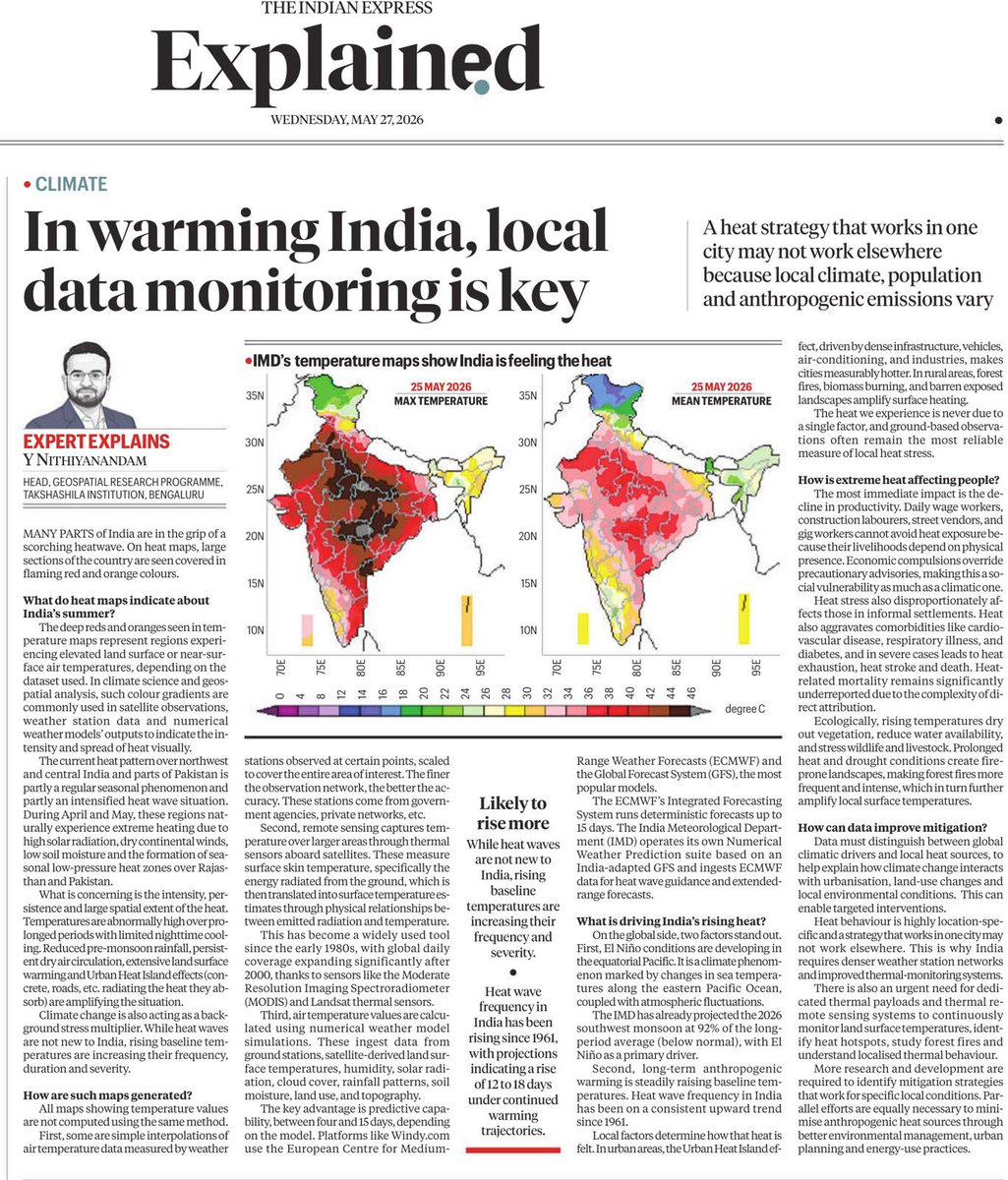
India’s heat crisis is not just about “high temperature.” A city showing 40°C can sometimes feel less dangerous than another at 35°C.
Why? Because human heat stress depends on humidity, urban design, land surface temperature, ventilation, vegetation, and local geography.
My latest explainer in @IndianExpress discusses:
• Why heat is deeply local
• Air temperature vs Land Surface Temperature
• Why some Indian cities trap heat more intensely
• The urgent need for hyperlocal heat monitoring systems
As India warms, the real challenge is not only measuring heat, but measuring the right form of heat.
#IPCSCommentary | "India’s diplomatic agility is constrained by the structural reality of its energy dependence."
Dr. Muneer Ahmed evaluates 🇮🇳's policy of multi-alignment in light of the political and economic consequences of the war in #WestAsia.
Read: https://t.co/gJIhFXGOxm
IPCS hosted an official event @MunSecConf titled 'Rising in a Storm: The Possibilities and Limits of India’s Multi-alignment' on 13 February, in partnership with @HSSde.
#MSC2026 (2/3)
#IPCSPublication | Four Pathways to Resolve the India-China Boundary Dispute
The 24th Special Representative meeting revived hopes & highlighted baggage on the 🇮🇳🇨🇳 boundary issue. Prof @Sri_Kondapalli outlines pathways to resolution in this Policy Brief.
https://t.co/b7GvVsxFhp
This is a story of grit and determination.
Story of Smt Santro Devi.
Her husband died 20 years ago, leaving behind three daughters and 2 year old Hardeep.
Worked as a 'mid day meal' worker in government school at paltry payment.
After school, worked in fields as a farm labourer, etching out a very tough life in the village of Alipur, Narwana, Jind, Haryana.
Today Lt Hardeep Gill gets commissioned from IMA.
Hardeep studied at a village school and later graduated from IGNOU.
He too worked in the fields till the day he finally joined IMA.
Happy to have played a small role in mentoring this young man.
The real strength of our armed forces is the rural youth, they will become leaders of tomorrow. Jai Hind 🇮🇳
@adgpi@thebetterindia@IndianMilitar11
#IPCSCommentary | "Pakistan’s securitisation approach has become a system that creates the very crises it claims to solve."
Dr. Muneer Ahmed (@Muneer9287) contextualises the 2025 Indo-Pak crisis in the Pakistani military's grip on domestic affairs.
Read: https://t.co/vgRLwfXcRt
I am late to our own party, but what a joy it is to make an idea come to life. Especially proud to see one we thought would be a one-time event now thrive as an annual dialogue, thanks to the good people I get to work with at @IPCSNewDelhi@priyadarshipre1@Muneer9287@only_fions
Dr. Muneer Ahmed (@Muneer9287), Senior Researcher, offers his expert analysis of the nuclear dynamics of the 2025 #IndiaPakistanCrisis in this piece by @BBCHindi.
Watch here: https://t.co/KUf2gJZyXH
Read here: https://t.co/snhqsilpYU
The authors delve into Russia and Iran's historical ties with Syria, the rise of HTS, and its impact on their regional ambitions.
Key observations about 🇮🇷🇷🇺 include:
-Loss of regional influence
-Blocked corridors in the Levant
-Inability to constrain US forces in the region.
#IPCSPublication
HTS’ takeover in Syria has amplified the political flux in #WestAsia. What does this mean for Tehran & Moscow?
In our latest Issue Brief, @Muneer9287 & @SiddharthAnilN1 examine 🇮🇷 & 🇷🇺’s investments in Syria and recent setbacks.
Read: https://t.co/t2GGecCxbM
Dr. Muneer Ahmed’s paper, 'State of Perpetual Crisis: Analysing Subnational Politics in Pakistan,' explores why Pakistan’s internal power struggles and regional dynamics keep the state in constant flux.