I think one of the biggest misconceptions in blockchain is that enterprises are waiting for “more speed".
Most enterprises already operate fast enough internally.
What they actually struggle with is fragmented trust.
A supplier sees one version of a shipment record.
An auditor sees another.
A regulator depends on delayed reporting.
Machines generate data that humans still need to manually reconcile.
DAC’s architecture seems built around reducing that fragmentation.
Not only through tokenisation, but through systems that make records continuously verifiable across multiple layers of interaction.
A warehouse update can become part of a supply-chain provenance trail.
An IoT trigger can automate actions without relying on centralized approval chains.
Identity-linked permissions can restrict who sees or modifies operational data.
Confidential workflows can remain private while still producing verifiable proof.
RWAs can carry ownership histories that remain auditable instead of scattered across disconnected databases.
That changes blockchain from “financial infrastructure” into coordination infrastructure.
But honestly, the most important part might be the security model underneath all of it.
Because enterprise records are long-duration records.
Some supply-chain histories, compliance logs, and operational records may need to remain trusted for decades.
That’s where DAC’s focus on quantum-resistant cryptography starts feeling less theoretical and more necessary.
If future systems depend on blockchain verification, long-term trust becomes the actual product.
@dac_chain
Six months from now, I don't think I'll remember most of the FIFA 2026 headlines that kept pulling my attention in different directions.
What I'll probably remember is realizing too late that the first Wingston whitelist snapshot had already happened while I was focused elsewhere.
That experience reminded me of something simple: attention is often more expensive than opportunity. Most opportunities stay available longer than we think. Attention rarely does.
The interesting part is that missing one snapshot didn't end the story.
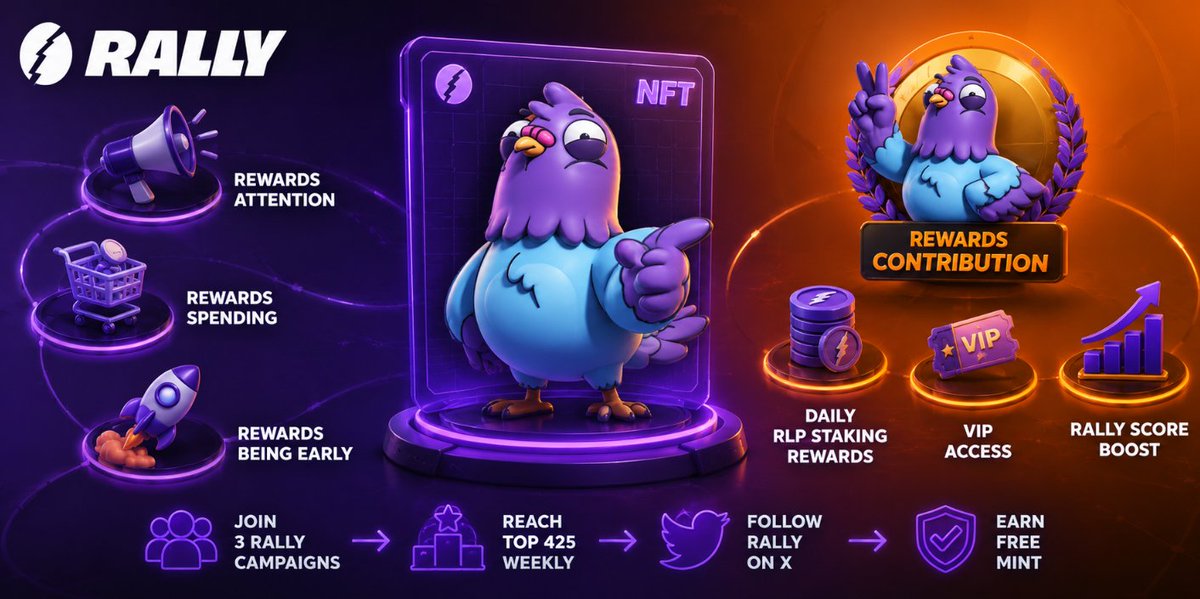
After reading more about Wingston from @RallyOnChain, I realized the whitelist isn't something you buy your way into. It's something you earn through participation. Join at least 3 Rally campaigns, stay inside the weekly Top 425, and follow Rally on X.
The more I looked at it, the more the design made sense. The free mint rewards contribution before ownership. For creators, that's a very different incentive model than simply rewarding whoever arrives first.
Wingston also comes with utility through staking, VIP community access, and Rally Score benefits, which makes it feel connected to an active protocol rather than existing on its own.
I'm currently fighting to stay inside the qualifying range, and honestly, that challenge has become more interesting than the snapshot I missed.
https://t.co/R2A25vOxFT
The leaderboard changes fast. Do you think maintaining momentum is harder than building it in the first place?
@onik_xyz The free mint acting as proof of participation makes sense, but I'm not convinced ownership has to come after contribution. Sometimes owning something is what motivates people to participate in the first place.
The easiest way to tell what a platform truly values is to look at what it rewards.
Some platforms reward attention.
Some reward spending.
Some reward being early.
A smaller group rewards contribution.
That distinction matters more than people think because incentives quietly shape communities.
While looking through the Wingston whitelist requirements from @RallyOnChain, I noticed something unusual. The path to a free mint is almost the same path someone would take if they genuinely wanted to become part of the ecosystem.
Join 3 rally campaigns.
Reach the top 425 on the weekly leaderboard.
Follow Rally on X.
The interesting part is that qualifying and participating are not separate activities.
You're already creating, learning, competing, and building a reputation before the NFT ever reaches your wallet.
And once it does, the utility continues through things like daily RLP staking rewards, VIP access, and a Rally Score boost.
That makes the free mint feel less like a giveaway and more like a record of participation.
Art can attract attention.
Utility can keep attention.
But contribution is usually what turns attention into community.
https://t.co/Vqk9ZFJK3a
What do you think creates stronger communities over the long run: ownership first, or participation first?
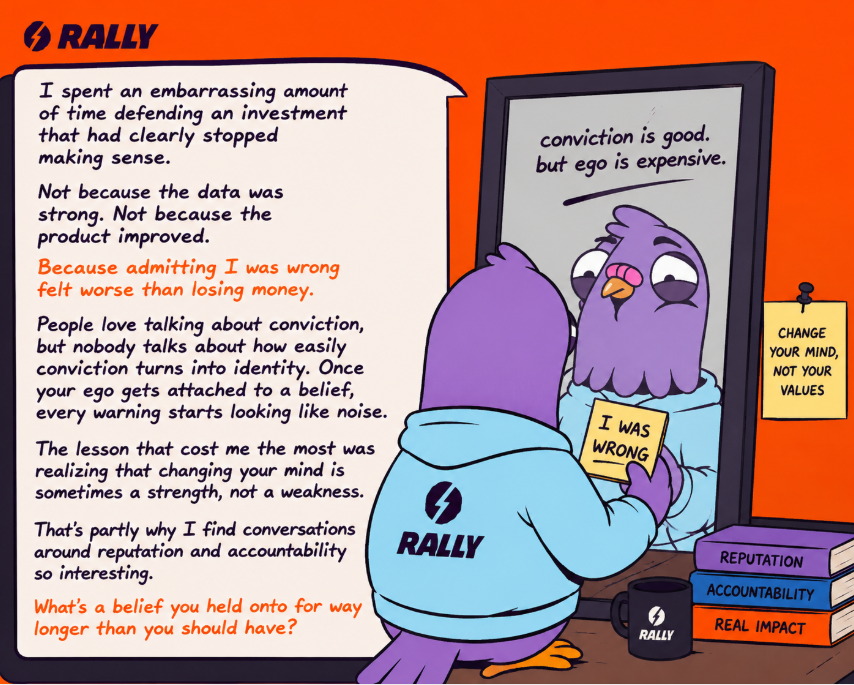
I spent an embarrassing amount of time defending an investment that had clearly stopped making sense.
Not because the data was strong. Not because the product improved.
Because admitting I was wrong felt worse than losing money.
People love talking about conviction, but nobody talks about how easily conviction turns into identity. Once your ego gets attached to a belief, every warning starts looking like noise.
The thing that finally changed my mind wasn't a new piece of information. It was realizing I was spending more energy defending the decision than evaluating it.
The lesson that cost me the most was learning that changing your mind is sometimes a strength, not a weakness.
That's partly why I find conversations around reputation and accountability on @RallyOnChain interesting.
What's a belief you held onto for way longer than you should have?
Retail can afford experiments.
Banks can't.
That's why I think the strongest signal around @zksync isn't a partnership announcement. It's deployment.
Deutsche Bank's Memento is already the production deployment of DAMA 2.0. ADI Chain brings together First Abu Dhabi Bank, the Central Bank of the UAE, BlackRock, Mastercard, and Franklin Templeton on the same ZKsync-based infrastructure. BitGo has integrated institutional custody through Prividium. Cari Network is currently onboarding five U.S. regional banks representing $600B+ in combined deposits, with production rollout planned for later in 2026.
What stands out is that these institutions operate under different regulators, risk frameworks, and compliance requirements, yet they arrived at the same settlement stack.
To me, that's what "already in production" really means.
Not that the technology exists.
That it cleared the trust, compliance, operational, and custody hurdles that usually stop institutional adoption long before launch.
The lead $ZK has today looks less like a technology story and more like a deployment story.
Discussions about 2026 focus on which settlement network banks might choose.
I think the more interesting question is what they become dependent on after they choose.
Financial infrastructure rarely locks in because of technology alone.
It locks in because counterparties connect, auditors approve workflows, regulators review implementations, and integration teams build around the same rails.
Years later, the dependency network becomes more valuable than the original technology decision.
That is how SWIFT scaled from hundreds of banks to more than 11,000.
Each participant increased the value of being inside the network and the cost of operating outside it.
2026 matters because institutions are moving beyond experimentation.
JPMorgan's Kinexys has processed more than $1.5T on blockchain rails. DTCC is advancing tokenized Treasuries. NYSE, BNY, and Citi are building tokenized securities infrastructure.
The question is no longer whether onchain settlement can work.
The question is which networks become embedded into the next generation of institutional dependencies.
That is why @zksync is worth watching.
As institutional deployments expand, the network effect is not just more participants.
It is more counterparties, more settlement corridors, and more infrastructure built around the same foundation.
Sometimes the most important decision is not the platform an institution chooses.
It is the ecosystem it becomes difficult to leave.
What I liked:
• Opened positions without issues
• Fast execution
• Smooth withdrawals
What surprised me:
• Being able to take both long and short positions
• Quick reward distribution
What I'd like to test next:
• More volatile markets
Overall, the experience felt much smoother than I expected.
FUD. IS LIVE ON MAINNET!
crypto finally has a conviction layer.
🧪 tested by 7,000.
🔵 built on @base
⚖️ settled by @GenLayer
📈 trade the FUD → https://t.co/OoIuBpSrEm