🚨🚨 Interested in ⬆️ mechanical properties of tendons? 🚨🚨
Please see below for a 🧵 on why strain magnitude is an important factor
based off my recent review https://t.co/3FBvh2TwAx
Whats the influence of contraction mode (con v ecc) or muscle length (shorter v longer) on neuromechanical /architectural behaviour of BfLh?
Data phase in our acute study looking at 4 SLDL variations using EMG, Vicon & ultrasound @Rodn3yK3nn3dy@BasVanHooren@TonyBlazevich
If you need 5-7 days (or longer 🥴) to recover from a single resistance training session I think you should reflect on your ability to prescribe resistance training
Muscles require a full 5–7 days (often longer) after true high-intensity training to failure to fully recover and supercompensate.
Anything less leaves them incomplete.
Never train two days in a row.
Consecutive sessions leave zero chance for systemic recovery, your nervous system and overall physiology need that complete rest.
Ignore this and you sacrifice longevity for short-term fatigue.
blood volume (it shoots way up - every time 😉)
4. Point to you and the support staffs really successful 8 week altitude block
5. Go around giving workshops on how to plan an outstanding altitude camp (that funnily enough won't replicate the results you've just been shown)
Physiologists were almost certain we knew this was going on about 10yrs ago.
The steps (grift):
1. Get baseline total haemoglobin mass & blood volume measured via Carbon monoxide rebreathing technique
2. Go to 🏔⛰️🚵♀️ & train (and dope) for a few weeks
3. Retest total tHb mass &
Doping didn't disappear from pro cycling.
It may have just moved to 2,500 metres.
This morning I interviewed James Witts, author of a new book called Dope. Halfway through the conversation, he described something I'd never heard in all my years around this sport.
He calls it "the altitude alibi."
Here's how it works.
Every spring, pro riders disappear to the same places. Mount Teide. Sierra Nevada. Weeks at altitude preparing for the biggest races of the year.
The logic is simple. Altitude exposure raises your hematocrit. More red blood cells, more oxygen, more power.
Except there are two problems nobody talks about.
Problem one: altitude doesn't work for everyone. There are genetic responders and non-responders. Some riders come down from the volcano flying. Some come down with nothing to show for three weeks of their season.
Problem two: altitude forces a trade-off.
At camp, you have a choice of protocol. Sleep high and train high, or sleep high and train low.
Sleep high, train high: you maximise the altitude adaptation. But the thin air caps your power. You can't train at full intensity, so you lose the training adaptation.
Sleep high, train low: you descend to do your sessions at full intensity and keep the training adaptation. But you give up some of the altitude effect.
You can't fully have both. Every altitude camp is a compromise.
Now here's where James's argument gets dark.
The biological passport, the system designed to catch dopers, doesn't test for drugs directly.
It tracks a rider's blood values against their own baseline. Deviate too far from your own normal, and you get flagged.
But when a rider is at altitude, the passport expects the deviation. Rising blood values are exactly what altitude is supposed to produce.
James believes some riders have worked out what that means.
Go to altitude. Microdose EPO. The passport reads the change in your blood as a natural altitude response.
Then train low, at full intensity, and take the full training adaptation - because you no longer need the mountain to raise your blood values. The drug does that part.
The altitude camp isn't the preparation.
It's the alibi.
I've spent years interviewing World Tour coaches, sports scientists and pro riders. I have never heard it framed like this before.
The full conversation goes much deeper: what the passport can and can't see, why microdosing is so hard to catch, and what it all means for the sport we love.
It drops soon on the Roadman Cycling Podcast. Follow along so you don't miss it.
His book is called Dope: How Drugs Changed Sport. Worth your time.
P.S. Genuine question for you: can the testers ever catch up in this game or cat & mouse?
🚨Our latest paper showing no effects of interset palm cooling on performance, physiological & perceptual responses
🥶🖐🏋♂️❌️
Well done Alec Pinero leading 👏 & thanks @BradSchoenfeld for invite 2 collab 🙏
@UlsterSchSport
https://t.co/In7kLL5o6f
This is untrue. Think about this claim: "Lose 2%, and physical performance drops 10%". Elite marathon runners finish marathons at 2-4% body weight loss. You're now saying they could run 1h50 if they replaced ALL sweat losses? Nope. We are quite happy dehydrated while exercising
@GuillemBalague Unfortunately you can't use match play peak speeds over time as a specific indicator of increases or decreases in maximal peak velocity capability. This requires objective, standardised testing. Match play peak speeds are constrained by whats going on in the game, distance etc.
🙏 to @bbcradioulster talkback for having me on today to 🗣 about modern elite athlete longevity w/ @MarkCarruthers7. We chatted mental & physical factors that are helping more of the best athletes play longer at the 🔝 level.
Link 👇
https://t.co/cCm9K796vG
@UlsterSchSport
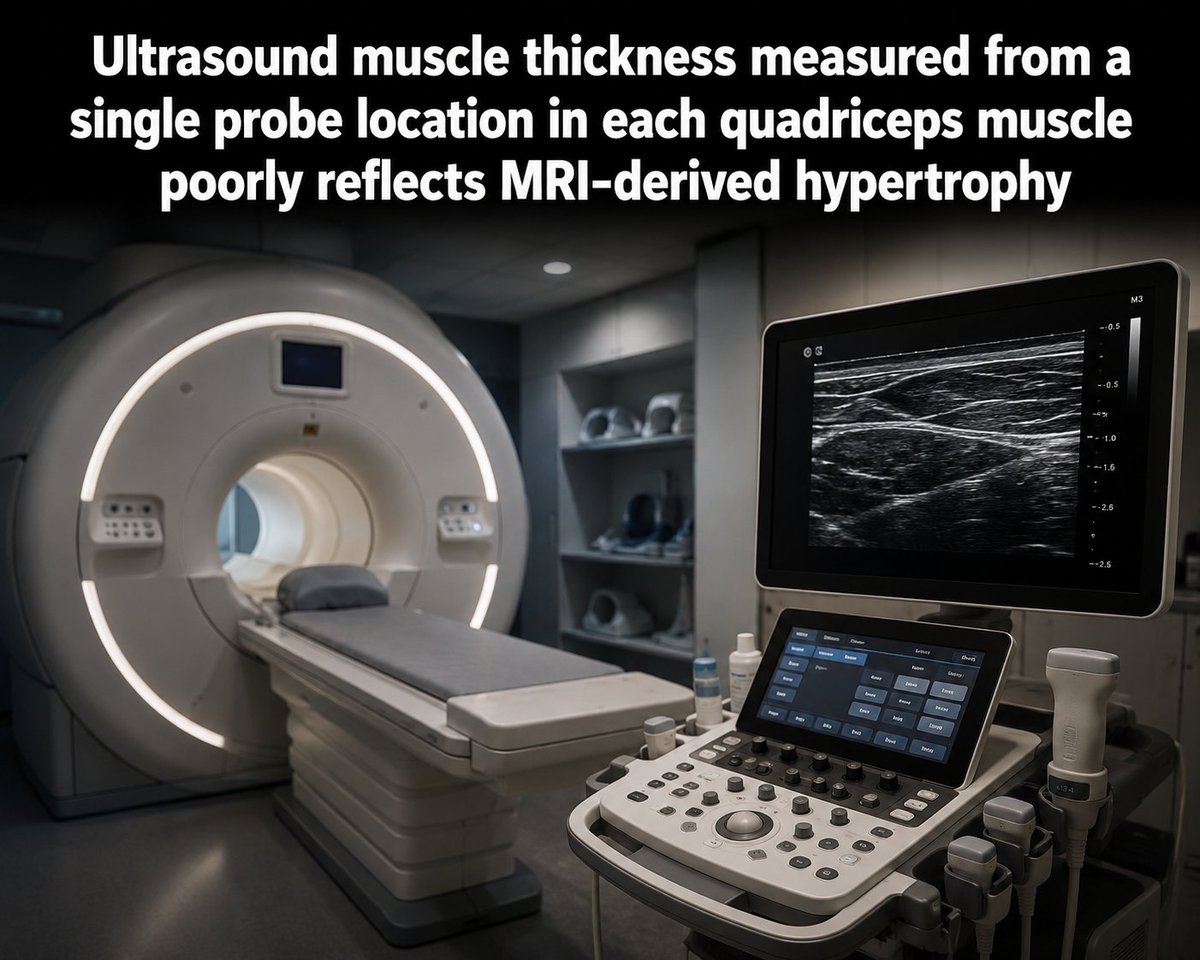
Single-site muscle thickness substantially underestimated MRI-derived hypertrophy and showed no meaningful relationship with MRI changes following 15 weeks of resistance training. See summary in image below
Ive seen many people suggest what England could do to mitigate the effects of acute altitude physiologically during the game. The one I haven't seen anyone suggest yet, which is within the rules & would provide the largest benefit is HYPEROXIA (supplemental O2) @BBCSport
@ChrisKirk_ASP@SimonBrundish id presume so which is why it offers more opportunity than usual. Theres nothing in the rules against it (that ive seen anyway). Its not useful in normobaric normoxia so likely goes under the radar a lot. Its expensive too which is why many dont use it
@SimonBrundish thanks. comes from working at altitude with different athletes over the years. always surprised how much this one slips through the cracks. Small margins...
@Scienceofsport I think the approach of limited time for acclimation is far from ideal, not certainly one you'd plan for in an ideal world. Do you think some of the heat/ hypoxia crossover might at least help mitigate some of this. Worked in int'l 🏑 in Jo'burg in similar altitude.. SpO2 of ~92%