Hon. Justice Martin Steven Egonda-Ntenda was Chief Guest at our Freshers' Orientation. He encouraged the new students to approach their university journey with determination, purpose and a commitment to excellence.
Drawing inspiration from the words of Martin Luther King Jr., Justice Egonda-Ntende challenged the students to discover their purpose and pursue it with dedication, regardless of the profession or role they eventually assume.
He emphasized that excellence is not determined by status or position but by the commitment to perform every responsibility with passion, integrity and dedication. “Strive to be the best of whatever you are,” he advised the students, adding that a meaningful life is built by giving one’s best in every endeavour.
The High Court Affirms that Family Land Transactions Require Written Spousal Consent and a Purchaser Who Does Not Inquire About a Family's Possession is Not Bona Fide.
Learn more: https://t.co/7mNKh6l983
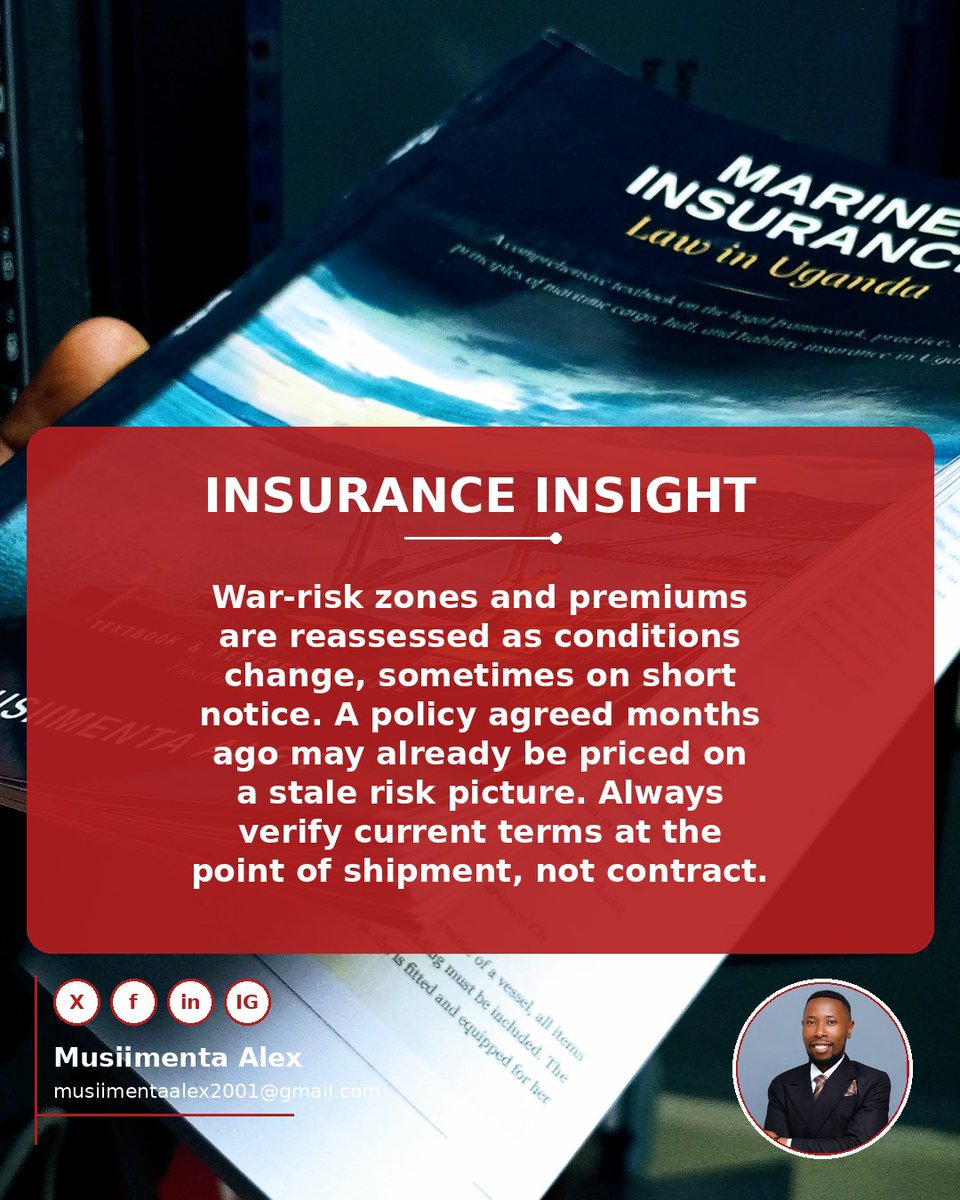
Your points on the need for harmonised conflict-of-laws rules, claims procedures, and mutual recognition of marine cargo policies across the EAC are well taken. An EAC-wide framework would indeed strengthen the Common Market. Grateful for the engagement.
Your points on the need for harmonised conflict-of-laws rules, claims procedures, and mutual recognition of marine cargo policies across the EAC are well taken. An EAC-wide framework would indeed strengthen the Common Market. Grateful for the engagement.
You've highlighted a practical legal issue that often escapes discussion despite its significant commercial implications.
One additional dimension worth emphasizing is the need for harmonisation not only of market access rules but also of conflict of laws principles, claims handling procedures, and mutual recognition of marine cargo insurance policies across EAC Partner States. Without these, traders may continue to face duplicated insurance costs, uncertainty over jurisdiction, and delays in claims settlement,outcomes that undermine the very objective of the EAC Common Market.
Perhaps the next frontier is an EAC wide marine cargo insurance framework, comparable in ambition to the COMESA Yellow Card Scheme, but tailored to multimodal cargo transit.
Congratulations on this insightful contribution.This is excellent.
You've highlighted a practical legal issue that often escapes discussion despite its significant commercial implications.
One additional dimension worth emphasizing is the need for harmonisation not only of market access rules but also of conflict of laws principles, claims handling procedures, and mutual recognition of marine cargo insurance policies across EAC Partner States. Without these, traders may continue to face duplicated insurance costs, uncertainty over jurisdiction, and delays in claims settlement,outcomes that undermine the very objective of the EAC Common Market.
Perhaps the next frontier is an EAC wide marine cargo insurance framework, comparable in ambition to the COMESA Yellow Card Scheme, but tailored to multimodal cargo transit.
Congratulations on this insightful contribution.This is excellent.
ENROLLMENT CRISIS: The profession views the continued criminalisation of young lawyers already victimised by the @LDC_Uganda monopoly & Law Council indifference as unnecessary, unjust,
and counterproductive. A humane & parental approach is required. @ODPPUGANDA#AbolishLawCouncil
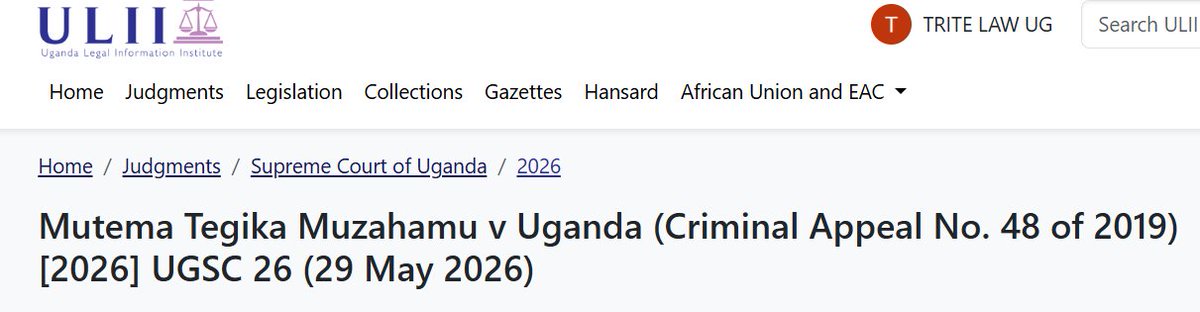
On 29th-May-2026, Supreme Court upheld Death Sentence for a father who killed his two year old child amid DNA paternity dispute, ✍️maximum sentence was to send a clear message to other men that might be similarly inclined that they could face the ultimate penalty for their ill‑conceived actions.
✍️In order to foster communal stability and social cohesion amidst the rising incidence of DNA paternity testing in Uganda, Courts ought to play their role in quickly and conclusively forestalling the murders of innocent children by vengeful, criminally‑inclined father figures
Legal representation:
Mr. Emmanuel Muwonge,holding brief for Mr. Henry Kunya
Respondent: Mr. Charles Richard Kamuli, Assistant Director of Public Prosecutions.
Case link: https://t.co/M6hIxNuIiR
A purchase agreement may open the story, but it cannot repair a broken chain of ownership.
In land disputes, the question is not always who bought first, who occupied the land longer, or who produced more witnesses.
Sometimes, the decisive question is much simpler:
What exactly did the seller own and could they legally pass it on?
In Mariam Mumeya v Management Committee of Mbale Primary School, the appellant claimed ownership through a 1999 purchase. But the chain through which her seller allegedly acquired the land became increasingly unclear. Her witnesses gave conflicting accounts about who had owned the land, whether it had been sold, and to whom it had allegedly been sold. Even the evidence concerning the alleged lease raised a troubling question: it appeared to have been issued before the appellant purchased the land.
The Court found the respondent’s account of ownership more coherent, convincing and legally supported.
“Long possession of customary land without more does not yield ownership.” Lubega Farouq J.
That statement carries enormous weight.
Possession may explain who has been using the land, but it does not automatically prove who owns it. Likewise, a purchase agreement proves that a transaction took place but it does not, by itself, establish that the seller had a valid interest capable of being transferred.
The Court also drew a sharp evidential line: a document merely marked for identification is not yet evidence. It must be formally produced, tendered as an exhibit and properly proved.
This judgment is a reminder that land cases are not won by the number of witnesses or the length of occupation.
They are won by a clear, credible and legally traceable chain of ownership.
Because in land law, you cannot pass a better title than the one you have and a weak root cannot grow into a strong claim.
#landtransactions
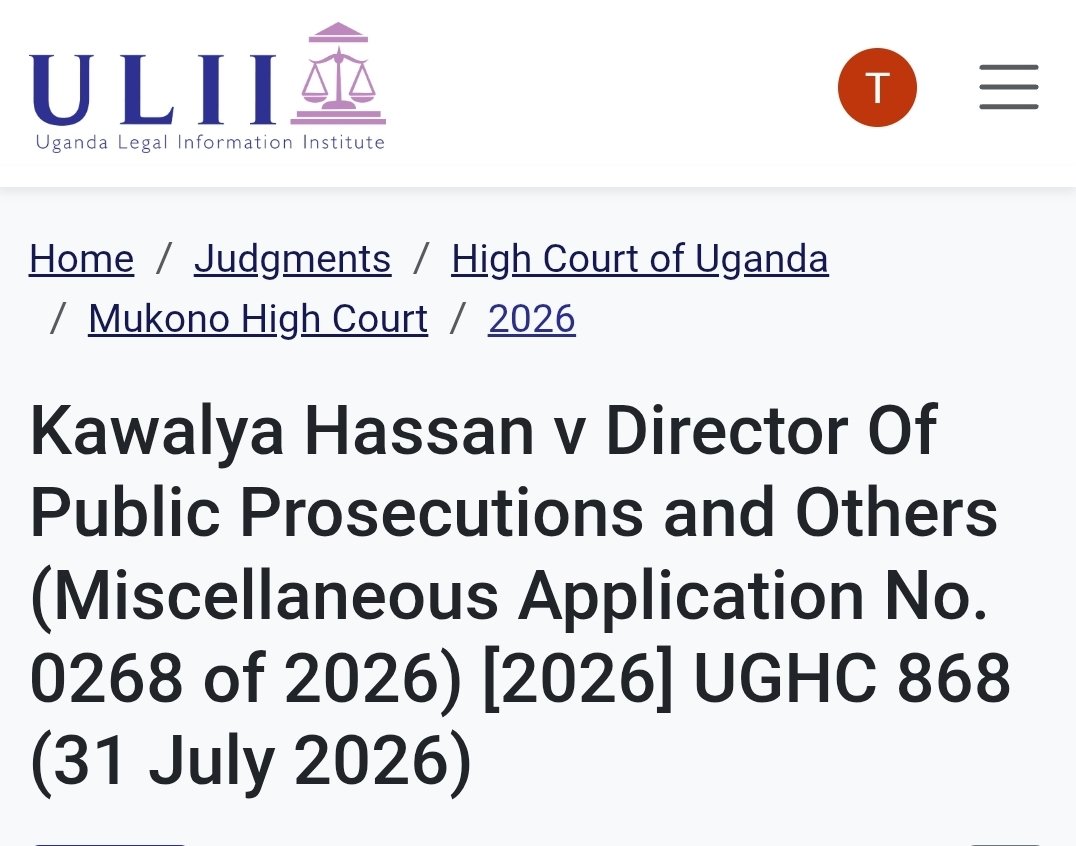
On 31st July-2026, Justice Mubiru
✍Unethical prosecutorial conduct “shocks the court’s conscience” and makes the judicial process look like a mockery, forcing courts to distance themselves from the taint✍If a prosecutor acts in bad faith or is corrupt, it can undermine the fairness of the trial✍Courts may intervene if the DPP’s decision is tainted by illegality, bad faith, bias, or constitutes an abuse of process
✍fairness of a criminal trial process is intrinsically linked to the integrity, impartiality, and good faith of the prosecutor
✍ Egregious bad faith or vindictive prosecution is viewed as an affront to the administration of justice, prompting courts to invoke their inherent power to protect judicial integrity.
✍The Court may permanently stay proceedings, even when a fair trial is technically still possible, simply because the state’s bad faith has compromised the moral and legal authority of the Court and threatens the justice system’s credibility.
✍While the office of the DPP operates with significant independence and discretion, their decisions are not entirely beyond judicial oversight because the DPP exercises public power, the office remains amenable to judicial review by the High Court.
✍ Judicial review does not substitute the court’s opinion for the DPP’s. Instead, the High Court scrutinises the decision-making process of the office to ensure it was lawful, rational, and procedurally fair.
Applicant : M/s Ismail Wandera Advocates & Legal Consultants.
For the 1 st and 2 nd respondents : Ms. Florence Akello Owinji, Asst. DPP.
For the 3 rd to 5 th respondents : M/s Stallone Advocates
Case link: https://t.co/U0AGQI3p6X
Cc: @PhillipKarugaba@JSCUganda
Attn: Bwana @ODPPUGANDA you are violating the fair trial rights of @kizzabesigye1. Justice must not only be done but must MANIFESTLY be seen to be done. As a public officer, you hold office in trust and are answerable to the people. We must hear from you.