Imagine thinking this is a flex.
Islam: You sin. You're accountable for it. You repent. God forgives you.
Christianity: You sin. So an innocent guy whom they think is God, has to sacrifice himself to himself to save from himself.
@_A_khalifa Because Abu jahl, abu lahab and marhab were arabs, and bilal habshi and salman farsi were non arabs.
I hope you got your answer who you are now.
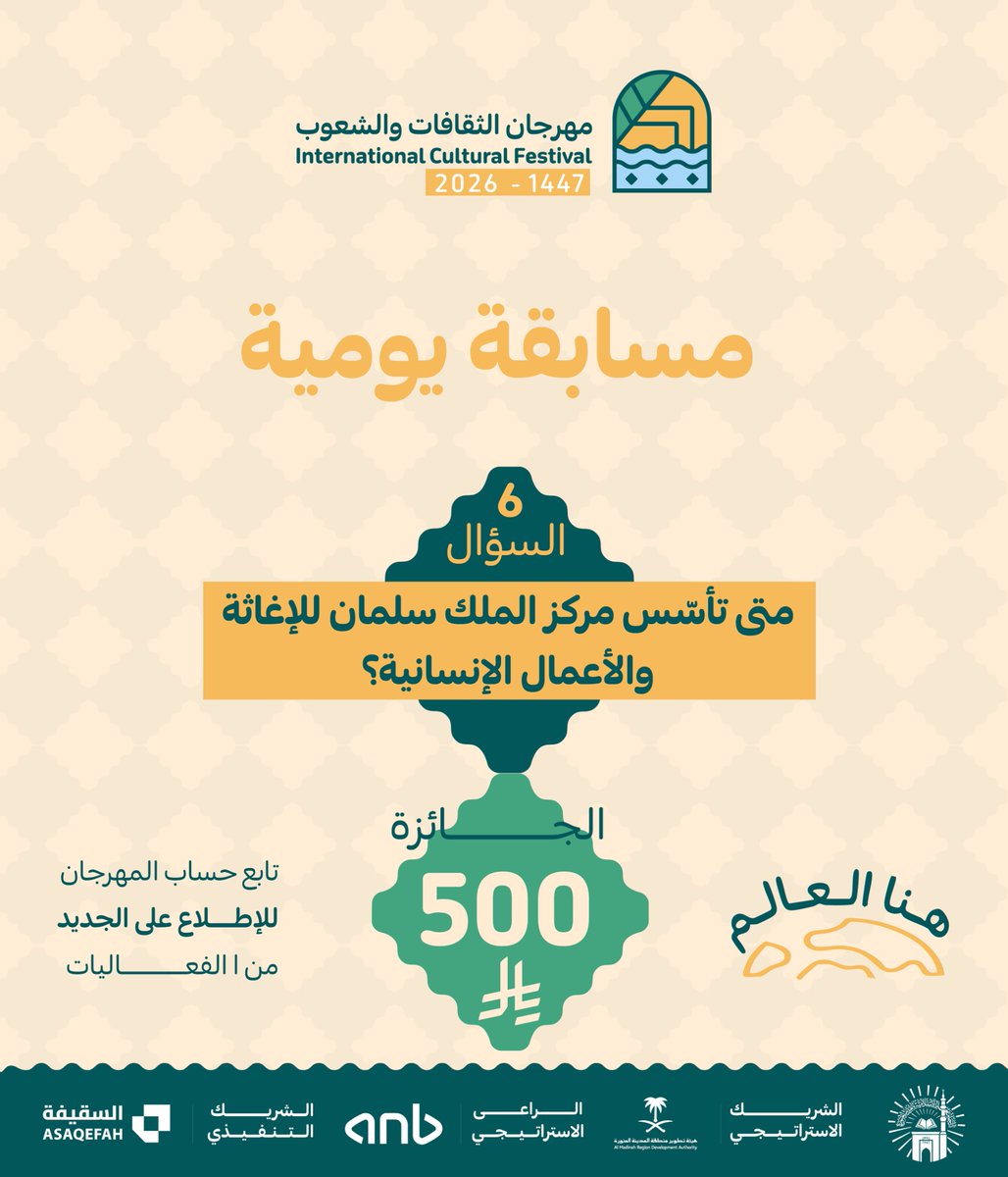
@fcf_iu_edu تأسس مركز الملك سلمان للإغاثة والأعمال الإنسانية في 15 مايو 2015م (الموافق 26 رجب 1436هـ)، بتوجيه ورعاية من خادم الحرمين الشريفين الملك سلمان بن عبدالعزيز آل سعود، ليكون مركزاً دولياً متخصصاً بالإغاثة، ومقره العاصمة الرياض
المسابقة اليومية | السؤال السادس
متى تأسّس مركز الملك سلمان للإغاثة والأعمال الإنسانية؟
شاركونا إجاباتكم الآن،
ولا تفوّتوا فرصة الفوز بجوائز مميزة.
تفاعلٌ ممتع… ومعلومة تثري تجربتكم
Dear Big Ayo @47kasz ,
I can understand why people ask this same question almost every time. Especially to a non-Muslim like you, it may look weird when you see a massive crowd fighting to touch a rock. It’s a fair observation.
This is why I want to establish a logical precedent before I go into historical and religious facts.
Let’s think about how we behave as human beings. Imagine a soldier sitting in a dirty trench. He pulls out a faded photograph of his wife and kisses it. Is he worshiping the photographic paper? Is he praying to the paper to protect him from bullets? No. The paper has zero power. The kiss is a physical expression of a deep emotional connection.
Or look at a national flag. People cry when it is raised. Soldiers take a bullet to stop that specific piece of fabric from touching the dirt. Are they worshiping cotton? No. It is immense reverence.
This is the intellectual difference we need to establish.
When someone bows down to a statue or an Ifa relic, the fundamental belief is that the object possesses independent power. The worshipper believes the statue can grant wealth, heal sickness, or curse an enemy. They pray to it.
However, for the Black Stone, the theology is completely different. Muslims do not pray to the stone. Nobody asks the stone for a visa, a child, blessing or even a record deal. If a Muslim stands in front of the Kaaba and says, "O Black Stone, heal my mother," they have committed Shirk (idolatry) and are immediately outside the fold of Islam. This is because the stone has zero divine power.
So what is the impact like you have asked, and why the intense desire to touch it?
For you to understand this, let me walk you through how humans interact with history across the Abrahamic faiths.
Let’s start with the Jewish faith. When Jewish pilgrims travel to the Western Wall in Jerusalem, they press their foreheads against the stones. They weep. They kiss the wall. They slip little written prayers into the cracks of the rock. Are they worshipping the limestone? No. That wall is a surviving remnant of their holy Temple. It is a physical anchor to their history. The wall itself has no divine power to grant the prayers on those pieces of paper, but touching it is a profound emotional release.
You see the same deep emotion in Christianity. If you walk into the Church of the Holy Sepulchre in Jerusalem, right near the entrance is the Stone of Anointing. Tradition holds this is the slab where the body of Jesus was prepared for burial. You will see Christian pilgrims from all over the world fall to their knees the moment they see it. They kiss the stone, they cry over it, they rub their hands and clothes on it. Are they praying to a piece of marble? No. They are overwhelmed by the historical weight of what that stone represents to their faith. It is tactile love.
The Black Stone operates on this universal human wavelength.
Historically, it is an ancient relic tracing back to Prophet Ibrahim (Abraham), the father of faith. It is a surviving piece from the original foundation of that sacred house. It serves as the physical starting line for the Tawaf, the seven rounds of walking around the Kaaba.
Spiritually, it is about deep emulation and love. The Prophet Muhammad (peace be upon him) touched and kissed it, so Muslims want to touch it. It is a physical connection to a historical and spiritual lineage. You are trying to place your hand where the Prophet placed his.
The companions of the Prophet drew this intellectual line 1,400 years ago to prevent this very confusion. Umar ibn al-Khattab (May Allah be pleased with him) stood before a massive crowd, looked directly at the stone, and declared:
"I know you are a stone that neither harms nor benefits. If I had not seen the Prophet kiss you, I would not have kissed you."
That is the core of it. It is emulation, not worship. It is a relic of reverence, not a deity of power. No more. No less.
Thank you for your attention.
I have seen so many comments in the CS. Some fair, some disgusting, some even went as far as calling it idolatry. Let me educate you because I see that the ignorance on this matter is loud.
First of all, people look at Muslims scrambling over a stone and jump to wild conclusions. However, Umar ibn al-Khattab (May Allah be pleased with him) ended this conversation centuries ago. He stood right in front of the Black Stone and said:
إني أعلم أنك حجر لا تضر ولا تنفع، ولولا أني رأيت النبي صلى الله عليه وسلم يقبلك ما قبلتك
"I know you are a stone that neither harms nor benefits. If I had not seen the Prophet kiss you, I would not have kissed you."
We don't pray to it. It is an act of love, tracing the footsteps of the Prophet.
If that’s the case, why the intense struggle?
There is a long-lasting orientation amongst us, particularly Yoruba Muslims, regarding this. Many people grew up with the mindset that touching or kissing the Black Stone is compulsory. It is seen as the ultimate badge of honor. A lot of pilgrims return home and the first question they get asked by family is, "Did you touch the stone?" If you say no, they look at you like your Hajj or Umrah is incomplete.
It creates this intense mental pressure. And when you are a huge celebrity like Asake, with all eyes and cameras on you, I can imagine the pressure to get that ultimate spiritual experience feels even heavier. But that deeply ingrained cultural orientation is what fuels the do-or-die struggle you see in this video.
But was that necessary? Was that the right thing he could have done?
No. Kissing the Black Stone is a Sunnah. It is a recommended act. But stepping on people, suffocating them, climbing on necks, and causing a stampede is Haram. You cannot commit a Haram act to achieve a Sunnah.
Abdullah ibn Umar once looked at the Kaaba and said:
ما أعظمك وأعظم حرمتك، والمؤمن أعظم حرمة عند الله منك
"How great are you and how great is your sanctity, but the believer has a greater sanctity in the sight of Allah than you."
The physical body and safety of your fellow Muslim are far more sacred than touching that stone.
If the place is packed, the religion gives us a very clear way out. You just face the stone from a distance, point at it, say "Allahu Akbar," and keep moving. The reward is recorded for you in full. This is one thing many don’t know till today.
The religion is built on ease. Make use of it.
Allah knows best.
Allah (sw) says;
"And if We had made it a non-Arabic Qur'an, they would have said, 'Why are its verses not explained in detail [in our language]? Is it a foreign [recitation] and an Arab [messenger]?'
Say, 'It is, for those who believe, a guidance and cure.' And those who do not believe – in their ears is deafness, and it is upon them blindness. Those are being called from a distant place."
(Quran 41:44)
I invote you all to Islaam today. Because, if you don't accept Islaam, the hereafter will be tough for you and there is no second chance.
Why not leave all the bad stuff your pastors ans men of gods told you and study Islaam from the sources themselves?
These intellectually bereft arguments are sickening. Muhammad is a pedophile, Muslims have sex with goats, Alzutt (that never existed), Al-Jannah (Heaven in Islaam) is all about sex, and more, are just lazy and indolent arguments. You hear baseless stories, then regurgitate them without ever trying to sit down and study the sources.
Some of us who are Muslims from The South Southern Nigeria have studied the bible from Genesis to Rrvelation more than twice. All because we wanted to be sure. Not that we were doubting. And the study of the bible only reaffirmed our beliefs.
Please pay special attention to
- The concept of spirituality in Islaam and Christianity.
The concept of worship in Islaam and Christianity.
- The concept of Sin in Islaam and Christianity.
- The concept of Repentance in Islaam and Christianity
- The concept of Piety in Islaam and Christianity.
- The concept of Original Sin in Islaam and Christianity.
- The concept of Obedience and Belief in Islaam and Christianity.
- The concept of Heaven and Hellfire in Islaam and Christianity.
- Then the biography of Muhammad and Jesus.
Then come out and decide on which Religion align with common sense and time.
I am very available to guide. Hit my DM.
~ OZEMOYA
False
I'm a Muslim from Edo state, benin city to be precise and since studying at ABU, Zaria, I've always preferred staying in the North...
Push your agenda somewhere else
Do you know that a Muslim from the South, will prefer to live in a Christian dominated community than live in a Hausa/Fulani Muslim dominated community?
It's not always about being a Muslim. It's about Sharia infested Jihadi mentality and mandate!
I don't hate Muslims. I've had good ones as friends.
What I hate is Shari'a and extremism. Anything that permits you to take another human life should not be mentioned in any sane society that desires growth.
This ḥadīth is not racist at all — it is anti-racist.
The misunderstanding comes from ignorance of Arabic rhetoric and prophetic teaching.
1. The Prophet ﷺ used this description to eliminate racism, not promote it.
The full meaning is:
“Even if your leader is a black Ethiopian slave — the lowest social class in your society — you must obey him as long as he leads by the Book of Allah.”
In the 7th century Arabian society:
•“slave” = lowest social rank
•“Ethiopian” = a group Arabs used to look down on
•“raisin-head” = common Arabic expression describing tightly curled hair, not an insult, just a physical description
The Prophet ﷺ intentionally used the exact example of someone the racists of Quraysh would look down on — to crush their arrogance.
This is the same teaching as:
“No Arab has superiority over a non-Arab,
and no white over a black, except by piety.”
— Prophet Muhammad ﷺ
So the message is:
Your leader’s race, color, lineage, or social status does not matter.
If he fears God, obey him.
That is anti-racism at its core.
⸻
2. Arabs used “raisin-head” to describe curly hair — not as an insult.
This expression exists in early Arabic poetry long before Islam.
It is a neutral descriptor, like saying:
•“blonde-haired”
•“broad-shouldered”
•“round-faced”
The Prophet ﷺ also described a white man as “red-skinned” (aḥmar), and nobody claims he was racist against white people.
Only someone ignorant of Arabic idioms interprets this as an insult.
⸻
3. The Prophet ﷺ honored Black Africans explicitly.
He said about Bilāl, the Ethiopian:
“I heard your footsteps in Paradise before me.”
And he appointed:
•Usāmah ibn Zayd — a black commander —
as the general of the Muslim army, even over senior Arabs.
This caused complaints from racists, and the Prophet ﷺ rebuked them.
So the ḥadīth is the opposite of racism.
⸻
**4. The Prophet ﷺ used the most “undesirable” leader in their eyes
to show that leadership is not based on race — only righteousness.**
Imagine saying today:
“Even if your president were a homeless man with nothing, obey him if he rules with justice.”
Not an insult — but a demolition of class arrogance.
That is exactly what the Prophet ﷺ did.
⸻
5. The only racism here is coming from the people twisting the text.
They impose their Western racist lens onto a 1400-year-old Semitic idiom
and then blame Islam for their own ignorance.
The Prophet ﷺ was the first world leader to declare racial equality publicly — centuries before Europe abolished slavery or declared human rights.




![ufc's tweet photo. THE BEST IN THE WORLD 👑
[ #VeChain #UFC322 | @MAKHACHEVMMA ] https://t.co/WasIyKLNXu](https://pbs.twimg.com/media/G52uZUibYAEXUpv.jpg)




![ufc's tweet photo. THE BEST IN THE WORLD 👑
[ #VeChain #UFC322 | @MAKHACHEVMMA ] https://t.co/WasIyKLNXu](https://pbs.twimg.com/media/G52uZUmbMAA5xLx.jpg)


