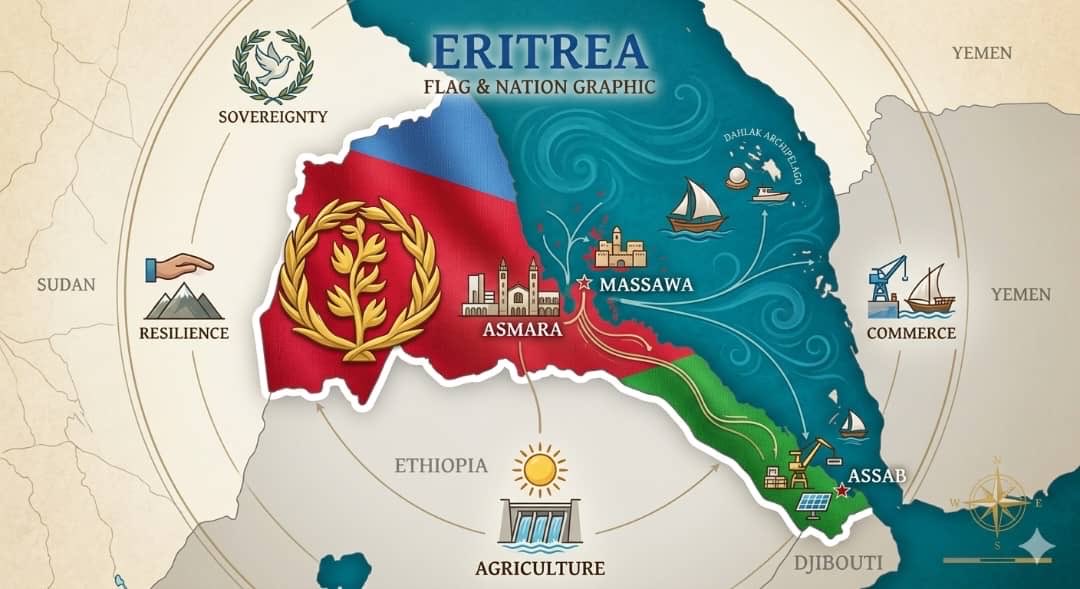
@SaraWilkin92 Oh look, another “profound connectivity” essay pushing Abiy’s Red Sea empire dreams. While Tigray & Amhara bleed, millions starve, and Prosperity elites feast in palaces, Abiy’s paid hyenas are working overtime😂 #AbiyTheButcher
The founding fathers and mothers of #Eritrea — the guardians of the nation — were tested repeatedly by war, famine, isolation, and enormous military pressure. They were pushed, attacked, and challenged from every direction, yet they refused to bend. From beginning to end, their motto was unwavering:
“ኣይንምብርኸኽን” — We shall never kneel down! #EritreaAt35 #EritreaPrevails
https://t.co/ABwvPe1w1n
Liar busted! That '#Eritrea' photo is from #Oromia, #Ethiopia. Stop weaponizing your own people’s suffering for propaganda. We see the lies. They fool no one. Ethiopian Potemkin Party minions, stop hijacking real tragedies for fake narratives. Liar busted. Facts > propaganda.👇👉
@ethioluptus@MissMartina19 😂 Classic desperation propaganda – fake images and twisted history to deflect from the real parasites bleeding the Horn of Africa. https://t.co/3p9bAqVRTO
Ethiopia is Not Being ‘Dragged into War’
A Response to Redwan Hussein and Getachew Reda’s Misleading Opinion Article.
By: Ali Ibrahim Ahmed, Ambassador of the State of #Eritrea to the State of Qatar
A Response to Redwan Hussein and Getachew Reda’s Misleading Opinion Article.
The recent opinion article by senior Ethiopian officials Redwan Hussein and Getachew Reda, published on Al Jazeera English’s website, attempts to portray Ethiopia as an innocent victim being reluctantly “dragged” into conflict by external actors. In doing so, the piece seeks to absolve the ruling Prosperity Party of responsibility for Ethiopia’s mounting domestic crises.
More dangerously, this narrative serves as a diplomatic smoke screen designed to normalise the unprovoked hostility, state-sponsored inflammatory rhetoric and aggressive military mobilisations that the Ethiopian government has directed towards Eritrea since late 2023.
By trying to reframe contemporary internal tensions as the direct product of external overreach or unresolved past grievances, the current Ethiopian security discourse represents a profound and dangerous inversion of reality. It distorts the true drivers of instability in the region to shield the federal authorities from international scrutiny.
The catastrophic war that engulfed northern Ethiopia for two years, from the initial outbreak of hostilities on November 4, 2020, until the signing of the cessation of hostilities agreement on November 2, 2022, did not arise from regional external manipulation or cross-border instigation. It was the product of Ethiopia’s long-standing internal ethnic cleavages and institutionalised political polarisation, rather than any external machinations.
The historical record confirms that Eritrea did not instigate this conflict, nor did it harbour expansionist designs on sovereign Ethiopian territory. Instead, Eritrea was reluctantly drawn into an imposed war at the explicit request and formal invitation of the Ethiopian federal government and for cogent reasons of self-defence.
Indeed, the broader objectives of the war agenda explicitly included and targeted the sovereignty and territorial integrity of Eritrea from its very inception. This reality is not a matter of speculative interpretation; it is an unalterable component of the public record.
Getachew’s own extensive public statements and numerous real-time posts under his official X handle during those tragic years easily validate that the targeting of Eritrea was a deliberate, premeditated strategy by regional forces rather than an accidental byproduct of a domestic policing action.
Following the formal cessation of hostilities, the political and military leadership of the Prosperity Party, extending from Prime Minister Abiy Ahmed downward, profusely and publicly expressed their profound gratitude to Eritrea. These acknowledgements were made through official statements, parliamentary discussions, state media and remarks by senior military officials. For Redwan and senior Prosperity Party officials to now retroactively frame Eritrea as an inherent antagonist or a constant spoiler of domestic peace runs completely counter to these explicit, recorded admissions.
This tendency towards revisionism is further illustrated by the highly romanticised anecdotes propagated by Getachew and Redwan regarding the tense environment during the Pretoria peace talks. Both officials have concocted a heavily theatrical and entirely fictitious story concerning the alleged consternation of their South African hosts, who supposedly feared that “the negotiating teams from the two warring Ethiopian parties might get into a fistfight in the middle of the conference hall if not continuously shepherded to steer clear of one another”.
According to this manufactured narrative, the hosts were then stunned to witness a “cordial tone”. This narrative of sudden, miraculous reconciliation between bitter enemies serves a specific propaganda purpose: it portrays the Pretoria Agreement as a spontaneous triumph of domestic unity over external division.
However, this narrative ignores the reality that months before the formal talks in South Africa, confidential contacts had already taken place in Djibouti and the Seychelles under the sponsorship of external mediators. As later acknowledged by Getachew himself, the warring parties had already established channels of communication while the war was still raging.
Under the deliberate prodding of elements within the Prosperity Party, the two teams explored options to join forces and redirect their combined military capacities towards a war of aggression against Eritrea. In their contorted views, a sovereign and stable Eritrea constituted the ultimate threat to their respective political futures.
When the Permanent Cessation of Hostilities Agreement was finally signed, it was fundamentally understood as a peace pact between internal warring sides within Ethiopia. It is, and remains, an Ethiopian affair, purely and exclusively. Its provisions concerned domestic constitutional arrangements, the disarmament of armed groups, and the restoration of federal authority.
Eritrea’s position regarding Pretoria has remained consistent and principled. It supports any genuine effort that promotes peace, stability, and predictability in Ethiopia and the wider region. A peaceful, stable, and united Ethiopia that respects the sovereignty of its neighbours is in the strategic interest of every state in the Horn of Africa. Eritrea possesses neither the political appetite nor the strategic interest to scuttle an agreement between competing Ethiopian political forces. A peaceful, unified, and stable Ethiopia that respects its neighbours is in the vital national security interest of every state in the region.
Against this backdrop, the current propaganda campaigns and transparent disinformation efforts, as epitomised by the recent opinion article, are systematically designed to re-package an unprovoked agenda of conflict and hostility that Addis Ababa has unleashed against Eritrea since December 2023.
During this period, the Prosperity Party abruptly shifted its state rhetoric, launching a manufactured campaign centred on what it termed “sovereign access to the sea”. To build legitimacy for this legally untenable and historically flawed narrative, the ruling party has systematically mobilised a vast, state-backed apparatus. Instructors, researchers, media figures, cultural icons and academic lecturers, both Ethiopian nationals and co-opted foreign commentators, have been aggressively deployed across international forums, television networks and digital platforms to push this warped sovereign access narrative.
This coordinated campaign seeks to normalise the idea that colonial boundaries in the Horn of Africa are negotiable in order to attempt to challenge inviolable principles of sovereignty and territorial integrity that have long underpinned regional stability.
This aggressive rhetoric has not been confined to speeches and opinion pieces. In a direct attempt to pull Eritrea into a militarised conflict, the ruling party has massed substantial military formations, heavy artillery, and mechanised divisions in close proximity to the Eritrean border.
This pattern of behaviour is directly mirrored along the northern frontier, where provocative pronouncements are accompanied by unremitting sabre-rattling regarding the acquisition of Assab and other Eritrean coastal lands through negotiations if possible, and by force if necessary.
The broader pattern extends beyond Eritrea. Ethiopia’s recent foreign policy conduct has increasingly generated tensions with several neighbouring states. The Memorandum of Understanding signed with Somaliland, which sought access to coastal territory without the consent of Somalia’s central government, triggered a major diplomatic crisis and raised serious questions regarding respect for established principles of sovereignty and territorial integrity.
Similarly, Ethiopia has repeatedly pursued interventionist policies in neighbouring conflicts in the quest for short-term geopolitical objectives. Whether in Somalia, Sudan or elsewhere, Addis Ababa’s reckless regional agenda of expansionism has contributed significantly to regional mistrust and destabilisation.
Thus, the narrative that Ethiopia is an involuntary victim being dragged back into war by external forces ignores the reality of the ruling party actively moving military assets, signing illegal treaties and threatening the borders of sovereign states. This explicitly coercive stance directly undermines the foundational principles of peaceful coexistence and good neighbourliness that are essential for the Horn’s stability.
Ultimately, peace in the Horn of Africa cannot be bargained away to appease the shifting calculations of a restless neighbour. The path forward demands an immediate end to the reckless sabre-rattling in pursuit of illicit “sovereign maritime access”, the unconditional cessation of cross-border proxy alignments, and a return to the foundational principles of non-interference and territorial integrity.
Until the international community confronts the true internal drivers of Addis Ababa’s aggressive posture rather than entertaining its manufactured grievances, the region will remain perilously vulnerable to dangerous miscalculation. Eritrea stands firm in its resolve, anchored in legal permanence and historical facts. Those who look to externalise their domestic ruin through regional destabilisation will find that Eritrea’s sovereignty is neither negotiable nor penetrable, and that lasting security can only be achieved when boundaries are respected and international law is upheld without exception.
The views expressed in this article are the author’s own and do not necessarily reflect Al Jazeera’s editorial policy.
For decades,#Ethiopian leaders have served the interests of the West, contributing to the destabilization of the Horn of Africa, including Eritrea, Sudan, and Somalia. Therefore, the Western Cabal will do everything it can to save its servant, the leaders of Ethiopia.
@DanielsonKassa1 Trying to spread religious propaganda to divide Eritreans? What a desperate move. Eritrean Muslims and Christians love and respect one another. It’ll never work.😂
The Eritrean people have repeatedly demonstrated their resilience and determination in the face of external pressure. #Eritrea’s future will be shaped by its people, guided by its national interests, and protected by the sacrifices of its martyrs.
Respect Eritrea’s sovereignty.
@Chakham_Analyst Ethiopia under Oromuuma PP leadership is the only nation that killed over 1.5 million its own citizens in less two years. In contrary, Eritrea is the only stable and peaceful country in Africa.
Excellent rebuttal to Getachew Reda and Redwan Hussain article by #Eritrea's Ambassador to Quatar "Ethiopia is not being ‘dragged into war’ @AJEnglish https://t.co/jsTFYgDApA via @AJEnglish
"The recent opinion article by senior #Ethiopian🇪🇹 officials Redwan Hussein and Getachew Reda, published on Al Jazeera English’s website, attempts to portray Ethiopia as an innocent victim being reluctantly “dragged” into conflict by external actors. In doing so, the piece seeks to absolve the ruling Prosperity Party of responsibility for Ethiopia’s mounting domestic crises...By trying to reframe contemporary internal tensions as the direct product of external overreach ...It distorts the true drivers of instability in the region to shield the federal authorities from international scrutiny."
Ethiopia is not a victim it is culprit and distabilizer in the region.
👉 >>>Full article https://t.co/Z0Ai5uWM8Y
Getachew Reda’s remarks are nothing more than historical revisionism wrapped in political propaganda.
#Eritrea’s independence is IRREVERSIBLE, its sovereignty is NON-NEGOTIABLE , and its legitimacy does not depend on the approval or disapproval of any Ethiopian politician.
🇪🇷
"A 2009 cable records Meles telling US Ambassador Susan Rice that Ethiopia's military mobilization along the Eritrean border cost less than 1% of GDP, and that he could maintain such forces indefinitely — while Eritrea was spending a much larger proportion of its GDP on its military posture, making economic attrition an effective pressure tool". Wikileaks
Over 20 year period, (1998 and 2020, the start of the border dispute and the successful recapture of Eritrean territories by Eritrean Defense Forces) an annual average of roughly 8 to 14 million Ethiopians required food assistance. Ethiopia also received an estimated 50 billion in total foreign economic assistance.
It was despite these facts that Ethiopia decided to spend 1% of its GDP to violate international law and disregard its treaty obligations.
Had Ethiopia used the 1% GDP on...
It’s sad that #Ethiopia, despite proudly claiming it was never colonized, still has cities like Addis Ababa where homeless children can be seen wandering the streets at night. This is the consequence of decades of failed expansionist and warmongering leadership.clean ur 🏠 first
I detest this woman for her role in destroying African states But she ain't lying. In a country where polarization is high, small towns are dying due to lack of infrastructure and jobs, and people start looking at each other as enemies or survival competition, national service with incentives can not only bring the nation together but it might help US catch up to China and others in infrastructure in addition to revitalizing small towns that are dying and forgotten by the beurocracy of Washington DC. diffrent form also worked for India during its green revolution.
They see the value of national service in a diverse country like America.
@Yes2Now_ Eritrea consistent position has always been respect internationally recognized borders and non-interference. Accusations of hidden agendas ignore this record.
Prof Asmaerom’s advice to the young generation of Eritreans is to think critically about friendship & good neighborly relations, including with Tigray. Trust should be accompanied by vigilance, as circumstances and alliances can change over time. #Eritrea