Quantum Mechanics 101
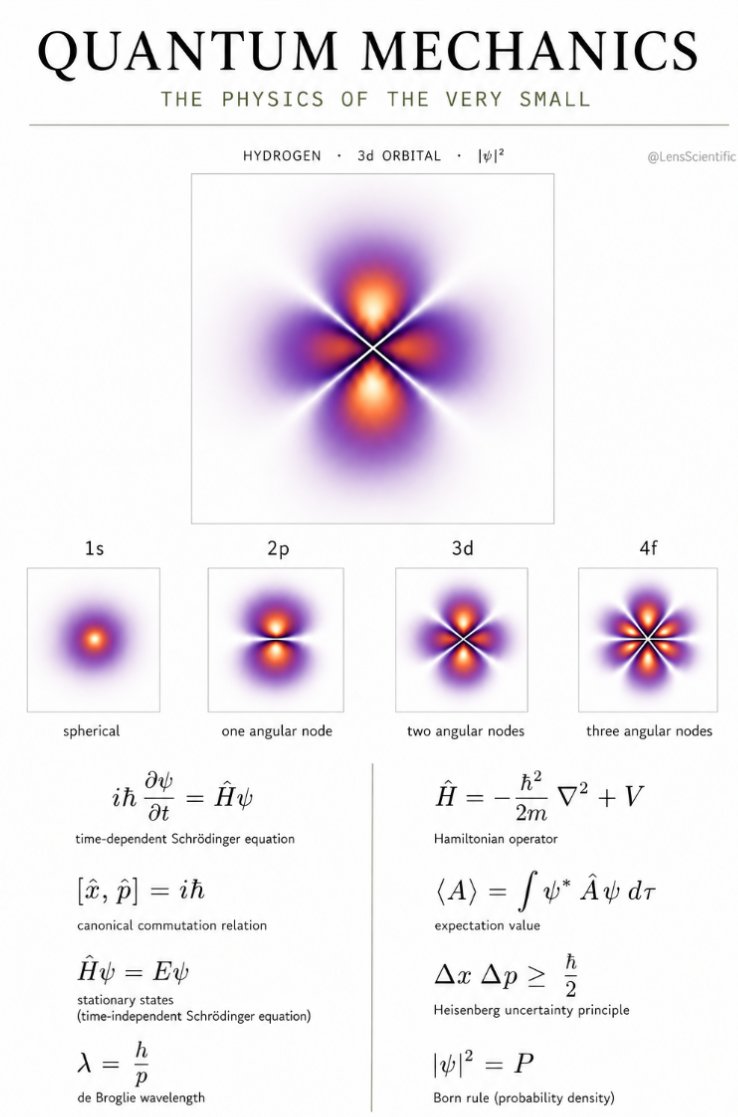
Electrons do not occupy fixed paths around the nucleus. Their quantum state is described by a wavefunction, ψ, and ∣ψ∣^2 gives the probability density for where the electron can be found.
The strange shapes of atomic orbitals are solutions to the Schrödinger equation, with their nodes emerging naturally from the mathematics. Even the familiar s, p, d, and f shapes are probability distributions, not electron trajectories.
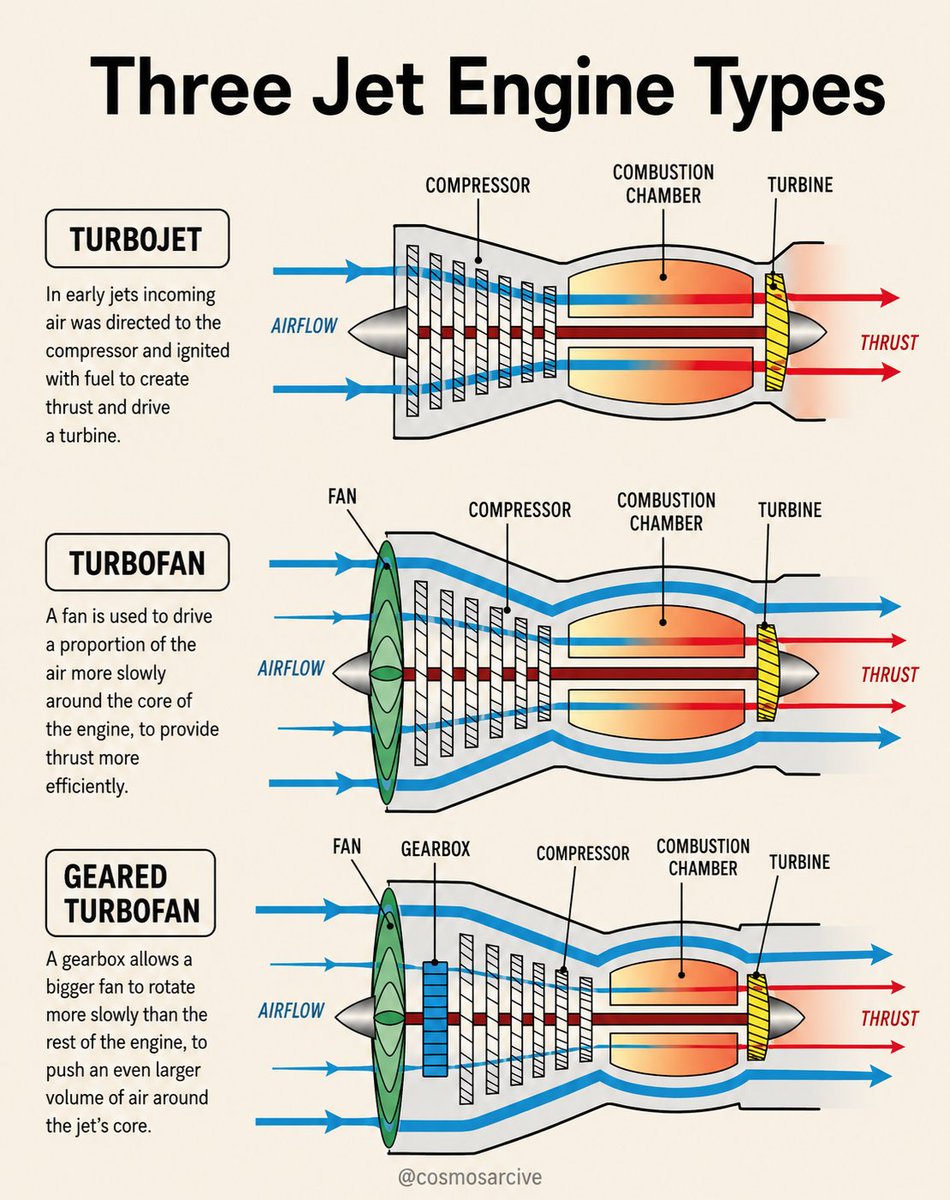
Jet engines are basically machines for moving air, but the way they move that air has changed dramatically.
A turbojet sends almost all the air through the core. A turbofan uses a large fan to move additional air around the core, making it much more efficient. A geared turbofan takes this further by using a gearbox so the large fan can spin slower than the compressor and turbine.
• Turbojet: high exhaust velocity, but relatively inefficient for modern airliners
• Turbofan: most commercial aircraft use this design because it produces thrust efficiently
• Geared turbofan: the gearbox lets the fan and core operate closer to their ideal speeds
The key idea: modern jet engines became more efficient not simply by making the core more powerful, but by moving a larger mass of air more effectively.
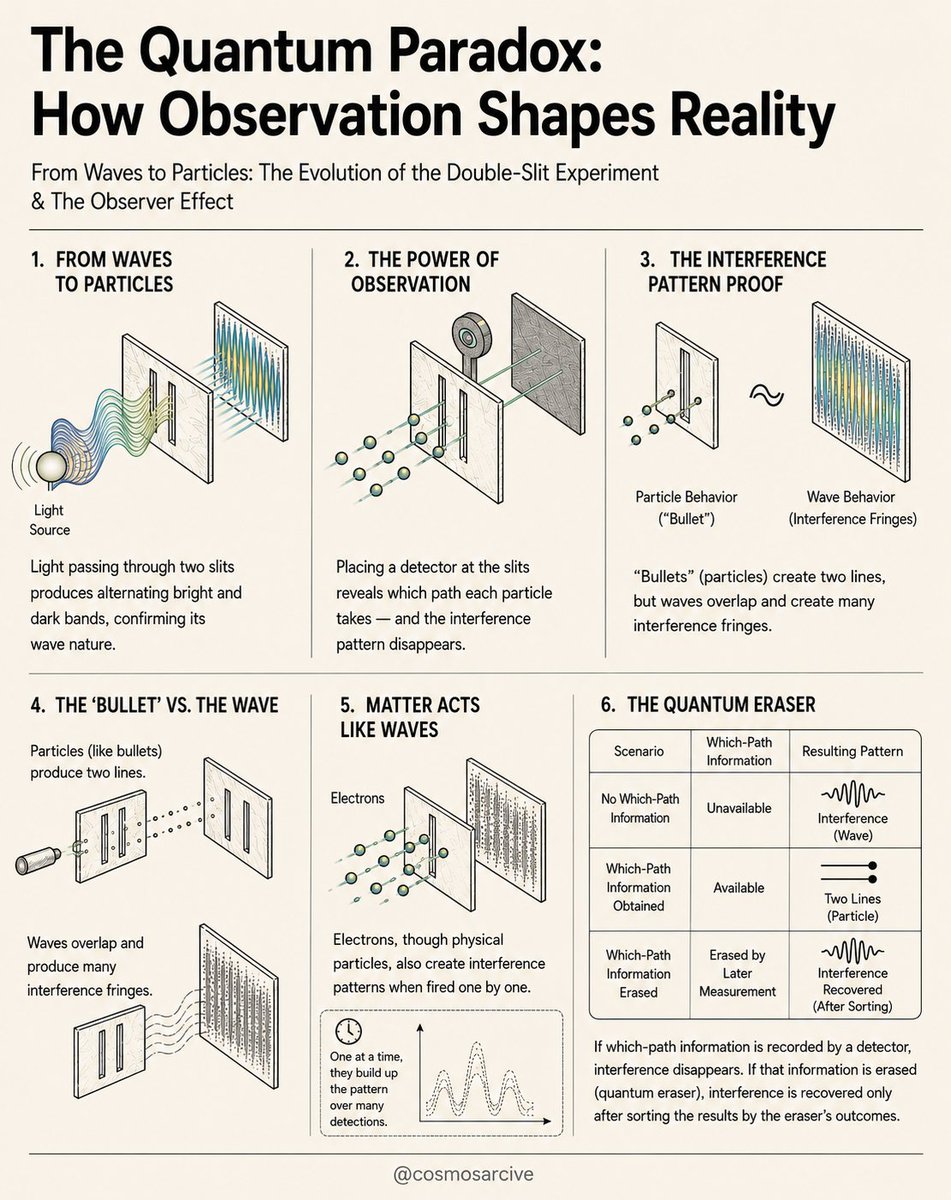
The strange part of the double slit experiment is not that particles behave like waves. It is that knowing which slit they take changes the pattern.
Fire electrons one at a time and they still build an interference pattern. Add a detector that reveals the path, and the interference disappears because the paths are no longer indistinguishable.
The lesson is not that consciousness creates reality. It is that quantum interference depends on whether which path information is physically available.
How can a snake write perfect circles while it swims?
Its body follows a serpenoid wave. At every point the tightest matching circle - the osculating circle - has radius ρ = 1/κ, where curvature is
κ = |x′y″ − y′x″| / (x′² + y′²)^{3/2}
Those circles become the vortices that turn muscle waves into thrust.
The same geometry now designs snake robots that slither through rubble or swim through pipes.
Nature solved the curve before we wrote the formula.
Where else have you seen a living body generate its own family of circles?
Why can driven wheels spin at different speeds without shredding tires?
Bevel satellites mesh side gears at 90°. Tooth count is
Zₛₐₜ = 2Rₑ / (mₑ √(Uₛₐₜ² + 1))
so pitch cones share one apex. That constraint lets a car turn without fighting its own drivetrain.
The same cone packing appears in robot joints and EV e-axles.
A short equation often decides whether two shafts may disagree.
Where else have you seen geometry, not torque, split motion?
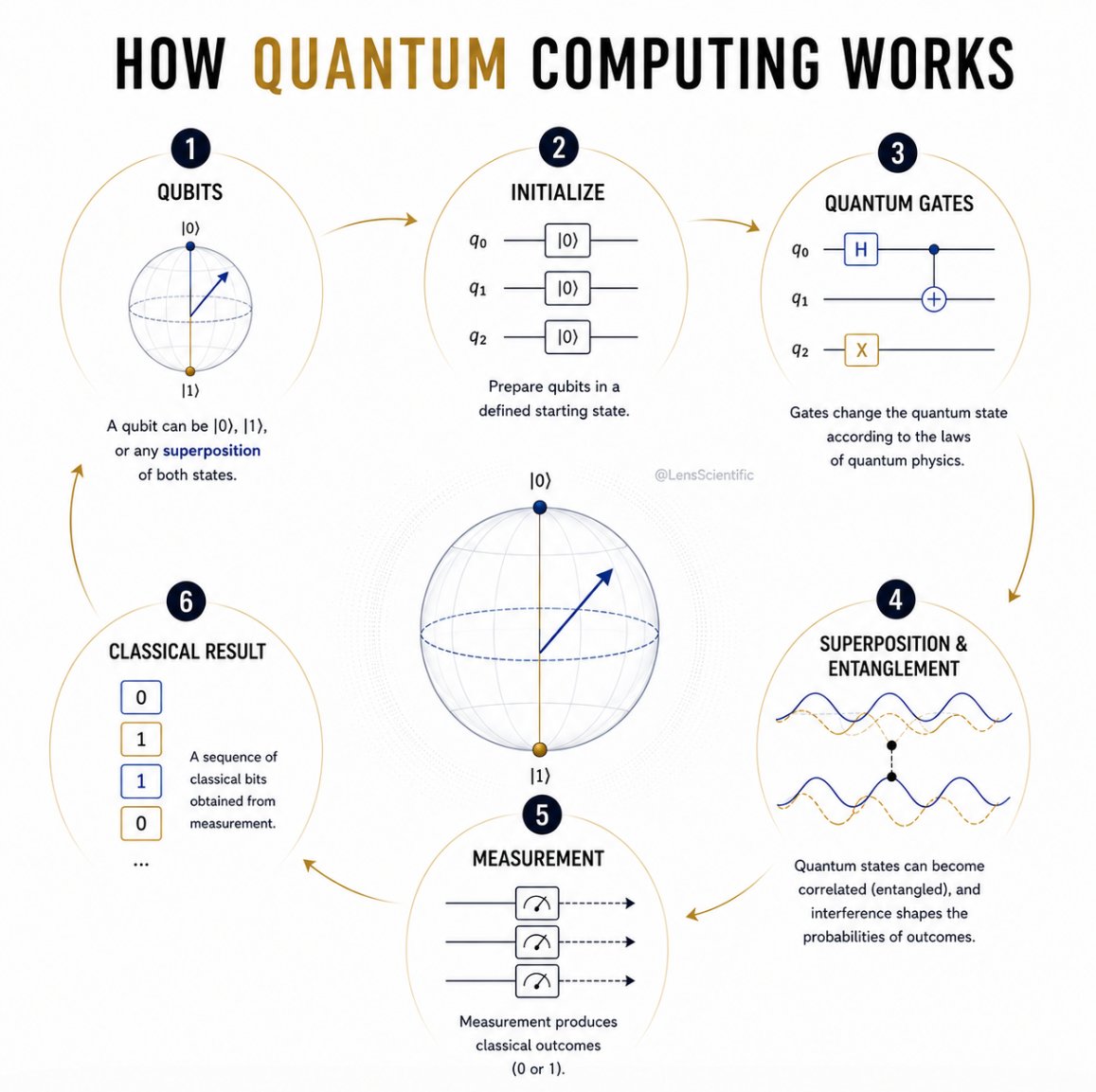
Quantum computing replaces the binary logic of classical bits with quantum states. Qubits can exist in superpositions, gates manipulate their amplitudes, and entanglement links their states. Carefully designed interference changes the probability of different outcomes. Measurement then turns the quantum state into classical information.
Superposition lets quantum states exist as combinations of possibilities. Entanglement produces correlations that cannot be explained by independent states. Tunneling lets particles cross barriers that classical physics forbids.
Uncertainty is fundamental, not just measurement error. Quantization gives certain observables discrete allowed values. Spin is intrinsic angular momentum, not literal rotation.
Behind all of this is Hilbert space, the mathematical framework used to represent quantum states. And virtual particles are mathematical components of quantum-field calculations, not particles flying around waiting to be detected.
The strange part of a plasma engine is that it can produce enormous exhaust speeds without producing much thrust.
In a VASIMR type engine, radio waves ionize and heat a propellant such as argon, while magnetic fields guide the plasma through a magnetic nozzle. The higher the exhaust velocity, the less propellant is needed for a given change in spacecraft momentum.
That tradeoff is the real strength of electric propulsion: tiny thrust, but exceptional efficiency over long periods.