MyDirectives pioneers digital advance care planning tools that capture and securely store individuals' care goals and preferences for anytime, anywhere access.
We’re excited to announce our partnership with b.well Connected Health to bring advance care planning documents into the consumer health record.
People already use https://t.co/zYrkeK4aHs to create, update, upload, store, and share their ACP documents. This partnership adds something new: the ability to find those documents alongside their other health information in a b.well-powered health summary.
Through the planned integration, available via b.well’s CMS Aligned Network, b.well will become the first consumer-facing organization to connect with MyDirectives’ nationwide ACP document registry for patient access.
That’s an important connection. Health records bring together diagnoses, medications, test results, and treatment history. Advance care planning documents add the person’s own goals of care and treatment preferences.
A complete picture of someone’s health includes the care they want. We’re proud to work with b.well to help bring that picture together.
Read the announcement: https://t.co/9xzR1cI027
#AdvanceCarePlanning #DigitalHealth #ConsumerHealth #Interoperability
Tomorrow, MyDirectives will be in San Jose for the Coalition for Compassionate Care of California’s 18th Annual Summit, Foundations and Futures.
The summit brings together people from across health care and the serious-illness community to share ideas and work toward better, more compassionate care. We’re glad to be part of that conversation and look forward to connecting with the clinicians, care teams, advocates, patients, caregivers, and leaders doing this work across settings.
On Friday, October 16, at 10:30 a.m. PT, Jessica Zan will present “Operationalizing ACP as Infrastructure Across Care Settings.” Advance care planning is often treated as documentation, but without the right infrastructure, a person’s goals of care and treatment preferences may not be available when decisions are being made. Jessica will share a real-world example of how workflow design and structured documentation can help make ACP part of routine clinical practice and support goal-concordant care.
Jessica and Ron Wozny will also be at the MyDirectives exhibit table, so please stop by. You can also schedule a meeting with us at https://t.co/qqwvqSUrvA.
We look forward to seeing you in San Jose.
#AdvanceCarePlanning #PalliativeCare #CompassionateCare #SeriousIllnessCare
Will you be at the Coalition for Compassionate Care of California Annual Summit next week?
Jessica Zan and Ron Wozny will be there October 15–16, and we’d love to connect!
Stop by the MyDirectives exhibit table to talk about your organization’s ACP challenges, from creating documents within clinical workflows to making advance directives, POLST, DNR, and other ACP documents accessible across care settings.
You can also catch Jessica’s presentation, “Operationalizing ACP as Infrastructure Across Care Settings,” on Friday, October 16, at 10:30 a.m. PDT.
Let’s set aside time to talk about what connected ACP could look like for your organization and community.
Schedule a meeting with us: https://t.co/1w9R9x5SOU
#AdvanceCarePlanning #PalliativeCare #MyDirectives
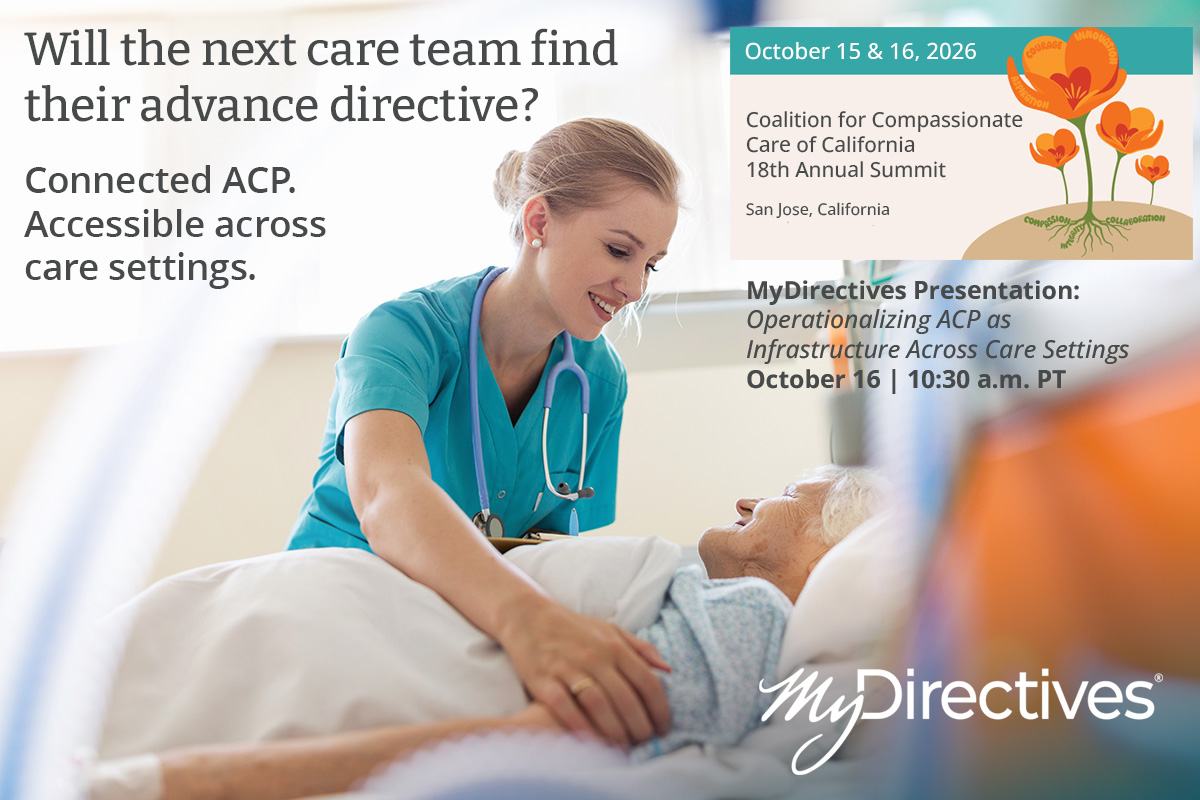
When a patient moves between care settings, can the next care team find their advance directive, POLST, DNR, or other advance care planning documents?
An ACP document stored in a paper chart, scanned file, or one organization’s EHR may be difficult to access elsewhere. Making patient goals of care and treatment preferences available across settings takes connected infrastructure, secure exchange, and ACP embedded in clinical workflows.
That’s the focus of Jessica Zan’s upcoming presentation, “Operationalizing ACP as Infrastructure Across Care Settings,” at the Coalition for Compassionate Care of California Annual Summit.
Join Jessica on Friday, October 16, at 10:30 a.m. PDT. Jessica and Ron Wozny will also be at the MyDirectives exhibit table, ready to talk about closing ACP gaps across your organization and community.
Schedule a meeting with us: https://t.co/5c1R6LBjhY
#AdvanceCarePlanning #PalliativeCare #MyDirectives
MyDirectives will be at the Coalition for Compassionate Care of California Annual Summit, October 15–16, and we’re looking forward to connecting with leaders advancing compassionate care.
Join Jessica Zan, our VP of Clinical Implementations & Success, for “Operationalizing ACP as Infrastructure Across Care Settings” on Friday, October 16, at 10:30 a.m. PDT.
When patients move between care settings, their goals of care and treatment preferences need to move with them. Jessica’s session will explore how to make ACP part of the infrastructure that supports care across those settings.
Jessica and Ron Wozny, our SVP of Marketing & Business Development, will also be at our exhibit table. Stop by to meet us and talk about connecting ACP across your organization and community!
Schedule a meeting with us: https://t.co/NiGRXsJdBV
#AdvanceCarePlanning #PalliativeCare #MyDirectives
Statewide advance care planning ecosystems were the buzz last week!
At Civitas, we had great conversations with representatives from states across the country about connecting providers, patients, and care teams through statewide ACP ecosystems. The discussions centered on making patient goals of care and treatment preferences accessible when and where care happens, with ACP embedded in clinical workflows and supported by secure exchange.
Scott Brown and Mike Munoz’s presentation reinforced that message: ACP belongs in healthcare infrastructure.
Meanwhile, at LifeSpan, Joanne Eason brought the conversation to post-acute care, highlighting the importance of accessible ACP documents and stronger care transitions.
Thank you to everyone who connected with the MyDirectives team at both events. We’re excited to keep these conversations moving and help turn statewide visions into connected care.
#AdvanceCarePlanning #HealthInformationExchange #MyDirectives
It’s a busy week for MyDirectives! While our conversations continue at Civitas, Joanne Eason is at the LifeSpan Annual Conference & Expo in Ocean City, Maryland.
If you’re at LifeSpan, visit Joanne at booth 49 to talk about closing gaps in advance care planning and making documents available when and where they’re needed.
Joanne will also present “Closing the Gaps in Advance Care Planning” on Friday, September 25, at 9:15 a.m. We hope to see you there!
#LifeSpan2026 #AdvanceCarePlanning
Yesterday’s Civitas session sparked exactly the conversations we hoped it would. Scott Brown and Mike Munoz shared why advance care planning belongs in healthcare infrastructure, and we’ve since connected with health information organizations exploring how ACP can create sustainable value for their participants and the communities they serve.
Those conversations are continuing today. If you’re at Civitas, come see us at booth 116. We’d love to hear what you’re working on.
#Civitas2026 #AdvanceCarePlanning #HealthInformationExchange
As a Richardson-based company, we’re proud to be part of this community. Today, we’re especially proud of our colleague Daniel Burdette, who has been named the lone finalist for an appointment to the Richardson City Council, Place 3.
Daniel has spent more than 20 years volunteering and serving Richardson. That same spirit of servant leadership is evident in the commitment he brings to MyDirectives every day.
Congratulations, Daniel! We’re proud to see your dedication to our community recognized, and we’ll be cheering you on as the council takes its final vote on September 28.
Read the City of Richardson announcement: https://t.co/OCjgexXJHP
Next week, MyDirectives is headed to two conferences, with two presentations focused on making advance care planning work better across care settings.
At the Civitas Networks for Health Annual Conference in Arlington, Virginia, Chief Executive Officer Scott Brown and Chief Product Officer Mike Munoz will present "Patient Goals and Preferences as Infrastructure" on September 22 at 8:15 a.m. ET. Visit us at Booth 116.
At the LifeSpan Annual Conference & Expo in Ocean City, Maryland, Joanne Eason, Senior Strategist, States & Partnerships, will present "Closing the Gaps in Advance Care Planning: Building Alignment, Access, and Accountability Across Care Settings" on September 25 at 9:15 a.m. ET. Visit us at Booth 49.
If you’re attending either conference, there’s still time to schedule a meeting with our team. We’d welcome the opportunity to learn about your ACP priorities and talk about how patient goals of care and treatment preferences can be more accessible across organizations, systems, and care settings.
Schedule a meeting at Civitas 2026:
https://t.co/akB4BYOK7P
Schedule a meeting at LifeSpan 2026:
https://t.co/9yb3ecnd12
See you next week!
#Civitas2026 #LifeSpan2026 #AdvanceCarePlanning #Interoperability #HealthIT #PersonCenteredCare
We’re headed to Arlington next week for the Civitas Networks for Health Annual Conference!
Scott Brown, Chief Executive Officer, Mike Munoz, Chief Product Officer, and Ron Wozny, SVP, Marketing & Business Development, will be there to connect with health information organizations, state leaders, and others working to build more connected healthcare ecosystems.
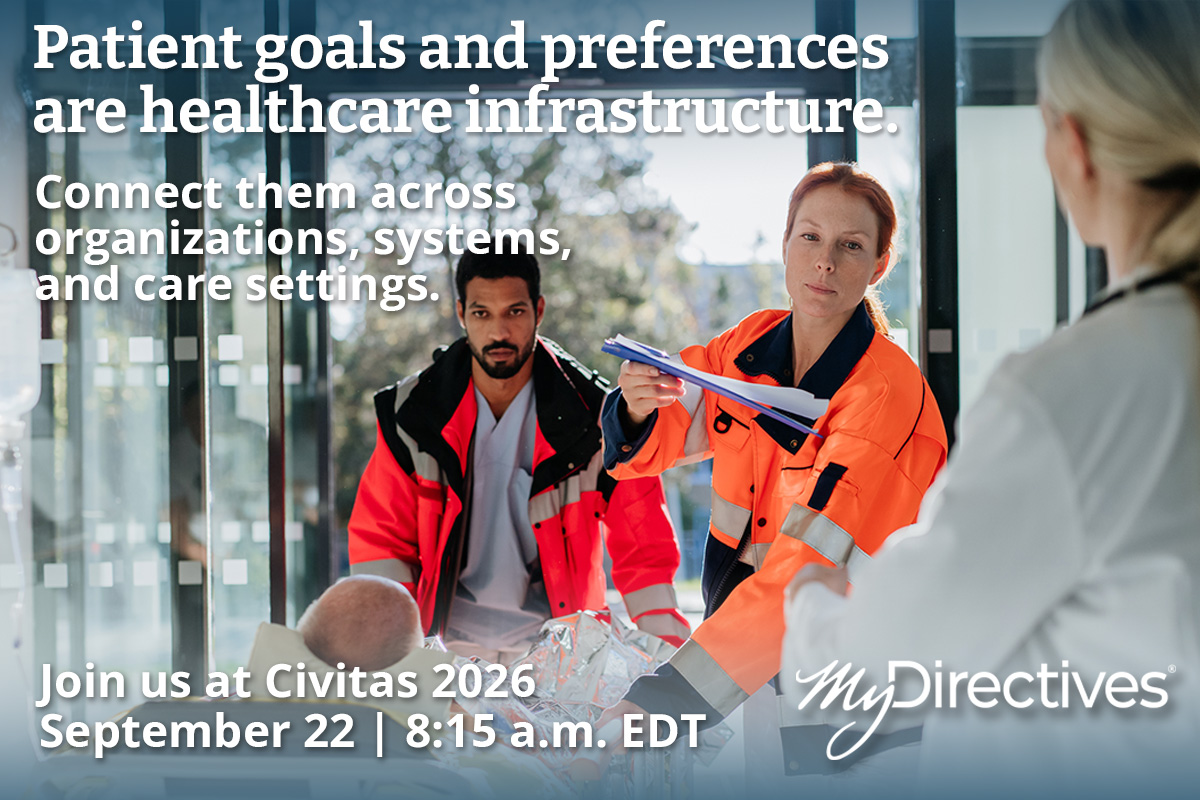
On Tuesday, September 22, at 8:15 a.m. ET, Scott and Mike will present "Patient Goals and Preferences as Infrastructure," exploring practical, scalable approaches to making advance care planning information part of connected statewide healthcare infrastructure.
If statewide ACP, interoperability, rural health transformation, or making patient goals of care and treatment preferences available across care settings is on your agenda, we’d like to talk.
Join us for the presentation, visit Booth 116, or schedule time with our team before we get to Arlington: https://t.co/iqfIOTVzRA
See you at Civitas!
#Civitas2026 #AdvanceCarePlanning #Interoperability #HealthInformationExchange #RHTP #HealthIT
Advance care planning doesn’t stop when someone moves from one care setting to another. But too often, access to their healthcare decisions does.
Admissions, transfers, changes in condition, and emergency situations can expose gaps in how ACP information is documented, maintained, and shared. Closing those gaps requires more than having a document on file. It requires alignment across care settings, reliable access to current information, and clear accountability for keeping it useful over time.
That’s the focus of our presentation next week at the LifeSpan Annual Conference & Expo in Ocean City, Maryland.
Join Joanne Eason, Senior Strategist, States & Partnerships, for Closing the Gaps in Advance Care Planning: Building Alignment, Access, and Accountability Across Care Settings on September 25 at 9:15 a.m. ET.
And while you’re there, visit MyDirectives at Booth 49 to learn how we’re helping organizations make advance care planning information accessible across the continuum of care.
Attending LifeSpan? We’d love to connect. Learn more about our presentation and schedule time with our team:
https://t.co/8DJU2rUPtl
#LifeSpan2026 #AdvanceCarePlanning #PostAcuteCare #LongTermCare #Hospice #PersonCenteredCare
What if patient goals and preferences moved through healthcare as reliably as other critical health information?
Health information organizations have built infrastructure that connects healthcare organizations, systems, and communities. Advance care planning (ACP) should be part of that infrastructure.
A person’s goals, treatment preferences, healthcare agent information, advance directives, and portable medical orders shouldn’t become harder to find simply because they move from home to EMS, from a rural hospital to a health system, or from acute care to a post-acute setting.
A statewide approach to ACP can help connect those pieces, making important information available across organizations and care settings while supporting the people and care teams who depend on it.
That’s the conversation Scott Brown, Chief Executive Officer, and Mike Munoz, Chief Product Officer, are bringing to the Civitas Networks for Health Annual Conference next week.
Join them for Patient Goals and Preferences as Infrastructure on September 22 at 8:15 a.m. ET, and visit MyDirectives at Booth 116.
If you’re attending Civitas, we’d love to talk about what statewide ACP could look like in your state. Learn more about the presentation and schedule time with our team:
Connect with MyDirectives at Civitas 2026
https://t.co/cm6fhdgKrG
#Civitas2026 #AdvanceCarePlanning #HealthInformationExchange #Interoperability #HealthIT #PatientPreferences
Twenty-five years later, we remember those who lost their lives on September 11, 2001, those who responded with extraordinary courage, and the families and communities forever changed by that day.
This month, MyDirectives will be at two important healthcare conferences at the same time, bringing the advance care planning conversation to two different audiences.
At the Civitas Networks for Health Annual Conference in Arlington, Scott Brown, President & CEO, and Mike Munoz, Chief Product Officer, will lead Patient Goals and Preferences as Infrastructure on September 22 at 8:15 a.m. ET. They'll explore practical, scalable strategies for making patient goals and preferences part of connected healthcare infrastructure across organizations, systems, and care settings. Visit us at Booth 116.
At the LifeSpan Annual Conference & Expo in Ocean City, Joanne Eason, Senior Strategist, States & Partnerships, will present Closing the Gaps in Advance Care Planning: Building Alignment, Access, and Accountability Across Care Settings on September 25 at 9:15 a.m. ET. She'll share practical approaches for improving the consistency, accessibility, and reliability of documented treatment preferences across care settings. Visit us at Booth 49.
Different audiences. Different perspectives. But the challenge is connected: helping ensure people's healthcare goals, preferences, and decisions are available when and where they're needed.
If you're attending either conference, we'd love to connect. Learn more about what we're presenting and schedule time with our team:
Civitas 2026: https://t.co/F3ecHepBWb
LifeSpan 2026: https://t.co/Hy05wHCDis
#Civitas2026 #LifeSpan2026 #AdvanceCarePlanning #Interoperability #HealthIT #PersonCenteredCare
Health information organizations have spent years building the infrastructure that connects healthcare across communities. What if advance care planning could make that infrastructure even more valuable?
A statewide approach to ACP can help HIEs and HIOs connect individuals, hospitals, health systems, EMS, post-acute care, hospice, and community organizations around something that matters across every setting: making people’s healthcare goals, preferences, and decisions available when and where they’re needed.
It can also create value beyond better care. Statewide ACP can strengthen relationships with participants, expand the services an HIE or HIO provides to its communities, support initiatives like the Rural Health Transformation Program, and create opportunities for sustainable revenue.
That last piece matters. Statewide healthcare infrastructure has to be sustainable if it’s going to deliver value long after individual programs or funding cycles end.
That’s one of the conversations we’re bringing to Civitas 2026.
Join us September 22 at 8:15 a.m. EDT for Patient Goals and Preferences as Infrastructure, where we’ll share practical approaches for making ACP interoperable, scalable, and sustainable across communities and care settings.
Attending Civitas? We’d also love to talk about what statewide ACP could look like in your state. Schedule time with our team:
https://t.co/dBcoplKD4n
#Civitas2026 #AdvanceCarePlanning #HealthInformationExchange #Interoperability #RHTP #HealthIT
Patient goals and preferences should be part of the information that moves with a person across the healthcare system.
When someone moves from EMS to the emergency department, from a hospital to post-acute care, or between healthcare organizations, critical information follows them. Advance care planning information should, too.
That means moving beyond paper, disconnected systems, and documents that can’t be found when they’re needed. It means treating a person’s goals, treatment preferences, healthcare agent information, advance directives, and portable medical orders as part of connected healthcare infrastructure.
That’s the conversation we’re bringing to the Civitas Networks for Health Annual Conference.
Join Scott Brown, President & CEO, and Mike Munoz, Chief Product Officer, on September 22 at 8:15 a.m. ET for Patient Goals and Preferences as Infrastructure, part of the Critical National, State, and Local Health Infrastructure Showcase. We’ll explore practical, scalable approaches to connecting this information across care settings and building statewide ACP ecosystems.
Attending Civitas? Visit us at Booth 116 or schedule time to meet with our team:
https://t.co/qrMndyL3AA
#Civitas2026 #KilltheClipboard #AdvanceCarePlanning #Interoperability #HealthInformationExchange #HealthIT
RHTP funding gives states an opportunity to rethink how healthcare is delivered across rural communities. But transformation shouldn’t stop at individual hospitals, technologies, or programs.
Advance care planning is one area where states can think bigger.
People often move across multiple healthcare settings. They may receive care from a rural hospital, EMS, a larger health system, post-acute care, hospice, or providers outside their local community. Their healthcare decisions need to be able to move with them.
RHTP investments in interoperability, consumer health technology, care coordination, and community-based care create an opportunity to make ACP part of connected statewide healthcare infrastructure.
HIEs, HIOs, state hospital associations, healthcare systems, EMS, and other community partners can play an important role in bringing those pieces together, helping people document their healthcare decisions and making that information available across organizations and care settings when and where it’s needed.
As states put their RHTP strategies into action, advance care planning deserves a place in the conversation.
Is ACP part of your state’s strategy?
Learn how states can use RHTP investments to build connected, statewide ACP infrastructure:
https://t.co/s8v4BF6oog
#RuralHealth #RHTP #AdvanceCarePlanning #Interoperability #HealthIT #HealthInformationExchange
Paper-based advance care planning creates challenges that go well beyond paper.
That was one of the topics Joanne Eason and Kathleen Taylor from our team explored in their presentation this week at the FHPCA Annual Forum. For hospice organizations, fragmented ACP processes can make it harder to know whether the right document is available, whether it reflects a patient’s most current decisions, and whether it can be accessed as that patient moves between care settings.
Moving ACP from paper to a digital, interoperable approach can improve accessibility, version control, and documentation while supporting regulatory readiness and better care coordination. Just as importantly, it can help ensure that a person’s healthcare decisions are available to the people caring for them when they’re needed.
Modernizing ACP isn’t simply about replacing a paper form with a digital one. It’s about making advance care planning an accessible, integrated, and ongoing part of care.
Thank you to the Florida Hospice & Palliative Care Association and everyone who joined Joanne and Kathleen for the conversation this week.
#FHPCA2026 #AdvanceCarePlanning #Hospice #PalliativeCare #HealthIT
We’re looking forward to connecting with Florida’s hospice and palliative care community this week at the FHPCA 41st Annual Forum in Orlando.
MyDirectives’ Joanne Eason and Kathleen Taylor will be there to talk about how hospice organizations can modernize advance care planning, improve access to patients’ documented healthcare decisions, strengthen interoperability, and better integrate ACP into existing workflows.
They’ll also present “Modernizing Your Advance Care Planning Program for Maximum Effectiveness,” exploring practical approaches and technologies that can help organizations overcome common ACP limitations and better align care with what matters to patients.
If you’re attending FHPCA, let’s find some time to connect in Orlando. Learn more about what we’ll be discussing and schedule time with Joanne and Kathleen: https://t.co/q8Xm66aM7F
#FHPCA2026 #AdvanceCarePlanning #Hospice #PalliativeCare #HealthIT