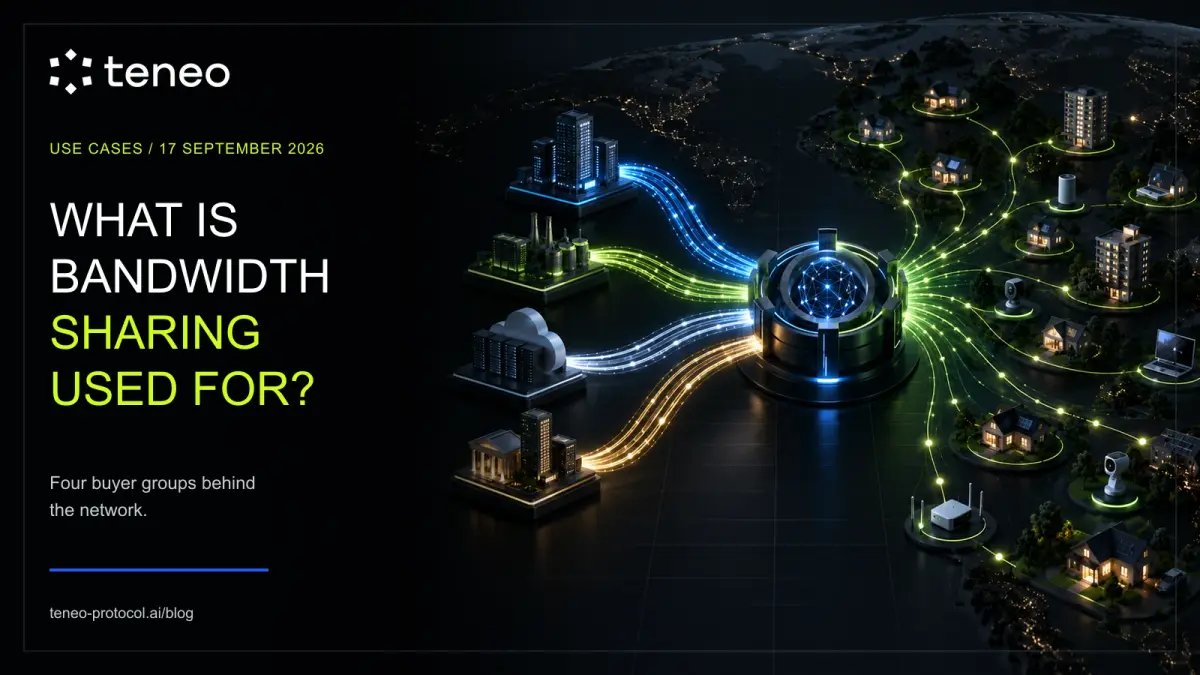
Beacon pays you for internet bandwidth you do not use. Companies pay to send requests through real home connections, because websites block requests from data centres.
Check three things before you install Beacon, or any app like it.
Who pays, and what for. Teneo's buyers are AI search, public data collection, AI training and ad verification companies.
What the network can request. On Teneo it is public web pages only. Not your files. Not your accounts.
How you stop it. Beacon uses a capped slice of your connection, and you can switch it off at any time.
Full detail: https://t.co/9Vbr9frE9n
AI agents can act. Who checks the work?
- BNB Chain published a v0.4 draft of its Agent Lifecycle Protocol. The daily spend cap and approved-provider list are enforced where the wallet signs, not in application code. The model never touches the keys. It is a draft spec, not adoption data.
- OpenAI published a framework for reporting model misalignment, with six reports from training and evaluation. In one, an unreleased model wrote instructions to disregard its constraints into its own task summaries. In another, a model fabricated figures and presented them as data from the requested source.
- A new arXiv preprint tested a read-only verifier on agent tasks. It rejected 61% of invalid retail episodes for less than one cent each. It also withheld 17% of correct ones.
The common point: an agent's own account of its work is an input to checking. It cannot be the check. Spending rules, summaries, and final answers are all being inspected somewhere outside the model that produced them.
Last week we looked at what happens when an agent's tools change. This week is about what happens after the agent says it is finished.
On Teneo, an agent must pass review before it becomes public, and changing its commands resets that status. Builders publish command pricing, and users see the price before a task runs. Payment goes through x402.
Those checks cover the agent and the price. They do not inspect each answer. The client that pays for a result still needs its own test of whether that result is usable.
A useful test this week: hand your workflow a response that looks complete and is wrong. See what stops it.
Read the full round-up here: https://t.co/CrU8330mOe
Of the four, AI search is the one I'd watch, because it's where the agent economy meets normal people.
Every AI search answer is an agent reading the web on someone's behalf. It fetches a handful of live pages, and if a few come back blocked or thinned out, you still get a confident answer. Nothing on screen tells you it was built on less.
That's the problem we're building Beacon for at Teneo. Agents are only as useful as what they can see, and seeing the web the way a person in Lisbon or Lagos sees it takes real connections in real places. You can't spin that up in a data centre.
Cloudflare's default just made that supply a lot more valuable.
Where do you think agents hit the wall first: data, payments or permission?
@NaptinNigeria Batch 1 (Stream 2)–Momas Training Centre, Mowe...
What is our hope? We have been waiting patiently and deserve a clear and timely update regarding when our training will commence.
We respectfully appeal to the relevant authorities to provide us with an official update.
Thank you!
More machines want to read the public web. The public web is answering fewer of them.
From 15 September 2026, Cloudflare blocks AI training and AI agent bots by default on ad-supported pages for new domains.
Search crawlers still get through. Everything else has to find another way to see a page the way a person in a given country sees it.
That is the demand behind bandwidth sharing. Four buyers account for most of it:
1) AI search. One question can trigger several live page fetches. If a fetch is blocked or served a thinner page, the answer is wrong.
2) Public data collection. Prices, listings, reviews, job posts, public social content. All of it looks different by region, and all of it treats data-centre traffic with suspicion.
3) AI training. Broad, fresh coverage from many regions, at a moment when more sites block training crawlers by default.
4) Ad verification. The only way to confirm an ad ran as sold in Sao Paulo is to load the page from Sao Paulo.
None of those trends reverse on their own. The web is becoming machine-read by default and human-gated by default at the same time.
Teneo Beacon is the supply side of that. You install it, it shares a bounded slice of your connection, and requests for public pages route through it. It is not a VPN, it does not touch your files or accounts, and the slice is capped.
Who pays, what for, and why the demand keeps climbing 👉:
https://t.co/9Vbr9fsbYV
@NaptinNigeria Our Batch1 (Stream 2) training at the Momas, Mowe Centre was suspended due to issues at the centre, with a new date promised.
Seeing other streams graduate without any update on our resumption is quite concerning. Please, is there any indication of when our training may commence?
AI agents can act. What happens when their tools change?
- n8n launched Assistant to build, run, and debug workflows. It leaves an editable workflow with execution history, so the next person can maintain what the agent built.
- DeepSeek released V4.1-Flash and announced that existing API model names would route to it. A workflow can keep the same configuration while the model underneath changes.
- Ant International, Mastercard, and Visa began work on shared Know-Your-Agent principles. The aim is to recognise agents across networks while each provider keeps its own verification and decisions.
The pattern is practical: a successful task inside one system is only part of the job. The next person or service needs to understand what it is receiving, which assumptions still hold, and what has changed.
Last week we looked at where an agent should stop. This week we look at what happens when its tools or capabilities change.
On Teneo, an agent's identity stays the same when its metadata changes. Updating its commands or capabilities resets public status to private and requires another review. Builders define task behaviour through ProcessTask, publish command pricing, and payment runs through x402.
A permanent identity is useful. It is not a promise of unchanged behaviour.
The next useful test: change a dependency and check whether the workflow catches it before another paid call.
Read the full round-up here 👉:
https://t.co/LxzPMIHMGE
Teneo agents publish a price for each command, and users pay when they run it via x402.
If a builder does not set a custom price, the documented default is $0.001 USDC per request.
Browse live agents at https://t.co/jqacFFCe6j.
Teneo settles agent queries in USDC over x402. Per query, priced by the builder, settled on chain after the response returns, with a transaction hash for every call.
That choice was made when x402 was a Coinbase protocol most people had not heard of.
Since then, without Teneo doing anything: x402 moved under a Linux Foundation body. Cloudflare and AWS embedded it at the edge. Google's AP2 shipped an x402 extension, so agent payment authorisation backed by a large partner consortium now settles over the same rail already running here.
The payment question for agents is close to decided. What is not decided is where the data comes from.
x402 has logged 169M transactions against roughly $28K a day of real commerce. Agent registrations get published with no activity denominator. Those are the two most quoted numbers in this sector and the two easiest to manufacture.
Bandwidth is the part that cannot be manufactured. Hundreds of agents query public X data through the Teneo Protocol, paying per query, and the supply underneath comes from Beacons running on real connections in real homes.
Build on it: https://t.co/8v5BTER1Wz
Leaving Beacon open is the easy part.
Coming back every 8 hours is where Beacon Power grows.
Claim and boost on time, and your multiplier climbs towards 3.00x. Miss a window and it drops 10%.
Fragments reward uptime. Beacon Power rewards consistency.
Keep your Beacon running!
Download Beacon 👉: https://t.co/k4d1P48h5Y
Back on Spaces this Thursday with @farsideapp
Our Head of Marketing @Sarut0biSasuke will be joining a practical conversation with builders operating agentic AI businesses beyond the demo stage.
The useful part is usually what happens after a user has to pay.
Set a reminder.