Android's openness distinguished it from iPhone for 17 years. Google is now requiring mandatory developer registration for all apps, including those distributed outside the Play Store. https://t.co/w2wINyZJ8U #KeepAndroidOpen
The most revealing thing about this AI leadership paper is that it reads less like a vision for innovation and more like a glossy whitepaper for a 21st century East India Company.
Every generation of incumbents discovers a new moral vocabulary for why they alone should control transformative technology.
In the 90s it was cryptography. We were told strong encryption was too dangerous to spread because terrorists, rogue states, chaos, dual-use, etc. So the US crippled exports, weakened products, slowed adoption, and kneecapped parts of its own software industry. Right up until reality steamrolled the policy and we woke up to its stupidity and then eCommerce, secure communications, software signing, and the modern internet exploded and gave us tremendous benefits.
Now the exact same priesthood has returned with AI.
- “Dual-use.”
- “Strategic advantage.”
- “Model distillation.”
- “National security.”
- “Responsible access.”
A few different nouns but mostly the same ones. Same instinct:
Centralize control, gatekeep compute, fuse state and corporate power, and call it safety.
The funniest part is that this strategy is almost perfectly designed to accelerate the thing they claim to fear.
You do not stop a rival superpower (who happens to be the absolute best at scaling energy and manufacturing and who has a choke-hold on rare Earths refinement) from building domestic capability by permanently attempting to strangle them.
You create the economic and political incentive for total self-sufficiency.
We have already done that as Jensen warned. We went from 100% market to nearly 0%. Huawei is now manufacturing millions of chips. DeepSeek v4 trained on them. They have more energy than the rest of the world combined. Meanwhile, we have activists and anti-economic fools like AOC and Bernie pushing for data center moratoriums and we can't build a single bullet train in 20 years and folks fighting to not expand the energy grid here and new nuclear plants getting tied up in environmental regulation for a decade.
The sanctions did the exact opposite of what the hawks wanted. They jumpstarted a moribund, dinosaur of a Chinese chips industry. We basically said to the people who happen control the most powerful manufacturing engine on the planet "we intend to squeeze you."
They rightly saw it as an existential threat.
The sanctions become the industrial policy.
Huawei. SMIC. Domestic lithography. Packaging. Memory. Entire Chinese supply chains that did not exist at serious scale a decade ago now exist precisely because Washington convinced Beijing they had no choice.
Brilliant work.
So the endgame here is what exactly?
1) Push China into a Manhattan Project for chips and AI.
2) Increase the strategic value of Taiwan even further.
3) Once China reaches self sufficiency that can invade Taiwan and choke off our own super advanced chips where are made there exclusively (and no we don't have even close to enough TSMC factories in Arizona or anywhere else in the world).
That's every NVIDIA chip. Every Google tensor chip. Every Apple chip. Every chip in you iPhone and Android phone. Every Amazon chip. The chips in your car and truck and hair dryer and washing machine.
4) Escalate a cold tech war into a permanent civilizational bloc conflict that is likely to turn into a shooting war at one point.
5) Fragment the global software ecosystem.
6) Create American AI aristocracies protected by regulation and compute licensing.
And somehow call this “open innovation.”
Meanwhile the actual history of software keeps screaming the opposite lesson:
Knowledge diffuses, open ecosystems win, developers route around gatekeepers, and attempts to permanently contain computation usually fail.
What really jumps off the page is the assumption that a tiny cluster of frontier labs should become quasi-sovereign actors, deciding who gets intelligence, who gets compute, who gets models, and which countries are permitted to participate in the future.
Not elected governments.
Not open markets.
Not open-source communities.
A handful of corporations sitting beside the national security state, insisting that concentration of power is necessary to protect democracy.
You almost have to admire the audacity.
What’s more likely?
1. All of physics is wrong along with the thousands of physicists around the world and all their expensive experiments.
2. A known liar just made up more fabulist stories about secret science he says was revealed to him.
If you want effective communication (especially on social media where people have limited attention span), you should just let an AI rewrite your rambling
I was at an event on AI for science yesterday, a panel discussion here at NeurIPS. The panelists discussed how they plan to replace humans at all levels in the scientific process. So I stood up and protested that what they are doing is evil. Look around you, I said. The room is filled with researchers of various kinds, most of them young. They are here because they love research and want to contribute to advancing human knowledge. If you take the human out of the loop, meaning that humans no longer have any role in scientific research, you're depriving them of the activity they love and a key source of meaning in their lives. And we all want to do something meaningful. Why, I asked, do you want to take the opportunity to contribute to science away from us?
My question changed the course of the panel, and set the tone for the rest of the discussion. Afterwards, a number of attendees came up to me, either to thank me for putting what they felt into words, or to ask if I really meant what I said. So I thought I would return to the question here.
One of the panelists asked whether I would really prefer the joy of doing science to finding a cure for cancer and enabling immortality. I answered that we will eventually cure cancer and at some point probably be able to choose immortality. Science is already making great progress with humans at the helm. We'll get fusion power and space travel some day as well. Maybe cutting humans out of the loop could speed up this process, but I don't think it would be worth it. I think it is of crucial importance that we humans are in charge of our own progress. Expanding humanity's collective knowledge is, I think, the most meaningful thing we can do. If humans could not usefully contribute to science anymore, this would be a disaster. So, no. I do not think it worth it to find a cure for cancer faster if that means we can never do science again.
Many of those who came up to talk to me last night, those who asked me whether I was being serious or just trolling, thought that the premise was absurd. Of course there would always be room for humans in science. There will always be tasks only humans can do, insight only humans have, and so on. Therefore, we should welcome AI. Research is hard, and we need all the help we can get. I responded that I hoped they were right. That is, I truly hope there will always be parts of the research process which humans will be essential for. But what I was arguing against was not what we might call "weak science automation", where humans stay in the loop in important roles, but "strong science automation", where humans are redundant.
Others thought it was immature to argue about this, because full science automation is not on the horizon. Again, I hope they are right. But I see no harm in discussing it now. And I certainly don't think we need research on science automation to go any further.
Yet others remarked that this was a pointless argument. Science automation is coming whether we want it or not, and we'd better get used to it. The train is coming, and we can get on it or stand in its way. I think that is a remarkably cowardly argument. It is up to us as a society to decide how we use the technology we develop. It's not a train, it's a truck, and we'd better grab the steering wheel.
One of the panelists made a chess analogy, arguing that lots of people play chess even though computers are now much better than humans at chess. So we might engage in science as a kind of hobby, even though the real science is done by computers. We would be playing around far from the frontier, perhaps filling in the blanks that AI systems don't care about. That was, to put it mildly, not a satisfying answer. While I love games, I certainly do not consider game-playing as meaningful as advancing human knowledge. Thanks, but no thanks.
Overall, though, it was striking that most of those I talked to thanked me for raising the point, as I articulated worries that they already had. One of them remarked that if you work on automating science and are not even a little bit worried about the end goal, you are a psychopath. I would add that another possibility is that you don't really believe in what you are doing.
Some might ask why I make this argument about science and not, for example, about visual art, music, or game design. That's because yesterday's event was about AI for science. But I think the same argument applies to all domains of human creative and intellectual expression. Making human intellectual or creative work redundant is something we should avoid when we can, and we should absolutely avoid it if there are no equally meaningful new roles for humans to transition into.
You could further argue that working on cutting humans out of meaningful creative work such as scientific research is incredibly egoistic. You get the intellectual satisfaction of inventing new AI methods, but the next generation don't get a chance to contribute. Why do you want to rob your children (academic and biological) of the chance to engage in the most meaningful activity in the world?
So what do I believe in, given that I am an AI researcher who actively works on the kind of AI methods used for automating science? I believe that AI tools that help us be more productive and creative are great, but that AI tools that replace us are bad. I love science, and I am afraid of a future where we are pushed back into the dark ages because we can no longer contribute to science. Human agency, including in creative processes, is vital and must be safeguarded at almost any cost.
I don't exactly know how to steer AI development and AI usage so that we get new tools but are not replaced. But I know that it is of paramount importance.
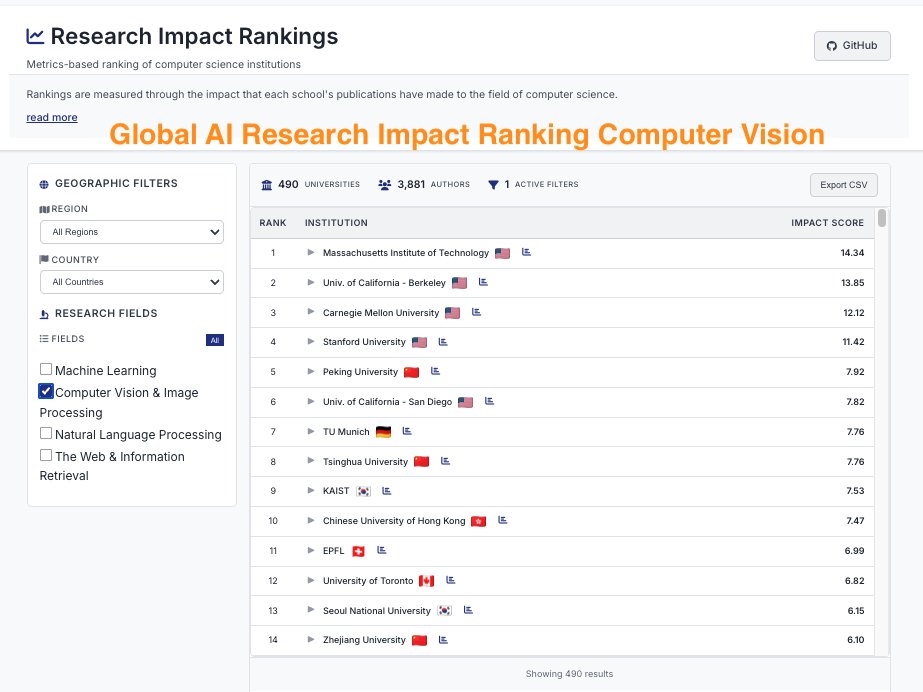
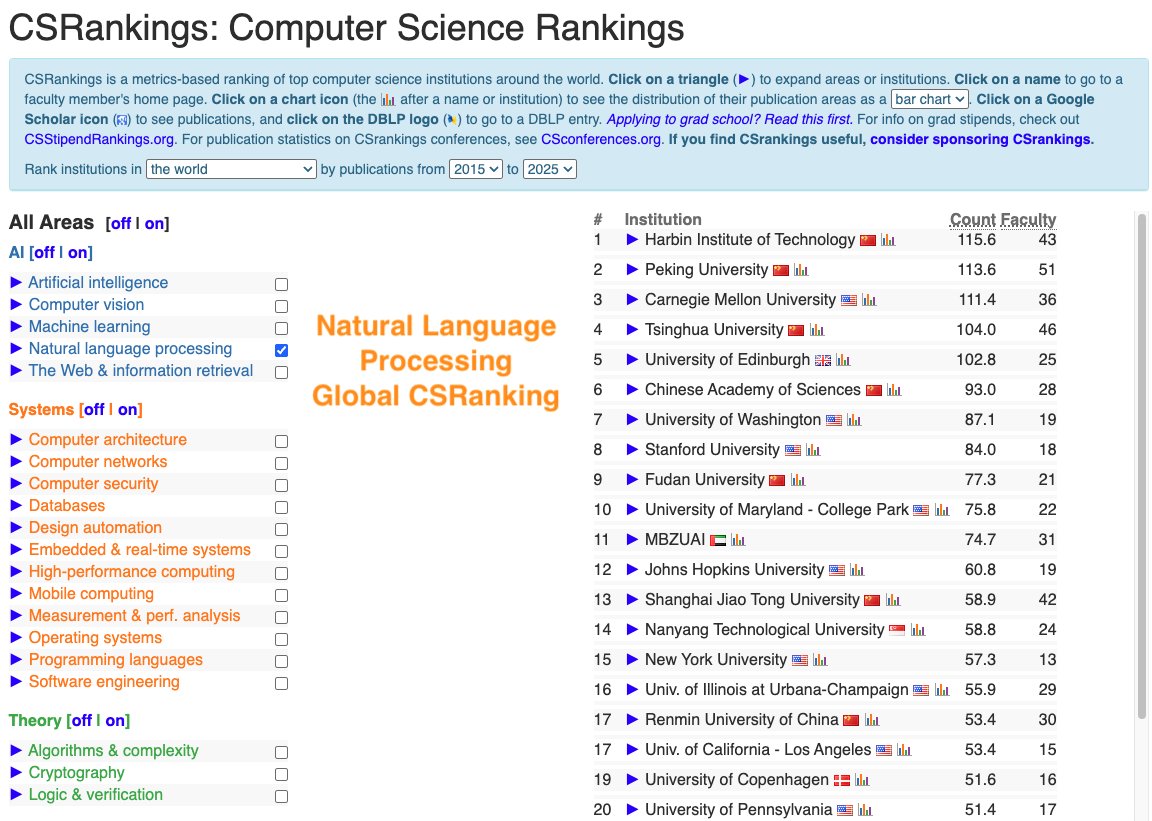
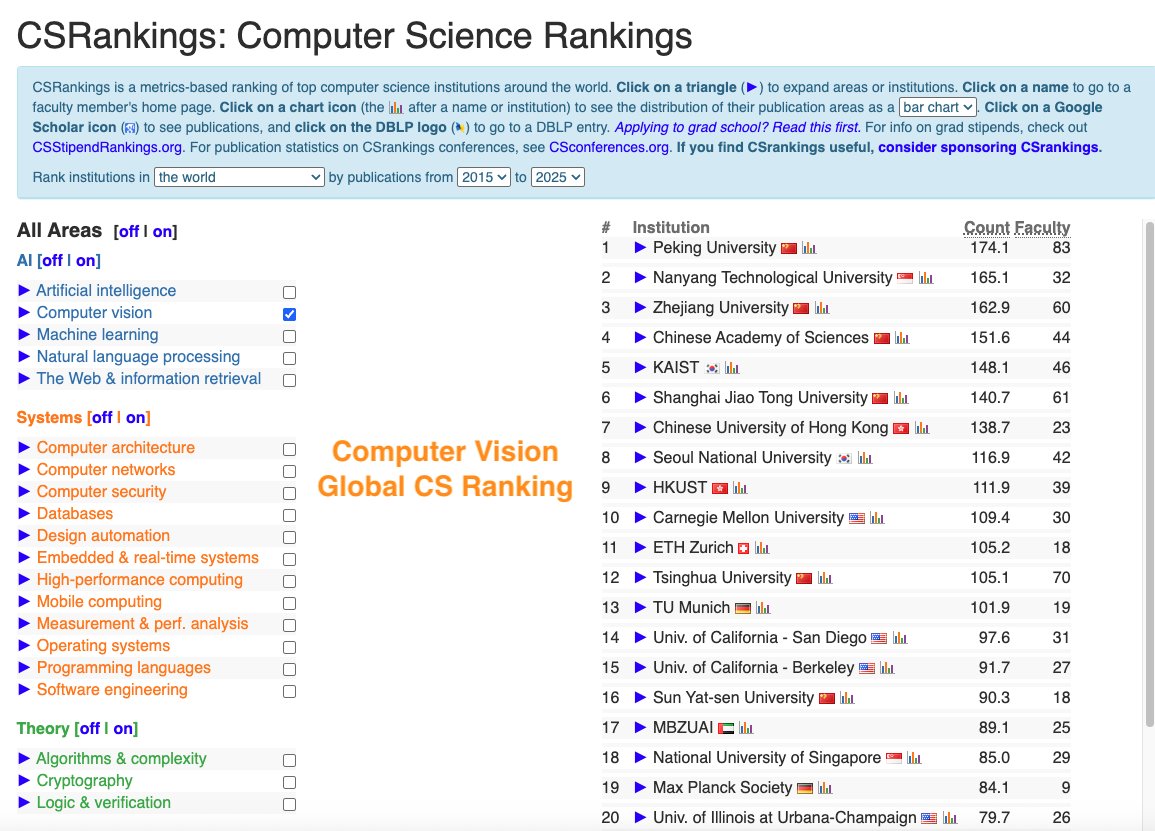
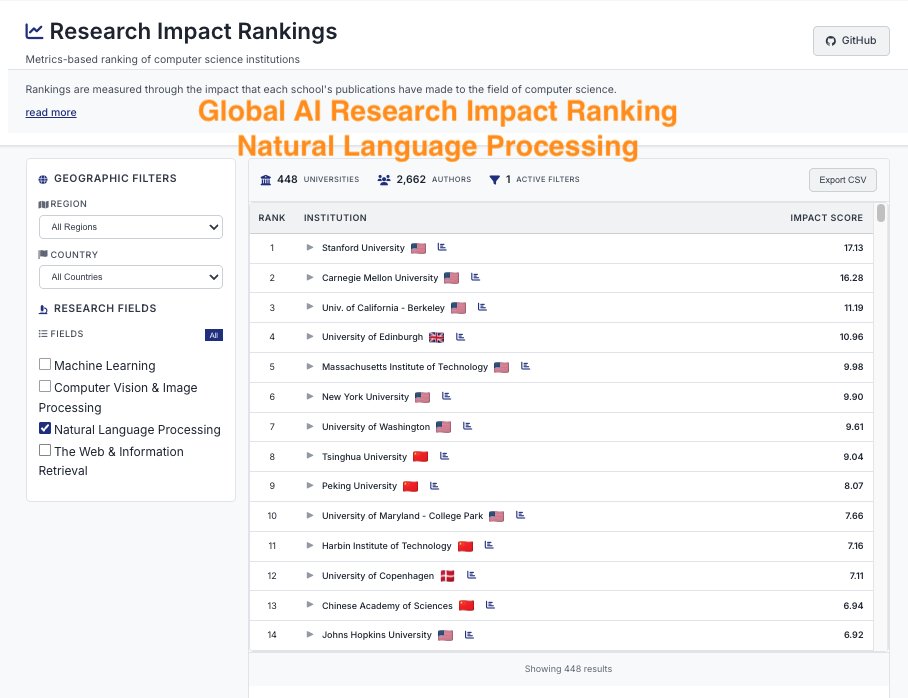
CSRankings counts publication in top conferences to rank professors/universities. But this encourages researchers to pursue quantity rather than quality.
We propose https://t.co/uDZLqYkD1g, a new university ranking system that tries to measure quality instead of quantity of publications.
How can we measure the quality of the publications? We believe that 1) The quality of research is best understood and evaluated by peers in the same research area;
2) With careful and informed use, LLMs can reveal the implicit quality judgments that peers convey through their citation practices and writing across large volumes of scholarly work.
Hence, we developed the new ranking system where we analyze research papers from major AI conferences with LLMs.
For each paper, we ask an LLM what are the 5 most important papers to this paper. In other words, the five works that most strongly influence the study. By doing this, we trace which papers and authors are consistently seen as inspirational and foundational to new discoveries in the field.
We ran the model on all papers from top conferences in machine learning, computer vision, natural language processing and information retrieval from 2020 - 2025, and filtered references to only have those from 2000 onwards.
Next, we map these influential authors to their affiliated universities using the CSRankings name–affiliation database. Each time a paper is recognized as one of the “top five references” in another work, its authors and their institutions receive credit. To keep the scoring fair, points are divided by the number of co-authors, ensuring balanced recognition across collaborations.
The result is a new kind of academic ranking: one that rewards universities not just for publishing often, but for producing research that endures, inspires, and drives the field forward. This approach highlights scholarly influence and provides students, researchers, and institutions with a clearer picture of where the most impactful work is happening.
Note that we believe that CSRankings had substantially improved university rankings in computer science by replacing subjective, reputation-based measures, such as those in US News, with more objective indicators, but the LLM era allows us to do something potentially better!
Due to computational resource limits, we were only able to run it with a small 7B language model. It is also a project primarily led by undergraduate and master students from Oregon State University and University of California Santa Cruz. As a result, the system is very much a work in progress and will inevitably contain errors and blind spots. We actively welcome community feedback, new collaborators and contributions of GPU compute so that we can run larger LLMs, obtain more reliable results and improve the methodology.