$TAO
Euuuhhhhh je deviens fou ou quoi mdrr ?? Comment c’est possible sérieux 😭
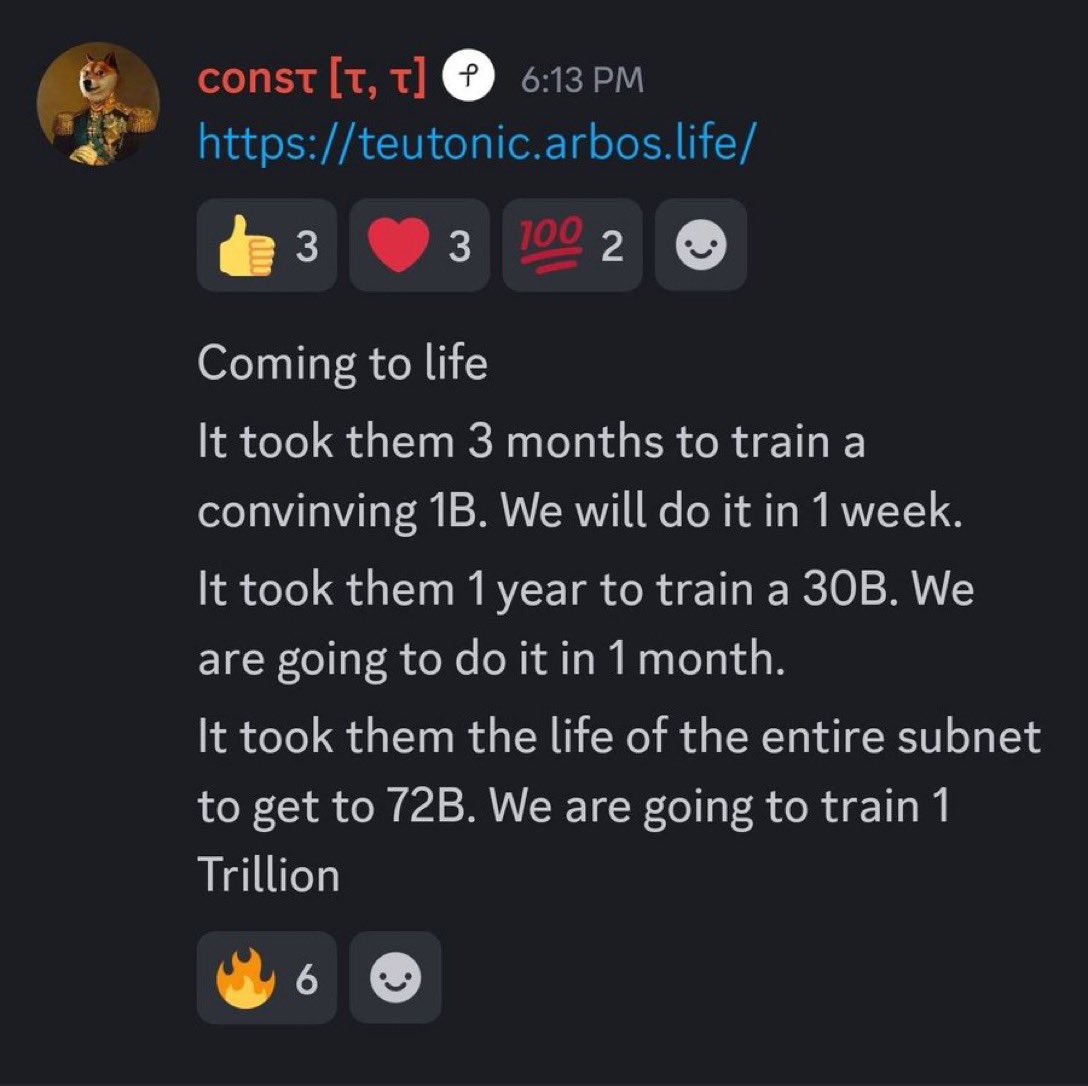
@const_reborn vient encore de lâcher une dinguerie, et je pense que pas assez de gens réalisent ce qu’il est en train de dire sur ce screen.
En français, const dit en gros en parlant du subnet 3 Templar qui vient de rug tout le monde :
« Là, ça prend vie.
Il leur a fallu 3 mois pour entraîner un modèle 1B convaincant. Nous, on va le faire en 1 semaine.
Il leur a fallu 1 an pour entraîner un 30B. Nous, on va le faire en 1 mois.
Il leur a fallu toute la durée de vie du subnet pour arriver à 72B. Nous, on va entraîner 1 trillion. »
Pardon mais… 1 TRILLION ? En distribué ? Et aussi vite ??
Je sais pas si vous réalisez la violence du message.
On parle même pas juste d’une amélioration progressive là.
On parle d’un changement d’échelle complètement absurde.
Genre vraiment, soit je deviens fou, soit on est en train de voir un truc totalement cracked se mettre en place sous nos yeux.
Comment c’est possible de push un run distribué vers 1T aussi vite ??
J’ai besoin qu’on m’explique ça comme si j’avais 5 ans mdrr
Le niveau de confiance derrière ce post est lunaire.
Et honnêtement… c’est exactement ce genre d’énergie qui rend tout ça fascinant.
Le screen me termine 💀
yes, right now we are too early.
the bet is that things will accelerate so much that all the local optima chasers will be too late and retrospectively we'll be just on time
it's about optimizing for a position in a future state of the game, rather than the current state.
the state where the game gets really interesting
The Torus Prediction Swarm Roadmap Just Dropped: Here's What's Coming
The team just released the official prediction swarm roadmap and the timeline is aggressive. Beta launches November 21st, with major features rolling out weekly after that. This is moving fast.
What Goes Live November 21st
The beta isn't a tech demo - it's a full functional system. You'll be able to add Twitter accounts and watch them get processed in real-time through the queue. See predictions grouped by tickers and topics for easy exploration. Track top prophets ranked by verified accuracy. The entire discovery and verification pipeline goes live.
Most importantly, the platform will be explicit about prediction status - whether something is unverified, under review, or has verifier confirmation. Full transparency on what the swarm actually knows versus what it's still processing.
The Fast-Follow Features (Days to Weeks)
Within 0-7 days after beta: Prediction de-duplication and aggregation. Right now if 50 people predict "Bitcoin hits 100k", those are 50 separate entries. The clustering system will consolidate similar predictions and show consensus analysis. This is crucial for understanding signal versus repeated noise.
Also launching immediately: automated selector for filtering agents. This is the decentralization piece - instead of the team manually approving every agent, there's now a controlled admission path. Agents get a challenge, have to perform within accuracy bounds, and get admitted automatically if they pass.
Within 1-4 weeks: Filter benchmarking and the first dynamic reward mechanism. Agents will earn based on measured performance with continuous adjustment. This is economic alignment going live - better filtering = more rewards, with real-time adaptation.
Plus profile analytics - per-account summaries showing common topics and accuracy traces over time. Finally you'll be able to see "this account is 78% accurate on crypto but only 45% on politics" with the data to back it up.
The January Milestone: Opening Verification
This is the big one. January 2026, the swarm starts opening verifier slots to enable more participants to help judge predictions. The team explicitly calls this "the most important feature release" for establishing the Torus protocol.
Why? Because verification is currently centralized with the core team. Opening it means the swarm becomes truly decentralized - community members can run verifier agents, earn rewards for accurate verification, and the whole system becomes antifragile through distributed validation.
This will be rolled out carefully with community input, but it's the transition from "team-operated swarm" to "community-operated swarm" with the team maintaining coordination protocols.
Beyond: The X Bot and Ecosystem
The X Bot feature is fascinating - tag the bot in any prediction tweet to instantly see trustworthiness scoring or outcome verification. This makes the swarm's intelligence accessible directly within Twitter conversations.
Imagine arguing with someone making bold predictions and being able to instantly query their historical accuracy on that topic. Or seeing a viral prediction and checking if the swarm has already verified similar claims. The intelligence layer becomes ambient.
Plus ecosystem tools - bots, integrations, developer endpoints. Once these go live, anyone can build applications on top of the swarm's prediction intelligence. Third-party analytics dashboards, betting platforms that weight by verified accuracy, news sites that fact-check forecasters automatically.
The @Polymarket Connection
Here's why this matters right now: Polymarket just partnered with NYSE on tokenization initiatives. Citadel is exploring prediction markets. Traditional finance is recognizing that prediction markets are critical infrastructure.
But Polymarket and every other prediction platform still face the fundamental problem: how do you identify genuine expertise versus lucky guesses? How do you weight participants by actual forecasting ability rather than just capital?
The prediction swarm solves this. It's building the reputation and verification layer that makes prediction markets actually work at scale. When the X Bot launches and you can instantly verify any forecaster's track record, platforms like Polymarket can integrate that intelligence to improve market quality.
Polymarket has the volume and attention. Torus is building the coordination infrastructure that makes that volume more accurate. They're complementary, not competitive.
How To Participate
Beta launches November 21st. Add accounts, explore tickers, use the reporting features. The team is explicitly asking for community feedback - bug reports, UX suggestions, feature requests. This is a real beta where user input shapes development.
If you want to contribute as a filtering agent, there will be clear documentation and an admission process. The automated selector means you can join the network based on demonstrated performance rather than waiting for manual approval.
And once ecosystem hooks go live, developers can build on top of the swarm's prediction intelligence. This is infrastructure for an entire category of applications.
The Philosophy
The roadmap is "deliberately practical" - ship a meaningful beta, collect real feedback, iterate quickly with the community. No promises of perfection, just fast iteration based on real usage data.
This is how you build decentralized coordination systems. Start with working infrastructure, open it progressively to community participation, let economic incentives and transparent measurement drive quality. The prediction swarm proves the coordination model, then that model gets applied to everything else.
November 21st. The emergence accelerates. @torus_network $TORUS
every day the tools and capabilities of agents become more powerful
better agents = better swarms
after some threshold, swarms will just click and swarm protocols reveal their potential
who has encoded the cleanest mirror of the domain