Are you 40? If you are, it's time to finnally buy a WinRAR license! Thanks to @buraktuyan for creating this awesome video that no one asked for but that everyone needs! 🤣😎
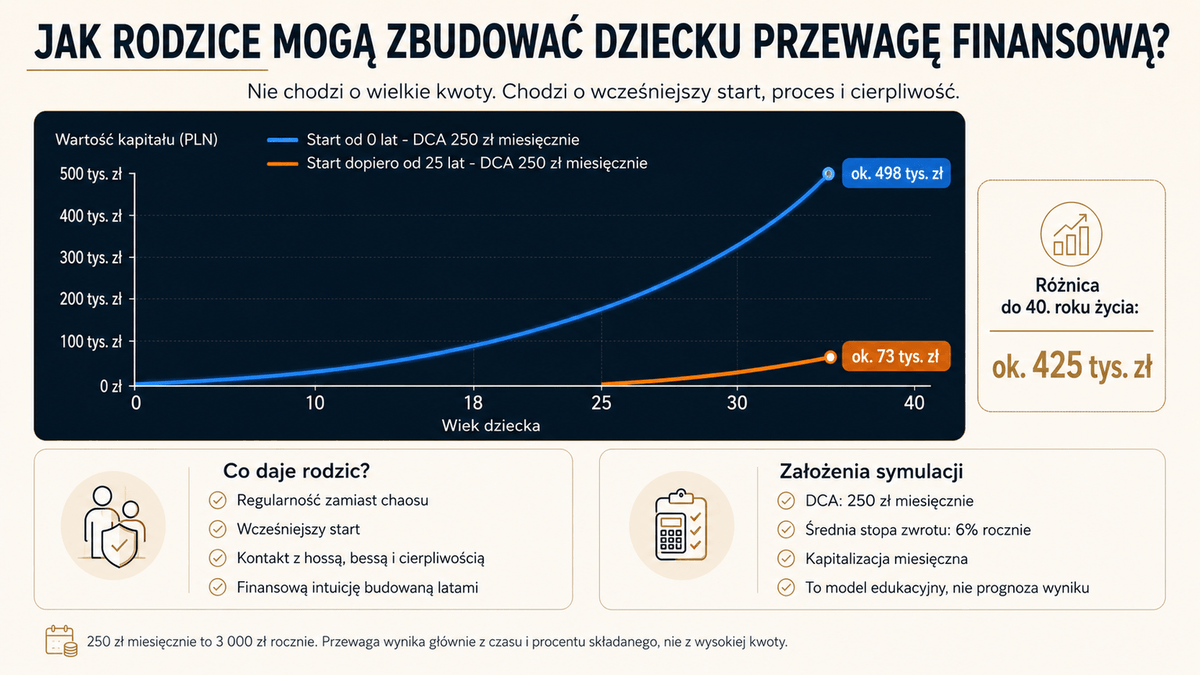
Rodzicu, zatrzymaj się na trzy minuty.
Wiem, że Ci jest trudno.
Ortodonta. Bezduszna szkoła. Posiłki. Kredyt. Praca. Niezangażowanii dziadkowie. Pogoń. Robisz rzeczy, którymi Twoi rodzice często się nie przejmowali, bo świat był inny no i mieli wywalone...
Ale jest jedna prosta rzecz, którą możesz zrobić dla dziecka i przy okazji dla siebie.
Nie chodzi o kupowanie mu kolejnej zabawki, telefonu ani spełnianie każdej zachcianki.
Chodzi o pokazanie mu, jak działa kapitał.
50-200 zł miesięcznie w szeroki indeks np cały świat, czy SP 500, globalny ETF, coś prostego, nudnego i regularnego.
Nie po to, żeby dziecko zostało milionerem z TikToka.
Po to, żeby przez lata zobaczyło hossę, bessę, spadki, odbicia, cierpliwość i procent składany. Czyli rzeczy, których szkoła zwykle nie uczy, bo szkoła nadal uważa, że najważniejsze w życiu jest znać budowę pantofelka.
Dziecko, które od małego widzi proces inwestowania, dostaje coś więcej niż pieniądze.
Dostaje doświadczenie.
A doświadczenie jest droższe niż kapitał, bo kapitał można odziedziczyć, a doświadczenia nie da się przelać Blikiem.
W Polsce ponad 50% osób w wieku 25-34 lata nadal mieszka z rodzicami. 🥲
Nie zawsze z lenistwa. Często dlatego, że start w dorosłość jest dziś po prostu drogi.
Taki kapitał może kiedyś dać dziecku większy wybór:
- studia za granicą,
- wkład własny,
- pierwszy biznes,
- rok spokojnego szukania sensownej pracy,
- albo zwykłą możliwość niebrania głupiego kredytu pod presją.
I teraz najważniejsze.
Twoją rolą jako rodzica nie jest bycie kumplem dziecka.
Nie jest nią też kupowanie świętego spokoju.
Masz nie być helikopterem, buldożerem. Twoją rolą jest stopniowe budowanie samodzielności dziecka.
A pieniądze są jednym z narzędzi tej samodzielności.
Może się oczywiście zdarzyć, że dziecko po latach pokaże Ci środkowy palec. 😅
Wtedy trudno.
Kapitał bierzesz dla siebie i pierwszy raz od dawna możesz zrobić coś szalonego.
Po prostu:
Nie musisz dać dziecku wszystkiego.
Wystarczy, że pokażesz mu zasady gry, zanim życie zacznie go dopadnie.
miłego dnia ☕️
@norstjern1@Paul__Crow Darowizna w 1 linii rodziny zgłoszona do US w ciągu pół roku zwalnia z płacenia podatku choć nie wiem czy to obejmuje inwestycje. Coś do rozeznania...
Unrealized gains tax for Gen-Z:
You buy a Pokémon card for $50.
Someone offers you $500 for it. You say no. You love that card. You're keeping it.
The government says: "Cool, but that card is worth $500 now. You owe us $100 in taxes."
You: "…I didn't sell it."
Government: "Don't care. Pay up."
You don't have $100 lying around. So you're forced to sell the card you love just to pay a tax on money you never received.
Next month? That card drops back to $50.
Your card is gone. Your money is gone. And the government shrugs.
That's a wealth tax on unrealized gains. They don't pay you back the tax...
Now picture this.
Your mom calls you crying. She has to sell the house she raised you in. Not because she can't afford it. She's lived there 30 years. It's paid off.
But some website says it's worth more now and the government says she owes $15,000 she doesn't have.
So she sells your childhood home. The kitchen where she made you breakfast. The doorframe where she marked your height every birthday.
Gone.
To pay a tax on money that was never real.
Now picture the opposite.
Your dad put everything into his small business. For 20 years he built it from nothing. One year the business is "valued" at $2 million on paper. He owes a massive tax bill. He empties his savings. Sells his truck. Borrows money. Pays it.
Next year the market crashes. His business is worth $200,000.
He lost everything to pay a tax on a number that doesn't exist anymore.
Does the government give him his money back?
No.
Does the government give him his truck back?
No.
Does the government care?
No.
They sold this idea as "taxing billionaires." But billionaires have armies of lawyers, offshore accounts, and trusts. They'll be fine.
You know who won't be fine? Your mom. Your dad. Your neighbor with a small business. The farmer down the road who's had the same land for four generations and now has to sell it because dirt got expensive.
You're not taxing wealth. You're taxing people for owning things.
It's like getting a parking ticket for a car you might drive somewhere someday.
They want you to own nothing and be happy. To fund the fraud, waste and abuse of the welfare state they created.
There is enough money. More tax isn't needed. It's all a lie. But you've been gaslit into believing this is a rich vs poor debate.
I hope you understand what's at stake.
🇳🇱 The Netherlands just passed a 36% unrealised gains tax.
You read that correctly.
Tax on gains… even if you haven’t sold.
Observe what comes next
This is a shift in tax philosophy.
Traditionally:
You sell → you realise a gain → you pay tax.
Proposal is:
Your asset goes up → you owe tax → even if you didn’t sell.
That’s a major change.
Why does this matter?
Because it moves taxation from economic events
to valuation events.
And valuation is subjective, volatile and politically flexible.
Especially for Bitcoin & crypto.
This won’t stay isolated.
When one developed EU country implements something like this:
• Others watch
• Policymakers compare
• Revenue departments model it
If it works fiscally, it spreads.
What makes this possible now?
Data.
Automatic reporting.
Exchange transparency.
CARF.
Cross-border information sharing.
You can’t tax what you can’t see.
Now they can see it.
The behavioural impact is huge.
Unrealised gains tax means:
• Holding long term has tax friction
• Volatile assets create tax volatility
• Investors may need to sell assets just to pay tax
Liquidity becomes king.
Watch what happens next:
• Legal challenges in the Netherlands
• EU-level discussion
• Carve-outs for certain assets
• Pressure on high-net-worth holders
This isn’t just crypto. It’s broader capital.
If you’re in Bitcoin & crypto, this matters.
The world is moving toward:
More reporting
More transparency
More data-driven taxation
The compliance window always closes slowly… then suddenly.
The real question isn’t “will other countries copy this?”
It’s:
When.
And how aggressive will they be?
What do you think comes next?
Yesterday, my friend @freddienew was in Westminster speaking directly to MPs about the real-world dangers of the Crypto-Asset Reporting Framework (CARF) in its current form.
This is not abstract policy.
This is about people’s physical safety.
CARF requires crypto exchanges to collect and share extensive personal data on users, including transaction history, asset balances, and in many cases home addresses, with tax authorities globally.
There is no de minimis threshold.
There is no proportionality.
And once this data exists, it cannot be made “safe” by good intentions.
Why is this dangerous?
Because crypto assets are bearer instruments.
Unlike bank accounts, Bitcoin and other crypto cannot be frozen, reversed, or recovered once transferred under duress.
That changes the risk model completely.
Over the last few years we have already seen a disturbing rise in kidnappings, torture, amputations, and murders linked to leaked or exposed crypto-holder data.
These are not hypotheticals.
These are documented cases.
Creating large, centralised databases of detailed financial information plus home addresses is effectively building a target list for violent criminals.
The intention of CARF, ensuring the correct payment of tax, is lawful and reasonable.
But the implementation is wildly disproportionate to that aim.
Freddie and others, including myself have proposed sensible mitigations:
• No sharing of home addresses
• Use of identifiers instead of names
• De minimis thresholds
• Strong cryptographic protections
• Data minimisation by design
These are not radical ideas.
They are basic principles of risk management.
So far, those concerns have not been meaningfully addressed.
Freddie deserves serious credit for putting this on MPs’ radar.
This is uncomfortable.
It challenges assumptions.
But it is absolutely necessary.
Privacy is not about hiding tax evasion.
It is about preventing real people from being physically harmed.
If policymakers get this wrong, the consequences are irreversible.
This needs urgent attention.
ORBT is the Unified Liquidity Layer.
The @orbt_protocol has a pipeline of over $20B to generate yield from.
They just launched the first step of their points campaign.
Claim the ORBT Module and earn ORBs: https://t.co/GwhrlN7eOI
I never intended to become a Bitcoiner.
I heard someone mention, “Bitcoin is digital gold.”
I read one article.
I bought $50 worth, then sold it at a profit five months later.
Then I read the whitepaper.
Then I started going deeper:
• Inflation
• The supply cap
• The issuance schedule
• The thermodynamic security model
• The game theory
• Monetary history
• The Cantillon effect
• The fiat endgame
• Deflation as the natural state of a free economy
And somewhere between "interesting technology" and "holy shit, every dollar I hold is melting," you cross a threshold.
Then I found myself pouring my savings into Bitcoin because I understood the math.
Once you see that 21 million is the only hard monetary ceiling humanity has ever coded into existence, you can’t unsee it.
Once you understand that Bitcoin is an escape from a debt-soaked empire printing itself into irrelevance, you stop asking whether you should buy it. You start asking why the hell you waited this long.
Bitcoin is a journey.
Get started in 2026.
✅ Sławomir Mentzen w obronie kryptowalut TOTALNIE zdemolował punkt po punkcie ruską narrację rządu‼️
"Przyczepiliście się do tych ruskich, a teraz próbujecie zrobić ludziom wodę z mózgu! Wy naprawdę nie wiecie o co chodzi, a 3mln Polaków doskonale wie! Wychodzicie na KŁAMCÓW i idiotów!"
BRAWO @SlawomirMentzen 💪
@KONFEDERACJA_
Dlaczego trzeba walczyć o przyzwoity kształt Ustawy o kryptoaktywach?
Po to aby biznes tworzył się i rozwijał w naszym kraju a nie musiał migrować do innych krajów UE by spełnić wymagania Rozporządzenia #MiCA. Sytuacja wygląda w ten sposób, że kraje UE muszą wprowadzić lokalnie przepisy (Ustawę i rozporządzenia) by zaimplementować unijne przepisy. Jednak nie wiadomo czemu, polski rząd postawił sobie za cel wprowadzenie takich przepisów by polskie firmy, nie miały warunków by być polskimi. I mamy już pierwszy owoc tych działań!. Firma @RampNetwork powstała w Polsce, założona przez (wtedy bardzo młodych) @szymsypniewicz oraz Przemek @przemekowalczyk ze względu na chaos w Polsce i brak sprzyjających warunków, zdobyła tą licencję zamiast w kraju w Irlandii. Świetny wpis o tym możecie przeczytać u @artbilski na LN. A dlaczego jest to ważny przykład w tej dyskusji, w której politycy koalicji rządzącej forsujący tą wadliwą ustawę, kompromitując się nie znając podstawowych pojęć takich jak "blockchain", atakują całą branżę web3? Wspomniany Ramp Network to dziś jeden z najciekawszych polskich fintechów krypto–fiat – i jednocześnie przykład, jak „lokalny” startup z Warszawy potrafi przyciągnąć globalny kapitał z absolutnego topu VC. Łącznie Ramp Network pozyskał ponad 130 mln USD finansowania venture capital w kilku kolejnych rundach od 2019 r. do 2021 r. a w 2023 r. dodatkowe 300 mln USD. Czyli mamy tu firmę technologiczną, która od inwestorów zebrała przeszło 1,5 mld PLN i to inwestorów technologicznych, dużych liczących się graczy.
Przy tej ostatniej rundzie firma była wyceniana na 5,8 mld USD, czyli wyżej niż @Grupa_PGE@TauronPE czy @Grupa_Enea czyli zbiór największych firm energetycznych. Skoro największe fundusze na świecie są zainteresowane inwestycją w taki podmiot to jak interpretować fakt, że koalicja rządząca osobami @donaldtusk@sikorskiradek@GiertychRoman czy nawet @AM_Zukowska tworzy prawo by taką firmę wypchnąć do innego kraju Unii Europejskiej?
To jest jawne działanie na szkodę Państwa Polskiego i działanie na niekorzyść podatników. Przecież taka firma działając w Polsce płaciłaby corocznie miliony podatków, zatrudniałaby dużo ludzi, stanowiłby istotny wkład w PKB kraju.
Świetne wystąpienie w tej kwestii miał w sejmie w tym tygodniu posel @JKowalski_posel który wypunktował butę, brak wiedzy rządzących. Do tego należą się podziękowania Prezydentowi @NawrockiKn za wetowanie ustawy oraz @SlawomirMentzen za mówienie o tym problemie od wielu miesięcy i wytrwałym zabieganiu o weto Prezydenta.
@Thesecretinves2 That's a great thread! Thanks! Could you please describe in more detail the UK strategy part:
-B&B rules - should we avoid that in favour of the 30-day rule?
-Avoiding mixed-use wallets- what do you mean by this?
-Using BTC-backed loans correctly - any hints about that please