Checking that a major mathematical proof is correct can take years. Formalization—converting the mathematical reasoning into a form computer proof assistants like Lean can verify—can help.
Last month, Claude completed the first formalized proof of Fermat’s Last Theorem, one of the most famous theorems of all time. This was a project experts thought would take many years. It is the largest Lean proof ever written.
Fermat’s Last Theorem was first proven in 1995 by Sir Andrew Wiles, more than 350 years after it was conjectured. Our proof, which totals over 13 million lines of code, provides machine verification. More importantly, it proves over 29,000 other theorems that the proof requires, across many areas of math which had never before been formalized.
We see this as a major step in the long process of firming up the core of mathematical knowledge, building on work from three centuries of mathematicians and hundreds of contributors to Lean and Mathlib. We are optimistic that AI-assisted verification of mathematical proofs will help reduce the burden of refereeing mathematics in an era where more proofs are being produced than ever before.
You can read about the process on our Science Blog: https://t.co/ryYnDEAU6J
And see the complete proof on GitHub: https://t.co/wlYMXYnofz
🚀 New paper: Balancing Frequencies and Pixels in Flow Matching
We tackle the low-frequency bias in pixel-space flow matching and train JiT up to 40% faster without any architectural changes.
📄 Read it here: https://t.co/VmNzR4wRzd
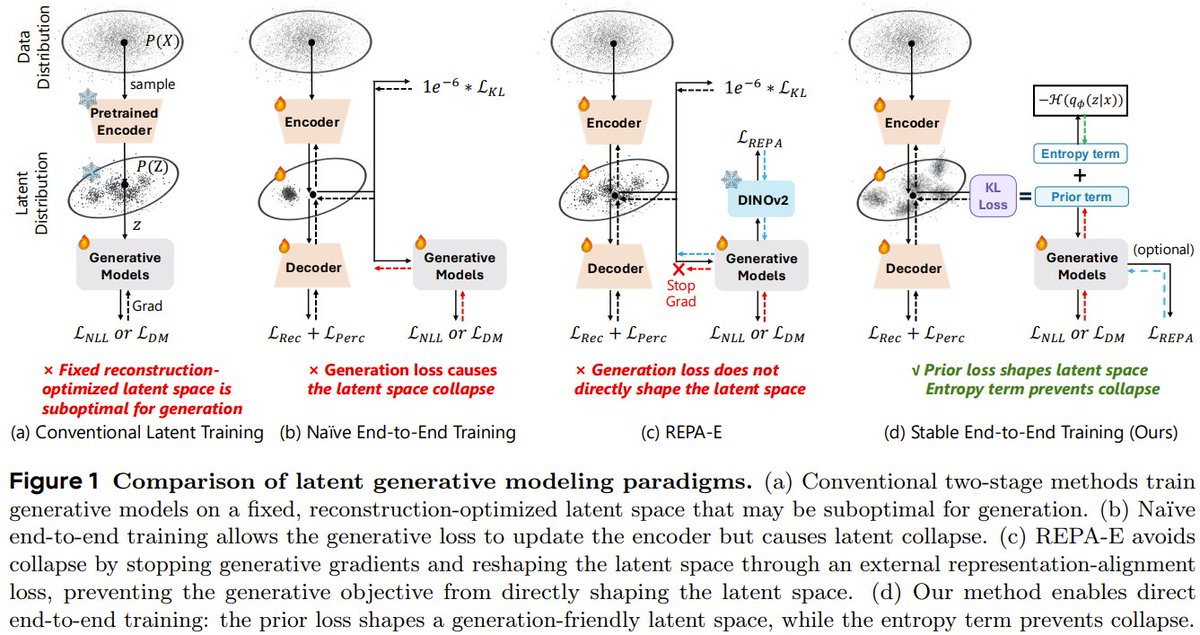
Most latent generative models still follow the same two-stage recipe: train a VAE for reconstruction, freeze it, then force the generative model to learn whatever latent space it gets. But reconstruction-optimal latents are not necessarily generation-friendly — so why not let the generative model shape the latent space directly?
ByteDance Seed presents GenFirst to make stable end-to-end latent learning work.
This work revisit the VAE objective and identify a prior–entropy imbalance as the key cause of latent collapse in naive end-to-end training. After fixing collapse with explicit entropy preservation, they find that generation and reconstruction have strongly asymmetric learning dynamics.
This leads to Generation Before Reconstruction (GenFirst): first let the generative objective shape a generation-friendly latent space, then strengthen reconstruction to recover visual details.
The results are strong. With end-to-end SiT + VAE training, GenFirst achieves 0.97 gFID with CFG / 1.45 without CFG on ImageNet-256, and reaches the final SiT result with at least 70× fewer training steps. This is the first diffusion model to reach FID < 1.0 without an FD loss. On text-to-image generation, it reaches 0.90 GenEval.
More importantly, this end-to-end framework goes beyond image generation: it learn a shared visual latent space that supports generation, representation learning, and reconstruction, and further extend end-to-end latent learning to continuous text latents, enabling unified text-to-image and image-to-text diffusion modeling.
GenFirst: Generation Before Reconstruction for Stable End-to-End Latent Generative Modeling
Paper: https://t.co/35pvv7FyuA
Project: https://t.co/3wAghilYvw
HF Daily Paper: https://t.co/9SwtR4xSef
Most latent generative models still follow the same two-stage recipe: train a VAE for reconstruction, freeze it, then force the generative model to learn whatever latent space it gets. But reconstruction-optimal latents are not necessarily generation-friendly — so why not let the generative model shape the latent space directly?
ByteDance Seed presents GenFirst to make stable end-to-end latent learning work.
This work revisit the VAE objective and identify a prior–entropy imbalance as the key cause of latent collapse in naive end-to-end training. After fixing collapse with explicit entropy preservation, they find that generation and reconstruction have strongly asymmetric learning dynamics.
This leads to Generation Before Reconstruction (GenFirst): first let the generative objective shape a generation-friendly latent space, then strengthen reconstruction to recover visual details.
The results are strong. With end-to-end SiT + VAE training, GenFirst achieves 0.97 gFID with CFG / 1.45 without CFG on ImageNet-256, and reaches the final SiT result with at least 70× fewer training steps. This is the first diffusion model to reach FID < 1.0 without an FD loss. On text-to-image generation, it reaches 0.90 GenEval.
More importantly, this end-to-end framework goes beyond image generation: it learn a shared visual latent space that supports generation, representation learning, and reconstruction, and further extend end-to-end latent learning to continuous text latents, enabling unified text-to-image and image-to-text diffusion modeling.
GenFirst: Generation Before Reconstruction for Stable End-to-End Latent Generative Modeling
Paper: https://t.co/35pvv7FyuA
Project: https://t.co/3wAghilYvw
HF Daily Paper: https://t.co/9SwtR4xSef





![Chamberartscn's tweet photo. アリス・マーガトロイド 夜汽車 ver.
夜汽車(@YOGISYA)先生のイラストをもとに、
1/7スケール ガレージキット化。
グレーモデルは WF2026[夏]にて展示済み。
現在、彩色見本を鋭意制作中です!
近日公開予定
原画:夜汽車(@YOGISYA)
#東方Project #アリス・マーガトロイド #ガレージキット #フィギュア #WF #ワンダーフェスティバル](https://pbs.twimg.com/media/HRT-9EZaQAATq6d.jpg)