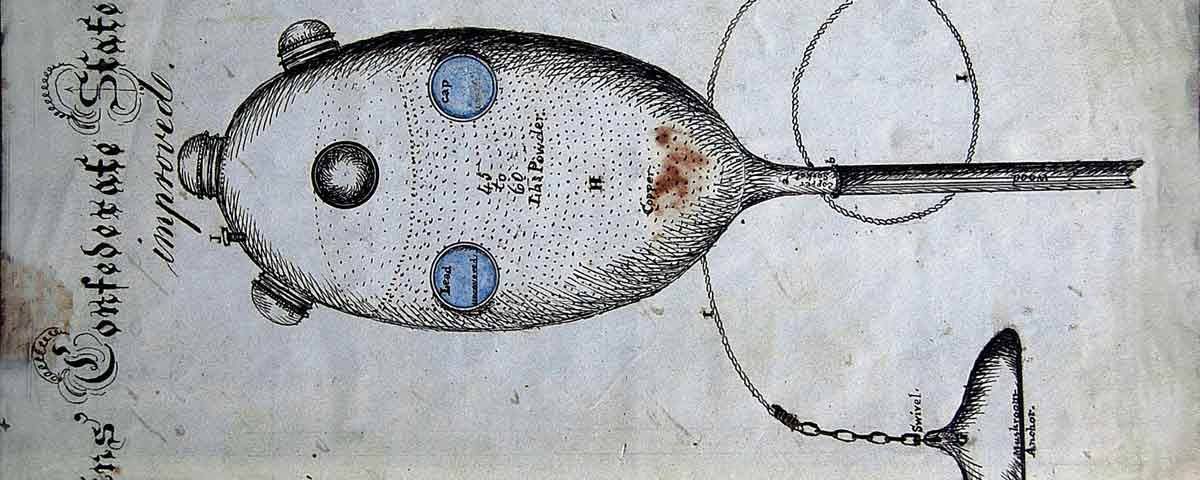
They provided an effective deterrent to Union naval attack, and they sank about fifty-eight Union vessels. Greater damage might have been done had the Confederacy been willing to put effort and money into torpedo defense earlier in the war. Perhaps Rains's greatest accomplishment in the use of explosives occurred on 9 Aug. 1864, when two of his agents exploded a bomb at the wharfs of Ulysses S. Grant's supply base at City Point, Va., causing a high loss of life and $4 million in damages.
After the war Rains lived for a time in Atlanta before moving to South Carolina, where he worked as a clerk from 1877 to 1880 in the Quartermaster's Department of the U.S. Army at Charleston. He died in Aiken, S.C. Rains had married Mary Jane McClellan, a granddaughter of Governor John Sevier. They had six children.
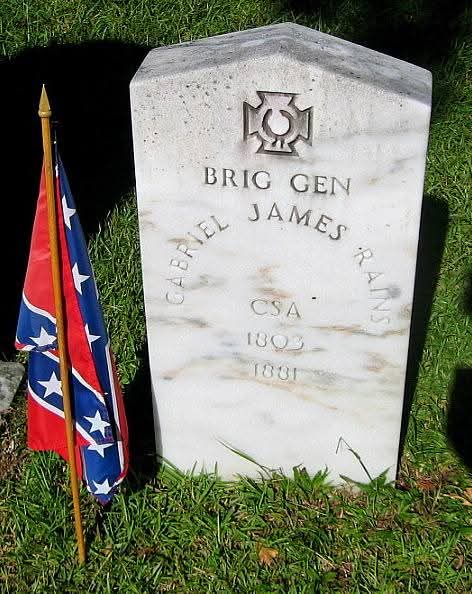
Happy Confederate birthday to Gabriel James Rains,
(June 4, 1803 – September 6, 1881)
a career soldier, Confederate general, and inventor, was born in New Bern, Craven County, the elder son of Gabriel M. and Hester Ambrose Rains. His brother, George Washington Rains, founded the Confederate gunpowder mill at Augusta, Ga. After his early education, Gabriel Rains entered West Point Military Academy on 1 July 1822. Graduating thirteenth in his class on 1 July 1827, he became second lieutenant of the Seventh Infantry Regiment and saw service in the West, mainly Indian Territory. On 28 Jan. 1834 he became a first lieutenant and on 25 Dec. 1837 he was promoted to captain.
In 1839 Rains took part in the Seminole War in Florida. Commanding a company of men at Fort King, he first began to experiment with explosives. The Indians harassed and beleaguered the garrison to such an extent that Rains in desperation rigged a live shell hidden under a blanket in the woods near a pond where the Indians went to get water. Some Indians set off the trap and were killed. Rains soon set a similar trap and when it was heard to explode, led a party of men out to investigate. It was discovered that the bomb had done no harm but as the group returned to the fort it was attacked by about a hundred Indians. Rains skillfully handled his men, however, and the Indians were repulsed though Rains himself was shot through the body and so badly wounded that announcements of his death were published. Nevertheless, he recovered and was promoted to brevet major on 28 Apr. 1840 for gallantry and meritorious conduct in theattack.
Upon returning to duty Rains served at posts in Louisiana and Florida and in the military occupation of Texas. In the Mexican War in 1846 he gave the deciding vote in a council of officers at Fort Brown against capitulation to General Ampudia. Rains participated in the defense of the fort and in the Battle of Rasaca de la Palma. Afterwards he was detailed to recruiting duty, at which he was quite successful. In 1849–50 Rains fought in a second Seminole War, and on 9 Mar. 1851 he was promoted to major of the Fourth Infantry Regiment. Sent to California the following year, he earned a reputation as an Indian fighter and on 5 June 1860 was made lieutenant colonel of the Fifth Infantry Regiment.
At the outbreak of the Civil War Rains resigned his commission on 31 July 1861 and offered his services to the Confederacy. He was commissioned a colonel in the Regular Confederate Army and on 23 Sept. 1861 was appointed brigadier general from North Carolina to rank from the same date (confirmed 13 Dec. 1861). Rains was then assigned to command the First Division of General John Magruder's army defending the Department of the Peninsula, which consisted of the Thirteenth and Twenty-sixth Alabama regiments and the Sixth and Twenty-third regiments. This command later became a brigade of General D. H. Hill's division. Rains commanded at Yorktown during the winter of 1861–62 and here continued his experiments with mines. He developed a type of subterranean mine (called "torpedoes") patterned after a design by Samuel Colt, and these were placed at a salient angle and other points along the earthworks that were considered to be accessible to the enemy. Rains even put mines in the nearby waters of the York River to discourage enemy naval operations.
When George B. McClellan's Union army finally forced the evacuation of the Yorktown defenses at the beginning of May 1862, Rains's brigade constituted part of the rear guard as the Confederate army retreated towards Richmond. His men hungry and exhausted from constant Union pursuit, Rains found outside Williamsburg a broken-down ammunition chest that contained several artillery shells fitted with percussion fuses. He had these quickly buried in the road. Pursuing Union cavalry trod on the shells and detonated them, causing a few casualties. Union troops entering the abandoned defenses of Yorktown also set off..
some of the mines Rains had left behind in the earthworks, causing about thirty casualties. All in all these devices made pursuing Union forces act with caution, and both the Northern press and General McClellan bitterly denounced their use as an improper means of warfare. McClellan described it as "the most murderous and barbarous conduct in placing torpedoes," and the Northern papers carried stories of booby traps being placed in wells, around houses, in bags of flour, in carpetbags, and what not. General Joseph E. Johnston, the Confederate army commander, read some of the stories in these newspapers and asked for comment from Rains. Rains, of course, took credit for the mines left in the works and placed in the road but denied using booby traps. General James Longstreet, Rains's wing commander, in writing out orders for Rains's brigade on 11 May 1862, requested that Rains not use any more mines because he did not recognize it as a "proper or effective method of war." But Rains protested and went over Longstreet's head to report to Secretary of War George W. Randolph. Rains defended his use of explosive devices as a means to discourage a night attack by an enemy, to defend a weak point of a line, to check enemy pursuit, and so forth. General Hill, Rains's division commander, added an endorsement saying that he believed any means of destroying the enemy was legal in warfare. Secretary Randolph's decision on the matter was that such explosive devices were admissible to check pursuit, defend a work, or sink a ship, but were not allowable for the sole purpose of killing enemy soldiers. He further added that if Rains and Longstreet disagreed, Rains should yield to his superior or transfer to the river defenses, where the use of explosive devices was "clearly admissible."
On 31 May 1862 Rains participated in the Battle of Seven Pines outside Richmond, where his brigade brilliantly outflanked a Union position known as "Casey's Redoubt" and thus enabled the Confederate forces to sweep the Union troops from the field. Rains was unable to advance farther, however, and drew criticism from General Hill because of this. After the battle, Rains was transferred to the submarine defenses of the James and Appomattox rivers on 18 June 1862 to continue his experiments with explosives. During the summer he was briefly in charge of the defenses of the Cape Fear River in North Carolina, and on 16 Dec. 1862 he was assigned to head the Bureau of Conscription in Richmond. While in service here Rains began to formulate plans for the torpedo defense of Confederate ports. These were presented to President Jefferson Davis, who was much impressed and transferred Rains from the Bureau of Conscription on 25 May 1863 and directed him to put his plans into operation. Rains was first sent to Vicksburg, Miss., and then to Charleston, S.C., and Mobile, Ala. From then until the end of the war he worked to bolster the defenses of the major Southern ports with torpedoes and mines.
Rains was formally appointed chief of a newly created Torpedo Bureau on 17 June 1864 and remained in this position until the close of the war. Under his supervision torpedo factories were established at Richmond, Wilmington, Mobile, Charleston, and Savannah. His men filled beer kegs or barrels with gunpowder, fitted them with a percussion primer at each end, and then set them adrift to strike against an enemy vessel and explode. Other types were developed to be anchored to the harbor bottom and fired from a wire leading to shore. Rains also invented an autosubterranean explosive shell for land use, complete with a tin shield for protection against the rain. Despite the fact that leaders early in the war had objected to the use of mines on moral grounds, these devices were widely employed by the end of the conflict. Some 1,300 such shells were buried in the defenses of Richmond. In addition, Rains invented a machine for manufacturing gun caps.
His torpedoes were a great success...
HBD to Brigadier General Otho French Strahl (June 3, 1831 – November 30, 1864)
Otho F. Strahl was born near Elliotts Cross Roads, Ohio, and raised in nearby Malta, both in rural Morgan County. Both of his grandmothers had been raised in the South and, through their strong influence, Strahl became an ardent supporter of states rights. Strahl was a graduate from Ohio Wesleyan University. He went south to Tennessee, reading law in Somerville and opening a practice in Dyersburg.
With the outbreak of the Civil War, Strahl raised a local infantry company among his friends and neighbors in Dyersburg. Within a short time, he became the captain of his company of the newly raised 4th Tennessee Infantry in May 1861. He and the regiment were transferred to Confederate service in August of that year. He progressed through the ranks to lieutenant colonel. In April 1862, the regiment was reorganized and consoldiated with the 5th Tennessee Infantry after the Battle of Shiloh, with Strahl promoted to colonel of the combined force. He led the 5th regiment in several actions before being promoted to brigade command. Along with five other Confederate generals, he was killed in the Battle of Franklin. His body lay on the back porch of a local plantation house, Carnton, until he was buried near the battlefield.
He was later reinterred in Old City Cemetery in Dyersburg, Tennessee.
Emma Sansom was born on June 2, 1847, near the small town of Social Circle, Georgia, to Micajah and Levina Vann Sansom, a niece of influential Cherokee leader James Vann. When Emma was five years old, her parents moved the family, which would include 12 children, to a farm outside the town of Gadsden, Alabama. Emma's father died six years later on Christmas Eve.
The story of Sansom's actions during Streight's Raid (April 19-May 3, 1863) is part Alabama history and part myth. Although she did aid Forrest in locating a crossing on Nathan Bedford Forrest (1821-1877) was a cavalry general Nathan Bedford ForrestBlack Creek, some of the details, particularly alleged conversations between Sansom and the cavalry commander, have undoubtedly been dramatized.
On the afternoon of May 2, Streight and 1,700 infantry, many mounted on mules, crossed Black Creek (located three miles from Gadsden) ahead of Forrest and destroyed the only local bridge, thus impeding the Confederate pursuit. Unable to use the bridge to cross the swollen creek, Forrest rode to a nearby home to find someone knowledgeable about the local terrain and came upon 16-year-old Sansom. According to an account published in the Jacksonville Republican one week later, Sansom volunteered to guide Forrest to a nearby ford. Initially, her mother objected to the idea of her daughter being escorted by a group of strangers. But Forrest was well known and respected, and Sansom's mother dropped her objections. With Sansom's guidance, Forrest located the ford, crossed it, and caught up with the Union forces. While escorting the general, Sansom reportedly faced enemy fire that ceased after the Union soldiers discovered that they had been firing upon a teenage girl.
Abel Streight (1828-1892) was a Union colonel during Abel D. StreightSansom's actions directly helped Forrest capture Streight and his raiders near Cedar Bluff the following day. By aiding the Confederate general, Sansom risked possible retribution for herself and her family from the Union soldiers had they escaped capture. At the time of the raid, her brother, who had been wounded in battle while serving in the Confederate Army, was at home recuperating from his injuries. His presence, in addition to her actions, would have certainly stirred the interest of the raiding party. That potential sacrifice made Sansom an enduring heroine of the Confederacy for generations.
In October 1864 Sansom married farmer Christopher B. Johnson. Around 1868, they moved to Upshur County, Texas, and the remainder of Sansom's life was spent primarily rearing the couple's seven children and running her household. In 1887, Johnson died, and Sansom never remarried. Historians have found no evidence that she wrote or commented on her wartime experiences in her adulthood. She passed away on August 9, 1900, and was buried in Little Mound Cemetery in Upshur County.
In 1906, the city of Gadsden erected an Emma Sansom Statue.Sansom's legacy has endured as an idealized representation of a feminine heroine defending the Confederacy. Her association with General Forrest further cemented her distinction as a heroine of the South. In 1906, the Gadsden Chapter of the United Daughters of the Confederacy erected a monument honoring her Civil War contributions. The base of the statue contains a carving of Sansom accompanying Forrest on horseback. In the 1920s, the town named a high school in her honor. She was also the subject of a poem written by John Trotwood Moore. A chapter of the Sons of Confederate Veterans in Louisiana bears her name.
Hurst, Jack. Nathan Bedford Forrest: A Biography. New York: Vintage Books, 1994.
HBD to Benjamin Hardin Helm (June 2, 1831 – September 21, 1863 a Kentucky politician, attorney, Confederate brigadier general, and a brother-in-law of Abraham Lincoln. He was also the son of Kentucky Governor John L. Helm.
Benjamin was born in Bardstown, Kentucky, to John L. Helm and Lucinda Barbour Hardin on June 2, 1831. He graduated from the United States Military Academy in 1851, 9th in his class of 42 cadets. He was appointed a brevet second lieutenant in the 2nd U.S. Dragoons, but resigned his commission the following year, after serving at a cavalry school at Carlisle, Pennsylvania, and at Fort Lincoln, Texas.
Following the resignation of his commission, Helm studied law, was elected a Kentucky state legislator for one term, and became the state's attorney for the 3rd district of Kentucky.
In 1856, Helm married Emilie Todd, the half-sister of Mary Todd Lincoln. Helm was a cousin-in-law of U.S. General and Congressman John Blair Smith Todd.
As Kentucky's status in the American Civil War remained neutral in 1861, Helm was offered the job of Union Army paymaster by his brother-in-law, President Abraham Lincoln. He declined the job, instead returning to Kentucky to raise the 1st Kentucky Cavalry for the Confederate States of America.
Helm was commissioned a colonel on October 19, 1861, and served under Brig. Gen. Simon B. Buckner in Bowling Green, Kentucky. Helm's group was then ordered south. He was promoted to brigadier general on March 14, 1862, and was given command of the 1st Kentucky "Orphan" Brigade several months later. Helm maintained command of the Orphan Brigade through the Battle of Baton Rouge and with the brigade joined the Army of Tennessee, where he was with Maj. Gen. John C. Breckinridge throughout the Tullahoma and Chickamauga Campaigns in 1863, when he was mortally wounded at the Battle of Chickamauga on September 20, 1863. He died on the battlefield the following day, with his last word being "Victory." Following his death, Abraham Lincoln and Mary Todd Lincoln went into private mourning at the White House, her niece recalling: "She knew that a single tear shed for a dead enemy would bring torrents of scorn and bitter abuse on both her husband and herself." Emilie Todd Helm was granted safe passage to the White House in December 1863.
Yankees describe how the Union troops suffered at Cold Harbor.
"The lead and iron filled the air as the snowflakes in an angry driving storm" wrote Captain James McGinnis. Private Nelson Armstrong said "the army seemed to melt away like a frost in July." "They were cut down like mown grass" wrote chaplain Alistair Haynes. "Their destruction seemed like that of the hosts of Sennacherib, who's Syrian army was destroyed before Jerusalem in biblical times. So complete and so sudden, it was the most sickening sight in this arena of horrors."
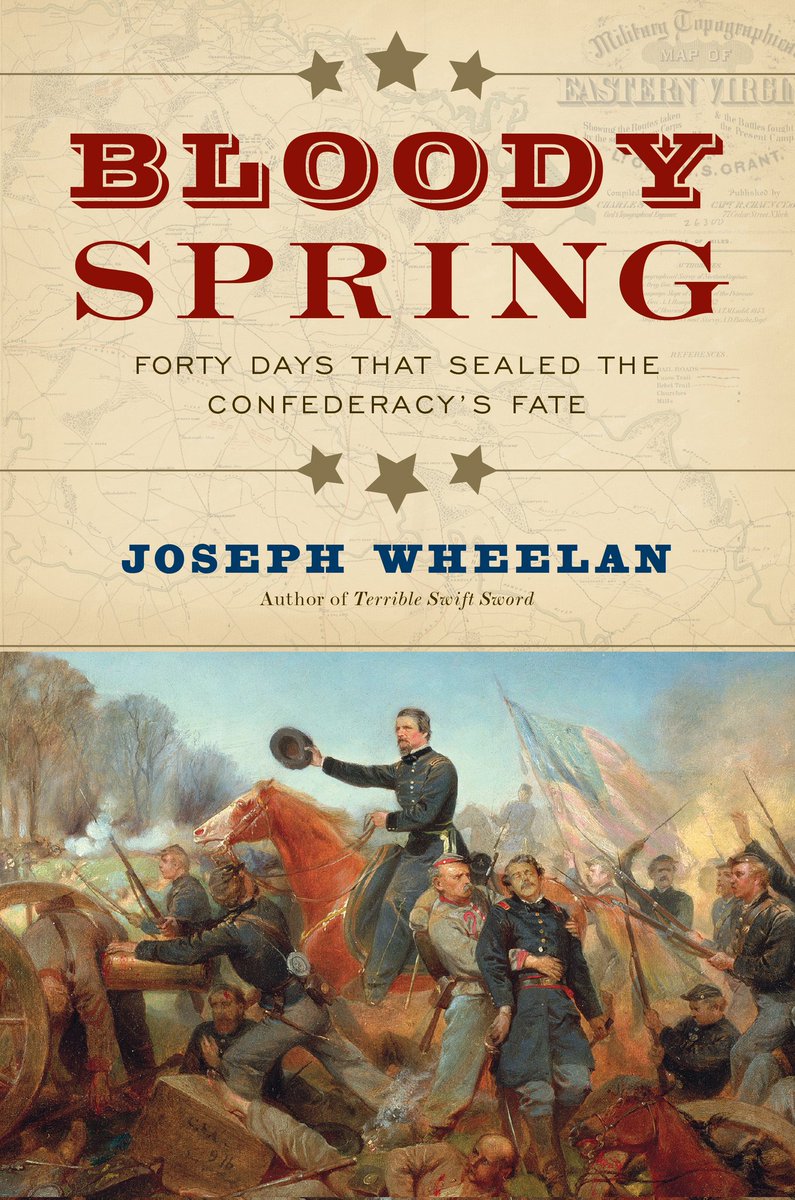
Source : Bloody Spring by Joseph Wheelan.
Major Robert A Stiles - Cabell's Battalion Virginia Artillery - describes the scene of Cold Harbor, June 1864.
"For My own part I can scarcely say if it lasted for 8 or 60 minutes or 8 or 60 hours. All of my power relied on keeping the gun supplied with ammunition, here then is the secret of the incredible butchery. A little after daylight our infantry opened upon the enemy, and artillery fired case shot and double-shotted canister at very short range into a mass of men 28 feet deep who could neither advance or retreat and most of whom couldn't fire their muskets at us."
"Shoot Us Down Like Turkeys in a Pen”: Union and Confederate Cavalry Clash at Cold Harbor
by: Daniel Davis
On May 30, 1864, Philip Sheridan’s Union cavalry tangled with Confederate horsemen in the vicinity of Old Church northeast of Richmond. After the Battle of Haw’s Shop, Sheridan had been sent to Old Church to secure the roads leading to the Union supply depot at White House Landing and screen the arrival of William Smith’s XVIII Corps then in route to the Army of the Potomac positioned along Totopotomoy Creek. Sheridan’s presence alarmed Robert E. Lee, who sent gray cavalryman under Matthew Butler and Martin Gary to see what the Federals were up to. The mounted forces clashed along the banks of Matadequin Creek and the Yankees eventually pushed the Rebels back toward a crossroads known as Old Cold Harbor. Fitzhugh Lee’s brigades under Lunsford Lomax and Williams Wickham arrived around noon after the fighting had ended to relieve Butler and Gary. The next day, Sheridan decided to renew the attack on Lee’s troopers.
Sheridan’s planned offensive called for Col. Thomas Devin’s brigade to advance along a by road and turn the Rebel right flank. In concert with Devin’s advance, Brig. Gen. Wesley Merritt’s brigade, supported by Brig. Gen. George Custer’s command advanced directly on Lomax’s brigade on the Cold Harbor Road.
Moving along Black Creek Church Road, the 9th New York and 17th Pennsylvania ran into stiff resistance from Wickham and eventually ground to a halt. On Devin’s right, Merritt had steadily pushed Lomax’s pickets back to the main line, which was “posted behind breastworks of logs, rails and earth.” Merritt dismounted and deployed three regiments to attack Lomax. The 5th U.S. Cavalry held the right, the 1st New York Dragoons the center and the 6th Pennsylvania Cavalry the left of the Union line. As Merritt advanced, Confederate infantry from Col. Thomas Clingman’s brigade arrived to bolster Lomax’s position.
The Confederates “poured upon us a most withering fire” recalled one of the Dragoons. “They had decidedly the advantage, and could shoot us down like turkeys in a pen.” Like Devin’s attack, Merritt had been stymied in front of Lomax. Reinforced now by Custer’s brigade of Michigan regiments, Merritt’s superior, Alfred Torbert decided to turn the Confederate left.
Torbert’s flanking force was led by Merritt and consisted of the 1st and 2nd U.S. Cavalry, along with the 5th Michigan. The rest of Merritt and Custer’s regiments were to keep the enemy occupied along the Cold Harbor Road. Torbert’s plan worked and Merritt’s force slowly but steadily rolled up the Confederate line. The crushing blow came when Custer sent a battalion from the 6th Michigan under Maj. Melvin Brewer in a mounted charge that struck the enemy line along the Cold Harbor Road. Under the weight of Merritt and Custer, the Rebels collapsed and ran for the rear as Sheridan took possession of Old Cold Harbor.
Sheridan’s capture of the crossroads loomed large in the thinking of U.S. Grant and George G. Meade. One road led to White House Landing while another led directly to Richmond. From a strategic perspective, it had to be held. Although Sheridan quietly abandoned the position late that night, a courier from army headquarters later arrived and ordered him back to his lines. The next morning, Sheridan managed to withstand Confederate attacks long enough for Union infantry to arrive. By the afternoon of June 1, the stage had been set for the famous infantry fighting at Cold Harbor to begin.
IN WAR A TOWER OF STRENGTH
Virginia Military Institute Cadets
New Market, Virginia - May 15, 1864
In War a Tower of Strength
By : John Paul Strain
The year was 1864, and for three years the Federal Army had tried everything to defeat the Confederate forces. Many battles had been fought with both sides winning and losing. Casualty counts were far beyond what anyone had considered possible. General Lee's Army of Northern Virginia had lost a major battle at Gettysburg, but the South's willingness to fight for their independence had not diminished.
Federal strategy began to focus on destroying the South's infrastructure which supplied Confederate forces in the field. In May, Federal General Franz Sigel's army began its march from Winchester, intent on destroying the Virginia Central Railroad located in Staunton. If successful, General Lee's Army would no longer receive the rich stores and supplies from the Shenandoah Valley.
To stop the Federal advance, the sparse Confederate forces under the command of General John C. Breckinridge and General John D. Imboden gathered all the troops they could muster. The Virginia Military Institute's Superintendent Francis Smith was asked if his "School Boy Soldiers" would fall in. Taught from the very beginning at VMI the principles of duty and honor, the young men were eager to prove their worth as soldiers. The cadets marched for 4 days covering 80 muddy miles from Lexington to New Market in the drenching rain.
The battle of New Market began in earnest on the stormy morning of the 15th with lightning, thunder, and cannon fire echoing across the valley. General Breckinridge had not wanted to deploy his 250 young VMI cadets, and held them in a reserve position on the battlefield. But when a large gap opened in the center line of battle, Breckinridge with tears in his eyes said, "Put the boys in, and may God forgive me for the order."
As the boys moved forward behind their colors the storm greatly intensified, with lightning, thunder and driving rain. Now in the eye of the storm, under heavy cannon and musket fire the cadets began taking casualties. Undeterred, they fought forward through a low section of the field with standing water and deep mud, with a number of the boys losing their socks and shoes. A 12 pound Napoleon cannon was abandoned in the face of the cadet's charge, which the cheering boys captured. A Confederate officer watching the cadets said their charge "surpassed anything that I witnessed during the war."
General Breckinridge would later ride to their position and say "Young gentlemen, I have you to thank for the result of today's operations. Well done, Virginians...well done men!"
The actions of those brave cadets fulfilled the motto of VMI, and would be remembered daily from that day forward. "In Bellō Praesidium - In War A Tower Of Strength".
Official Records Series 1, Volume XXXVI, Part 1, pg. 1094
Excerpt from the Report of Confederate Brigadier General Samuel McGowan - Spotsylvania Courthouse
"To give some idea of the intensity of the fire, an oak tree 22 inches in diameter, which stood just in rear of the right of the brigade, was cut down by the constant scaling of musket-balls, and fell about 12 o'clock Thursday night, injuring by its fall several soldiers in the First South Carolina Regiment."
From an account by a member of Co. K, 16th Mississippi (probably Pvt. David Holt) in the Times-Democrat, April 21, 1907:
"The enemy now adopted different tactics. A line of battle moved up over the brow of the hill and lay down upon the ground in front, not more than fifty yards off and opened up a terrific fire. Just behind the ranks of the Sixteenth Mississippi Regiment was a white oak tree about two feet in diameter, solid within and vigorous. The bullets of the Federals, passing over the embankment, struck the tree, and we saw that it was only a question of time when the tree would be cut down by bullets. All sorts of suggestions were made as to the way we might control the fall of the tree. We had no rope, nor could a man have lived in that volley of lead long enough to have tied a rope to the limb. We soon saw that the limbs were being cut off in the front and that the weight of the branches in the rear would draw the tree from the breastworks. It slowly swayed and finally came down."
Lt. James F. J. Caldwell, Co. B, 1st South Carolina, in History of a Brigade of South Carolinians:
"Every tree about us, for thirty feet from the ground, was barked by balls. Just before sunset, a tree of six or eight inches diameter, just behind the works, was cut down by the bullets of the enemy. We noticed, at the same time, a large oak hacked and torn in a manner never before seen. Some predicted its fall during the night, but the most of us considered that out of the question. But, about ten o'clock, it did fall forward upon the works, wounding some men and startling a great many more. An officer, who afterwards measured this tree, informed me that it was twenty-two inches in diameter! This was entirely the work of rifle-balls."
Spotsylvania Courthouse
"About daylight we withdrew from our position . . . with blackened faces and crisped hands from being in the water so long. Our clothing stained with red mud and blood, we marched out of this place where more than one-third of our men lay dead. . . . We stopped in a grove of trees where General Harris told us to build a fire and dry our clothes. Our men stood around in groups, inquiring of each other about their missing comrades—some in tears at the loss of a brother or near relative."
Pvt. Buxton R. Connerly of Co. E, 16th Mississippi
"We halted in a pasture and broke ranks. Then came the reaction. All moved by the same impulse, we sat down on the wet ground and wept. Not silently, but vociferously and long. Officers and men together. Some of the boys had been at outs with one another. They made friends and deplored the times that they ever held an unkind thought against one so true and brave. Two fellows, both named Bill, who never could get along together, rushed into each other's arms, begging for forgiveness and swearing undying friendship. We washed our hands and faces in pools of rain-water. We were covered with bloody mud from head to foot. Soon we got rations of corndodger and fried bacon, but not a man could eat."
- Pvt. David Holt, Co. K, 16th Mississippi
"They couldn't hit an elephant at that distance."
OTD in 1864 at Spotsylvania Court House, John Sedgwick was deploying his men to face the enemy, with Confederate snipers hindering their preparations. His statement "They couldn't hit an elephant at this distance" are probably some of the best-known of all 'famous last words'. They may sound contrived, but are in fact precisely what he said just before being shot. The alternative version "They couldn't hit an elephant at this dist..." is apocryphal and an elaboration made for comic effect, as is made clear by this verbatim report made by General McMahon, who was at Sedgwick's side at his untimely death.
I gave the necessary order to move the troops to the right, and as they rose to execute the movement the enemy opened a sprinkling fire, partly from sharp-shooters. As the bullets whistled by, some of the men dodged. The general said laughingly, "What! what! men, dodging this way for single bullets! What will you do when they open fire along the whole line? I am ashamed of you. They couldn't hit an elephant at this distance." A few seconds after, a man who had been separated from his regiment passed directly in front of the general, and at the same moment a sharp-shooter's bullet passed with a long shrill whistle very close, and the soldier, who was then just in front of the general, dodged to the ground. The general touched him gently with his foot, and said, "Why, my man, I am ashamed of you, dodging that way," and repeated the remark, "They couldn't hit an elephant at this distance." The man rose and saluted and said good-naturedly, "General, I dodged a shell once, and if I hadn't, it would have taken my head off. I believe in dodging. "The general laughed and replied, "All right, my man; go to your place."
For a third time the same shrill whistle, closing with a dull, heavy stroke, interrupted our talk; when, as I was about to resume, the general's face turned slowly to me, the blood spurting from his left cheek under the eye in a steady stream. He fell in my direction ; I was so close to him that my effort to support him failed, and I fell with him.
After the Wilderness battle
May 1864
The rebel yell began on the rebel right. Anderson's men raised it after calling for three cheers for General Lee. The sound traveled along the line to Lee's extreme left flank near the Rapidan. "At first heard like the rumbling of a distant railroad train, it came rushing down the line like the surging of the waves upon the ocean. Increasing in loudness and grandeur and passing It would be her dying away on the left in the distance" wrote a soldier in the 26th North Carolina. "Twice more of the weird high-pitched battle cry made its way from one end of the Confederate line to the other, the effect was beyond description" wrote a South Carolina lieutenant.
Source : Bloody Spring by Joseph Wheelan.
Micah Jenkins: More Friendly Fire Near Chancellorsville
By : Tim Kent Author
Everyone that studies the Civil War knows that Confederate Lieutenant General Thomas Jonathan “Stonewall” Jackson was mortally wounded at Chancellorsville in May of 1863 by his own troops. In every war, there have been incidents of friendly fire, especially when circumstances become confusing.
A year later, in May of 1864, there would be another incident of friendly fire in another battle in the same general vicinity as the Battle of Chancellorsville. This battle has come to be known as the Battle of the Wilderness. It would be Grant's first engagement with General Robert E. Lee and he would quickly learn that he was no longer dealing with the bumbling commanders of the west no longer. He'd faced John C. Pemberton at Vicksburg and Braxton Bragg at Chattanooga, both two of the worst Confederate commanders of the war.
Lieutenant General James Longstreet was leading an assault against Federal General Winfield Scott Hancock. One of his favorite brigade commanders Brigadier General Micah Jenkins was sick that afternoon. He'd ridden to the field in an ambulance, but determined to mount his horse and lead his men into battle. Exiting his ambulance, he threw his arm around Moxley Sorrel, Longstreet's staff officer and said, “We will smash them now.”
Jenkins had always been one of Longstreet's favorites. When Hood was wounded at Gettysburg, Law had taken over the division. When Hood was promoted to lieutenant general and assigned to the army of Tennessee, the position came open permanently. Law stood in line for the promotion, after all, Jenkins brigade belonged to George Pickett's division. Longstreet attempted everything he could think of to give the position to Jenkins, although Law eventually wound up with the promotion and assignment.
When Jenkins mounted his horse on this date, he was just twenty-eight years old. He was a graduate of the South Carolina Military Academy where he finished first in the class of 1854 at the age of nineteen. He entered the Civil War as a colonel and led his regiment at First Manassas, Williamsburg, Seven Pines, and the Seven Days Campaign. He was then promoted to brigadier general and given command of a South Carolina brigade. He was wounded at Second Manassas, held in reserve at Fredericksburg, and missed both Chancellorsville and Gettysburg as his division was assigned to different posts. The Wilderness battle would be his first major battle in over a year and a half.
Three Confederate generals would lead the brigade down the plank road and into action. They would be Lieutenant General James Longstreet, Major General Joseph Kershaw, and Brigadier General Micah Jenkins. Unfortunately, Jenkins men were wearing new gray uniforms that appeared blue in the dark woods of the Wilderness. Jenkins was excited to be leading his men into action again.
To Longstreet, he said, “I am happy. I have felt despair for the cause for some months, but I am relieved now, and feel assured that we will put the enemy back across the Rapidan before night.”
Moving down the road, troops under Confederate General William Mahone mistook the brigade in the dark uniforms for Federal troops. They immediately opened fire. One round hit Longstreet in the neck and passed into his shoulder. He left the field critically wounded, coughing up blood. One bullet struck Jenkins in the forehead, the bullet entered his brain and paralyzed one side of his body. Two members of Kershaw's staff were killed instantly. Kershaw rode between the opposing lines and yelled that they were friends. He would not be injured in the exchange.
Severely wounded, Longstreet would survive to fight again, but Jenkins wound was mortal. He was still conscious but couldn't recognize any of his friends or fellow officers. As he lay dying, he continued to call for his men to press forward, obviously thinking he was still leading his brigade into battle. Jenkins would die about five ...
Battle of the Wilderness 1864
Meade's ordinance chief Morris Schaff expressed the deep bewilderment felt by many of the Union soldiers over not having beaten Lee. "2 days of deadly encounter. Every man who could bear a musket had been put in. Hancock and Warren repulsed, Sedgwick routed, and now on the defensive behind breastworks. The cavalry drawn back, thousands and thousands of killed and wounded.The air pervaded with a lurking feeling of being face to face with disaster. What! What is the matter with the army of the Potomac?"
Source : Bloody Spring by : Joseph Wheelan
On the night of May 7-8, the Union Fifth Corps and the Confederate First Corps, moving independently and unknown to each other, led the marches of their respective armies toward Spotsylvania Court House. In the morning the lead elements met on the Spindle farm along the Brock Road, and the fighting lasted throughout the day as more units from each army arrived. Elements of the Federal Sixth Corps joined in the attack around midday, but the Union troops were unable to force their way through, and nightfall found two sets of parallel fieldworks across the Brock Road. What the Federals had thought would be a rapid march into open country had stalled behind these works. The battle of Spotsylvania Court House was under way.