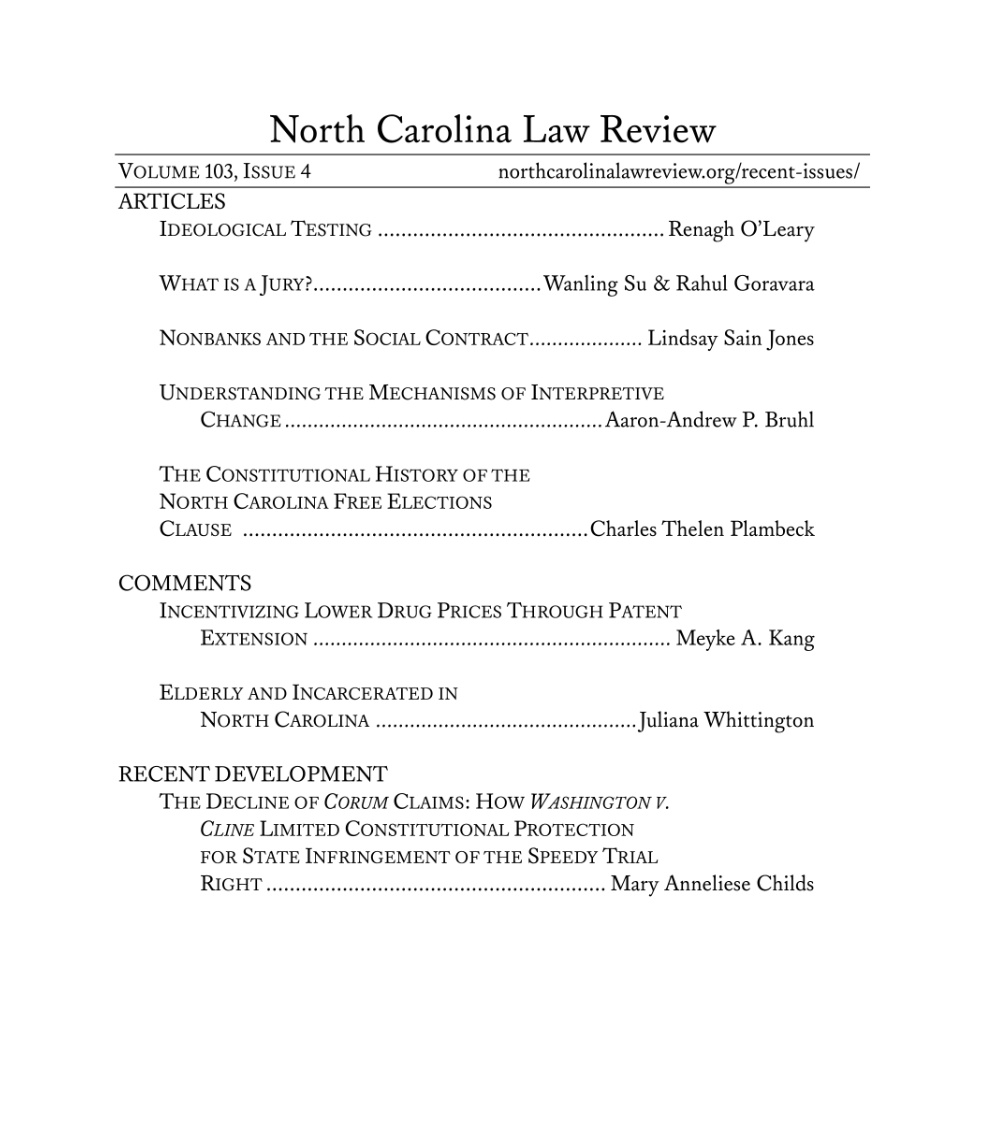
The North Carolina Law Review, a student-operated journal, serves judges, attorneys, scholars, and students by publishing outstanding legal scholarship.
“The Review is pre-eminently a vehicle for advocating, rationalizing, and justifying change. It has never been merely a mausoleum in which are enshrined the embalmed cadavers of the law.”
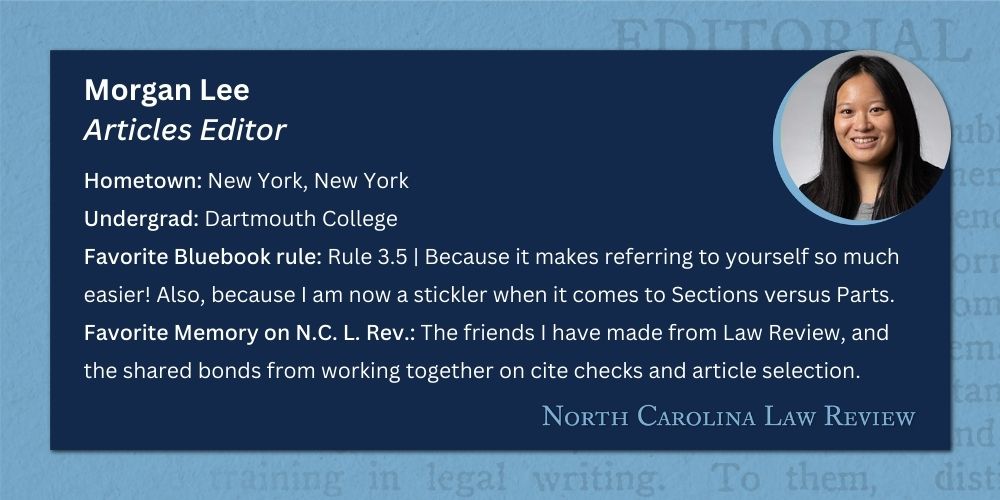
In her Comment published in 103-3, Morgan Lee analyzes North Carolina’s House Bill 76, which significantly reformed North Carolina’s Certificate of Need statute, and, over a multiyear period, will relax CON regulation of several healthcare services and facilities.
She argues that while H.B. 76’s regulatory reforms are generally positive for North Carolinians, CON should ultimately remain law in North Carolina, both due to its impact on healthcare access and its ability to be utilized to address various health policy goals.
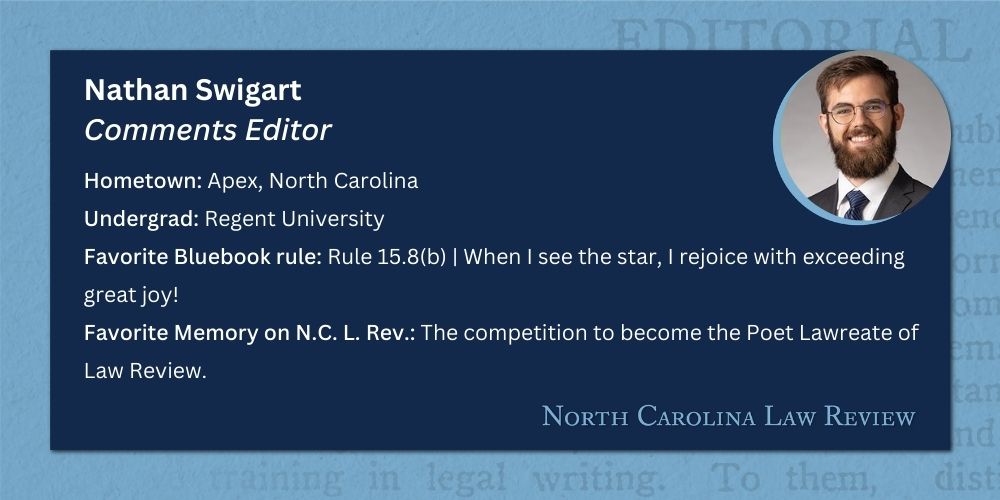
In his Comment published in 103-3, Nathan Swigart evaluates the ecological cost of solar farms in North Carolina using geographical information system data to explore trends in land being converted to solar farms.
After demonstrating that solar farms are primarily built on land ideal for wildlife conservation, he suggests how North Carolina could reform its solar panel tax incentives to reward the solar companies that take steps to decrease the ecological cost of solar farms.
Volume 103, Issue 3 has been posted to the N.C. L. Rev. website at https://t.co/gz1rWuUM7o, and new article can be found on the Forum at https://t.co/UPP0Ab8qJq.
Dylan argues that while the case itself is unlikely to make waves, it demonstrates the malleability of the major questions doctrine and its effectiveness as an antiregulatory tool.
Check it out here: https://t.co/gz1rWuUM7o
In his Recent Development published in 103-2, Dylan T. Silver analyzes the Fourth Circuit’s decision in North Carolina Coastal Fisheries Reform Group v. Capt. Gaston LLC.
Gapt. Gaston applied the major questions doctrine (absent any agency interpretation) to a definition at the heart of the Clean Water Act—what counts as a water pollutant.
She argues that this change impedes judicial independence and may even violate the Separation of Powers Clause of the North Carolina Constitution.
Check it out here: https://t.co/gz1rWuVjWW
In her Recent Development published in 103-2, Kathryn Turk examines House Bill 259, which increased the number of legislative appointments to the Judicial Standards Commission.
She demonstrates that in doing so, the North Carolina General Assembly expanded its influence over the disciplinary body, which has already been accused of partisanship.
He argues that the Supreme Court of North Carolina should amend the state’s appellate rules to allow parties to submit materials in a sans-serif font.
Check it out here: https://t.co/gz1rWuVjWW
In his Comment published in 103-2, Andrew Parco explains that although disability advocates generally advise writers to use sans-serif fonts for accessibility purposes, the North Carolina Rules of Appellate Procedure require litigants to submit filings exclusively in serif fonts.
Volume 103, Issue 2 has been posted to the N.C. L. Rev. website at https://t.co/gz1rWuVjWW, and new article can be found on the Forum at https://t.co/UPP0Ab8YyY.