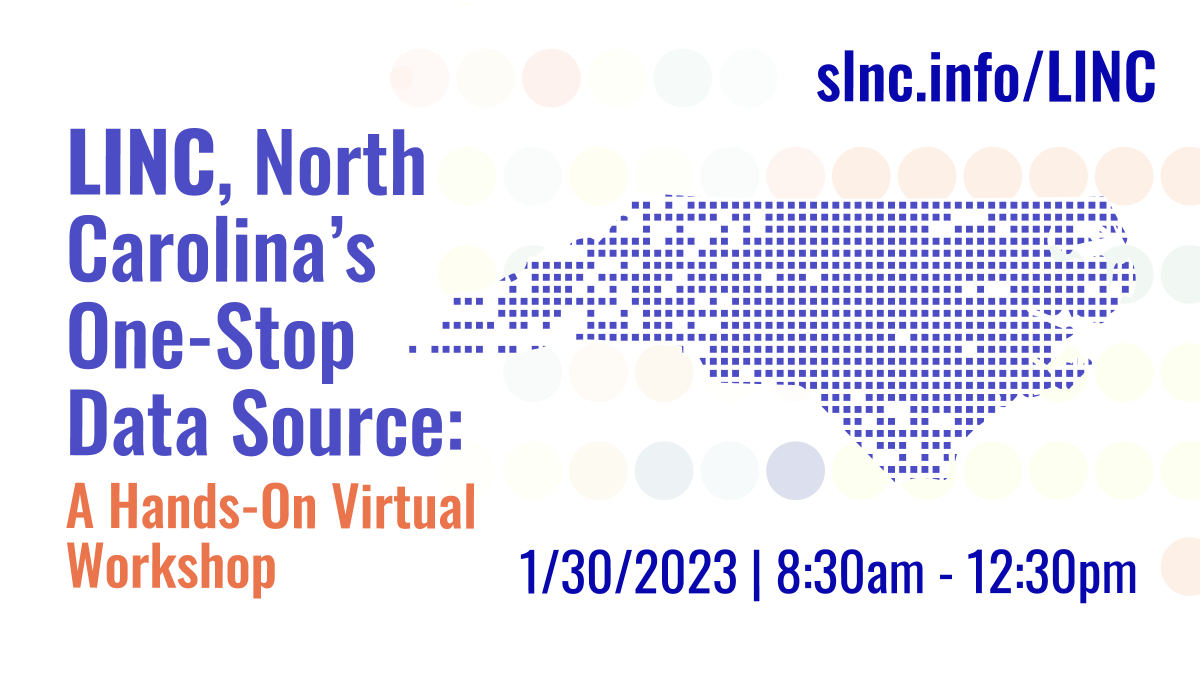
Join us on Jan. 30 for LINC, North Carolina’s One-Stop Data Source. This workshop will provide participants with essential information for using LINC, tools, search & navigation strategies, and hands-on practice. Register for the virtual workshop at https://t.co/DWsSwk4yvC.
Today is the 233rd anniversary of #NorthCarolina’s statehood.
The population of the #OldNorthState grew 9.5% to 10,439,388 from 2010 to 2020.
For more insights on North Carolina’s population, check out our #AmericaCounts state profile: https://t.co/guSxS9fsV0
@ncdemography joined our Fall Fellows this week to discuss NC's population trends and their expected impact on policy. We also discussed "Who are NC's 7.4 Million Registered Voters." #ncpol#elections2022 https://t.co/Ho8biZATaX
Had a great discussion about county profiles last week with the NC Office of Strategic Partnerships, @NCACC & @ncIMPACTsog. How can data profiles support your work? https://t.co/NJNaQ3L4Nd
2.6 million registered North Carolina voters didn’t pick a party. Learn about the data behind our state's unaffiliated voters from @ncdemography. https://t.co/vzJvOMiVal
Thanks to the hard work of @myFutureNC and @ncdemography schools, researchers, and education stakeholders will be able to monitor seniors across NC who have completed their FAFSAs. This will allow us to reference the completion rate and continue to help guide critical decisions⬇️
NEW: The Census Bureau has released an interactive map that shows the 2020 census quality metrics for counties and census tracts that it recently released
https://t.co/SoUM9tDZS4
We're hiring a new director to lead @ncdemography! Help us provide demographic assistance to various governmental and private entities in North Carolina, including local governments, educational institutions, businesses, tribal units, and the media.
https://t.co/6M7AXApMFY