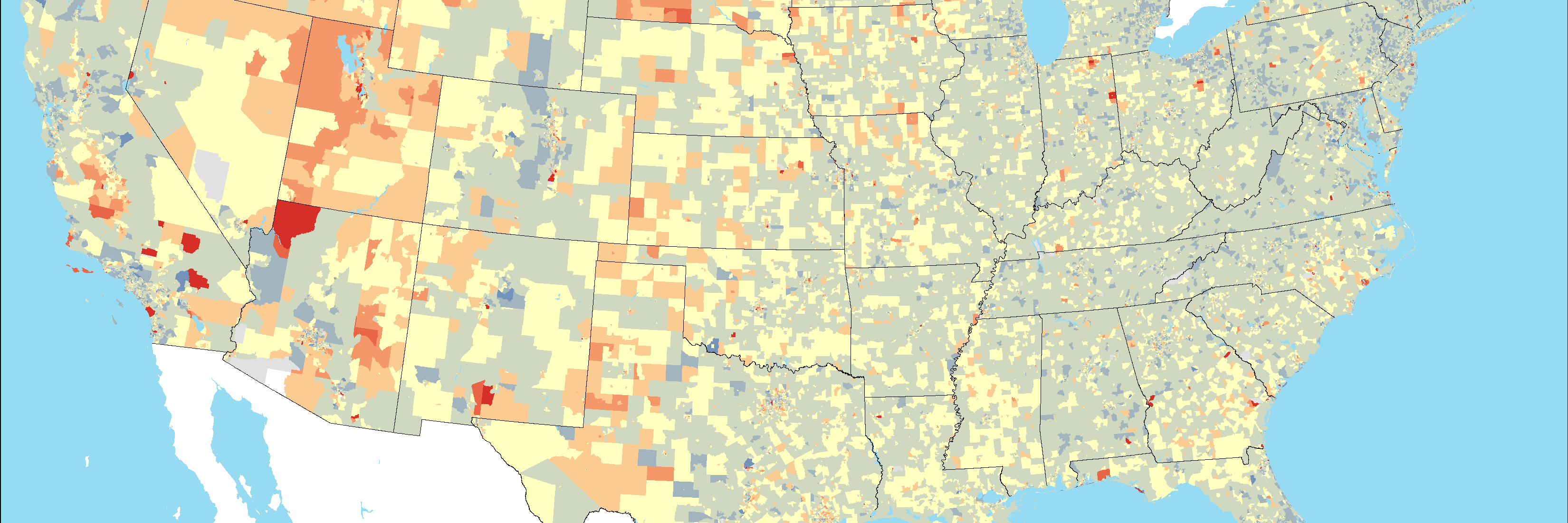
Interested in sea level rise and migration? How many people might migrate? Climate refugees? Continued pop growth in coastal areas? Here's a new OA Review on Sea Level Rise and Human Migration in @NatRevEarthEnv with @Val_Mueller_ASU, @rmcleman & others
https://t.co/PtsqDeznU7
My new article on the “Pig in the Python” argues that the demand for young workers will grow dramatically over the coming decades, likely leading to rising wages, stronger unions, and lower inequality. 1/28
@francoisfleuret Here’s a longer run series for a select set of European countries. Publication at the top of the tweet thread (I think).
https://t.co/KyxnusPMgc
We also estimate historical TFRs for select European countries that predate the collection of age-specific fertility data! In some cases, predating detailed fertility data by up to 150 years! We hope to open new lines of inquiry into historical demographic estimation
I'm seeing a lot of people suddenly become AGI and LLM experts from 2025-. And this is after they suddenly became public health experts from 2020-2024. And this after they were 'experts' in their own niche area unrelated to AGI/LLMs or public health from 2015-2019. 🤔
@ConsumerRick@catboosted Eh. It’s probably its location in the South and a lack of other, nearby elite schools so it suffers from a lack of agglomeration effects.
A new paper published in Nature Astronomy says if LLM can easily replicate what counts as your scientific contribution, then the deeper problem is not the model, but the fact that the work was too routine, formulaic, or low-value to begin with.
---
nature .com/articles/s41550-026-02837-2
The AI Scientist: Towards Fully Automated AI Research, Now Published in Nature
Nature: https://t.co/nNfpSV5e5I
Blog: https://t.co/i6h8LVQOdl
When we first introduced The AI Scientist, we shared an ambitious vision of an agent powered by foundation models capable of executing the entire machine learning research lifecycle.
From inventing ideas and writing code to executing experiments and drafting the manuscript, the system demonstrated that end-to-end automation of the scientific process is possible.
Soon after, we shared a historic update: the improved AI Scientist-v2 produced the first fully AI-generated paper to pass a rigorous human peer-review process.
Today, we are happy to announce that “The AI Scientist: Towards Fully Automated AI Research,” our paper describing all of this work, along with fresh new insights, has been published in @Nature!
This Nature publication consolidates these milestones and details the underlying foundation model orchestration. It also introduces our Automated Reviewer, which matches human review judgments and actually exceeds standard inter-human agreement.
Crucially, by using this reviewer to grade papers generated by different foundation models, we discovered a clear scaling law of science. As the underlying foundation models improve, the quality of the generated scientific papers increases correspondingly. This implies that as compute costs decrease and model capabilities continue to exponentially increase, future versions of The AI Scientist will be substantially more capable.
Building upon our previous open-source releases (https://t.co/H1tBT14Yx8), this open-access Nature publication comprehensively details our system's architecture, outlines several new scaling results, and discusses the promise and challenges of AI-generated science.
This substantial milestone is the result of a close and fruitful collaboration between researchers at Sakana AI, the University of British Columbia (UBC) and the Vector Institute, and the University of Oxford. Congrats to the team!
@_chris_lu_@cong_ml@RobertTLange@_yutaroyamada@shengranhu@j_foerst@hardmaru@jeffclune
Paul Ehrlich died. Imagine making a prediction this wrong: "The battle to feed all of humanity is over. In the 1970s hundreds of millions of people will starve to death... At this late date nothing can prevent a substantial increase in the world death rate..."
I think one of the conclusions we should draw from the tremendous success of LLMs is how much of human knowledge and society exists at very low levels of Kolmogorov complexity.
We are entering an era where the minimal representation of a human cultural artifact... (1/12)