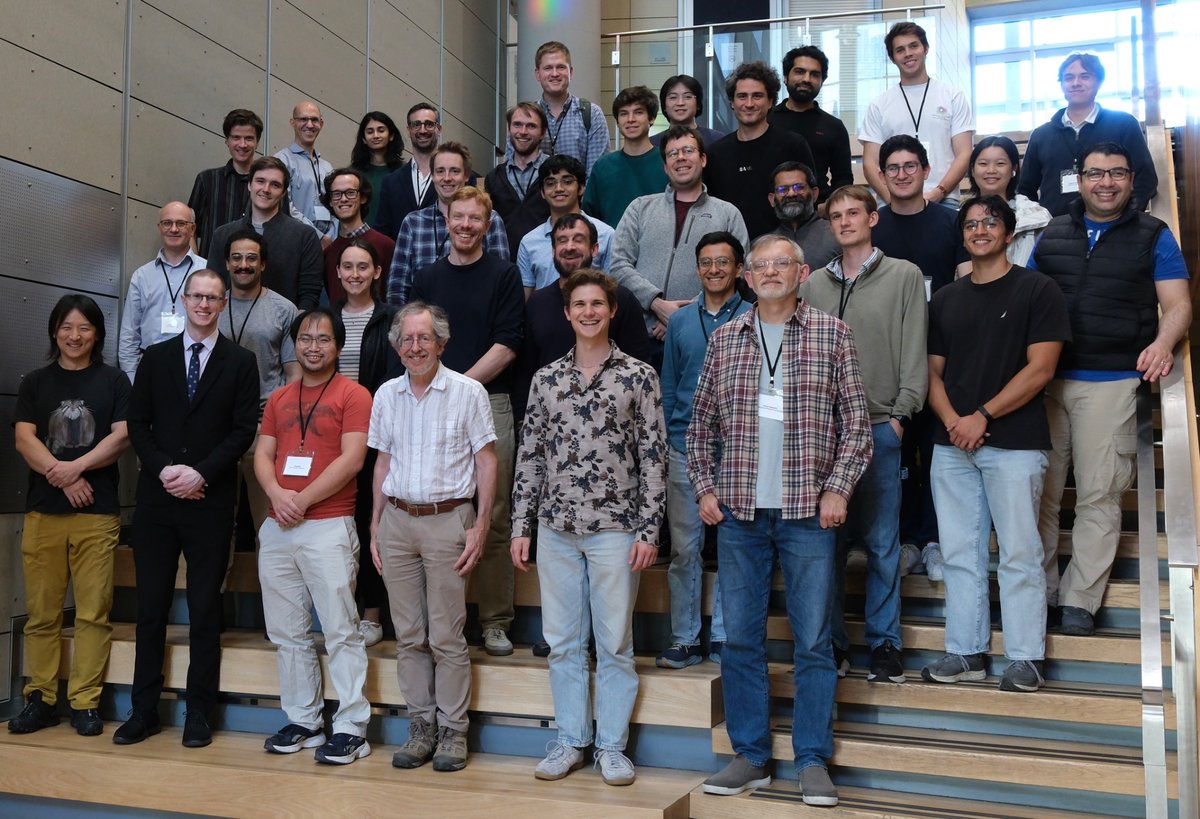
The first (but certainly not last!) workshop on the Formalization of Physics, held this week at ICARM (Carnegie Mellon University).
It was great fun, and extremely stimulating. We need to adapt, but the future of physics is bright!
Pressure and temperature don’t really exist, says my guest, mathematician and physicist @getjonwithit.
Look at water closely enough and there is just molecules bouncing around. We invented those properties because we can’t see individual molecules.
Other key moments from our conversation:
>A galaxy-sized intelligence wouldn’t know what we meant by “temperature.” It could track every particle. It would never need our equations. Jonathan thinks all of physics is like this, with space, time and particles dissolving at high enough resolution.
>Relativity and quantum mechanics both came from one realization: the observer is part of the universe, under the same limits as the thing being measured. Once you ask what a limited observer would actually see, both theories become unavoidable.
>Intelligence and consciousness may work against each other. Far more sensory data arrives than your brain can process one piece at a time. That’s why it batches that data (pain, pleasure, the color red etc). AI might become less sentient as it gets smarter, because it stops needing the shortcuts.
>Jonathan says his digestive system is probably conscious. It has enough neurons to model the world and has the same bottleneck as the brain. It just can’t speak (reminded me of Michael Levin).
>General anesthesia may not actually knock you out. As best we understand it, anesthesia makes you calm, paralyzed and unable to remember. It turns off the conscious part of you from the part that can report. This would explain why so many people have PTSD from surgery.
Full interview below
An interview I did with @sopharicks a few months back, just a couple of weeks before we founded @lanyon_ai.
"Is our universe made of computation?"
https://t.co/4v7fbnMSRY
Participants at APS DPP/GEC have been having fun building and running their own formally verified simulations with Lanyon (plus some help from Jimmy and Tasman...)
Come to the booth if you want to have a go! And chat to Brian if you're interested in collaborating further.
Congratulations to Vishnu (pictured), Kristoffer, Christian, Hamza, and others, for winning Lanyon backpacks at the Vibecheck Hackathon!
Particular congratulations to Kristoffer for winning the informal "most awesome formally verified simulation performed with Lanyon" prize!
Tasman bravely manning Lanyon's booth at the American Physical Society (Gaseous Electronics Conference and Division of Plasma Physics).
If you're at APS, come use Lanyon, run some cool simulations, and win some cool merch!
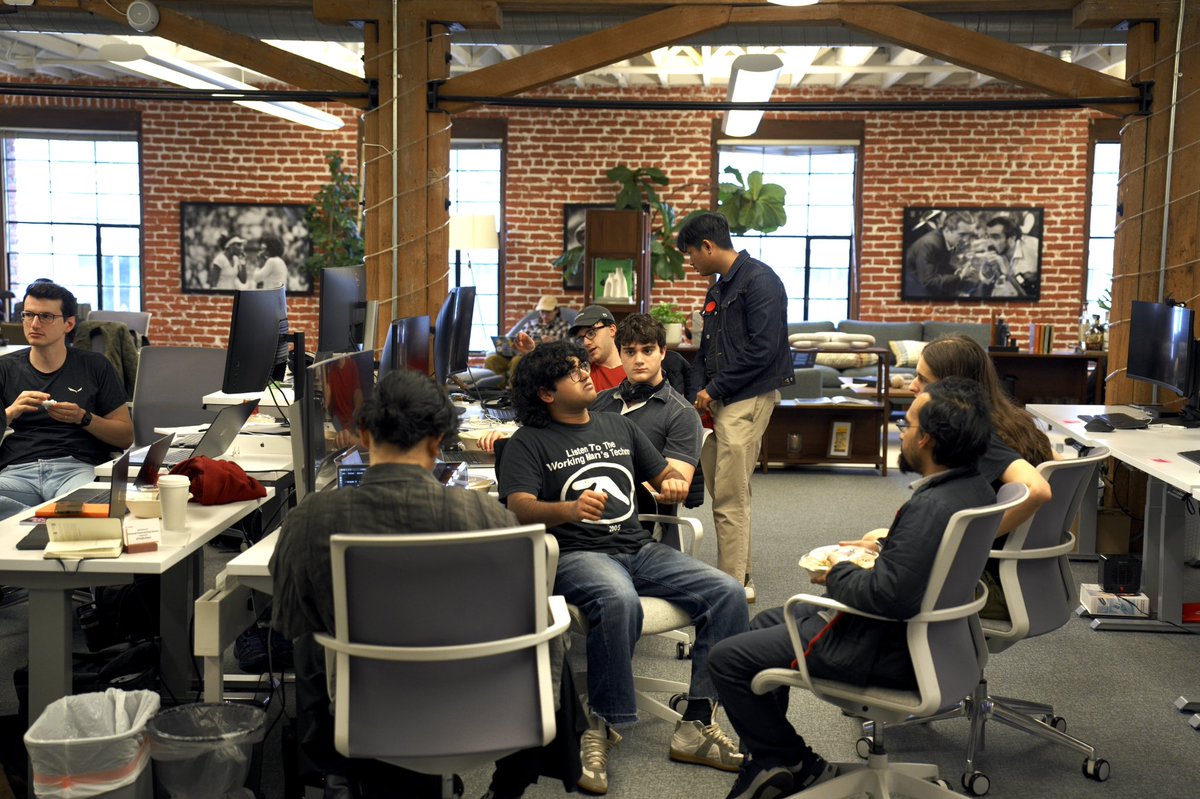
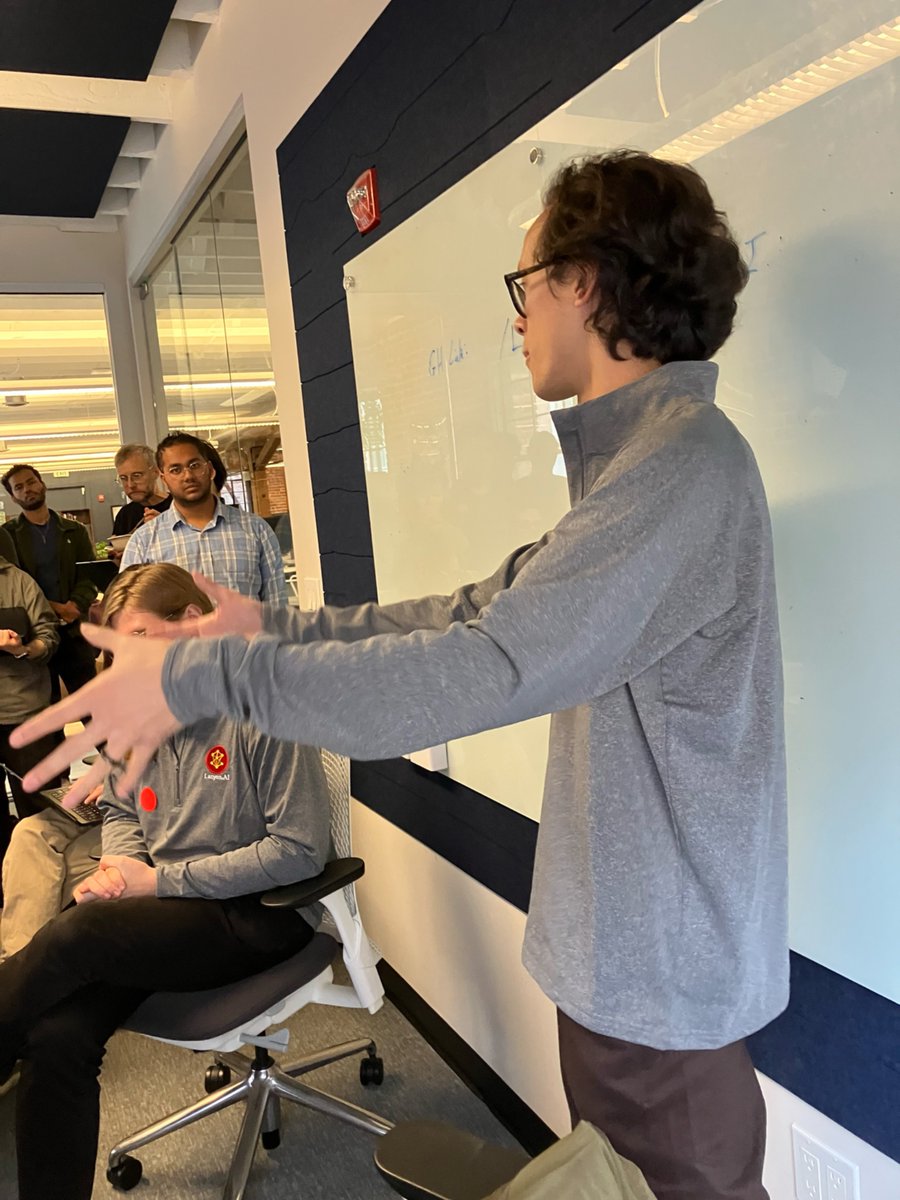
The first public workshop on Lanyon at the Vibecheck Hackathon in SF.
So many interesting projects! From using Lanyon to model articulation constraints in robots, to producing a full flight simulator, to modeling integrable systems, to solving the Klein-Gordon equation!
I think you may have fundamentally misunderstood what we're doing. For what it's worth I agree (if there ever was any scope for disagreement?) that perfect gas dynamics can't capture boundary layers etc. In that sense what we're doing right now is very much "Colorful Fluid Dynamics" in the Phil Roe sense. My apologies if I gave any impression (though I don't think I did) that anything about this simulation was more than a numerical test case. For context:
We have an ongoing research project - over several years now - to produce formally verified (up to machine precision) numerical solvers. Part of the promise of formal verification is that one can go far beyond standard numerical validation (although of course one can do that too) by proving that certain mathematical, physical, algorithmic, etc. correctness properties of the solver are always satisfied perfectly, up to machine precision. See e.g. https://t.co/wWIqGlych2 for more details of what we're doing.
This particular test case arose from an attempt to prove correctness of a hyperbolic solver coupled to an explicit integrator for reactive source terms, combined with a level set implementation for a rigid body geometry. Would be very easy to write by hand, but almost impossible to formally verify without (highly specialized) AI tools. Eventually we want to be able to do formally verified hypersonics calculations with proper tabulated equations of state, viscosity contributions, more realistic geometries, etc. But to get there, we have to treat these much simpler cases first (and these are already very far beyond what the state-of-the-art was even just a few months back - give us some time!).
And to be clear, none of the code (except some of the visualization scripts) is written by AI. Only the formal specification is written with some AI assistance.
Mach-10 hypersonic reentry of an Orion-like space capsule, simulated in full 3D with native GPU acceleration.
Around 20 seconds to build (and formally verify) the solver, and around 10 minutes to build, optimize, run, visualize, and analyze the simulation on a single H200.
At @lanyon_ai, we’re completing Hilbert’s (other) dream.
From November 1st, we’re rolling out pre-release versions of Lanyon to early customers and testers, and will be hosting simultaneous public demos of Lanyon capabilities in San Francisco and Chicago.
From moon bases to modular reactors to atomic-scale programmable matter, we're on a mission to make the abstract concrete, to make the digital physical, and to formally verify reality. Join us!
in order for there to be any such thing as infosec in the 2030s, AI+human collaborations will need to formally verify hyperproperties of silicon chips from assumptions like “Maxwell’s equations” instead of “Armv9.4-a SAIL”