Co-founder, Recursive. Professor, CS, U. British Columbia. CIFAR AI Chair, Vector Institute. | ML, AI, deep RL, deep learning, AI-Generating Algorithms (AI-GAs)
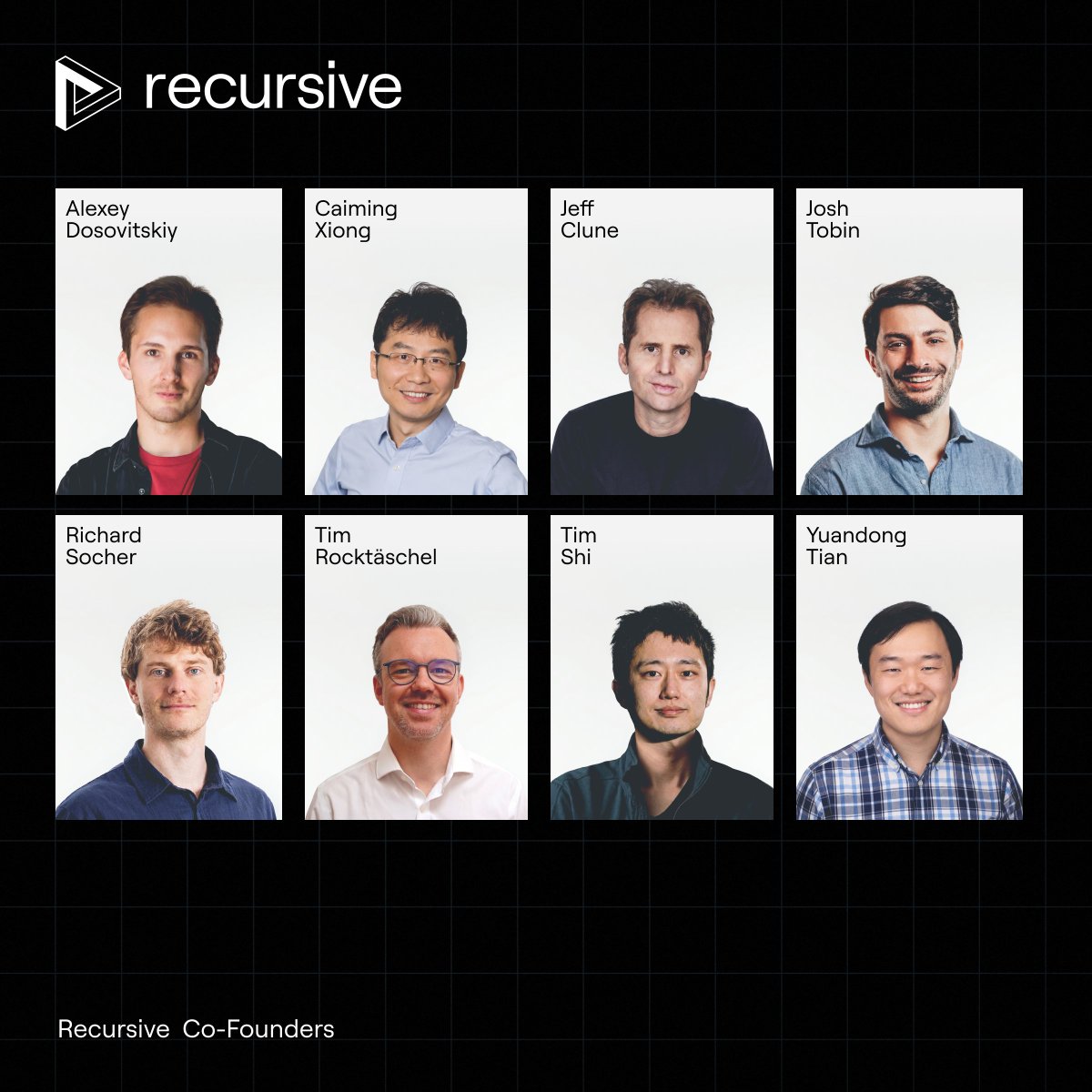
Thrilled to share that we founded Recursive to create AI that safely conducts experiments on how to improve itself in an open-ended process of endless, automated scientific discovery. As I wrote in my 2019 AI-generating algorithms paper, this will likely be the fastest path to superintelligence. Our work since has shown the power of this approach. Excited to scale up and improve upon ideas like the Darwin Gödel Machine, HyperAgents, ADAS, OMNI, ALMA, The AI Scientist, PromptBreeder, Rainbow Teaming, Automated Capability Discovery, and other work on open-ended and AI-generating algorithms. We’ve assembled a dream team of researchers and significant resources to pursue this vision. My amazing co-founders are pictured here, and we have an all-star team of founding members (we’re over 25 and growing).
Please join us if you are interested! Follow our progress @Recursive_SI
@eccentric1ty@InverseMarcus@polynoamial Adam, if you assume that's not going to happen, or at least not going to happen fast enough, then what do you conclude? Do you still want the more safety-conscious people stopping, so ASI is created by those who are not concerned about safety and alignment?
BREAKING: A mathematician at Anthropic claims to have used the company's AI to solve the Riemann hypothesis, the most notorious open problem in all of math
https://t.co/nEXAyIkvSt
@aviral_kumar2@XuIvan78278@QuYuxiao@ianwu97 Very interesting! How would you say it differs from ALMA, which learns memory designs—including how to store, retrieve, and update information—to help agents learn from experience?
https://t.co/lZsn89eCSb
Can AI agents design better memory mechanisms for themselves?
Introducing Learning to Continually Learn via Meta-learning Memory Designs. A meta agent automatically designs memory mechanisms, including what info to store, how to retrieve it, and how to update it, enabling agentic systems to continually learn across diverse domains. Led by @yimingxiong_ with @shengranhu 🧵👇 1/
Jaw-dropping stat in here: the median OpenAI researcher is using $2,400 worth of AI tokens per *day* at list prices ($876,000 per year), and 10% of them are using at least $23,000 per day (or $8.4 million per year)
https://t.co/5n688nJKY8
Knowledge work has moved from the 80/20 rule to the 99/1 rule: AI hands you something 99% finished in a minute.
Doing 1% of the work sounds restful. Instead, a March HBR/BCG study coined “AI brain fry”: workers pushed into heavy AI oversight report 33% more decision fatigue and 39% more major errors, with strain surging past 3 concurrent AI tools.
Why? Because the old 80% slog (formatting decks, tidying models) was disguised recovery where your brain worked out the argument.
Delete the cruise, and the whole day is take-offs and landings.
I have a major result to share.
I’ve found conclusive forensic evidence that the top 4 Chinese AI labs—DeepSeek, Moonshot, MiniMax and Ant Group—have built their newest models on NVIDIA’s most advanced Blackwell chips, which are barred from export to China.
This sounds insane, but I discovered that almost every AI model carries a hidden signature of the GPU that trained it. When a model is first set up, the starting values of its weights are laid out in a pattern that depends on the exact GPU. Each combination of GPU and seed number produces a unique pattern—a sort of fingerprint of the hardware used to create the model. Traces of that pattern survive training into the published model.
Again, this evidence isn’t based on any insider information or leaking. It’s based on a forensic analysis of the model weights released by the companies themselves.
I searched more than six trillion combinations of chip layout and seed number and matched them to open-weights models. In doing so, I found conclusive evidence that six Chinese AI models—including DeepSeek-V4-Pro, Kimi K3, and MiniMax-M3—were initialized on NVIDIA Blackwell systems. Four of the models match Grace Blackwell, the GB200 and GB300 parts in NVIDIA’s flagship liquid-cooled rack-scale systems.
I then verified these results on real hardware. Running unmodified PyTorch with the seeds I’d recovered, a Blackwell B300 reproduced DeepSeek-V4-Flash’s untouched starting weights bit for bit, and a rented GB200 reproduced Kimi K3’s to a correlation of 0.999995. A Hopper H100 reproduced none of DeepSeek-V4-Flash’s, and changing the seed by one broke the match. (DeepSeek’s seed is 953049583 by the way.) The method also was verified to match 24 known open-weights models to the hardware that developers said they used.
It is exceedingly unlikely that these results are a coincidence. Across six trillion combinations, the best accidental match should reach only about 8 sigma (i.e., eight standard deviations above what random chance would produce). The real matches range from 49 to 1,385 sigma, and even the weakest single test hits 20.
These were data-center-scale training runs. With some analysis of release schedules and model details, I estimate that the largest, Kimi K3 and DeepSeek-V4-Pro, used 2,000 to 3,000 Blackwell GPUs each. Clusters of this size cost on the order of $150 to $200 million each to buy, and across these labs alone would add up to more than half a billion dollars of export-controlled GPUs, not counting experimental compute or otherwise. It’s quite likely that we see multi-billion dollar expenditure on export-controlled GPUs.
I am highly confident in this result, and it has been independently verified by senior researchers at OpenAI and Anthropic. You can read the full report at https://t.co/YOtzND0Jqk.
There is much more I’ve identified about these models through other forms of checkpoint forensics like this, and will have more to share soon.
This is so fun, and an example of how AI can bring so much joy to the world. Love the idea of being able to step into any painting and explore. That was one of the reasons we were so excited about the Genie project.
Research News! Announcing the 1st release of fundamental AI research from the Open-Endedness Team @LilaSciences: a vision-focused blog + 4 preprints. The blog details a broad research agenda for achieving open-endedness while each paper unveils its own novel research direction.
The ideas covered in the papers include:
• a novel approach to training for creativity designed to sidestep a newly-identified problem called the “creative paradox,” which means that directly reinforcing creative outputs can sometimes limit reaching full creative potential;
• an investigation of the advantages of seeing the world through fresh eyes by training an LLM that is intentionally naïve in a certain area (in effect presenting less data as a potential advantage);
• a new kind of training regularization technique for SGD called unified factored organizers (UFOs), which is designed to achieve unified factored representation (UFR) as seen in Picbreeder CPPNs;
• and finally a unique study of catastrophic forgetting that shows that networks with UFR (like those from Picbreeder) are intrinsically resistant to catastrophic forgetting. The inset video on this post is a visualization from that catastrophic forgetting work.
The blog post also includes an interactive “wheel of science” demo.
The implications of these ideas are broad and diverse, but the fun part is that each one opens up its own new research playground - there is a lot of room for further research here!
Moreover, we hope this release also highlights one other important point about AI today: while it may seem that the road ahead is already paved and all that’s left is to drive mindlessly forward, there actually remains a lot of room for new directions and insights in the pursuit of open-endedness and creativity.
This research was possible because @LilaSciences appreciates the critical role of open-ended innovation in the pursuit of scientific superintelligence. The advances you see here are part of this much larger company-wide ambition, which includes AI Science Factories and many other unprecedented components. When this engine is fueled by open-endedness, the result will be much more than a step change.
More advances in open-endedness are coming!
Blog link below 👇
When we launched the Remote Labor Index a year ago with @ScaleAILabs , the best AI could fully automate 2.5% of real freelance projects. Fable 5.2 now automates 41.3%.
The automation rate is doubling every ~3 months. AIs may soon be able to do all remote work faster and more cheaply than humans.
Great to see @Recursive_SI in the top 10 in talent movement. We are actively hiring: https://t.co/syowQbElPN
Join a fantastic team of ex OpenAI, Anthropic, DeepMind, and Meta members of technical staff.
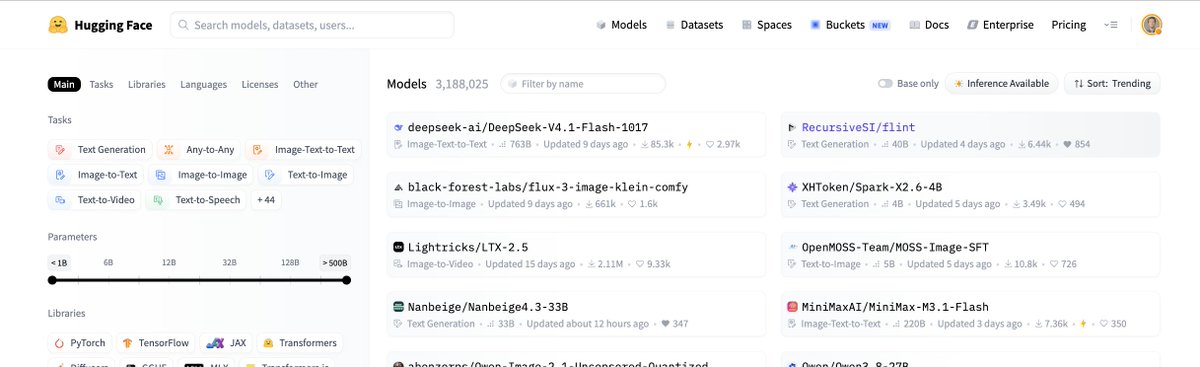
thanks for trying Flint! it was cool to see it trending #2 on @huggingface.
glad also to hear so many people enjoying it.
we're working on improving tool calling, broadening harnesses / inference support, and reducing thinking.
anything else you'd like to see?
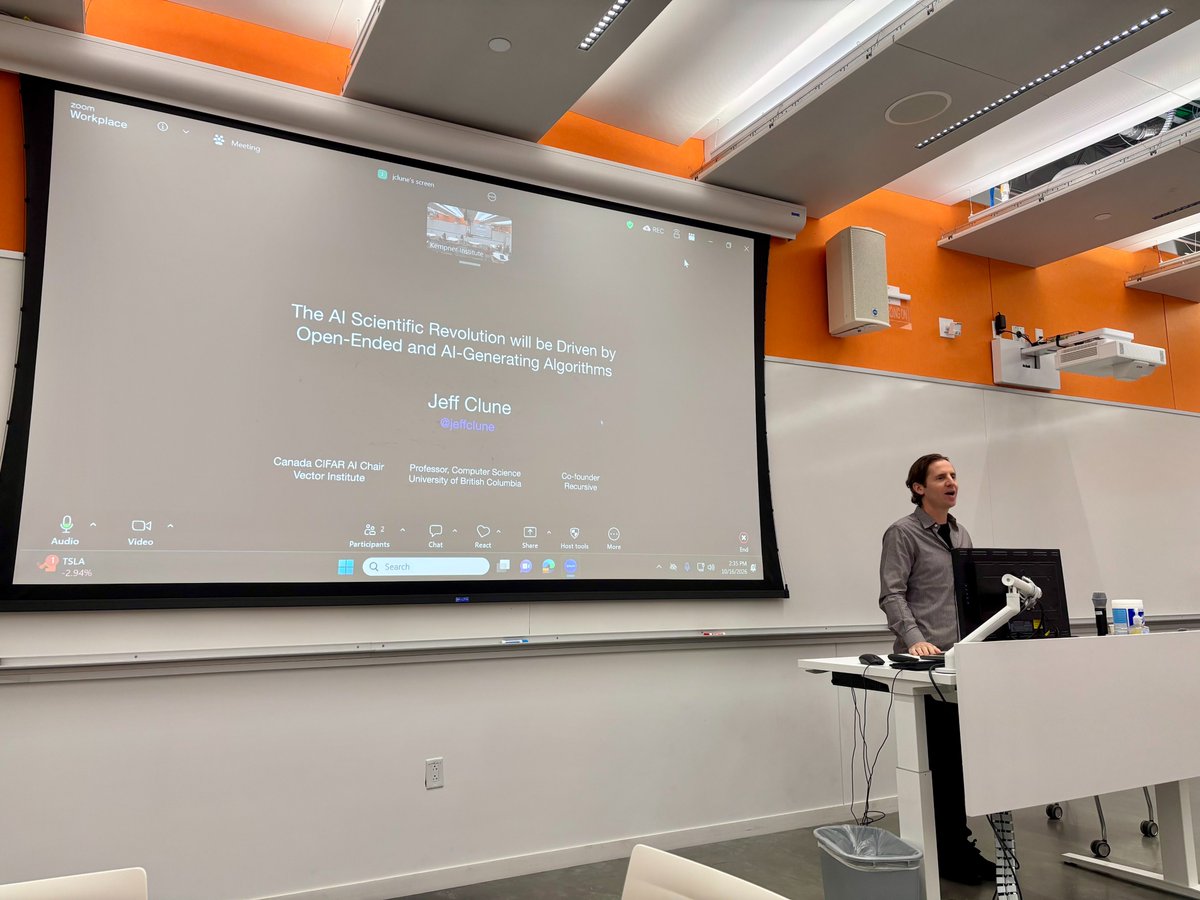
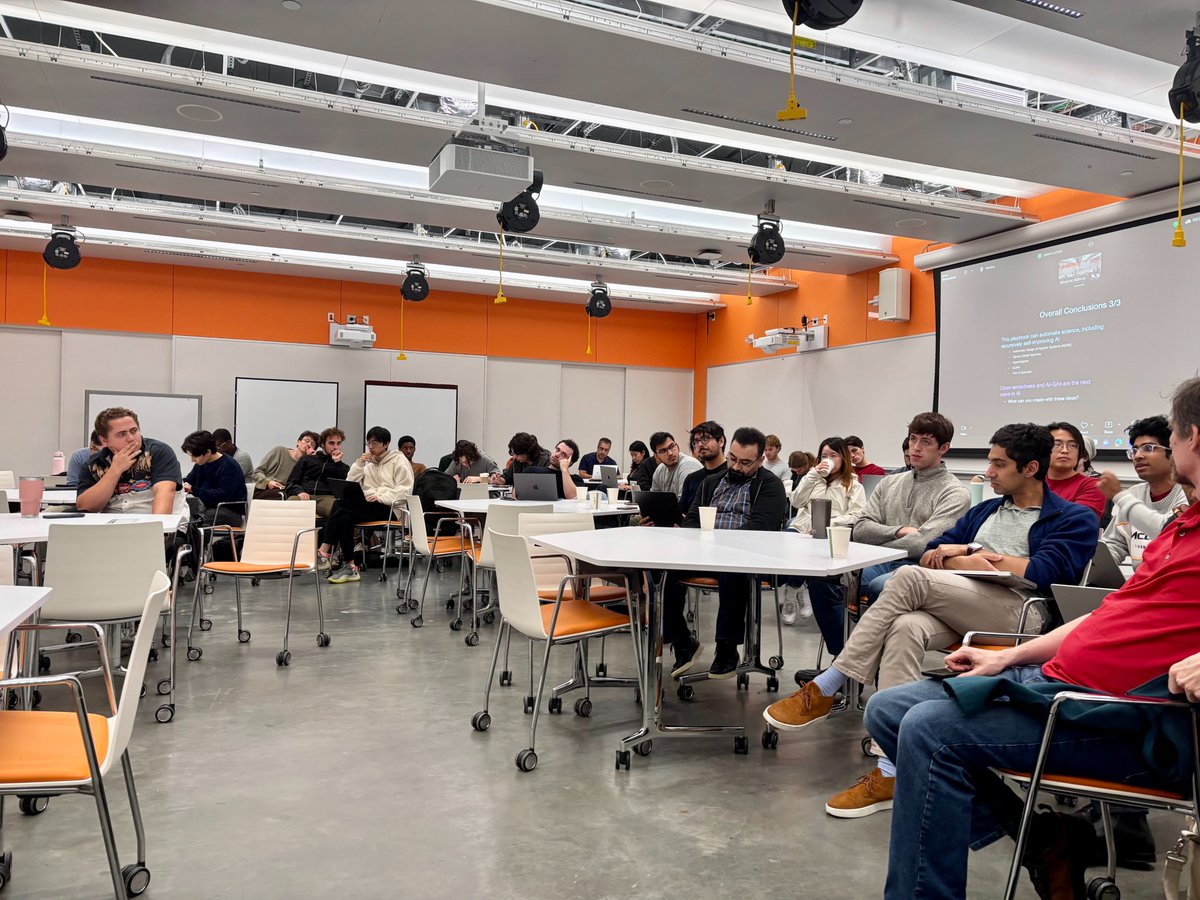
✨Thank you to @jeffclune of @ubc for starting off this year's Kempner Seminar Series! We were excited to welcome him to the #KempnerInstitute earlier this month to discuss his work on open-ended and AI-generating algorithms. 📹ICYMI, watch his talk here: https://t.co/r2udhmPD1L
Amazing and rewarding to see our small-team research effort (led by @ashrewards , @jparkerholder, @_rockt et al.) take on a life of its own as an ever-improving flagship Google product! For me personally, a crazy idea I proposed in my 2019 AI-GA paper (a NN as the entire environment including pixels, sound, etc.) barely worked in Genie1 (2024), worked decently in Genie 2 (8 months later), became incredible in Genie3 (9 months later), and now Genie4 seems ready for Hollywood and VR. What an arc to observe in such a short time. Wild times! Now imagine open-ended learning in Genie. ✨ 🚀
This is Genie 4, our most realistic and interactive world model yet. 🌐
Explore dynamic environments in real time to see how the scene responds, sounds, and how the people in it move, react, and speak.