🤖 LLMs are already very capable, how do we make sure they can continually improve from their experience at deployment?
And how do we train agents to push the frontier of both capability and continual learning ability?
In our new technical post, we build an RL recipe for this: https://t.co/yXK4sAEqeR
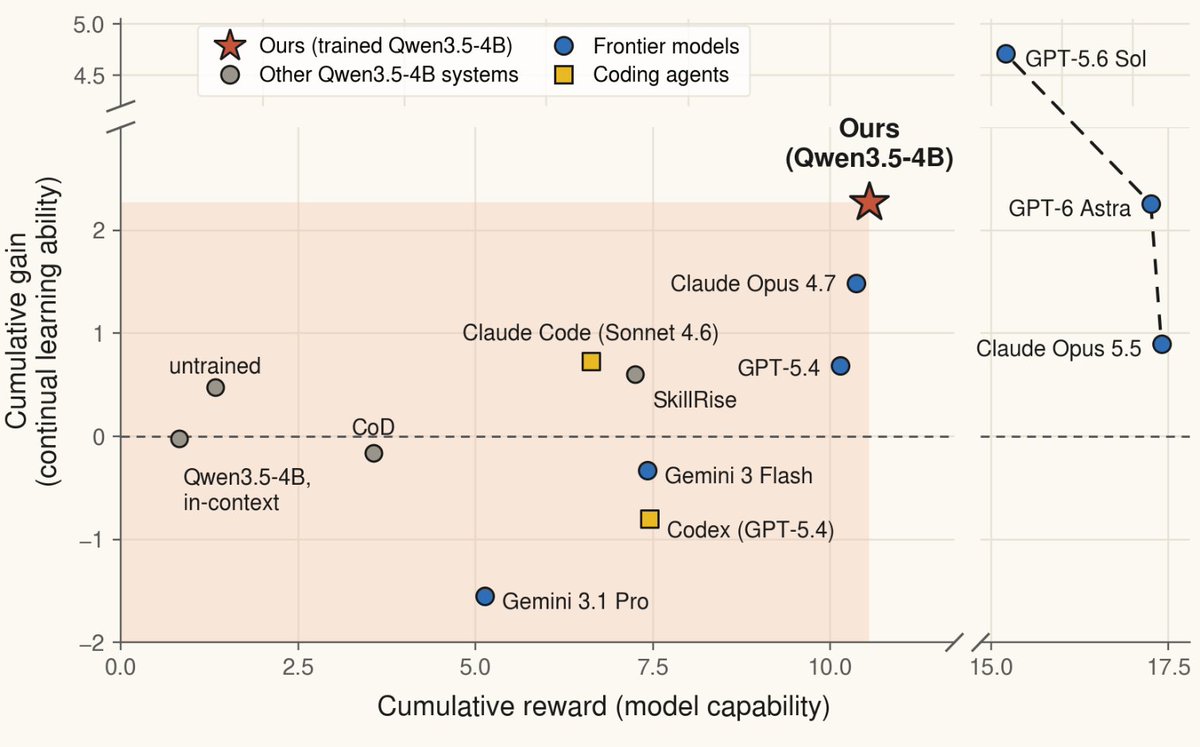
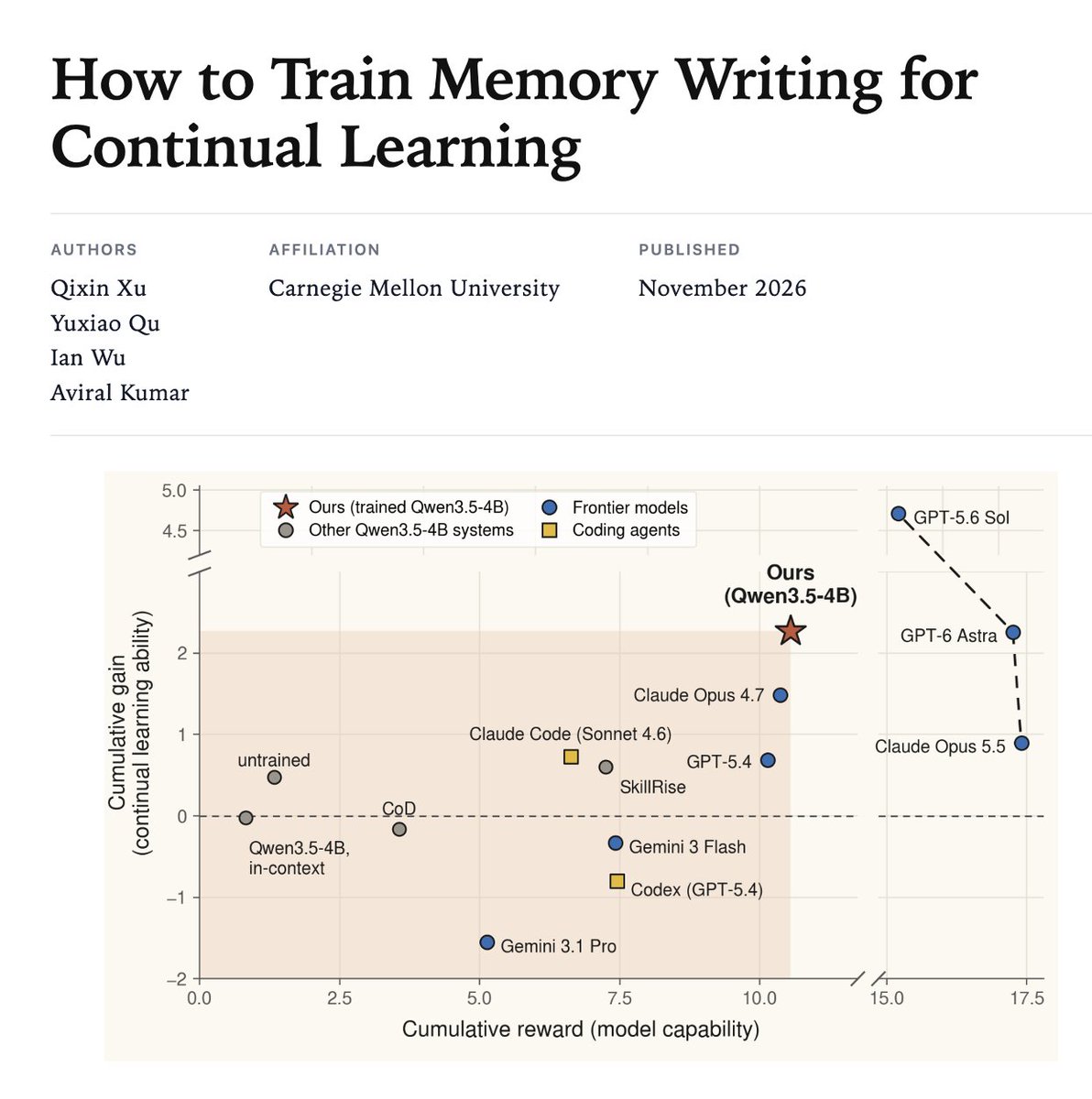
On Continual Learning Bench, our trained Qwen3.5-4B performs comparably to GPT-5.4 and Claude Opus 4.7, and gains more from its past experience than they do, or than Claude Code and Codex 📈
🧵👇
For me, continual learning means getting better through experience after deployment.
One way to do this is to carry experience forward through memory. But is training the memory writer enough? 🤔
How can we train LLMs to write memories from experience collected on the fly to as best as possible solve the next task, i.e., optimize for both capability and "continual learning" ability?
In our new post, we study this question in the setting continual learning over a sequence of tasks, and develop a simple approach to train models to write effective memories
https://t.co/2NfvlzJV9V
*Spoiler*: the picture is more nuanced than you think 🧵 ⬇️
🤖 LLMs are already very capable, how do we make sure they can continually improve from their experience at deployment?
And how do we train agents to push the frontier of both capability and continual learning ability?
In our new technical post, we build an RL recipe for this: https://t.co/yXK4sAEqeR
On Continual Learning Bench, our trained Qwen3.5-4B performs comparably to GPT-5.4 and Claude Opus 4.7, and gains more from its past experience than they do, or than Claude Code and Codex 📈
🧵👇
🧱 How we build training streams matters too.
1️⃣ Not single tasks: training on one task at a time teaches the model to solve tasks, but not to carry experience from one task to the next.
2️⃣ Related tasks: each stream draws consecutive tasks from the same repository, so what the model learns early can help later.
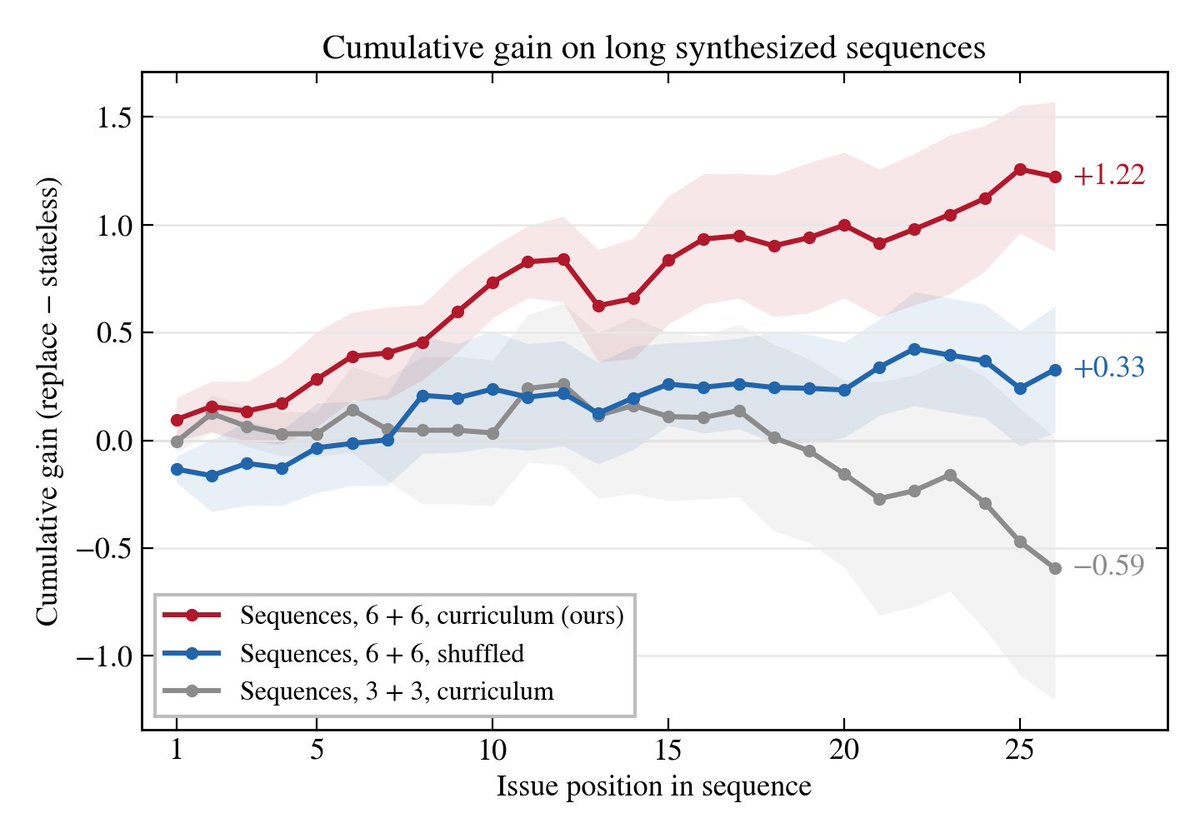
3️⃣ Long enough: when training streams are too short, memory has little room to build up, and the model ends up close to the single-task baseline.
Trained on long streams of related tasks, our model's cumulative gain keeps rising on held-out streams more than twice as long as the training streams 🚀
Introducing Lattice, a local LaTeX workspace for your research.
A paper is more than a .tex file: the papers you cite, notes, slides, Overleaf co-authors and now an AI agent.
I wanted it all in one app, so I built it.
Free to download, open source:
https://t.co/hnoC9AQ84m
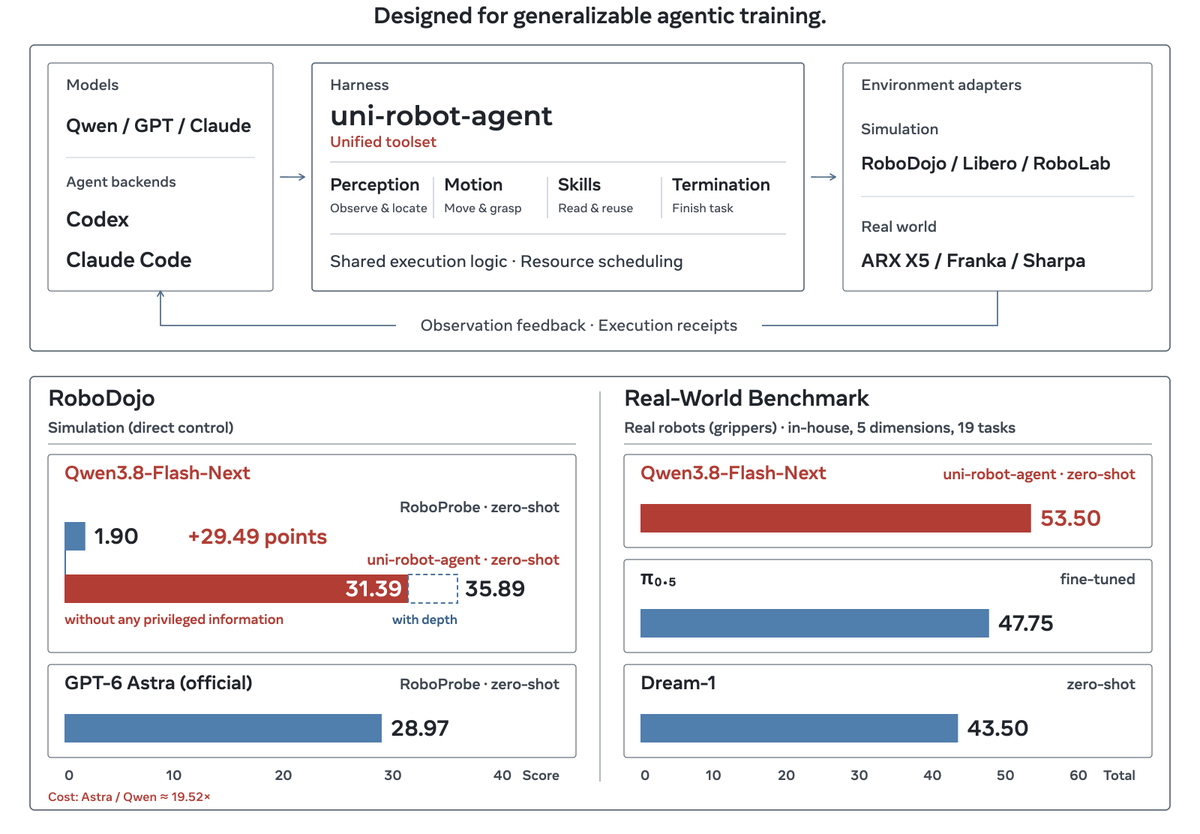
‼️ Can Qwen directly control the robot as well as GPT-6 Astra?
🚀 Introducing uni-robot-agent: a unified harness for Robot-Use Agents (RUAs), a first step toward RUA training and local deployment.
We tested uni-robot-agent with Qwen3.8-Flash-Next running locally:
1️⃣ On RoboDojo, its score rose from 1.90 to 31.39, surpassing the RoboDojo Team’s score with GPT-6 Astra.
2️⃣ On real-world tasks, it outscored fine-tuned π0.5 by 5.75 points and zero-shot Dream-1 by 10 points.
🧵 [1/7]
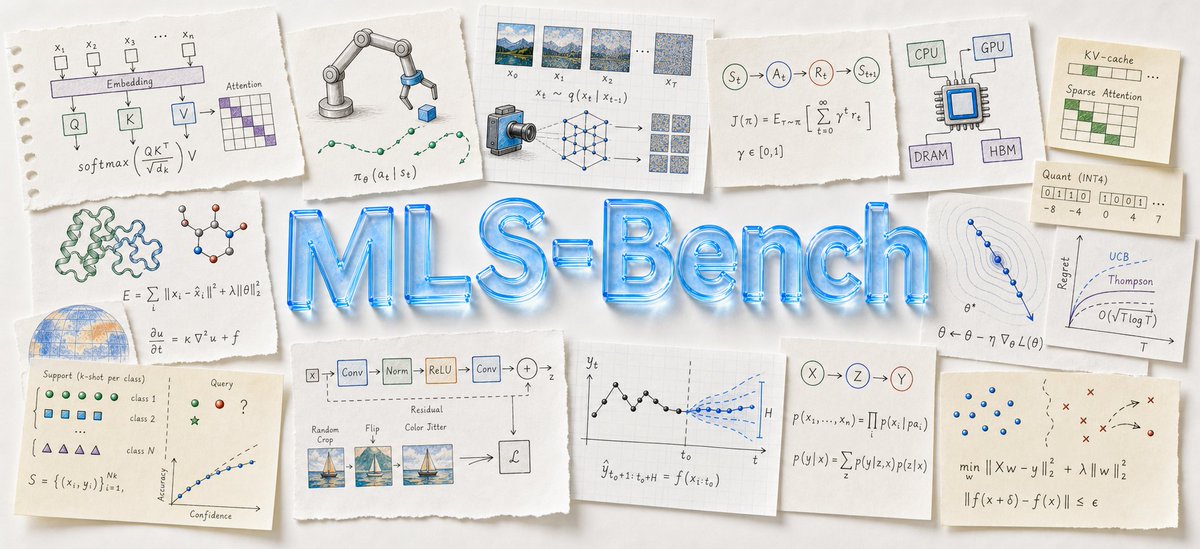
MLS-Bench has been accepted as an Oral at the NeurIPS 2026 E&D Track (15/3757)! It has also been featured in model releases from AI labs like Qwen.
MLS-Bench tests whether current Agents can invent ML methods that scale and generalize, the way human researchers have driven AI forward. It spans 140 tasks across 12 domains, with anti-hacking designs that isolate method invention from benchmark gaming.
We find that agents are much better at tuning existing methods than inventing new ones. They also lack the scientific judgment to plan experiments and test their own assumptions. Even the newest models, like Fable and Astra, plateau near existing human-designed methods.
📄 Paper: https://t.co/70RKNElJf8
🏆 Leaderboard: https://t.co/R1AwPz1VJT
💻 GitHub: https://t.co/zhLEsWTEuu
In our new work ⬇️, we develop robot VLMs that can improve their own reasoning simply by practicing to *explain* demo data. Trained robot VLMs then control low-level VLAs.
This is important as reasoning in language can provide a cheap axis for scaling TTC even for robots and hence, enable fast autonomous improvement & generalization in new scenarios.
Many SOTA robot learning methods still handcraft reasoning annotations (or equivalents). But this is suboptimal if we take a lesson from how LLMs are trained to reason.
How should robots think? 🤔
In our new paper R³, we introduce a simple way to get robots to think before they act—like humans: free-form, deliberate, and actually useful.
The recipe is surprisingly simple: just RL, done carefully. Yet it enables reasoning that can effectively steer low-level robot policies.
🧵[0/9]
🚀 OpenRSI is a new open research series from @FrontisAI for concrete, testable progress toward recursive self-improvement (RSI).
As its first project—and also my first work as first author—I’m proud to present OpenMLE: an open full-stack AI4AI system for autoresearch, where evolutionary agents improve ML solutions through executable feedback.
OpenMLE has three components:
- OpenMLE-Gym: 5,758 executable tasks + evaluators
- OpenMLE-ERL: execution-grounded SFT + RL
- OpenMLE-Evo: experience-guided long-horizon search
🏆 The full system—our trained Frontis-MA1-35B model paired with OpenMLE-Evo-Max—reaches 71.21% Medal Average on MLE-Bench Lite: surpassing GPT-5.5 + Codex (68.18%) and just 1.52% from GPT-5.6 Sol + Codex and the 2.8T Kimi K3 + Claude Code (72.73%). Budget: 12 hours/task on one RTX 4090 capped at 12 GB VRAM.
🌍 On 10 held-out NatureBench Lite tasks, both components transfer:
• same framework, model swap: Match-SOTA 50% → 70%
• same base model, framework swap: Match-SOTA 20% → 50%
🔓 Paper, code, models, data, and analysis below. 🧵
Everyone is talking about self-evolving AI, or recursive self-improvement. The methods that built modern ML are the ones that keep working across settings and scales, yet no benchmark directly tests AI systems for that ability.
Today, after months of cross-platform validation with external teams, we're proud to introduce MLS-Bench, a benchmark for ML Science with 140 tasks across 12 ML domains. It asks whether AI systems can create scalable and generalizable ML methods, the way human researchers have pushed AI forward. (1/9)
🚀 We found a scaling law for context management in deep research agents.
Not a heuristic. A data-driven curve: 10 models (4B → 284B) × 3 retrievers × 4 benchmarks = 32K evaluation trajectories.
💡 Given your model scale + retriever: it predicts whether context compression helps — or backfires.
📄 Paper: https://t.co/Slm4fZnH8A
💣 New open-source SOTA:
84.3% on BrowseComp-Plus (DeepSeek-V4-Flash + AgentIR-4B). Our scaling law picked the winning config.
Insights 👇
📈 CM gain isn't monotonic — it peaks then collapses.
🧠 Agents naturally focus on the first and latest steps of their context — the middle gets skipped.
🎯 For strong models on deep search tasks, skip the CM overhead — just invest in a better retriever.
🧵We're also open-sourcing one of the largest evaluations of deep research agents to date:
✅ 10 models × 3 retrievers × 4 benchmarks
✅ 32K evaluation trajectories
✅ Deep research evaluation framework
👨💻 Code: https://t.co/d3Xe2bgkyB
🤗 Trajectories & eval logs: https://t.co/Y5HM4ANAya