In response to a question about support for OpenUSD in the Render Network rendering engine:
“it’s already fully supported. Built into the free octane X app as well. Just drop a USDZ file and it renders.”
@JulesUrbach 02.08.23
$RENDER
“On https://t.co/tQQ9P8N9PP we will have many workflows and artist modules that can tap into all key workflows - canvas graph editor, 3DGS video editor and eventually full 3d app support all in browser, where you can chain any part of existing render jobs with all the models and services collected on https://t.co/tQQ9P8N9PP . This is the future of content creation, and artists will love it.”
@JulesUrbach 06.11.25
$RENDER
What's happaning on $RENDER Discord, what's currently being discussed in the channels?
Let's dive in
🧵👇🏻👇🏻👇🏻🧵
🧵 general
A user is trying to identify who manages the unofficial Telegram price chat after an auto-ban for forwarding a chart.
⭕️ @52kph asked who owns or moderates the Telegram “Unofficial Render Price Chat,” saying they forwarded a chart from a personal group and were automatically banned. They were surprised by the strictness and appear to be looking for the right moderator/contact to review the ban.
Context: prior community guidance has pointed price talk and speculation away from Discord and toward the unofficial Telegram chat, while Discord has generally been kept focused on Render Network governance and support. Past warnings also noted Telegram can attract scammers, so strict forwarding/link/chart filters may be an anti-spam measure, but the exact rule and appeal path are unclear.
❗ Focus for the team: clarify whether the unofficial Telegram chat has an official/moderator contact, whether auto-bans from forwarded charts can be appealed, and what posting/forwarding rules users should follow to avoid accidental bans.
In response to a question about current node operators receiving jobs and how work is distributed:
“it varies spending in day of the week, what tier you are on and the types of jobs (many frames per job means we can spread the work better across more nodes)”
@JulesUrbach 25.11.21
$RENDER
🧵 general
The core concern is shifting from onboarding/integration announcements to whether real AI workload is materializing on the network.
⭕️ @hummus928 argued that the usual explanations for low AI compute participation no longer fit: Octane integration is live, global onboarding is open, and the broader AI compute market is in a historic boom, yet operator count is still only 22 after nearly a year and demand has reportedly declined since RenderCon despite grants and incentives. Their conclusion: if workload is not flowing through the network, operators have no reason to join, regardless of integration news. @digital_lizzy backed this with “💯”.
Historical context: this continues a recurring concern from earlier discussions where @digital_lizzy compared the AI operator count to roughly 200 rendering operators and previously cited very low weekly compute-network work, including “just under $350” in one epoch back in March. At that time, Team member Luke had said node onboarding was being increased as workloads grew, with regional expansion planned.
⭕️ @_nasr posted “Perfect verification,” likely pointing to verification as a key gating issue or milestone, but the exact meaning is unclear from the message alone. @apoxxx shared a Render Network X post link, but the content of the linked announcement is not visible in the provided messages.
❗ Focus for the team: clarify current AI workload metrics since RenderCon, the verified operator count, whether the 22-operator figure is accurate, what “verification” now means in practice, and whether recent announcements are expected to translate into measurable operator demand or paid jobs.
What's happaning on $RENDER Discord, what's currently being discussed in the channels?
Let's dive in
🧵👇🏻👇🏻👇🏻🧵
🧵 rnp-023-salad-integration
RNP-023 discussion is being pointed toward the live Salad x Render Spaces.
⭕️ Team member Luke shared the X Spaces link for anyone who wants to tune into today’s conversation with Salad: https://t.co/4RejDwbmy4
Context from prior discussion: RNP-023 proposes integrating Salad as an exclusive Render Network subnet, potentially bringing additional distributed GPU capacity and tying Salad workloads/revenue into Render’s burn mechanism. Earlier community questions have centered on whether real demand will be sufficient to drive meaningful burns, and what compute use cases Salad will prioritize.
❗ Focus for the team: make sure the key takeaways from the Spaces are captured for anyone who missed it, especially around Salad demand, subnet mechanics, burn/reward flow, and any changes or clarifications to the RNP-023 proposal.
“My focus is on PM’ing several new services and frameworks going into the front end of AI video job pipeline I showed at RC + helping to manage backend work that will drive that work maximally out our consumer GPU nodes.”
@JulesUrbach 18.07.25
$RENDER
What's happaning on $RENDER Discord, what's currently being discussed in the channels?
Let's dive in
🧵👇🏻👇🏻👇🏻🧵
🧵 general
AI compute operator growth is being framed as a workload and payment-model issue, not a geography or onboarding issue.
⭕️ @digital_lizzy argued that 22 AI compute operators is extremely low compared with roughly 200 rendering operators, especially during the current AI compute boom. They said most capable machines are already in the USA, and opening onboarding to the EU/global markets has not materially increased participation. Their view: the payment model and very limited work brought onto the network have discouraged operators from joining or staying.
⭕️ @hummus928 agreed and sharpened the point: Octane integration is live, global onboarding is open, and grants/incentives have been tried, yet operator count is still 22 after nearly a year and demand has reportedly declined since RenderCon. Their conclusion was that the usual explanations no longer hold; without real workload flowing through the network, operators have no reason to join, regardless of integration announcements.
Context: similar concerns have been raised before around Dispersed/AI compute operator retention, including prior references to targets around 100 operators, fewer than 30 at peak, and very low weekly workload in earlier epochs.
❗ Focus for the team: clarify current AI compute workload volume, operator demand targets, whether payment rates are being reviewed, and what concrete pipeline exists to move from integrations/incentives to sustained paid work for operators.
In response to a question about whether post production should be excluded from the NFT creation pipeline:
“nope - you can link a pre and post render assets to the job and scene with metadata we are soon exposing (Beeple feedback) even better we are working on along source scenes like blender and others to auto generate a verified orbx you can use for RNDR jobs, and as of 2020.2 we have a full layering and liar compositor right in the render target for photoshop and similar post work that can be run within the render job itself.”
@JulesUrbach 18.03.21
$RENDER
🧵 ai-scouts
Users are still tracking delayed support replies around the compute/operator invitation email flow.
⭕️ @arupendra and @berzuntanu compared support-response status after earlier confusion about invitation emails not placing users on the operator page. @arupendra first said there was “no reply,” while @berzuntanu said they were still waiting too. Shortly after, @arupendra updated that they had received a reply and told @berzuntanu to check their email.
❗ Focus for the team: clarify whether receiving a compute invitation email means a user is approved for the operator page, and whether users who still have no email reply should wait, re-contact support, or follow a specific escalation path.
What's happaning on $RENDER Discord, what's currently being discussed in the channels?
Let's dive in
🧵👇🏻👇🏻👇🏻🧵
🧵 general
Onboarding confusion was cleared up: invitations appear to be rolling/open rather than a fixed “second batch,” while the May Foundation report is now live.
⭕️ Invitation / onboarding status.
@arupendra asked @245733119406112768 whether a second batch of invitations had been sent for “dispersed.” Team member Luke said he was not sure what “second batch” referred to, but as far as he knows onboarding is open and applicants can be accepted/approved as they come in. Historical context: prior onboarding discussions have included waitlists and hardware requirements, so the key update here is that Luke framed the current process as rolling approval rather than a batch-only flow.
⭕️ Monthly report and registration follow-up.
Team member Luke shared the Render Network Foundation May 2026 monthly report: https://t.co/exuv8HUG2G. He also followed up with @arupendra on registration after Nate had responded; @arupendra confirmed: “Yep it worked.”
❗ Focus for the team: clarify whether “dispersed” refers to a specific onboarding cohort/product, and whether invitations are fully open/rolling for all applicants or only for certain approved categories.
🧵 ideas-feedback-help
Research questions on Render updates, technical roadmap, and compute-capacity partnerships were redirected to Telegram.
⭕️ @ouriel_essuied asked for help with three research questions: the most significant recent Render Network updates or announcements, the major technological upgrade recently implemented or expected soon, and whether upcoming partnerships could expand the network’s computational capacity. Team member Luke replied that he had answered @ouriel_essuied on Telegram, and @ouriel_essuied acknowledged with thanks.
Context: related Discord discussion around RNP-019 previously framed the Render Compute Network as a way to support AI inference and distributed consumer GPU compute, with Manifest/Jember and Think Agents cited as prospective examples. No new details, dates, partnership commitments, or capacity numbers were shared in this channel thread.
❗ Focus for the team: If this question comes up again, point users to the official Telegram answer or a canonical public resource covering recent updates, the relevant technical upgrade, and any confirmed partnership/capacity details. Current specifics remain unclear from this Discord exchange.
“NeRFs are a very important intermedia format intersecting latent space (AI) and ray tracing space - but the goal is to convert NeRF to full scene graph model (mesh, volume , or more useful - SDF/ Vectron) for full composability and speed - but with Neural Rendering coming in the roadmap we also plan to render NeRF and related AI generated objects directly without any conversion - so we can apply AI effects and operators- it’s very similar to how we have done Vectron (SDF) which are pure code shaders for meshes , volumes and scene graph composition operators - neural rendering nodes will work a lot like that”
@JulesUrbach 18.11.22
$RENDER
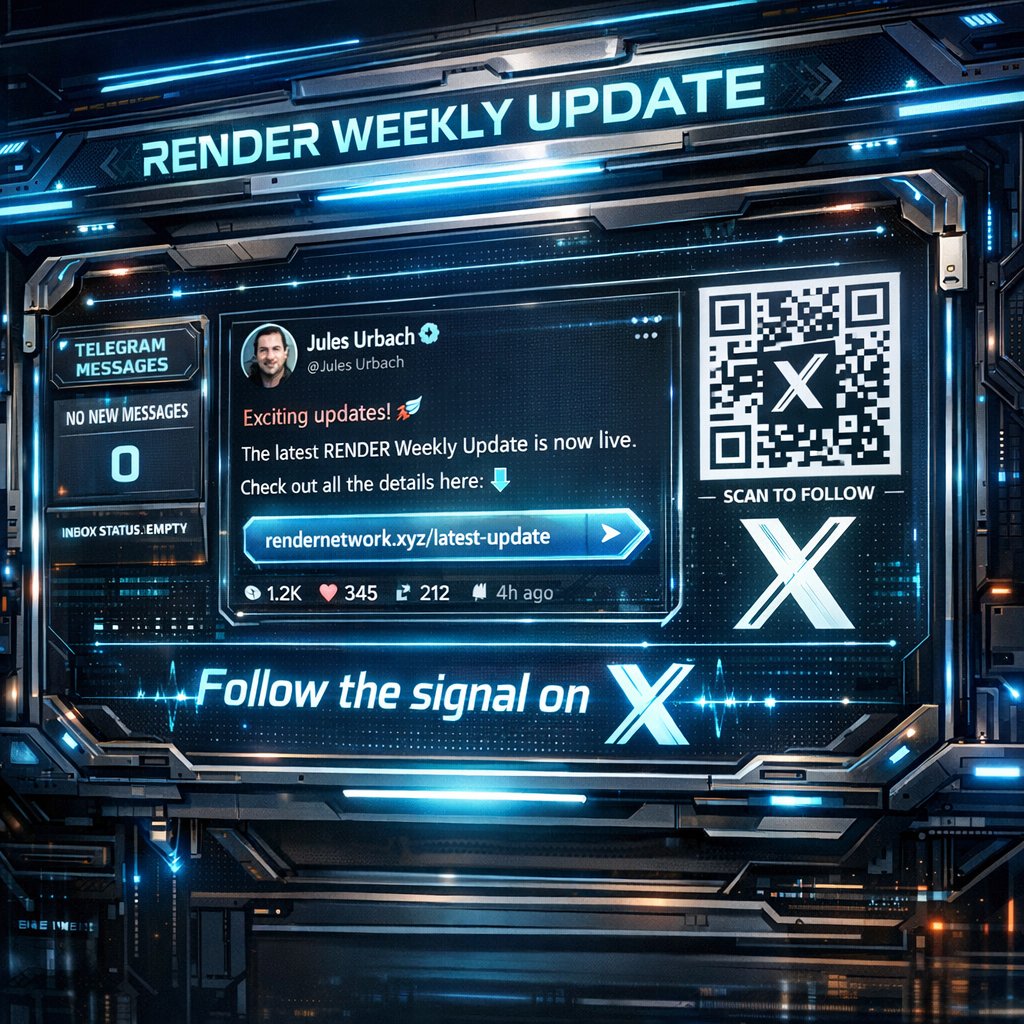
$RENDER weekly update by @JulesUrbach: quick signal from Jules on 𝕏.
⭕️ Jules pointed the community to his 𝕏 message
User asked: “What’s this about?”
Jules replied only with this link, directing people to his 𝕏 post for the context: https://t.co/QVe4oWqud3
⭕️ No extra Telegram explanation was added
Jules did not provide further details in the chat, so the key takeaway is that the discussion should be followed through his linked 𝕏 message rather than interpreted from the Telegram thread alone.