We’re always looking for new ways to connect with the public we serve. Bluesky provides another opportunity for us to share updates from our Open Market Trading Desk, research, district engagements, and monetary policy insights.
https://t.co/vbRHzNU7SN
In this post, the 3rd in a 3-part series, the authors’ evidence finds that the same internal capital markets that helped banks meet tighter Basel III requirements left nonbank affiliates with thinner buffers and riskier business models. https://t.co/3Msa6uWYqR
Basel III's binding capital minimums took effect in January 2015. In this post, the 2nd in a 3-part series, the authors show what organizationally complex U.S. bank holding companies did in response to higher capital requirements. https://t.co/snYPEiIpFe
Business activity picked up in the New York-Northern New Jersey region’s service sector in July for the first time in nearly two years. Employment increased modestly, and firms grew more optimistic about the outlook for the months ahead. Learn more: https://t.co/zv2J0M6j91
In today's post, the 1st in a 3-part series, the authors document the scale of nonbank activity within bank holding companies and describe balance-sheet features that make these subsidiaries a vehicle for regulatory arbitrage. https://t.co/bWPDNZuwyZ
New York State manufacturing activity increased substantially in July, with new orders and shipments picking up sharply. Employment grew for a sixth consecutive month. Price increases remained elevated and supply availability continued to worsen. Learn more: https://t.co/8sdhy2EqGG
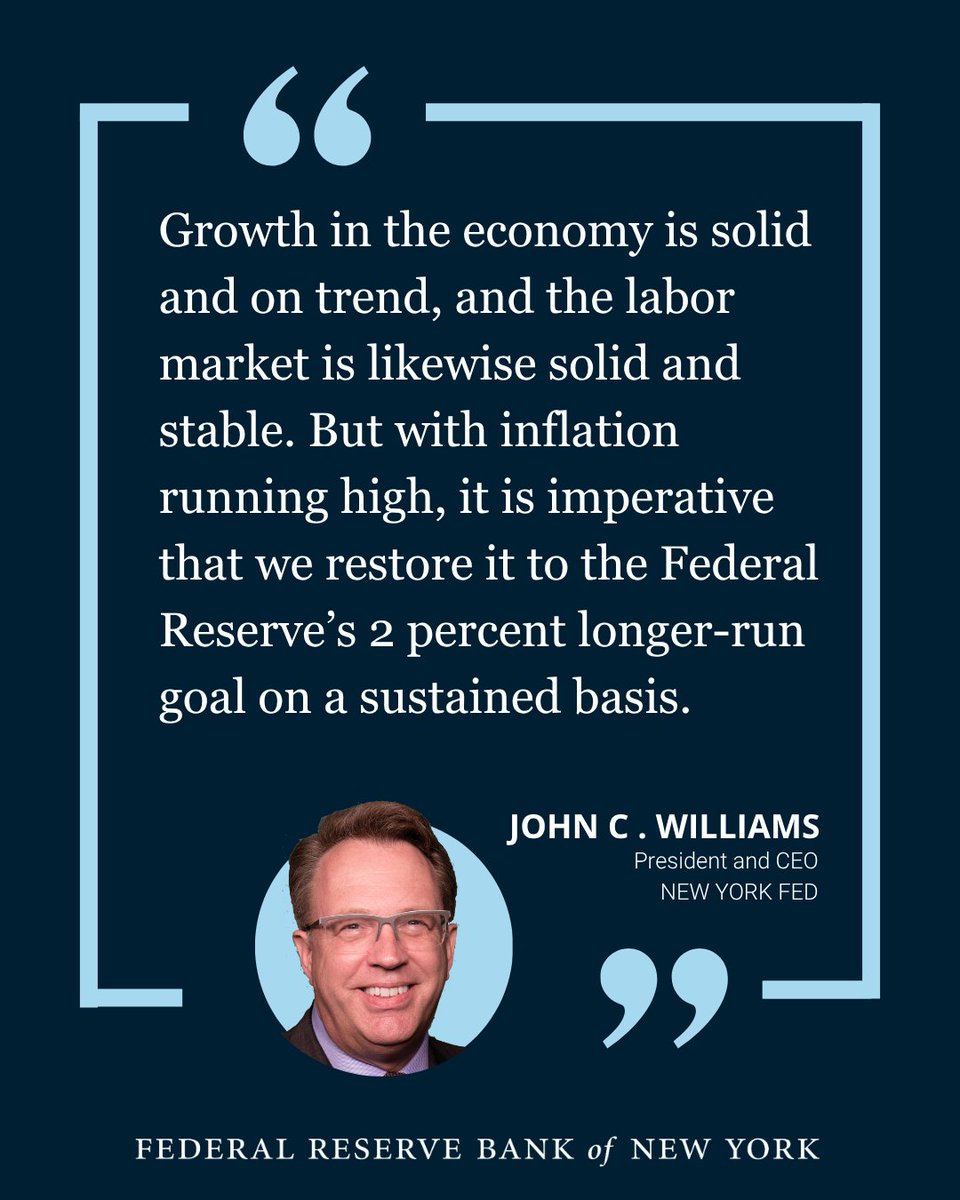
In remarks today, President John C. Williams spoke about the U.S. economic outlook, New York City’s economy, and how the FOMC is working to achieve its dual mandate goals of maximum employment and price stability at a time of great uncertainty.
Key Takeaways: https://t.co/aXo0OekVnl
Read the full speech: https://t.co/4ZVkXtrEwP
How has the recent implementation of tariffs affected small businesses? In today's post, the authors use data from the 2025 Small Business Credit Survey to explore this question at both national and regional levels. https://t.co/83adwqtO4K
Have firms finished adjusting prices, or do further tariff-induced price increases lie ahead? In today's post, the authors share their latest regional business surveys reveal nearly half of firms that paid tariffs still plan additional price increases to offset these costs. https://t.co/A2TT02Rvcx
In this post, the 2nd in a 2-part series, the authors use a new database of more than 3,000 bank runs to show that poor fundamentals are central to explaining both when runs occur and when they have severe economic effects. https://t.co/m8crwAf3EZ
Our June 2026 Survey of Consumer Expectations shows that households’ inflation expectations increased at the short- and medium-term horizons and were unchanged at the longer-term horizon. Learn more: https://t.co/nJ1HXo2vX9
In this post, the 1st in a 2-part series, the authors discuss large language models used to extract information on bank runs from millions of digitized historical newspaper pages, creating the most comprehensive database of bank runs in U.S. history. https://t.co/qRM8BiCkMW
In 2021, the authors documented the "overnight drift"—a large, persistent return to holding U.S. equity futures between 2 & 3am ET, when European equity markets open. 5 years of data later they revisit to ask which of three observable channels accounts for the change. https://t.co/55DYUbP12U
Less than 4% of the $30T-plus outstanding U.S. Treasury debt, associated with on-the-run securities, accounts for 65% of avg daily trading volume. In today's post, the authors study how trading activity & liquidity evolve as securities move from on-the-run to off-the-run. https://t.co/ch3Q2eaqeI
In today's post, the authors analyze how emerging market economies fared through the U.S. monetary policy tightening cycle of 2022-23 relative to predictions of a model calibrated to capture empirically relevant features of these economies based on historical data. https://t.co/gXpSyYfQyH
How are regional businesses adjusting to tariffs? At our Regional and Community Banking Conference, Economic Policy Advisor Joelle Scally explained how pricing pressures among regional businesses have intensified over the past year as they adjust to tariffs. Full presentation: https://t.co/oJXgGxgUQU
In remarks prepared for delivery at the Crane’s Money Fund Symposium, President John C. Williams highlighted the U.S economy and the stance of monetary policy. He also noted the tools the Federal Reserve uses to implement monetary policy. Full remarks: https://t.co/NTlNajRoFL
After staying near 63% for decades, the labor share, which is the fraction of output paid to workers as wages and salaries, now stands at an all-time low in the postwar period. Learn more:
https://t.co/GwuyeKyRQW
This article shares highlights from the 7th Annual State-of-the-Field Conference on Cyber Risk to Financial Stability, which examined emerging threats to the financial sector, distilling what the industry is learning, and discussing what more can be done.
https://t.co/huT27QzTLV