🧵 【雇用統計 The Deep Dive】詳細解説スレッド (1/6)
6月の米雇用統計、非農業部門雇用者数はプラス5.7万人。前月の12.9万人(下方修正後)から大幅に減速し、市場の注目を集めた。しかしこの数字を額面通りに受け取るのは早計だ。内訳を見ると、レジャー・ホスピタリティが季節的な採用不振でマイナス6.1万人と急落しており、これが全体を大きく押し下げた主因。これを除いた民間部門は、プロフェッショナルサービス・ヘルスケア・建設が堅調に雇用を積み上げており、自律的な雇用創出は継続している。失業率は4.2%に小幅改善。賃金は前年比プラス3.5%と安定的で、インフレ再燃リスクは限定的。一方で4月・5月の雇用者数が合計7.4万人下方修正された点と、労働参加率が0.3ポイント低下し61.5%となった点は、労働市場の緩やかな軟化を示唆する可能性がある。強弱混在の複雑な結果だ。
#雇用統計 #FED利下げ観測 #NFC_Market_Live
[NFC Market Live]
A deep dive into global bond market data as of July 6, 2026. While 10-year yields rose across the US, Germany, UK, and Japan, Japan's JGB posted the largest weekly move among G7 peers—10Y +14bp, 30Y +16bp. We break down JGB auction data showing a front-end-strong, long-end-soft demand pattern, shifting indirect bidder participation in US Treasury auctions, narrowing European periphery spreads, and NFC's proprietary HMM regime analysis for FX implications.
#JGB #Treasuries #BondMarket #ForexTrading
(5/5)
NFC's HMM model currently classifies the ECB regime as "Services Stagflation," the BOE as "Hawkish Hold," the US as "Recovery," and the BOJ as "Hawkish," each at 100% confidence. Last week the ECB was in "Latent Inflation" and the BOE in "Hawkish Pause," meaning both regimes shifted. The BOJ's Hawkish reading aligns with this week's sharp JGB yield rise and widening term spread. The US-Japan 10-year spread narrowed from 1.76 to 1.70 percentage points, while the US-Germany spread held steady at 1.55 points. A narrower spread can compress the profitability of JPY carry trades, though this data alone cannot determine the direction of any currency pair.
#JGB #MacroEconomics #NFC_Market_Live
🧵 [Thread 1/5]
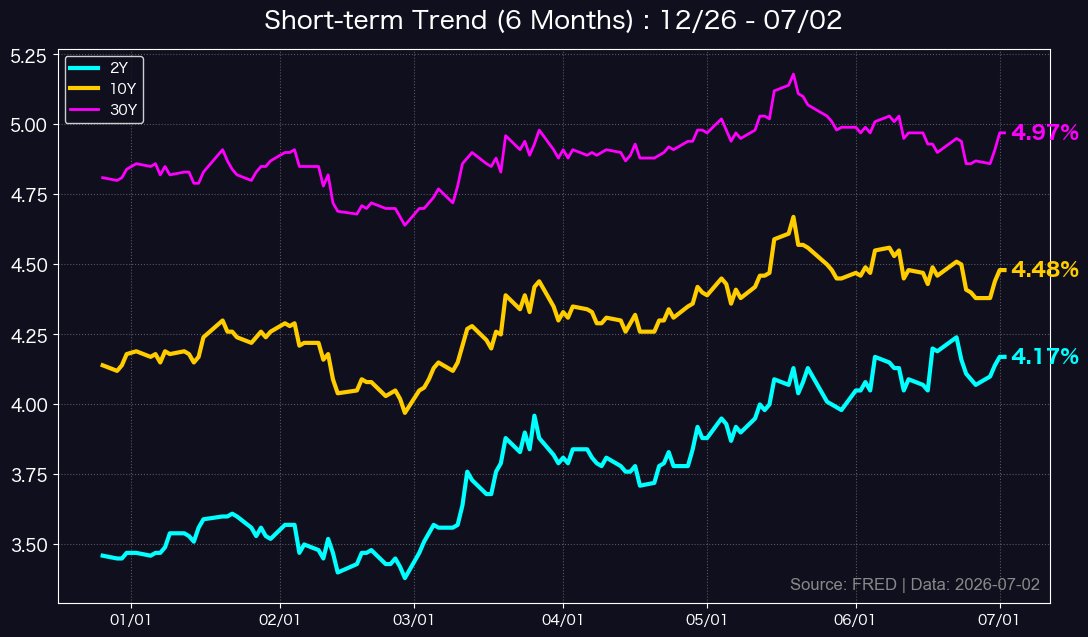
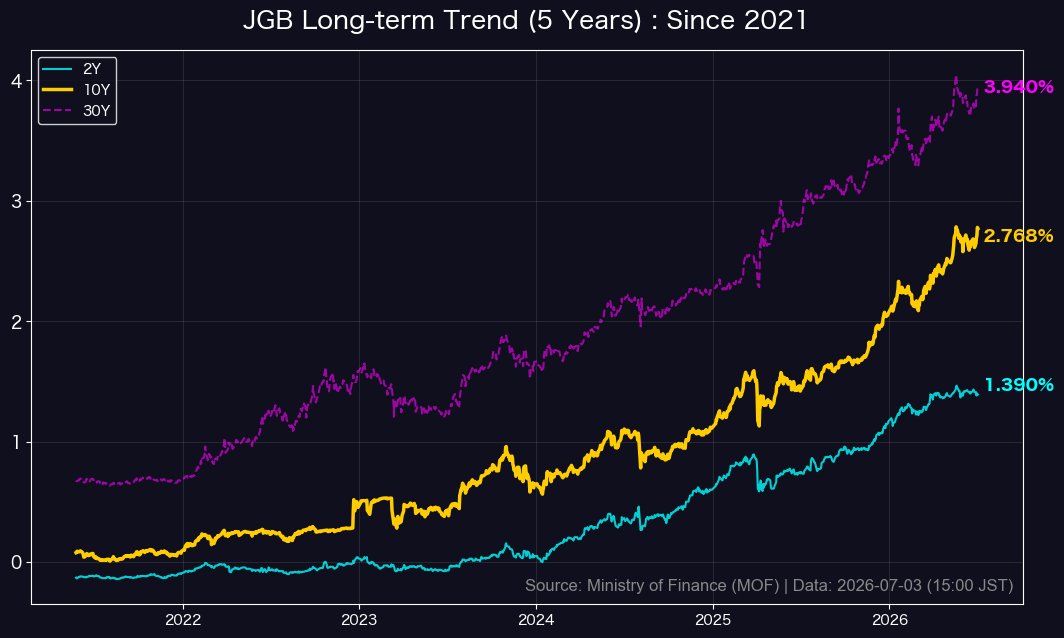
As of July 2, 2026, government bond yields moved higher across the board. The 10-year US Treasury reached 4.48%, up 7 basis points on the week. Germany's Bund rose to 2.93%, also up 7bp, and the UK Gilt climbed to 4.74%, up 6bp. But the standout mover was Japan. The JGB 10-year yield jumped 14 basis points to 2.78%, and the 30-year rose 16bp to 3.94% — the largest weekly moves among all markets compared here. As a result, Japan's 10-year minus 2-year term spread widened from 1.22 to 1.38 percentage points. The US equivalent held flat at 0.31 percentage points, keeping its curve normally sloped.
#JGB #MacroEconomics #NFC_Market_Live
(4/5)
Japan's government bonds now stand at 1.40% for 2-year, 2.78% for 10-year, and 3.94% for 30-year. Week over week, the 2-year fell 2 basis points while the 10-year rose 14bp and the 30-year rose 16bp — gains concentrated at the long and super-long end. The 10Y-2Y term spread widened from 1.22 to 1.38 percentage points. The BOJ policy rate stood at 0.73% as of May 2026. Auction data shows a sharp contrast: the 2-year auction on June 30 saw its bid-to-cover ratio improve from 3.70x to 4.82x with a narrower tail, while the 10-year auction on July 2 saw its ratio fall from 3.53x to 3.13x, with the tail widening from 0.7bp to 2.6bp. The 20-year and 30-year showed similar softening. This front-end strength versus long-end softness underpins the widening term spread.
#JGB #MacroEconomics #NFC_Market_Live
🧵 【日本国債・金利ウォッチ週次 The Deep Dive】詳細解説スレッド (1/8)
2026年6月、財務省は2年から30年まで5本の利付国債入札を実施した。結果を貫くキーワードは需給の二極化だ。10年国債の落札利回りは平均2.649パーセント。流通市場の10年金利は月末に2.69パーセントと、1990年代後半以来となる水準に到達した。一方、月間の金利変化そのものは小幅であり、織り込みが急速に進んだ春と比べれば表面上は静かな月だった。しかし入札の内側を見ると、超長期ゾーンの買い手の慎重姿勢が数字としてはっきり表れている。今回は、一般ニュースでは報じられない応札倍率とテールのデータから、この静けさの下で何が起きているのかを解読していく。
#日本国債 #国債入札 #NFC_Market_Live






![NFCMarketLive's tweet photo. 🧵 [Thread 1/5]
As of July 2, 2026, government bond yields moved higher across the board. The 10-year US Treasury reached 4.48%, up 7 basis points on the week. Germany's Bund rose to 2.93%, also up 7bp, and the UK Gilt climbed to 4.74%, up 6bp. But the standout mover was Japan. The JGB 10-year yield jumped 14 basis points to 2.78%, and the 30-year rose 16bp to 3.94% — the largest weekly moves among all markets compared here. As a result, Japan's 10-year minus 2-year term spread widened from 1.22 to 1.38 percentage points. The US equivalent held flat at 0.31 percentage points, keeping its curve normally sloped.
#JGB #MacroEconomics #NFC_Market_Live](https://pbs.twimg.com/media/HMfyH2qbwAAo8yG.jpg)