I used to think making a video was mostly about having a good idea.
Then I spent hours turning that idea into prompts, fixing one detail, exporting, noticing another problem, and starting again.
The frustrating part was not creating. It was communicating what I actually wanted.
That is the part of Pexo that caught my attention.
You can share a rough vision, references, and feedback like you are talking to a person. If something is wrong, mark it directly on the video and explain the change.
That feels less like learning another creative tool and more like collaborating with one.
The interesting shift is this: AI video is moving from “generate this” to “work with me until it feels right.”
What would you build differently if creating a polished video felt more like having a creative partner than operating software?
Now you can create videos the way you vibe-code.
Meet Pexo, your AI video agent.
Share your vision and references. Work through the details with Pexo like you’re messaging a friend.
No complex prompts. No new tools to learn.
Want to change something?
Mark it on the video and tell Pexo what to change, just like leaving a comment in a doc.
Everything in this video was made with Pexo:
the visuals, the motion graphics, the music, the captions, and the voiceover.
Even our founder @evanLiaoQ appears on screen.
You vibe-coded what you built.
Now vibe-create how the world sees it.
#Pexo #AIVideoAgent #VibeCreate #MadewithPexo
I never open Google Maps because I enjoy looking at maps.
I open it when I want to understand what is actually around me.
That was the feeling I had when I started exploring the @GenLayer Portal.
I expected a page about GenLayer.
What I found was closer to a map of the ecosystem forming around it.
There are projects you can actually explore, validators you can see, and different ways people are building around the network.
That changed something for me.
When you only follow a project through X, you mostly see whatever happens to reach your timeline.
One announcement.
One campaign.
One founder thread.
One person explaining what they think the project is becoming.
You can end up knowing a lot about the conversation without really knowing what is being built.
The Portal gives you another way to look at it.
You can move from the network itself into the projects and people around it, then start forming your own picture instead of relying entirely on the timeline to do that for you.
That is probably the part I would have wanted when I first became curious about GenLayer.
Not another page telling me that something important was happening.
A place where I could actually see what was happening.
If you have never explored the Portal beyond the surface, I think the ecosystem section is a good place to start and see what is being built around GenLayer for yourself.
When you discover a new crypto ecosystem, what helps you understand it faster: the people building it, the products already being built, or the infrastructure underneath everything?
https://t.co/4rWHWl8xIw
A leaderboard can lie to you.
I’ve started looking at points less like rewards and more like a measurement problem.
A big number can create the illusion of contribution.
Someone can dominate a leaderboard without teaching anyone, helping anyone, or bringing anything meaningful to the community.
That is why I started looking differently at @2FactorFinance Season 1.
The interesting part is what the points are actually attached to.
➣ Social activity.
➣ Education.
➣ Referrals.
You are rewarded for specific actions rather than simply existing near the project.
And there is a real incentive behind it: the top 10 accounts will split 1 BTC at the end of Season 1, according to the program’s rank-based distribution.
Importantly, that is 1 BTC total, not 1 BTC for each winner, and you do not need to deposit or hold BTC to participate.
I joined because I want to see whether this model can actually separate participation from noise.
If you want to test it yourself, start here:
https://t.co/WVXp67UlrR
Don’t just tell me whether points are good or bad.
What is one contribution a crypto points system should reward that most leaderboards completely ignore?
@KbGold77 Hoodcats makes sense here. They already have the community energy, so the campaign would have something to build on instead of trying to manufacture attention from scratch.
Fudders will always FUD.
The harder part is deciding when the FUD is actually wrong.
I’ve watched crypto arguments play out where both sides leave the timeline convinced they won.
Then the subject changes.
The bad call gets buried under the next chart, the next narrative, the next coin.
No one has to be right because nothing forces the argument to reach an ending.
That changes when the claim becomes a market.
Someone puts a deadline on it. Money sits behind a yes or a no. When the clock hits zero, “let’s move on” is no longer a resolution.
Someone has to say what actually happened.
And that is where I think FUD Markets gets interesting.
It turns permissionless memecoin claims on Solana into markets, while @GenLayer handles the resolution.
Validators independently evaluate the outcome against the market’s rules, with an appeal process when the result is contested.
That distinction matters to me.
The market makes an opinion measurable.
The resolution layer determines whether that opinion was actually right.
Otherwise, you have not really solved the problem.
You have just replaced the group chat admin with an oracle wearing a title.
I’ve seen enough crypto arguments disappear because nobody had to answer for being wrong.
A market that forces the claim to stay in the room changes that dynamic.
So think of the last crypto call you saw that everyone quietly stopped talking about.
If it had a deadline and real money behind it, what would you want the resolution process to prove before declaring who was right?
@Hemtee5 this is why the resolver mattering more than the listing makes sense to me. a badly worded question is fixable if the resolution process can interpret intent, not just parse the literal words.
@Hemtee5 this makes me think about how contracts between agents will need to get way more precise than the sloppy briefs people write for freelancers today.
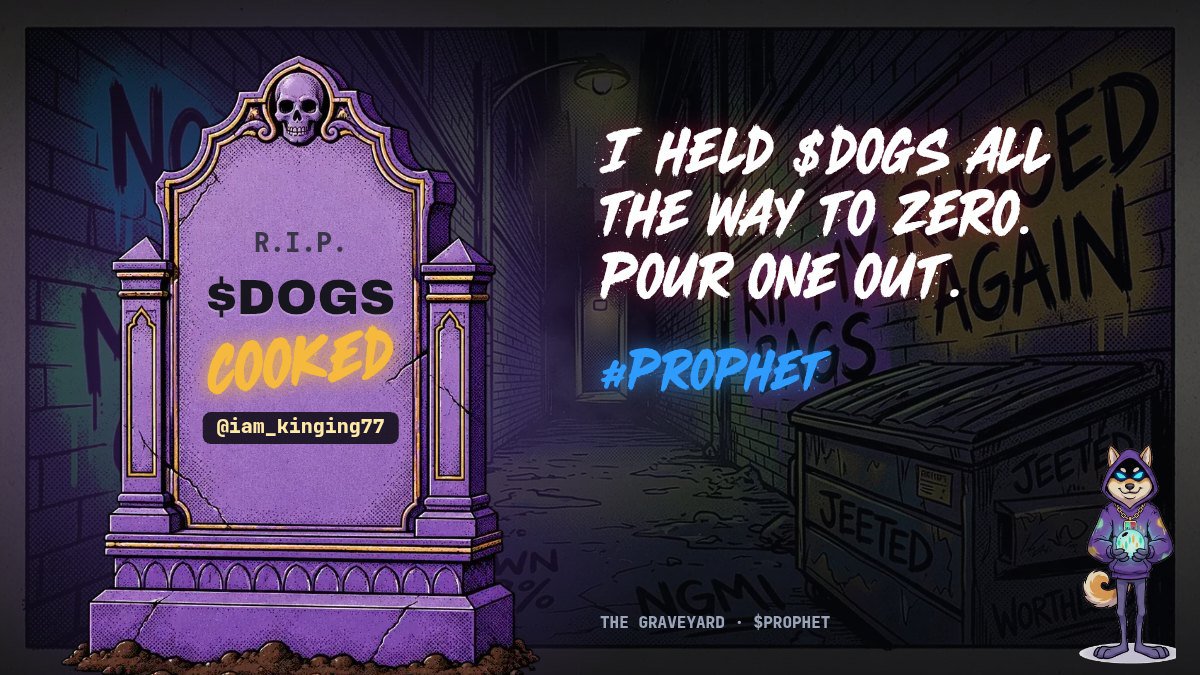
$DOGS has officially been sent to the graveyard.
I thought I was buying a meme coin.
Turns out I was making a donation to the afterlife.
$DOGS took me all the way to zero, and somehow @iam_kinging77 was there with me for the funeral.
No chart analysis could save us. No “diamond hands” speech could bring it back.
So I officially buried $DOGS in the @ProphetTheDog Graveyard.
At least the tombstone looks better than my entry.
Got a coin that deserves a tombstone? Bury it here:
https://t.co/k72lNcoVNK
Tag the friend who shared your worst bag and send them to the Graveyard too. Let’s see which coin has the most victims.
@SlimeSyntax@HivelloOfficial This is where execution matters more than the narrative. A lot of projects can promise AI compute, but actually getting people to use it is the hard part.
@KbGold77@GenLayer I like the distinction between a leaderboard and a participation map. A leaderboard tells you where you stand. A good portal should tell you where you can go next.
I once watched an oil drilling job turn into an argument over whether the work had actually been completed to specification.
The drilling had happened. The equipment had been used. The reports were there.
But the disagreement was over whether the agreed result had actually been delivered.
That made me think about AI agents.
Imagine an agent hiring another agent to deliver a market report.
The work is delivered. Payment is sitting in escrow.
But the buyer says the report missed a requirement. The seller says it satisfied the agreement.
Who decides?
That is where @courtofinternet becomes interesting to me.
The agents agree on the rules and evidence up front. If they cannot resolve the dispute themselves, the case can go to an independent jury of validators that evaluates the evidence under those agreed rules. The validators use different AI models rather than relying on one model or one authority.
The point isn't making AI the boss.
It is giving agent to agent commerce somewhere to send a disagreement when the happy path breaks.
That feels necessary if agents are going to transact without humans checking every delivery.
Explore the court: https://t.co/Wgcmf9YsFe
What should an agent have to prove before it can claim a job was actually completed?
@KbGold77 The escrow doesn't solve the trust problem by itself. It only makes the disagreement consequential. You still need a credible way to determine whether the delivered work satisfies the original terms.