This is an email I sent earlier today to all employees at Coinbase:
Team,
Today I’ve made the difficult decision to reduce the size of Coinbase by ~14%. I want to walk you through why we're doing this now, what it means for those affected, and how this positions us for the future.
Why now
Two forces are converging at the same time. We need to be front footed to respond to both.
First, the market. Coinbase is well-capitalized, has diversified revenue streams, and is well-positioned to weather any storm. Crypto is also on the verge of the next wave of adoption, with stablecoins, prediction markets, tokenization, and more taking off. However, our business is still volatile from quarter to quarter. While we've managed through that cyclicality many times before and come out stronger on the other side, we’re currently in a down market and need to adjust our cost structure now so that we emerge from this period leaner, faster, and more efficient for our next phase of growth.
Second, AI is changing how we work. Over the past year, I’ve watched engineers use AI to ship in days what used to take a team weeks. Non-technical teams are now shipping production code and many of our workflows are being automated. The pace of what's possible with a small, focused team has changed dramatically, and it's accelerating every day.
All of this has led us to an inflection point, not just for Coinbase, but for every company. The biggest risk now is not taking action. We are adjusting early and deliberately to rebuild Coinbase to be lean, fast, and AI-native. We need to return to the speed and focus of our startup founding, with AI at our core.
What this means
To get there, we are not just reducing headcount and cutting costs, we’re fundamentally changing how we operate: rebuilding Coinbase as an intelligence, with humans around the edge aligning it. What does this mean in practice?
- Fewer layers, faster decisions: We are flattening our org structure to 5 layers max below CEO/COO. Layers slow things down and create coordination tax. The future is small, high context teams that can move quickly. Leaders will own much more, with as many as 15+ direct reports. Fewer layers also means a leaner cost structure that is built to perform through all market cycles.
- No pure managers: Every leader at Coinbase must also be a strong and active individual contributor. Managers should be like player-coaches, getting their hands dirty alongside their teams.
- AI-native pods: We’ll be concentrating around AI-native talent who can manage fleets of agents to drive outsized impact. We’ll also be experimenting with reduced pod sizes, including “one person teams” with engineers, designers, and product managers all in one role.
In short: AI is bringing a profound shift in how companies operate, and we’re reshaping Coinbase to lead in this new era. This is a new way of working, and we need to leverage AI across every facet of our jobs.
To those who are affected
I know there are real people behind these decisions — talented colleagues who have poured themselves into this company and our mission. To those of you who will be leaving: thank you. You’ve helped build Coinbase into what it is today, and I am sincerely grateful for everything you've done.
All impacted team members will receive an email to their personal account in the next hour with more information, and an invitation to meet with an HRBP and a senior leader in your organization. Coinbase system access has been removed today. I know this feels sudden and harsh, but it is the only responsible choice given our duty to protect customer information.
To those affected, we will be providing a comprehensive package to support you through this transition. US employees will receive a minimum of 16 weeks base pay (plus 2 weeks per year worked), their next equity vest, and 6 months of COBRA. Employees on a work visa will get extra transition support. Those outside of the US will receive similar support, based on local factors and subject to any consultation requirements.
Coinbase prides itself on talent density. Our employees are among the most talented people in the world, and I have no doubt that your skills and experience will be highly sought after as you pursue your next chapters.
How we move forward
To the team that is staying, I know this is a difficult day. We’re saying goodbye to colleagues and friends you've been in the trenches with. But here’s what I want you to know as we move forward together:
Over the past 13 years, we have weathered four crypto winters, gone public, and built the most trusted platform in our industry. We’ve made it this far by making hard decisions and by always staying focused on our mission. This time will be no different – nothing has changed about the long term outlook of our company or industry. And most importantly, our mission has never been more important for the world. Increasing economic freedom requires a new financial system, and we’re building it.
The Coinbase that emerges from this will be more capable than ever to achieve our mission.
Brian
So you’re telling me World Liberty Financial (WLFI)
a project linked to the Trump family
deposited billions of its own tokens, used them as collateral
and borrowed tens of millions against it
inside a protocol where it controls most of the liquidity
This happened on April 9, 2026
- around 5 billion WLFI tokens used as collateral
- $75 million borrowed in stablecoins
- all through the Dolomite lending protocol
- WLFI represents around 55% of the entire protocol liquidity
So how does that even work
They deposit their own token, borrow stablecoins against it and keep the position open as long as the price holds
But here’s where it gets uncomfortable
- the main stablecoin pool is used at around 93%
- meaning most liquidity is already borrowed
- retail users could struggle to withdraw
- funds inside the system start to feel “locked”
And it gets worse
Dolomite was co-founded by someone connected to WLFI
meaning the borrower and the infrastructure are linked
same circle on both sides of the trade
Then you have this
- over $40 million moved to Coinbase Prime
just hours before a major Trump-related geopolitical announcement
The team denies everything
But if it’s real
then it’s a closed loop
where the same circle is providing liquidity
borrowing from it and holding it up at the same time
Insane crime
Today is a monumentous day for quantum computing and cryptography. Two breakthrough papers just landed (links in next tweet). Both papers improve Shor's algorithm, infamous for cracking RSA and elliptic curve cryptography. The two results compound, optimising separate layers of the quantum stack. The results are shocking. I expect a narrative shift and a further R&D boost toward post-quantum cryptography.
The first paper is by Google Quantum AI. They tackle the (logical) Shor algorithm, tailoring it to crack Bitcoin and Ethereum signatures. The algorithm runs on ~1K logical qubits for the 256-bit elliptic curve secp256k1. Due to the low circuit depth, a fast superconducting computer would recover private keys in minutes. I'm grateful to have joined as a late paper co-author, in large part for the chance to interact with experts and the alpha gleaned from internal discussions.
The second paper is by a stealthy startup called Oratomic, with ex-Google and prominent Caltech faculty. Their starting point is Google's improvements to the logical quantum circuit. They then apply improvements at the physical layer, with tricks specific to neutral atom quantum computers. The result estimates that 26,000 atomic qubits are sufficient to break 256-bit elliptic curve signatures. This would be roughly a 40x improvement in physical qubit count over previous state-of-the-art. On the flip side, a single Shor run would take ~10 days due to the relatively slow speed of neutral atoms.
Below are my key takeaways. As a disclaimer, I am not a quantum expert. Time is needed for the results to be properly vetted. Based on my interactions with the team, I have faith the Google Quantum AI results are conservative. The Oratomic paper is much harder for me to assess, especially because of the use of more exotic qLDPC codes. I will take it with a grain of salt until the dust settles.
→ q-day: My confidence in q-day by 2032 has shot up significantly. IMO there's at least a 10% chance that by 2032 a quantum computer recovers a secp256k1 ECDSA private key from an exposed public key. While a cryptographically-relevant quantum computer (CRQC) before 2030 still feels unlikely, now is undoubtedly the time to start preparing.
→ censorship: The Google paper uses a zero-knowledge (ZK) proof to demonstrate the algorithm's existence without leaking actual optimisations. From now on, assume state-of-the-art algorithms will be censored. There may be self-censorship for moral or commercial reasons, or because of government pressure. A blackout in academic publications would be a tell-tale sign.
→ cracking time: A superconducting quantum computer, the type Google is building, could crack keys in minutes. This is because the optimised quantum circuit is just 100M Toffoli gates, which is surprisingly shallow. (Toffoli gates are hard because they require production of so-called "magic states".) Toffoli gates would consume ~10 microseconds on a superconducting platform, totalling ~1,000 sec of Shor runtime.
→ latency optimisations: Two latency optimisations bring key cracking time to single-digit minutes. The first parallelises computation across quantum devices. The second involves feeding the pubkey to the quantum computer mid-flight, after a generic setup phase.
→ fast- and slow-clock: At first approximation there are two families of quantum computers. The fast-clock flavour, which includes superconducting and photonic architectures, runs at roughly 100 kHz. The slow-clock flavour, which includes trapped ion and neutral atom architectures, runs roughly 1,000x slower (~100 Hz, or ~1 week to crack a single key).
→ qubit count: The size-optimised variant of the algorithm runs on 1,200 logical qubits. On a superconducting computer with surface code error correction that's roughly 500K physical qubits, a 400:1 physical-to-logical ratio. The surface code is conservative, assuming only four-way nearest-neighbour grid connectivity. It was demonstrated last year by Google on a real quantum computer.
→ future gains: Low-hanging fruit is still being picked, with at least one of the Google optimisations resulting from a surprisingly simple observation. Interestingly, AI was not (yet!) tasked to find optimisations. This was also the first time authors such as Craig Gidney attacked elliptic curves (as opposed to RSA). Shor logical qubit count could plausibly go under 1K soonish.
→ error correction: The physical-to-logical ratio for superconducting computers could go under 100:1. For superconducting computers that would be mean ~100K physical qubits for a CRQC, two orders of magnitude away from state of the art. Neutral atoms quantum computers are amenable to error correcting codes other than the surface code. While much slower to run, they can bring down the physical to logical qubit ratio closer to 10:1.
→ Bitcoin PoW: Commercially-viable Bitcoin PoW via Grover's algorithm is not happening any time soon. We're talking decades, possibly centuries away. This observation should help focus the discussion on ECDSA and Schnorr. (Side note: as unofficial Bitcoin security researcher, I still believe Bitcoin PoW is cooked due to the dwindling security budget.)
→ team quality: The folks at Google Quantum AI are the real deal. Craig Gidney (@CraigGidney) is arguably the world's top quantum circuit optimisooor. Just last year he squeezed 10x out of Shor for RSA, bringing the physical qubit count down from 10M to 1M. Special thanks to the Google team for patiently answering all my newb questions with detailed, fact-based answers. I was expecting some hype, but found none.
Most of you know me as the retarded and goated dev, bagworker/believer or trader I am
18, Employed & still in school making ~500k from crypto in the past 6 Months
But for about ~1 Year now I'm fighting demons I've not managed to defeat
After beeing at broke all summer 2025, and beeing -8,000€ in debts I managed to pay off my debt after making my first 5 & 6 Figs from Crypto in 4 Weeks (Sept/Oct. 2025)
I turned that 6 figs into ~260k$ Trading in november
But 1 Month later, 1 Day before christmas? I was at dead zero again.
Gambled every single penny, every single sidewallet, stables, holdings, oneclipped every conviction play in 2 Nights without sleeping a single minute between two Workdays where I sat shaking in my office
But I decided to lock in harder than ever before, built myself up from the ground, hit a nice small 5 Fig play, and turned that 20k$ into 220k$ in the trenches again.
I was so fking happy to make it all back this fast.
In June I will finally have my last day at Work/School....
I was thinking about the summer vacations I can afford now.
Bought a nice watch, and actually "lived" for a few weeks after turning 18 and I was finally able to travel independently, etc. On top of that, I was ~ 2 Months completley gambling free.
But what happens when the "few weeks off" are over and you fall back into old habits? Beeing depressed at your 9-5 all day, isolating yourself in your own room for months? Not going outside? Doing nothing with friends or family anymore?
A few weeks later I had a relapse, had a small win, and wanted to "call it a day."
A few days ago I tweeted, "The people who never won big at the casino don't even realize how lucky they are."
Let me explain this: since the year I've been dealing with my gambling addiction, I've lost all enjoyment in everything else in my life.
No walks, no motivation, no sports, no training, no gaming, no chill weekends with friends, no good food or appetite, nothing. Nothing felt real anymore because it didn't give my brain what the casino gave me.
Addicts (whether to drugs or gambling) lose interest in everything else in their lives, and with gambling, it's a constant "hunt for dopamine" until it becomes a "hunt for what you've lost."
How did it end?
After that relapse, I gambled 4-5 times a day for 4-12 hours each day, for 1-2 months, without any relation or attachment to the money and while I was experiencing severe withdrawal symptoms. I knew it would end badly, so I transferred almost everything I had to my Ledger and gave it to my parents (who knew nothing about my addiction).
Offcourse, that didn't work, because an addict always finds excuses and ways.
I've had good and bad phases, but after almost every heavy trading loss, I tried to gamble the loss back at the casino. Most of the time it worked, sometimes it didn't.
In the past three days, I've gambled away my entire portfolio again, every single penny I had.
I wouldn't wish on my worst enemy to go to school/work the day after he'd rinsed the yearly salary of all your colleagues in 30 seconds, and had to pretend everything was okay and keep answering his emails for the company that pays you 700€ a month.
What I want to tell you all with this tweet:
Get a life outside of crypto, you need a second IRL activity that you can focus on. Your goal should be to Lifemaxx. Eat clean, get a clear had everyday, and dont destroy your dopamine receptors with cheap doomscrolling, gooning, fastfood or gambling. NEVER GET BORED
Never, ever touch a casino. (not 5$, not 50$ and not 1000$+)
The second your brain is taught that it's possible to turn $500 into $1,000 in 2 seconds, or $10 into $10,000, your brain may never recover from that.
Block every single user and bastard who promotes any kind of casino.
Never press the "Increase Bet" button. Whether you win or lose, your next bet will be at least the same amount or more than the previous one. (To chase your loss or chase the next dopamine hit, because a lower bet doesnt give you the same feeling anymore)
Don't tell everyone about your money, and don't get excited about the numbers on your phantom wallet until you've converted them into cash, physical items, or numbers in your bank account.
Never touch the hand of the devil bros.
God can take everything from you faster than He can gave it to you.
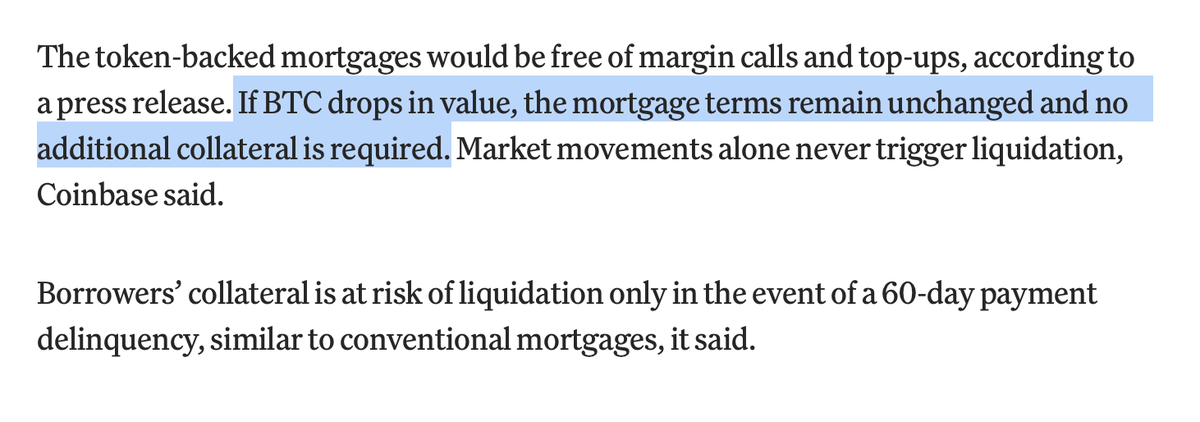
COINBASE: NO MARGIN CALLS FOR BITCOIN-BACKED MORTGAGES
Coinbase says its crypto-backed mortgages will carry rates around 0.5% to 1.5% higher than a standard 30-year, depending on borrower profile.
Loans feature no margin calls or collateral top-ups.
BTC price drops do not change loan terms or trigger liquidation.
Collateral is only at risk after 60 days of missed payments, aligning with traditional mortgage standards.
is there a way to test this and determine how much your energy bill would be affected, what the MoM returns would be in comparison and how long it'd take to b/e considering you are also utilizing the energy for everyday use?
WATER HEATER PAYS YOU IN BITCOIN
Superheat unveils a $2,000 electric water heater that mines Bitcoin.
The unit uses the same energy as a standard heater but runs ASIC miners to recoup costs, offsetting water heating bills.
BREAKING: US oil prices fall over -16% on the day and officially drop below $80/barrel.
Geopolitical risk premiums are being rapidly priced-out.
The oil market says the war is ending.