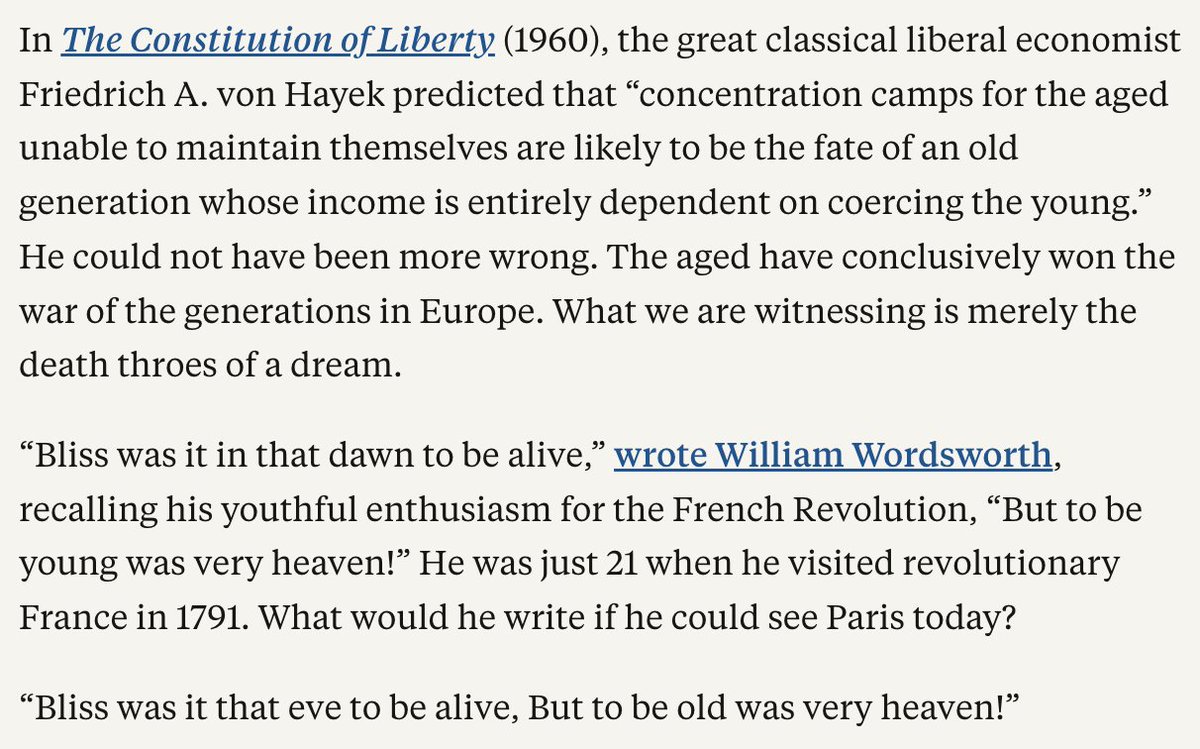
This really is one of @BillMaher’s best-ever monologues, and I don’t say that just because I got a namecheck. Tldr: Socialism is what old people already get and young people want a piece of it.
Hoover Senior Fellow @NFergus rejects the reading that Europe's riots are migrants running amok, "the sack of Rome all over again."
Ferguson argues that Europe's youth are angry about the wrong thing, and that the real grievance is a welfare system that moves resources from the young to the old.
Watch GoodFellows on Hoover+: https://t.co/vMv5bRErUs
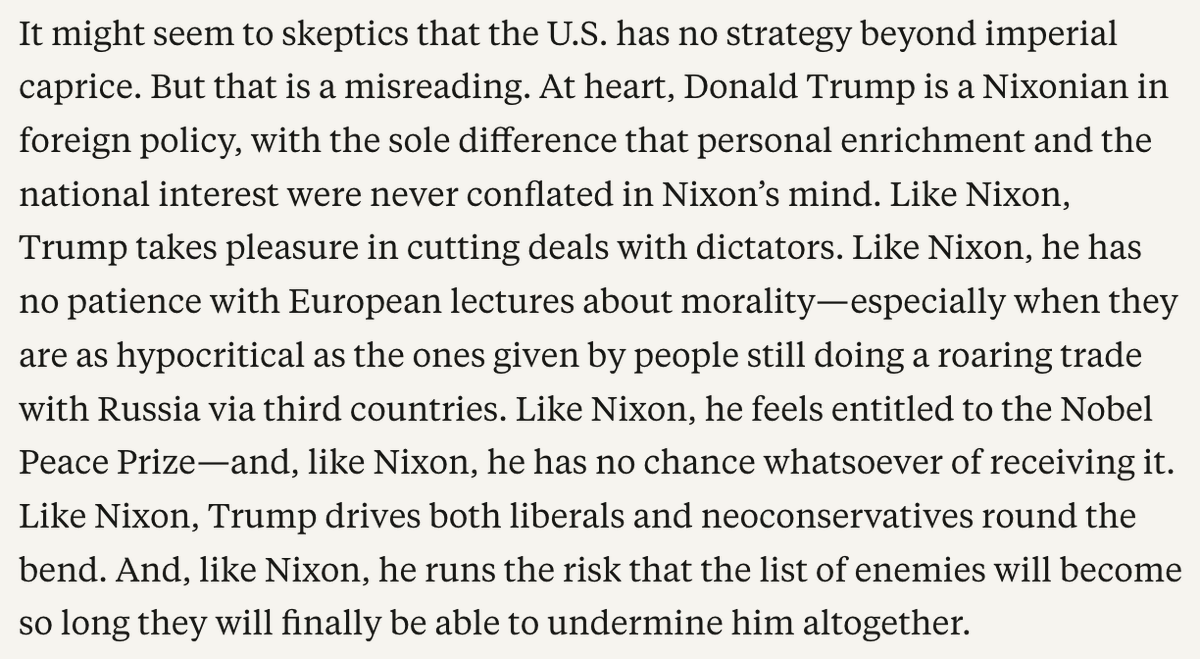
If you’re confused by President Trump’s approach to the Ukraine war, don’t fret. Instead, look to Richard Nixon.
Read @nfergus's latest piece here: https://t.co/WZsw8edfFc
In a new installment of Reflections, Hoover Senior Fellow @NFergus examines the devastating human toll of World War I through the Hoover Institution Library & Archives' extensive collection of photographs and historical records.
Ferguson recounts the horrors of trench warfare on the Western Front, in particular the staggering casualties of the Battle of the Somme, and the experiences of his own grandfather, who survived a German gas attack. Recalling Wilfred Owen's phrase "the pity of war," which inspired the title of Ferguson's 1998 book on World War I, he reflects on the conflict's human legacy.
He also traces the Hoover Institution's origins to Herbert Hoover's wartime relief efforts and his determination to preserve the historical record of war, revolution, and peace for future generations.
Watch on Hoover+: https://t.co/2WgvriiMdW
Georgetown University computer scientist Cal Newport joins Hoover Senior Fellows @NFergus, @LTGHRMcMaster, and @JohnHCochrane, as well as moderator @BillWhalenCA, on GoodFellows to lay out what Congress should be asking AI leaders.
After that, the fellows unpack what's fueling the fiery riots across Western Europe and what compelled President Trump to threaten Ukraine with blocked access to Starlink.
In the "Lightning Round," they discuss their Hoover colleague Robert E. Hall receiving a Nobel Prize, America's midterm elections, and whether they will be buying Elon Musk's "flying" roadster.
Watch on Hoover+: https://t.co/jyHEo5rKh2
@YelingT .@nfergus, Lisa Klaassen, and @ericschmidt argue that AI is an inherently imperial technology—and explore what past empires can tell us about the future of U.S.-Chinese competition.
https://t.co/iz7q8EuAED
The reputational destruction of Prof. David Sabatini was one of the worst excesses of the Great Awokening / Me-Too era. @BillAckman acted bravely in offering him support when the entire academic establishment cancelled him. Without his efforts, the complete absence of due process in his treatment by @MIT might never have come to light. The question I am left with: Will those whose misconduct has finally been exposed pay anything like the price they imposed on Sabatini? Will they be fired? Will their reputations be destroyed? They deserve it. He did not.
Five years ago, an important miscarriage of justice occurred.
The story began in April 2018 when David Sabatini, an MIT, Howard Hughes Medical Institute (HHMI), and Whitehead Institute scientist and professor began a consensual intimate relationship with Dr. Kristin Knouse, a principal investigator with her own lab at the Whitehead.
By January 2020, David sought to end the relationship, but Knouse apparently did not want it to end. When David thereafter started a new relationship and Knouse learned about it, she began a secretive campaign to destroy him by attempting to end his career as a scientist. She did so by damaging his name, reputation, and that of his family with false sexual harassment and other claims, thereby making him unemployable.
Knouse conspired with Dr. Ruth Lehmann, the then- and still current Director (i.e., President) of the Whitehead Institute, in her efforts to destroy Sabatini.
The record presented in court demonstrated that Dr. Lehmann committed to Knouse in October of 2020 that she would fire David. Dr. Lehmann made this commitment to Knouse before any investigation of the facts had taken place.
Seven months after committing to fire him, in March of 2021, Dr. Lehmann, on behalf of the Whitehead, hired the law firm of Hinckley, Allen, Snyder (HAS) to undergo an investigation of David. By July 2021, HAS shared a draft of its conclusions with MIT, HHMI, and the Whitehead, but not with David or his lawyers.
On the morning of August 19, 2021, David for the first time received the more than 200-page investigative report and a calendar invite for a meeting the following day with Dr. Lehmann, the president of HHMI, and the HR directors of both institutions. The report was riddled with errors and unsupported claims about David and his relationship with Knouse.
When David's lawyer immediately thereafter reached out to Whitehead counsel to ask whether David was about to be fired, they confirmed that he would be terminated at the meeting.
On the advice of his lawyer, David immediately resigned from HHMI and the Whitehead rather than attend the meeting. HHMI did not accept his resignation, choosing instead to fire him. MIT put David on leave and ultimately revoked his tenure. David thereafter resigned from MIT.
On August 20, 2021, one day after sending David the HAS report and before David had the opportunity to dispute the facts and the conclusions of the investigation, Dr. Lehmann emailed all employees at the Whitehead informing them that David had violated a number of Whitehead policies "including policies concerning sexual harassment."
The Lehmann public email, David's resignation and firing, and Dr. Lehmann's claims about David's sexual harassment exploded into a major global scandal covered in mainstream, social, and scientific media around the world as it had all of the requisite ingredients:
An attractive target with David, one of the most important scientists of his generation in line for the Nobel Prize, a purported inappropriate sexual relationship with a younger female colleague, and a political and institutional environment where punishing a man for sexual harassment advanced the career and reputation of the person and/or institution that destroyed the career and reputation of the accused, regardless of the validity of the allegations.
As a result of Knouse's claims, Lehmann's sham investigation, and the media onslaught that followed, David lost all sources of income and his reputation was destroyed. All prizes he had been previously been awarded were withdrawn. He was removed from all scientific advisory and other honorary roles other than as a member of our family foundation's (the Pershing Square Foundation's) scientific advisory board.
When I initially learned of the news about David in the summer of 2021, I hired him as a consultant to the Pershing Square Foundation as I believed our small foundation team would benefit greatly by his insights (and he now had the time to help us), and he needed the money to support his family.
At my request and under a confidentiality agreement, David provided us with many hundreds of pages of documents including texts and other communications with Knouse, the investigative report, and David's responses to the allegations so that we could do our own evaluation of Knouse's claims.
I and a member of our family office's legal team carefully reviewed the documents. After a careful review of the empirical documents -- in particular the texts between Knouse and David -- it became abundantly clear that Knouse's actions were that of an angry and jilted lover, not those of a sexually harassed junior colleague. And the investigative report appeared designed to deliver a pre-ordained conclusion rather than a dispassionate fact-based analysis.
The impact of the firings and the destruction of his career and reputation on David and his family was extraordinarily devastating, so much so that we became increasingly concerned that he might commit suicide.
[In order to make sure that David's important scientific research would continue, in February 2023, in partnership with an anonymous donor, we funded $25 million to support David launching a new lab. As you might expect, I was reviled in the press, in scientific journals, and on social media for doing so and for supporting a so-called sex offender.]
On October 20, 2021, David filed suit against Knouse alleging defamation and tortious interference in his career and his contractual arrangements. Thereafter, Knouse brought counterclaims against David.
Today, nearly five years to the date of the filing of the suit, he has finally received justice.
Today, a 13-person jury (seven men and six women) of David Sabatini's peers (12 jurors plus an alternate) unanimously determined that David proved that Kristin Knouse defamed him, tortiously interfered with his contractual relationships (his entire career as a scientist), and tortiously interfered with his prospective advantageous relationships (his future employment). The jury awarded him nearly $10 million in damages including interest.
The jury rejected all of Knouse's claims including her claims that David engaged in quid pro quo sexual harassment and created a sexually hostile work environment.
While five years is a very long time to live under a reputational cloud, justice was finally served today for David, but not completely in my view.
To this day, Dr. Ruth Lehmann remains Director of the Whitehead Institute. Dr. Lehmann worked alongside Dr. Knouse to destroy David Sabatini, an acclaimed scientist and professor. She did not follow due process before she intentionally destroyed David's career and reputation.
Dr. Lehmann nearly killed David with her actions, as had we not rescued David by finding him employment, supporting him publicly to buffer the reputational damage, and supporting his recovery, he could have ended his life and left his son without a father before the world understood what had transpired here.
And the reputational damage was not just to David.
David's brother, Bernardo Sabatini, is one of the most important neuroscientists in the world. To this day, he has had to deal with a large cloud over his family name and reputation. Recently, when the new CEO of our brain institute mentioned that Bernardo Sabatini was on our board, he was asked: "Wasn't he involved in some kind of sex scandal?"
For obvious reasons, the character of the person who runs a scientific institute is of utmost importance. Among other failures here, Dr. Ruth Lehmann committed to Knouse that she would fire David many months before an investigation was even launched and without consideration of the empirical facts.
How can one trust research produced by a scientific institute if its leader is not committed to observing the empirical facts before reaching conclusions that have life-threatening import? We have unfortunately seen massive amounts of scientific fraud which has harmed innumerable human lives and wasted billions of dollars of research funding and time.
For her ethical breaches here, Dr. Lehmann should be fired from the Whitehead. Based on her actions in this case, she is in no position to serve as the leader of an important scientific institute.
I speak with some perspective on how scientific and other institutions should be led. Including the recent launch of the Ackman Oxman Institute, we have funded approximately $1 billion of scientific research and institutions over the last decade or so, and this experience has given us the opportunity to meet the leadership of many of the most important scientific institutions in the world.
To put it plainly, we would not give a dollar to a scientific institute whose leader compromised basic moral principles as has happened here.
At an absolute minimum, the board of the Whitehead should immediately launch a detailed and independent investigation of Dr. Lehmann's actions in the Sabatini case. I would encourage the investigation, among other considerations, to carefully exam all of the correspondence between Lehmann and Knouse, as well their correspondence with the HAS law firm on among other areas, the various drafts of the Sabatini investigative report.
Alternatively, Dr. Lehmann could resign, minimize further distraction for the Whitehead, and save institutional time and resources that would be better spent on research that benefits humanity.
FOOL BRITANNIA by @EdConwaySky
While many countries face higher energy costs due to the events in the Middle East and Russia, few have seen quite as big a spike as Britain has. Industrial power costs are comfortably higher than in most developed nations, with domestic costs not far behind. To some extent, this is a function of bad luck and geopolitics. Britain is particularly dependent on natural gas to provide the critical baseload power for its electricity, not to mention much of its domestic heating.
But higher energy costs are also the product of policy. Britain pushed faster and further towards net zero (the goal of diminishing carbon emissions to close to nothing in net terms) than most of its peers. The ambition, held by Labour and Conservative governments, was that the UK should be the global leader in decarbonisation – the flag-bearer for net zero. In one respect, the enterprise was a stunning success – Britain is one of the fastest-decarbonising major economies in the world.
The main catch in – and the cardinal sin of – the make-things-cheap economy is how it affects energy bills. For all that Boris Johnson and Ed Miliband insisted (and as far as I can tell, sincerely believed) that renewables would mean lower costs, the opposite has happened. Unlike solar power, the cost of which fell precipitously as the Chinese mastered the mass production of arrays, wind power has remained comparatively expensive. And so Britain’s ambitious offshore wind programme happened largely thanks to a complex web of subsidies and price guarantees. Those interventions will lock in higher power costs in this country for years.
There is a point – most likely a decade and a half in the future – at which the savings from net zero (less spent on gas and fuels) should outweigh the costs of building all the necessary infrastructure. But for the time being, the policy is expensive – nearly £30bn a year for the next five years, which is the equivalent of an extra 5p on the basic rate of income tax. One of the main reasons net zero is becoming so controversial (and will likely get more controversial) is that the majority of those costs end up on consumer bills.
The other problem is that much of this decarbonisation was achieved through deindustrialisation. In the face of higher energy costs and rising environmental taxes, many manufacturers relocated overseas. Indeed, more than half of Britain’s carbon footprint is now accounted for by imported goods. Paradoxically, the more steel mills and chemicals plants shut down, the better the UK’s environmental credentials, since net zero plans ignore the embedded carbon in our imports and focus solely on what is puffed out of domestic flues and chimneys.
Cover art by Doug Chayka
Young Europeans have taken to burning garbage in the streets because they're being screwed, writes @NFergus. But they’re pointing their fingers at the wrong people.
Read his latest column here: https://t.co/90Gf03L2Xn