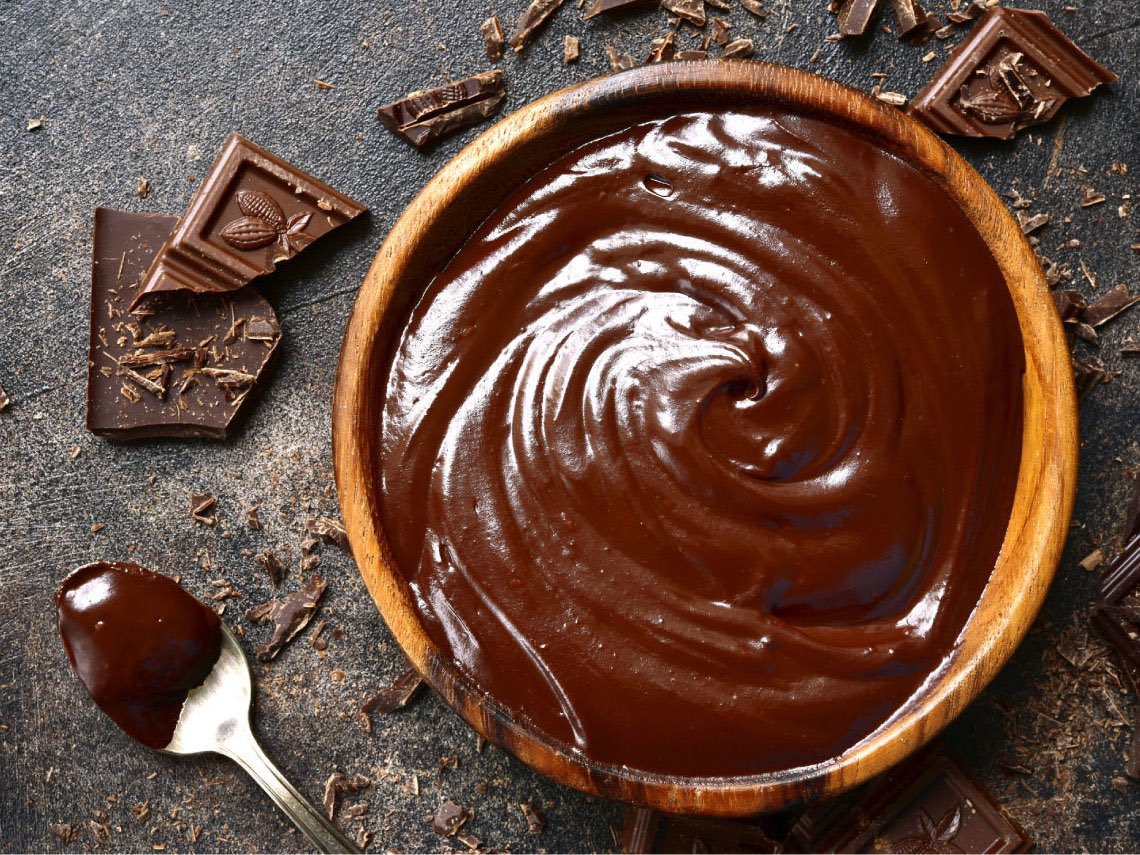
“Chocolate” fue la primera palabra que introdujo al diccionario la Real Academia Española procedente de Latinoamérica. Viene de “xocolatl" del náhuatl, la lengua de los aztecas y hoy aún hablada por 3 millones de personas.
Es la palabra más internacional que prestó el náhuatl.
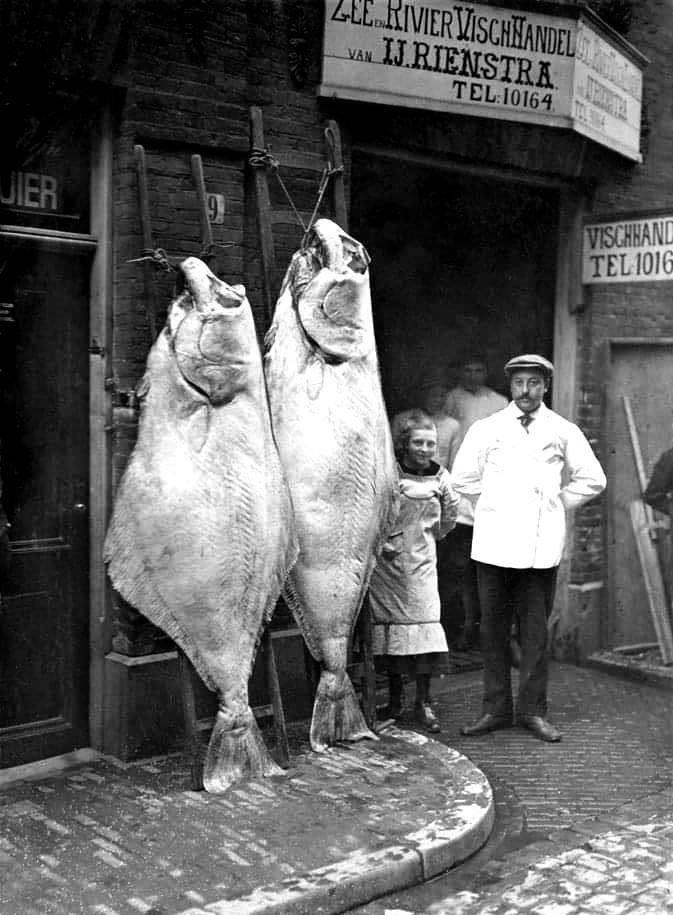
Those fish were impossible to ignore. A vendor displays two enormous halibut outside his shop in Amsterdam, 1913, using sheer size to draw in customers passing by.
Este es el modelo más detallado de una célula humana hasta la fecha, utilizando conjuntos de datos de rayos X, RMN y microscopía crioelectrónica.
La "Sección transversal del paisaje celular a través de una célula eucariota" de Evan Ingersoll y Gael McGill es una ilustración digital de alta precisión, basada en datos científicos reales y desarrollada para Cell Signaling Technology.
La imagen destaca por mostrar la alta densidad del citoplasma y la estructura molecular detallada mediante técnicas de criomicroscopía electrónica.
El arte de la naturaleza.
A Persian scholar finished a single math book in 9th century Baghdad that quietly became the foundation for every line of code running on Earth today.
I started reading about him at midnight and could not believe how many things in my daily life trace back to one man.
His name was Muhammad ibn Musa al-Khwarizmi. The book is called The Compendious Book on Calculation by Completion and Balancing.
Every time you say the word algebra, you are saying his book title. Every time someone says the word algorithm, they are saying his name. Both English words come from him. Both are Latin transliterations of Arabic and of his own identity. The man did not just contribute to mathematics. He named it.
Here is the part almost nobody tells you.
Al-Khwarizmi was born around 780 CE in Khwarazm, in what is now Uzbekistan. He moved to Baghdad and worked at a research institution called the House of Wisdom, which during the Islamic Golden Age was the single most important center of learning on the planet. The caliph al-Mamun hired the best mathematicians, astronomers, and philosophers from across three continents and put them in one building with one job. Translate, study, and produce new knowledge.
Al-Khwarizmi finished his book on algebra around 820 CE. The Arabic title contained the word al-jabr, which referred to one of the two operations he used to solve equations. When the book was translated into Latin in the 12th century, the Latin world did not have a word for what he had built. So they kept his Arabic word. Al-jabr became algebra. The discipline was named after a single Arabic word in the title of a single book by a single man.
The deeper insight is what he actually changed about how humans think.
Before al-Khwarizmi, mathematical problems were solved geometrically. You drew shapes. You measured them. You compared areas. The Greeks had built an entire mathematical tradition on visual proofs and physical constructions. It was beautiful and limited. You could not solve a problem you could not draw.
Al-Khwarizmi did something nobody had done before him at this scale. He said you could solve any problem using abstract symbols and rules. You did not need a shape. You needed a procedure. You moved terms across the equation. You cancelled like terms on both sides. You isolated the unknown. He invented the idea that mathematics is a manipulation of symbols according to rules, not a study of physical figures.
That single shift made everything that came afterward possible. Calculus. Differential equations. Linear algebra. Quantum mechanics. None of it works if math is locked inside geometry. He pulled it out.
The second thing he did is the one that changed how the world counted forever. He took the Hindu numeral system from Indian mathematics, refined it, and wrote a book introducing it to the Arab world. That system included the concept of zero as a placeholder, and a positional notation where the value of a digit depends on its location. Roman numerals could not do complex calculation. Hindu-Arabic numerals could.
When his book on numerals was translated into Latin as Algoritmi de numero Indorum, the word Algoritmi was just the Latin spelling of his own name. Europeans started calling the new method "doing algorism," then "running an algorithm." The word for the most important concept in computer science is literally his name in Latin.
The third thing he did is the part that should haunt anyone who works in tech.
His method of solving problems was systematic. Step one, do this. Step two, check that. Step three, if condition A, then do X, otherwise do Y. He wrote down procedures that could be followed by anyone, anywhere, who knew how to read. The procedure did not depend on intuition or genius. It worked because the steps worked.
That is exactly what an algorithm is. A finite, deterministic procedure for solving a problem. He did not just give us the word. He gave us the entire concept of programming a thousand years before there was anything to program.
When Alan Turing built the first abstract model of computation in 1936, when John von Neumann designed the first stored-program computer in 1945, when every engineer at Google, OpenAI, Anthropic, and DeepMind writes code in 2026, they are working in a paradigm that started with one man in Baghdad twelve centuries ago.
The strangest part is what happens when you walk into any tech office in San Francisco or Bangalore or Lahore today. Engineers say the words algebra and algorithm hundreds of times a day. They do not know whose name they are saying. Almost nobody can spell al-Khwarizmi correctly on the first try.
His original Arabic manuscript is preserved at Oxford. His book on Hindu numerals survives only in Latin translation. The Latin version was the textbook that taught medieval Europe how to count.
The man who built the foundation of the AI revolution did not live to see a calculator. He died around 850 CE, a thousand years before the first electric current was sent through a wire. The civilization he built mathematics for collapsed. The library he wrote in burned. His own grave is unmarked.
But every algorithm running on every machine on Earth right now still answers to his name.
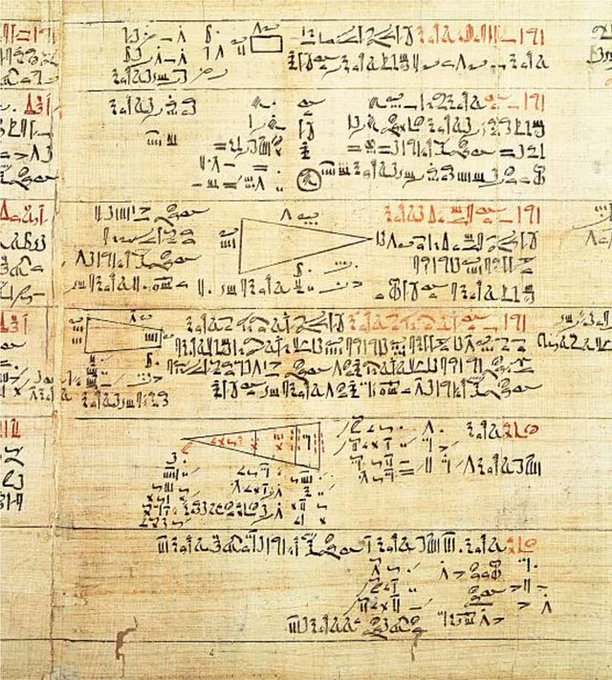
The Rhind Mathematical Papyrus is the oldest manuscript written in algebra and trigonometry, dating back to 3,550 years ago.
It shows that the Egyptians used first-order equations, geometric series and a second-order algebraic equation, related to the Pythagorean theorem a² + b² = c²
It also describes how to obtain an approximation of π accurate to within less than 1% and one of the earliest attempts at squaring the circle.
Delft, 29 januari 1584. Op het Prinsenhof werd Frederik Hendrik (zoon van De Zwijger) geboren. Net als zijn vader en halfbroer Maurits streed hij tegen de Spanjaarden tijdens de Opstand. Door zijn slimme tactiek van succesvolle belegeringen — in plaats van risicovolle veldslagen — verwierf hij de bijnaam ‘Stedendwinger’ 1/3
Vroeger waren de straten onverhard of lagen ze vol keien en kinderkopjes. Bij regen spatte modder en water op tegen de gevels. Door 60-100 cm van de gevel te schilderen met zwarte teer of verf, werd de muur beschermd tegen vocht en bleef de gevel schoon en mooi. Fijne dag!
Tijdens graafwerkzaamheden bij het idyllische #terpkerkje uit 1869 van het buurtschap #Homoet in de Overbetuwe ten zuidwesten van Arnhem zijn botresten en oude #funderingsstenen ontdekt. Mogelijk horen deze bij een eerdere kerk die hier al in 1732 stond.
https://t.co/mop55jcMrw
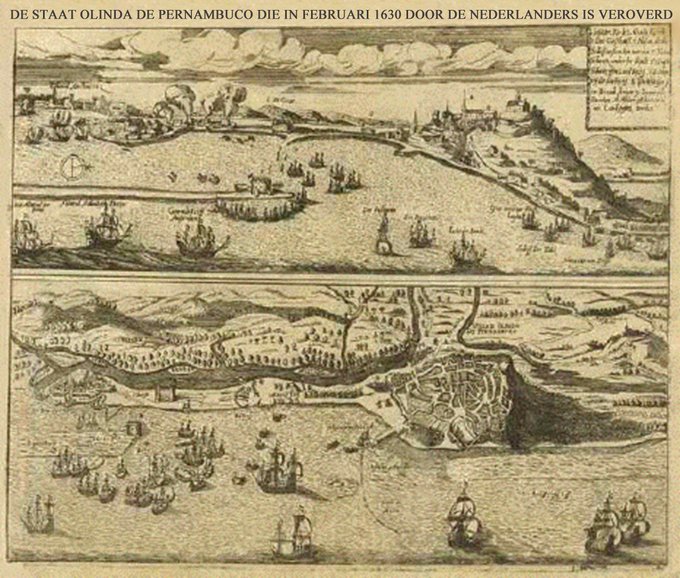
Op deze dag in 1631 staken Nederlanders de Braziliaanse stad Olinda in brand nadat ze de stad het jaar daarvoor hadden veroverd (zie afbeelding). Ze roofden de kostbaarheden en verplaatsten die naar het naastgelegen Mauritsstad (tegenwoordig: Recife)
Dordrecht, 24 november 1813. Op het gerucht van de nadering van geallieerde troepen verliet het Franse bezettingsleger halverwege november de stad. Maar toen de tegenstander wegbleef, probeerden ze Dordrecht weer in te nemen. Op deze prent is de beschieting van de Fransen te zien.