Businesses, professionals, and enthusiasts promoting Web3, digital assets, blockchain, and distributed ledger technology in New Hampshire. A 501(c)(6) org.
Good coverage by @NHBulletin on HB 639. A few additional points are worth highlighting.
HB 639 wasn't written to address hypothetical concerns. States like Vermont have already taken action against staking, arguing staking rewards were unregistered securities. This law provides important legal clarity for New Hampshire residents.
Another advantage is New Hampshire's trust industry, which administers over $1 trillion in assets. That existing legal framework could prove to be a significant competitive advantage as digital assets continue to evolve.
HB 639 is intentionally the "Blockchain Basic Laws." It's a foundation to build on, not the final chapter.
https://t.co/CWuPFB9X0B
🚨 EXCLUSIVE: ICD reconstructed the largest verified COLDCARD theft on-chain: 594.48 BTC drained from 500 addresses in 15 minutes and 18 seconds.
The attacker exploited a vulnerability by rebuilding COLDCARD's faulty seed generator on their own machine, produced the limited set of seeds it could ever have made, derived the Bitcoin addresses for each one, and checked them against the public blockchain. Every funded match was a live wallet, and the key to it.
The flaw: a March 2021 build error left COLDCARD building seeds from predictable device and clock values instead of true randomness, shrinking the pool of possible seeds from astronomical to searchable, about 40 bits on an Mk3, where 128 was intended. The PIN, the air gap and the secure element were all guarding a key that could be recreated from scratch.
Largest verified sweep: 594.48 BTC from 500 addresses in four blocks on 30 July, all it took was 15 minutes 18 seconds by block timestamps.
BREAKING: 🇺🇸 Senate Republicans just released an updated Clarity Act text after stakeholder briefings this morning.
The ethics package, negotiated with the White House and no Democrat sign-off, bans the President, VP, Members of Congress, federal judges and covered officials (plus spouses) from issuing or sponsoring digital assets for compensation while in office through January 20, 2029.
Covered officials must sell crypto holdings or place them in a blind trust.
DOJ gets civil enforcement power, including the ability to sue exchanges that list prohibited tokens.
BRCA and stablecoin yield sections remain unchanged, protecting non-custodial devs, self-custody rights, and barring interest on idle stablecoin balances.
A new law-enforcement section adds funding, training, a cyber center for nation-state threats, and freeze/seize authority for stablecoin issuers.
Bankruptcy rules keep customer assets out of an exchange’s estate.
Ethics remains the primary open issue as bipartisan talks continue.
Ownership means control.
HB 639, signed by @KellyAyotte last week, protects the right of New Hampshire citizens to self custody their digital assets, recognizing that individuals should be free to hold and control what they own without relying on a third party.
This is about property rights, innovation, and preparing New Hampshire for the future.
That's leadership. 🇺🇸₿
🚨 Today is another historic day for New Hampshire.
Governor @KellyAyotte has signed HB 639, the Blockchain Basic Laws, making New Hampshire home to one of the nation's strongest legal frameworks protecting blockchain innovation and digital asset rights.
The law protects self-custody, supports blockchain developers, miners, stakers, and node operators, and establishes a first-in-the-nation Blockchain Dispute Docket.
Thank you, Governor Ayotte, bill sponsor @KeithAmmon, legislative leaders, and everyone who helped make this landmark legislation possible.
New Hampshire continues to lead the nation in blockchain innovation.
Full press release ⬇️
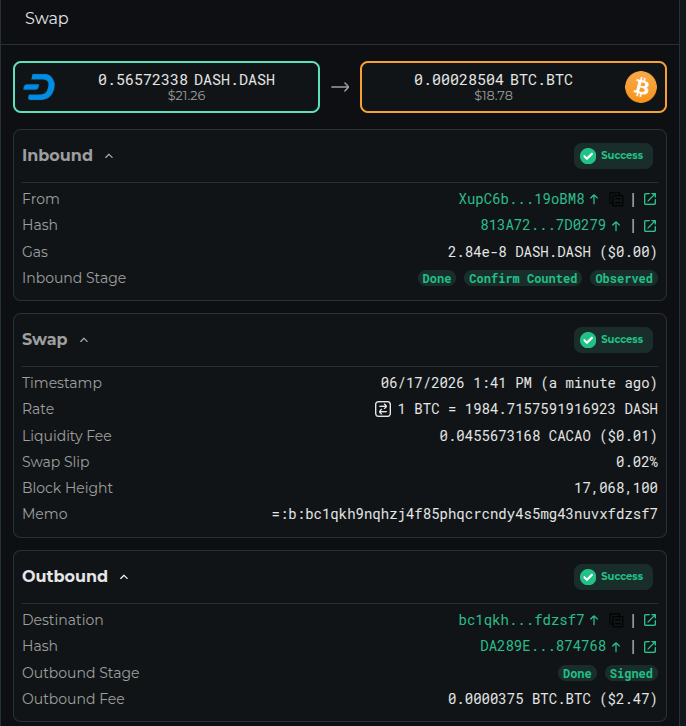
Just tried a Dash-to-Bitcoin swap using the @Maya_Protocol.
Dash to Bitcoin in 45 seconds flat. 👀⚡️
No middlemen, no waiting, no hassles.
Only possible on a DEX because of Dash's InstantSend technology.
Only possible to have this experience in a DEX because of the Mayan wizards. 🧙���️🇲🇽
Dash to anything in seconds. Imagine the possibilities.
This is one of the most anti-crypto laws in the U.S.
It taxes the exchange, transfer, or storage of digital assets—you buy BTC, you pay a tax; you hold your BTC on Coinbase, you pay a tax; and so on.
There is effectively no comparable state financial transaction tax on stocks, bonds, or derivatives anywhere in the country. That means crypto is being singled out in violation of several federal laws.
Further, the approach makes little sense—you aren’t taxed if you exchange a stock, bond, or derivative in paper form, but you are taxed if they happen to be recorded on a blockchain? That’s like taxing email.
So, rather than embracing innovation and the cost efficiencies blockchains can deliver for ordinary people in Illinois, the state is poised to punish its entrepreneurs and citizens that want to use crypto.
This is a shame—it was only just recently that Illinois embraced a constructive approach to blockchain technology through the adoption of the effectively-scoped Digital Assets and Consumer Protection Act. This new tax is a complete 180.
When states adopt discriminatory, asset-specific taxes that drive builders and users elsewhere, we all lose.
🇺🇸 The White House wants crypto's regulatory framework signed into law by July 4th, 2026, on U.S. 250th birthday.
The CLARITY Act has already passed the House and cleared the Senate Banking Committee. The finish line is close.
The finish line is close, but the packed Senate calendar has killed plenty before.
Crypto regulatory clarity could still land in weeks.
Source: @WatcherGuru / Writer: Lucas
BREAKING: The first Federal National Mortgage Association-backed mortgage using Bitcoin in the US just closed using Coinbase 🇺🇸
The homebuyer said: “We closed on our home and my Bitcoin stayed intact. We didn’t have to liquidate, didn’t have to time the market” 🙌