1/4
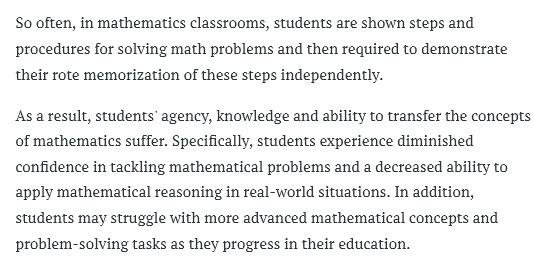
New: Another math expert explains why conceptual understanding is far more important than learning the "correct" steps & procedures. And why inquiry-based teaching works better than direct instruction to help kids develop that conceptual understanding: https://t.co/OjPr45SPED
Engaging math students through concepts rather than processes can drive deeper understanding and retention. Learn how @NHodkowski,and @MINDEduOrg are transforming math education. @EdSurge#MathEducation#MINDEducation
https://t.co/5c2dgf7Oro
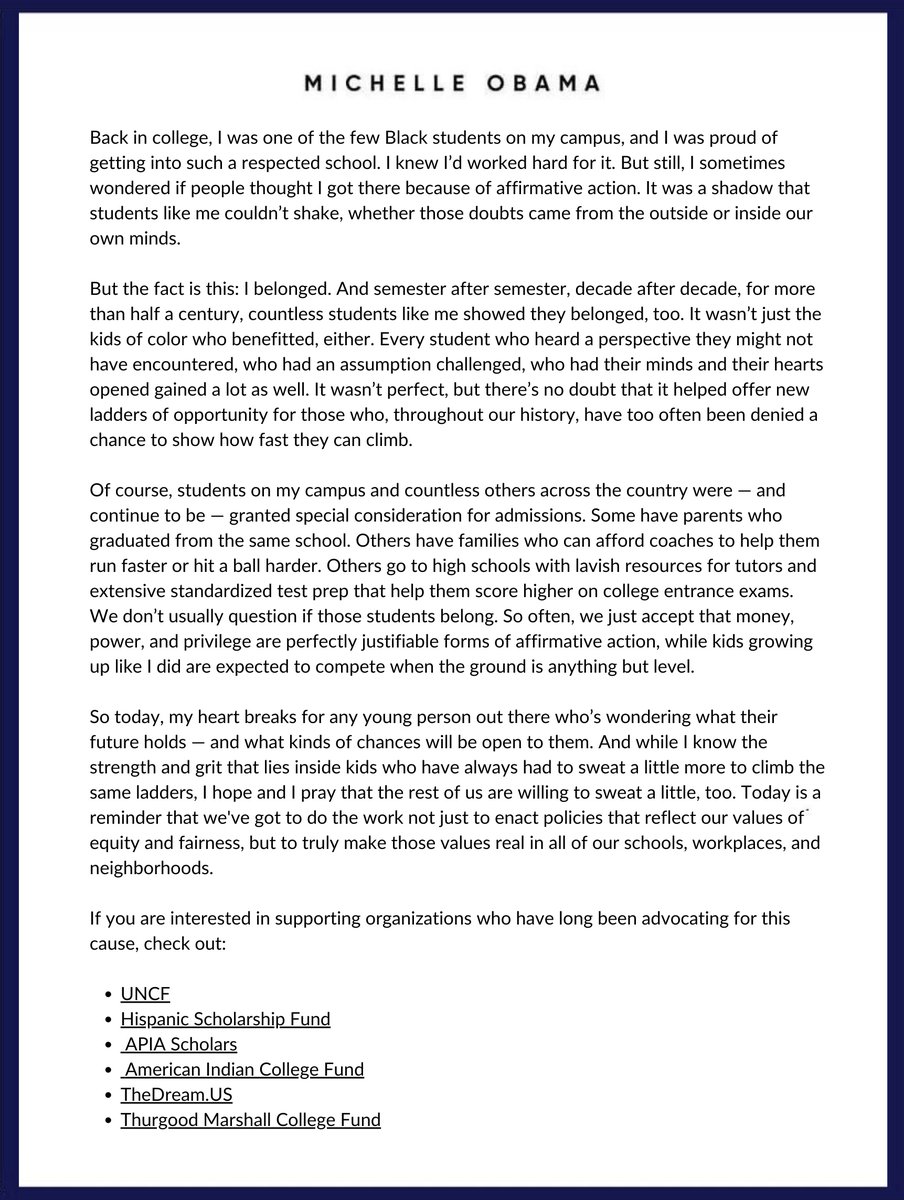
Affirmative action was never a complete answer in the drive towards a more just society. But for generations of students who had been systematically excluded from most of America’s key institutions—it gave us the chance to show we more than deserved a seat at the table.
In the wake of the Supreme Court’s recent decision, it’s time to redouble our efforts.
Nationally, mathematics achievement on average remains low with glaring inequities across racial and ethnic groups. In this new @EdSurge piece, @NHodkowski and @BrizardJC urge us to focus on approaches that recognize learners’ existing knowledge: https://t.co/2lG3QrICyN
The "curse of knowledge" can be a dangerous thing, especially as it relates to how we are teaching our students mathematics. This was an insightful piece about how we can begin to close the math achievement gap. https://t.co/gmzdpk8kuY #edtech via @NHodkowski@BrizardJC@EdSurge
To foster success in mathematics, we need to consider what students already know as a way to advance what they don’t yet know, argue Senior Mathematics Education Researcher @NHodkowski and President & CEO @BrizardJC. Read their new @EdSurge piece for more: https://t.co/2lG3QrICyN
"To foster success in mathematics, we need to consider what students already know as a way to advance what they don’t yet know." https://t.co/2MDlxszUq5
I’m a coauthor on this article Our team created & validated a multiplicative reasoning assessment that can serve as a proxy for a student interview. 50 days free access. https://t.co/dUdMgFmNJE @HthrLynnJ @BingqianWei
"Assessment of multiplicative reasoning validated using Rasch modelling." #OpenAccess free copies of this piece by Ron Tzur, @HthrLynnJ, @NHodkowski, et al. available here: https://t.co/o8KlQ1s0Un
"Relating children’s spontaneous additive strategy (counting-on, doubling, or break-apart-make-ten) to their multiplicative reasoning." Read more from Ron Tzur, @HthrLynnJ, @NHodkowski, et al. here: https://t.co/o8KlQ1s0Un
@HthrLynnJ Thanks @HthrLynnJ Purpose of the arrows in the diagram is to represent a possible student’s thinking process when engaging in multiplicative reasoning with tracking both towers and cubes together. The color, well, that’s just what was doable and seemed to work. ;)