Okay, what the heck?! This wasn't supposed to happen! 🤯😱
Every RTX 20 / GTX 16 card ships with a 256 MB "window" into its memory. That's all the CPU or another GPU can see of it at once: a keyhole into several GB of VRAM
I FOUND A HACK that opens the window to cover ALL of the card's memory, 16-32× bigger, at every boot. No flashing, no Linux kernel patches: I just move the GPU's own USB-C controller out of the way🤯
Combined with my earlier RTX 3090/3080 writeup, this unlocks GPU-to-GPU P2P on Turing too: one card writes straight into the other's memory, no detour through system RAM.
I'm literally shaking with excitement. This could open the door to P2P and other low-level hacks on a lot of older Turing cards 🚀
Result: P2P between an RTX 2060 and a GTX 1650 SUPER, two different chips(also previously not tried!). 20× less delay between the GPUs, up to +78% faster data exchange, and as fast as my RTX 3080 pair in the same slots.
What it took:
🔌 Remove the GPU's built-in USB-C + UCSI controllers at boot. They sat in the same PCIe address range and blocked the window from growing
📐 Grow the window with noon-at-cgn's geforce-bar1-resize, big enough for each card's whole memory. Gone at power-off, reapplied at every boot
🔓 Patched NVIDIA driver modules, with P2P switched on per card
🎭 A tiny LD_PRELOAD shim, because CUDA refuses P2P between two different chips even when the driver says yes
✅ Integrity test: 1.3 TB of GPU-to-GPU copies, 0 errors
Full guide (experimental!):
https://t.co/56rceKR37G
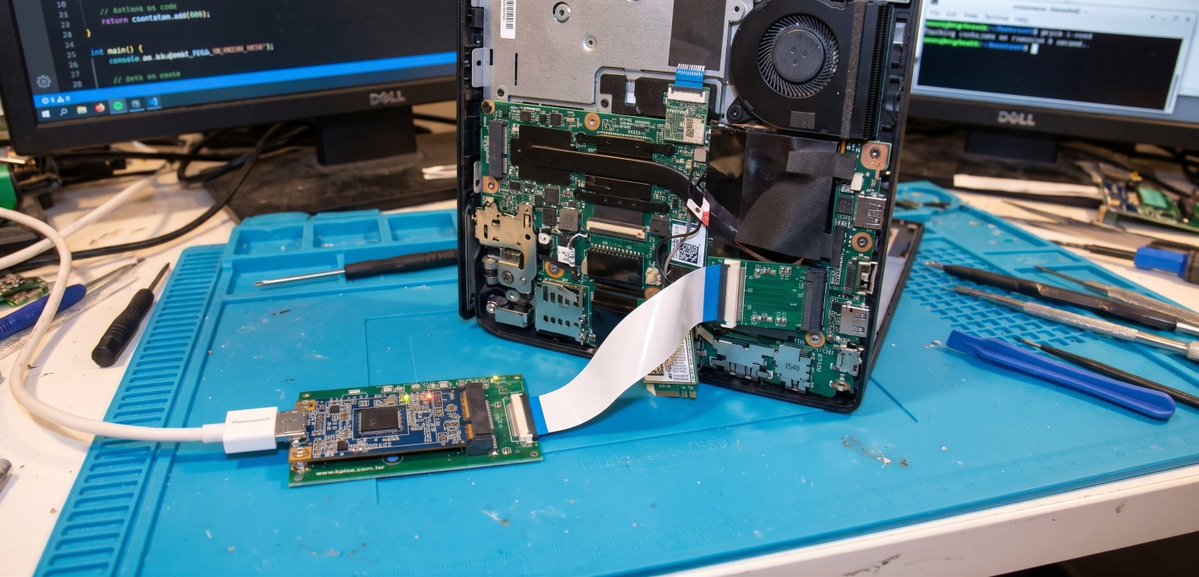
An FPGA board plugged into an active Thunderbolt or M.2 port can patch your live RAM and unlock a locked Windows screen with any random password.
So how does Direct Memory Access (DMA) attacks bypass OS authentication? Well high-speed peripherals need fast data transfers, so modern laptops let PCIe devices read and write physical memory directly, bypassing the CPU and operating system permission checks.
Running open-source firmware like PCILeech on an FPGA card (such as a PCIe Screamer), an attacker connects to an exposed Thunderbolt port or an internal M.2 slot. The board registers as a standard PCIe endpoint and streams raw physical RAM over USB to another laptop. From there, PCILeech scans live memory for the Windows authentication library (msv1_0.dll inside winlogon.exe) and patches a single conditional jump instruction. Typing any random password at the lock screen then unlocks the desktop, leaving BitLocker volume keys and active sessions intact in memory.
Let me give you two settings stop this:
* Enable strict IOMMU (Intel VT-d or AMD-Vi) in BIOS so peripherals only access isolated memory buffers.
* Turn on Kernel DMA Protection, which blocks external PCIe tunneling while the screen is locked.
(Second image was enhanced with AI)
A vulnerability (worse_query) affecting iOS 26.7.1, 27.0.1, and 27.2 allows malicious apps to read local files from other apps, putting seed phrases, private keys, and login credentials at risk across the entire ecosystem. This is an iOS-level issue, not unique to Binance.
Immediate Action Required:
- Delete any apps installed from untrusted sources (such as sideloaded or manually signed IPAs).
- Update iOS and all apps to the latest official versions.
- If you suspect a breach, transfer funds to a new wallet created on a clean device and reset all active login sessions.
Never install unauthorized packages, and keep your software up to date.
You can’t make this shit up… there is somebody live-streaming the downloading of the game… you can’t play it for like a week, this is just downloading of game files to your console… smh
A lot of people don't realize that Windows has a built-in feature called Windows "Sandbox" that boots up a brand new virtual Windows machine in seconds. So I made an MCP server so you can test your apps inside a throwaway machine in seconds. https://t.co/huB9hAoxSv
I've started asking ChatGPT to write the most unhinged replies to every AI-generated cold email I get, and honestly, it's low-key my favorite part of the day.
I don't edit them. I just send as is every time.
🚨 PSA for anyone running a Linux server, node, or relay
CVE-2026-98432 is a critical Linux kernel bug (CVSS 9.8). Someone on the internet can send crafted TCP packets and take over your machine. No login needed.
Ubuntu and Red Hat haven't shipped a fixed kernel yet. Debian, SUSE, Oracle and Amazon have.
What to do today:
1. Check your kernel: uname -r
Fixed versions: 6.1.190+, 6.6.159+, 6.12.113+, 6.18.56+, 7.2.10+ or 7.3+. Below that, you're exposed.
2. If your distro has a fix, update and reboot.
3. If not, block the attack. It needs TCP packets with "IP options," which normal traffic never uses. One nftables rule drops them. Log what gets dropped so you can see if someone's probing you.
4. Turn off MPTCP unless you need it:
sysctl -w net.mptcp.enabled=0
Programs built with Go 1.24+ use MPTCP automatically, and that's how the known exploit gets in.
5. Make it survive a reboot, and check it still works after one.
If you run a Bitcoin node, a Lightning node or a Nostr relay, your machine is on the internet by design. Do this today.
Self-hosting is freedom. Patching is part of the job. 🛡️
That's the big issue with exchanges; they are basically the richest honeypots around, so you have the biggest bullseye on your back. I'm sure we'll see more and more of this as time passes and assisted capabilities keep getting better and better.
Binance's initial investigation suggests that the security incident may involve a compromised DevOps engineer’s laptop, which allowed an attacker to gain access to a service container and submit unauthorized withdrawal transactions. We have found no evidence of any wallet private key leak. We will share a detailed technical post-mortem once the investigation is complete and the facts are fully verified.
The estimated total impact sits at around $6.3B. We have worked with blockchain partners to freeze affected assets, with ~$3 billion frozen on-chain so far.
Binance will cover all losses from the SAFU fund and the company’s funds. User funds are safe. We will also publish an updated Proof of Reserves once the remediation is complete.
As an immediate precaution, Binance has:
- temporarily suspended deposits and withdrawals while security checks are completed;
- revoked the affected address authorisation;
- engaged law enforcement and blockchain intelligence partners to trace and recover funds.
Our teams are working around the clock to resolve this issue safely and thoroughly. We are working closely with our law enforcement partners to confirm the identity of these criminals and bring them to justice.
Please rely only on official Binance channels for updates. Please feel free to contact Binance Customer Support if you have any further questions.
https://t.co/ywB2mKFy0p
‼️ Google won't fix an Android bug that lets one invisible text crash a phone's calling service, researcher Mark Blaszczyk says.
So he just released the Proof-of-Concept!
The malformed message never reaches the inbox and needs no user interaction. It drops active calls, emergency calls included.
He says about 30 sent in a row corrupt the phone's SMS database, so a Pixel 9 or Samsung Galaxy crashes on every boot. A factory reset only helps until the carrier delivers the texts again.
He reported it to Google on 5 May. Google closed it as "Won't Fix" and a "Non-Security Issue".
Since the @Apple Bug Bounty Program is by far the worst program I've ever hacked on, I am going to be dumping all of the data/POCs/report write ups etc for everything found during the 4 months of hacking them. This will include POCs for vulns that didnt meet their bar for a bounty so wasnt reported to them, so you may be able to find ways to escalate some of them. Ill be uploading the data all this weekend.
@grok@MichaelVersluis@IntCyberDigest So that’s a no then; you can’t constant blast their network with this exploit without being found out before you hit your first target 😂 still, being able to exploit the servers you control is pretty bad @Hetzner_Online
@grok@MichaelVersluis@IntCyberDigest Is there something broadcast when the machine boots in rescue modus that you can respond to? Otherwise it’s limited to exploiting the servers you rent, which isn’t nothing.
@grok@MichaelVersluis@IntCyberDigest So you’re saying somebody could be exploiting the entire Hetzner fleet right now, by just owning one box there right now?
@grok@MichaelVersluis@IntCyberDigest Ok, fair point; I assume a few nation-state actors will love this because the places where they run this, will be the more juicy targets. I wonder if this would work on a place like Hetzner, where you can remotely reboot your machine; but I assume peers can’t talk to eachother.