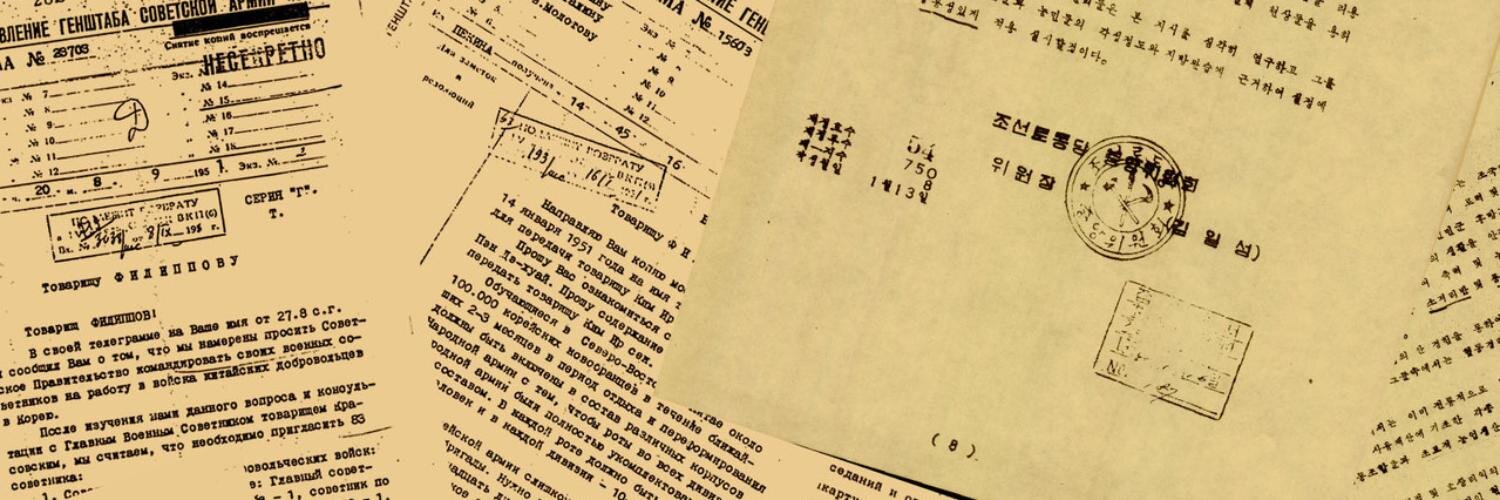
Records from the Russian archives offer insights into the deadlock in Soviet-American negotiations over Korea in 1947 and the permanent division of the peninsula into two rival states. https://t.co/P9jDcRtGNu
Tens of thousands of children were orphaned as a result of the Korean War. Intaek Hong presents the experiences of a group of young North Korean orphans that lived in Poland from 1953-1959 and their reintegration into postwar North Korean society. https://t.co/Romax1JiRp
“We must hold hands closely together with them and learn many things from them." @GBrazinsky on the praise for the People's Republic of China in North Korea's wartime propaganda https://t.co/t9uHZmPfUj
Youngjun Kim @bumanbake describes the diverse, records in the captured North Korean documents collection at the US National Archives, and how they can help scholars to give voice to ordinary North Korean people. https://t.co/ijxZ5LvoLD
Even in the midst of fighting a war, North Korea managed to print a significant number of newspapers, magazines, pamphlets, and other materials devoted to its chief ally, China. @GBrazinsky explains where to find such publications, and why they matter https://t.co/t9uHZn6QLR
Newly translated and published records offer insights into the collapse of Soviet-American diplomacy over Korea, Soviet aid to the DPRK prior to and during the war, Chinese-North Korean relations, and the early days of the Korean War https://t.co/6oJQy1qxne
We’re marking the upcoming 70th anniversary of the start of the Korean War with a series of posts on Sources & Methods that explore the conflict in all its dimensions. See what we’ve published already, and stay tuned for more https://t.co/3QAD9McJ3O
The USSR, China, and North Korea accused the United States of using biological weapons during the Korean War. Milton Leitenberg highlights what we know about those accusations today.
Thanks to recent declassifications and accretions to the Truman library’s collections, the documentary record of the Korean War continues to grow. https://t.co/6dsQMDy7lY
How the Soviet Union nurtured North Korea’s ability to wage war in the months, days, and even hours leading up to the invasion of South Korea on June 25, 1950. https://t.co/23zcJMwGTQ
Explore Jiyul Kim and Sheila Miyoshi Jager's Korean War series, covering the UN coalition, special operations, the Battle of Ch'unch'on, and the war's impact on South Korean society https://t.co/PcDfZkeao1
A total war, the Korean War required the total mobilization of all segments of South Korea's society, including women, students, and boys https://t.co/vrsxZiHCgN
The Battle of Ch’unch’ŏn and the record of the South Korean 6th Division in the opening weeks of the Korean War deserves more coverage and recognition. Jiyul Kim and Sheila Miyoshia Jager explain why. https://t.co/q634JYEoPE
The UN coalition that joined the Korean War was long portrayed as 22 nations, but new research shows that as many as 63 UN member states participated https://t.co/wVn2ehpcc1