My good friend @jae_noza and and I have finally released the first episode of our podcast on the 9-to-5 work day! At under 25 minutes, we've tried to keep this episode nice and short so you can have a listen on your next commute! #iopsych#podcasts#itunes#spotify#work#HRM https://t.co/Mjr3EyIcTK
We've launched! Check out the very FIRST episode of MindYourWork, a #podcast about social science and #work. This episode, @jae_noza and @NLBremner discuss the origin and science behind the 9-to-5 work day. Is this really how we should work? https://t.co/qWDYEo9pgR #iopsychology
These camera-equipped air pods will create an explosion of consumer training data for AI. They'll also enable measurement of psychological concepts not previously possible if people wear these during day to day interactions. Mixed feelings about this. https://t.co/vqsnZDcXFC
@emollick my greatest hope out of all of this talk about jaggedness is that it will result in greater acceptance of the theory of multiple intelligences
@meta_x_ai@JoinBlind I've worked drill rigs for years and work in tech. Physical strain and psychological strain are challenging in different ways and I would not diminish the significance of either.
@emollick This is also a really popular framing from a work productivity standpoint when companies use usage as a proxy for productivity. Assuming that using AI for "the work to be done" is zero sum leads to a misinformed narrative about AI impact
Somewhere out there is a guy who uses Notion, Superhuman, OpenClaw on a Mac Mini, Raycast, a mechanical keyboard ($400), Wispr Flow, and gets nothing done every day
@emollick Strongly agree. 5.4 pro has a ton of horsepower but the experience of using Cowork for local environment mgmt and spawning subagents is so damn good. Right now I need to use both tools to effectively conduct qual data analysis
Agentic software engineering adoption is on fire at @Uber. 1,800 code changes per week are now written entirely by Uber's internal background coding agent, and 95% of our engineers now use AI every month across all the tools we track.
This is a real reset moment for engineering; it's one of the most exciting times to lead. This shift requires builders to be curious and hands-on. I’m incredibly lucky to be surrounded by a team that’s doing exactly that.
The best part is that the strongest adoption isn’t being pushed top down from leadership announcements; it’s coming from engineers who are quietly experimenting, quietly shipping, and quietly pushing things forward.
I love spending time with those engineers because there’s no substitute for being close to the work.
Over the last few months, we leaned in hard, and the results have been phenomenal.
The bigger shift: going agentic.
84% of AI users are now working with agent-style workflows, not just tab completion. Claude Code usage nearly doubled in 2 months (32% → 63%), while IDE-based tools have largely plateaued.
Engineers are moving from accepting suggestions to delegating tasks. Even within traditional IDEs, ~70% of committed code is now AI-generated.
Background agents are writing code autonomously.
Our internal background coding agent went from <1% of all code changes to 8% in just a few months. There is zero human authoring. Engineers review and approve, but the code is written entirely by AI agents.
The role of the engineer is shifting - from writing every line to architecting systems and reviewing AI-generated code.
More to come from the @UberEng team in the coming days.
Paper drop, 3 years in the making.
Ever felt the model "helped" but somehow made things worse? Now we can measure it: AI proactivity imposes cognitive load that degrades your work - and once the model derails, it doesn't recover. You do. 🧵 https://t.co/zWpYL6vCsg
Uber Is Quietly Winning the AV Rideshare Setup
If 2025 was the proof point that consumers will actually take autonomous rides at scale, 2026 is starting to look like the year the strategic map gets redrawn. For the last few years the AV debate has mostly been framed around who has the best self-driving technology. That still matters of course. But increasingly that is the wrong question for investors.
The more important question now is: who is best positioned to turn AV supply into a scaled rideshare network? That is a different question entirely.
To level set: this is no longer just about the best AV stack
@Waymo is the only player that has really crossed from demo to scaled commercial reality.
The company said in February it was already doing more than 400,000 paid rides per week across its operating markets, and it raised another $1.6 billion while laying groundwork for expansion into more cities. Its new Arizona manufacturing facility with $MGA is designed to produce “tens of thousands” of autonomous vehicles per year at full capacity. That is the most real robotaxi business in the U.S. by a mile.
But the leap from “best AV operator today” to “winner of AV rideshare economics” is not automatic.
Because scaled rideshare is not just a software problem. It is a supply problem, a dispatch problem, a maintenance problem, a financing problem, and maybe most importantly a utilization problem. That is where $Uber's setup starts to look much more interesting than the market gives it credit for.
Uber is not trying to win autonomy. It is trying to win the network.
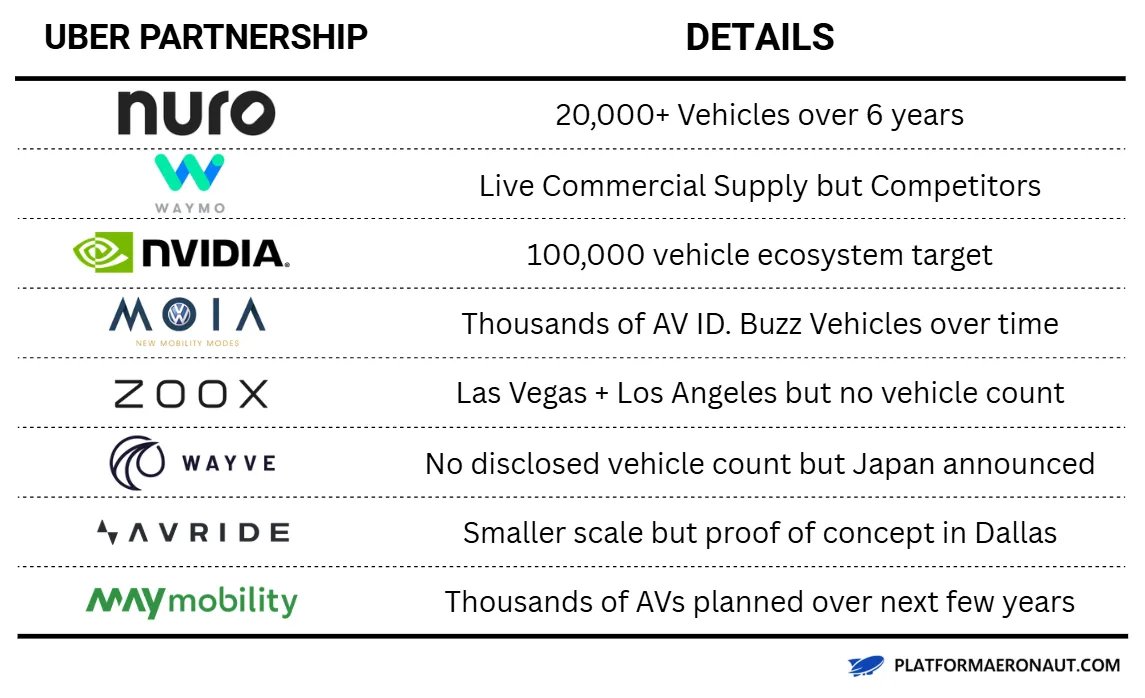
Uber’s strategy now looks pretty clear: let others build the autonomous brain, while Uber becomes the default marketplace, demand layer, and utilization optimizer. That may end up being the smarter economic position.
A lot of commentary around AV tends to sloppily bundle “partnerships” together as if they are equal. They are not, some partnerships are real supply, some are geographic options, but Uber increasingly has both.