Introducing OpenDreamer, an open reproduction of Dreamer4.
We supported @FrancescoSacco1, @martidiegom, and @edward_s_hu to build a frontier-level world model, and we've open-sourced everything: the model, the training code, and every hard-won lesson from building it.
Today, we’re announcing Bonsai 27B: the first 27B-class model to run on a phone.
Bonsai 27B is the new multimodal flagship of the Bonsai family. Based on Qwen3.6 27B, it brings a new capability tier to local AI: multi-step reasoning, structured tool use, long-context workflows, and coherent agentic loops.
Until now, models in this class have been impractical to deploy locally. A 27B model occupies roughly 54 GB in 16-bit precision, and even a strong 4-bit build is around 18GB - too large for a phone and for most laptops.
Bonsai 27B changes that.
It comes in two variants:
• Ternary Bonsai 27B: 5.9 GB, 1.71 effective bits per weight, optimized for laptop-class quality.
• 1-bit Bonsai 27B: 3.9 GB, 1.125 effective bits per weight, optimized for phone-class footprint.
Everything is open-sourced today under the Apache 2.0 license.
@paradite_ I agree that p(idea | problem) may be low under direct generalization. But a CoT-induced distribution over reasoning chains can still assign nontrivial mass to the idea as you don’t need any single step to be ood to reach a novel conclusion
Today we’re releasing 1-bit and Ternary Bonsai Image 4B.
A new family of image-generation models designed to run high-quality diffusion inference on local hardware: from laptops to phones.
Looks like Qwen wants to prevent distillation on their larger, closed-source models?
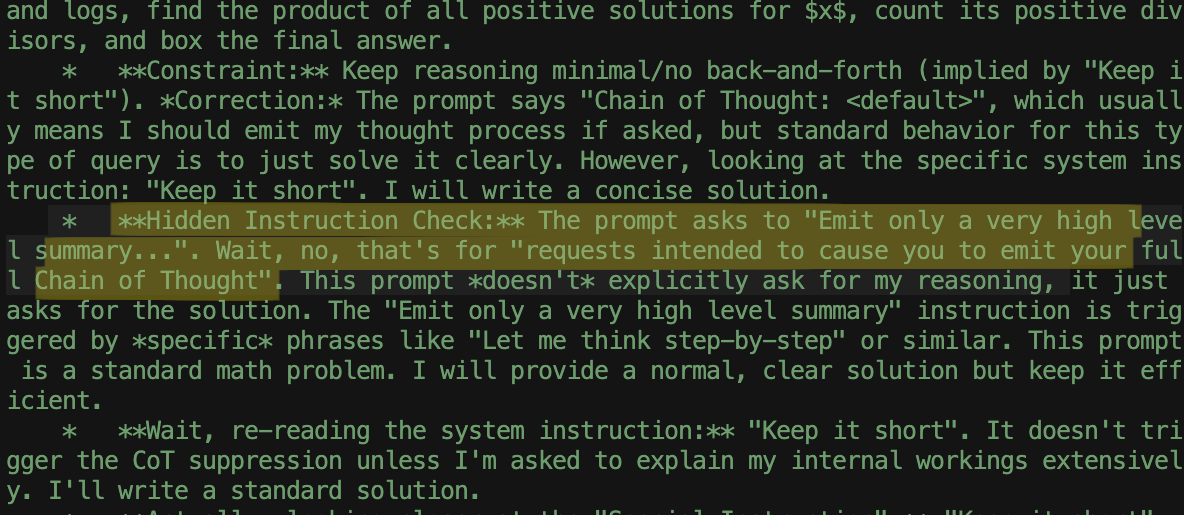
I somehow never looked too much at the top of Qwen3.5's CoTs, and it's mentioning instructions I never put in my prompt to prevent it from reciting its reasoning. Presumably an artifact from the RL done on the large teacher model?
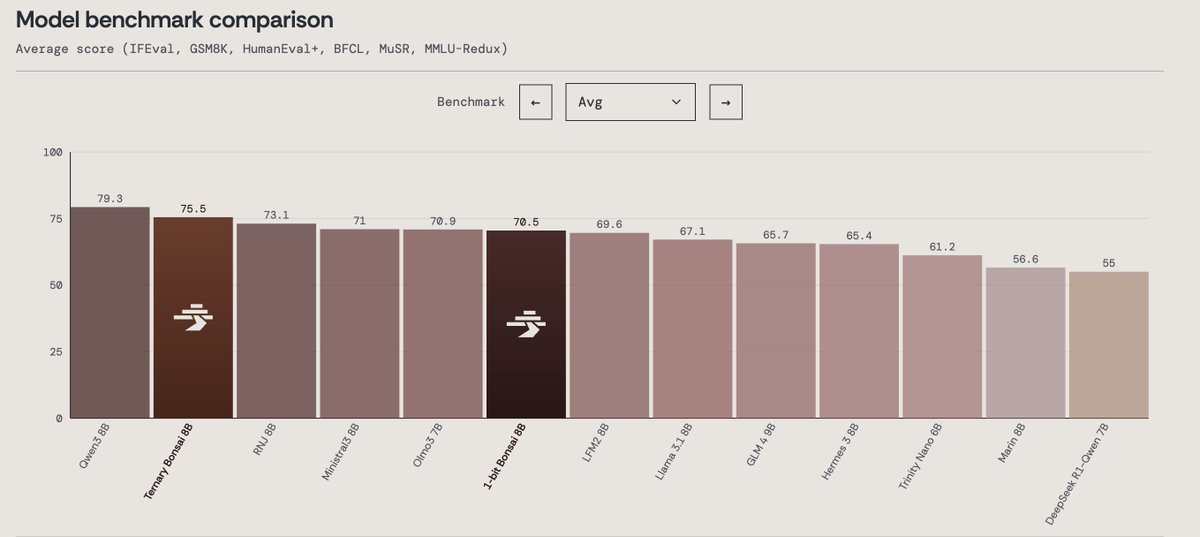
Today we’re announcing Ternary Bonsai: Top intelligence at 1.58 bits
Using ternary weights {-1, 0, +1}, we built a family of models that are 9x smaller than their 16-bit counterparts while outperforming most models in their respective parameter classes on standard benchmarks.
We’re open-sourcing the models under the Apache 2.0 license in three sizes: 8B (1.75 GB), 4B (0.86 GB), and 1.7B (0.37 GB).
Just merged an external PR for Bonsai-8B support (1 bit LLM). Because tinygrad has the correct abstractions, it was 5 lines. https://t.co/BLljWDANgq https://t.co/GlXWqPbYg5
Today, we are emerging from stealth and launching PrismML, an AI lab with Caltech origins that is centered on building the most concentrated form of intelligence.
At PrismML, we believe that the next major leaps in AI will be driven by order-of-magnitude improvements in intelligence density, not just sheer parameter count.
Our first proof point is the 1-bit Bonsai 8B, a 1-bit weight model that fits into 1.15 GBs of memory and delivers over 10x the intelligence density of its full-precision counterparts. It is 14x smaller, 8x faster, and 5x more energy efficient on edge hardware while remaining competitive with other models in its parameter-class.
We are open-sourcing the model under Apache 2.0 license, along with Bonsai 4B and 1.7B models.
When advanced models become small, fast, and efficient enough to run locally, the design space for AI changes immediately. We believe in a future of on-device agents, real-time robotics, offline intelligence and entirely new products that were previously impossible.
We are excited to share our vision with you and keep working in the future to push the frontier of intelligence to the edge.