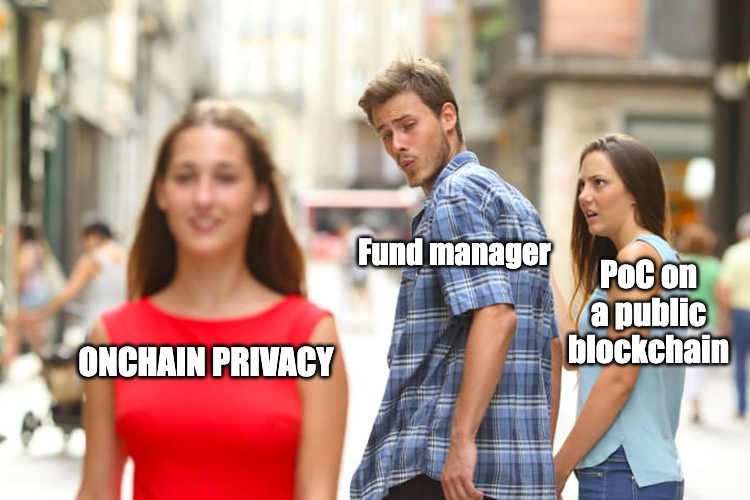
. @VitalikButerin is right: privacy must be integrated directly into wallets.
But, while smooth UX is necessary, it is not sufficient for broader adoption of privacy in web3.
Privacy must be on by default, regulatory compliant & free.
How do we make it accessible for all?
🧵
Blockchain’s hyped as the next Internet, but its pay-per-use fees are a mess, deterring users & businesses. Compare that to ISP's flat subscriptions, or even Netflix's model.
Why hasn’t crypto figured this out? And should it even try?
Inviting an open discussion here!
🧵
More alpha dripping from the Kinexys Project EPIC report by @jpmorgan, just for you, anon:
Onchain privacy for institutions matters on three fronts:
1. Anonymity
2. Confidentiality
3. Auditability
Without these three, no serious institution will ever deploy assets onchain 🧵
Until @TornadoCash is fully cleared from the OFAC list, onchain privacy will suffer low adoption.
What if we could provide users with a compliant privacy tool?
At @NPLabs_ we propose one such design: it's like Tornado, but with an anonymity revoker.
Curious how it works?
🧵
To `withdraw` funds, the user must create a zero-knowledge proof (actual ZK!) attesting to:
1. Knowledge of the randomness used in generating the commitment
2. Membership in the Merkle Tree of commitments
They also publish part of their randomness to prevent double spending
↩️
As I've been diving deep into privacy for blockchains over the last months, I naturally assumed that everyone in web3 is familiar with how @TornadoCash works - at least at a high level.
I was recently surprised that many had no clue.
Here's my CT explainer of Tornado Cash 🧵
Tokenized funds on public blockchains: $3B
Global assets under management: $98T
Yes, that's T for TRILLION.
The onchain tokenized assets account for 0.003% of the TAM.
For traditional investors, data privacy is a baseline requirement.
Provable Anti Money Laundering would combine AI models for flagging suspicious activity with verifiable SNARK techniques (such as @ezklxyz's tooling for zkML) to "identify and stop high-risk activity without compromising a user’s privacy" - as desired.
It's the North Star, but:
We are stuck with programmable privacy.
Private payments have been possible with ZCash or Tornado, but a fully private, programmable chain (like EVM) remains elusive. “zkRollups” are not private! (see my linked thread for details)
So, why are we stuck? And is there any hope? 🧵
Detected: high density of quality technical content.
Learn all about arithmetic circuits, how they fit into SNARKs, and how one could implement them in Rust.
Unstoppable technical blogging only from @NPLabs_:
Today, we have a deep dive into arithmetic circuits (AC): their usage in SNARKs, our Rust implementation, and the relation (no pun intended) between AC and Rank-1 Constraint System.
Blog: https://t.co/eAWUiuuWaA
tl;dr in 🧵:
This is one of the best technical explainers on Merkle Trees in the context of recursive STARKs.
The blog expands into Hybrid-Hash Merkle Trees, and even further to Hybrid-Hash Mixed-Matrix Commitment Scheme (H2M2CS) we PR'ed to plonky3.
Disclaimer: we might be a bit biased :)
As part of our exploration at @NPLabs_ into plonky3 and recursive proofs, we've been working on an implementation of hybrid-hash Merkle Trees.
We have a technical primer for you: https://t.co/t0qX1AmaXs and a high-level summary in this 🧵:
Last year, @Istvan_A_Seres, @cryptonoemi and @josephbonneau published the Naysayer Proofs paper, proposing optimistic verification of SNARKs.
We present the first instantiation of Naysayer proofs for Ligero & Brakedown polynomial commitment schemes:
https://t.co/V17sBn3dGA
Looks like there is some renewed interest in Rabin-Williams signatures out there.
Sharing my old implementation in case this helps the community. There is no audit, use at your own risk:
https://t.co/8wNei1Zdk1
Rabin-Williams has a much faster verifier than RSA, because it involves squaring instead of exponentiation (or, put simply, exponent e=2).
Its security relies on the difficulty of finding quadratic residues mod n (composite), which follows from the difficulty of factoring n.
Accurate Insights about (zk)AI.
When exploring the various ZK coprocessors, we spent a lot of time thinking about the tradeoffs in the zkML space.
tl;dr: carefully pick the model architecture and complexity, or else the proving costs blow up.
Hopefully, the write-up helps!
Another deep dive from @NPLabs_ just landed, this time in the zkML land:
https://t.co/xZ9mXgqvyM
Our goal is to highlight how changes in the number of model parameters impact the tradeoff between accuracy of ML models vs. proving time for verifiable inference.
Why will interoperability of rollups win vs. single chain with massive throughput?
Because apps will benefit from modifications to the underlying execution engine (e.g. EVM). These chains, with minor modifications each, can still be interoperable and provide much better UX.
The first piece of writing we have for you as the newly rebranded @NPLabs_ is a deep dive into the Ligero Polynomial Commitment Scheme (PCS): https://t.co/acJTUfSbPS
We review its soundness analysis and study the number of column openings required for a target security level.
Hungry Cats Studio is undergoing a re-branding!
It started as a game studio, and hence the original, playful name. Already a while back, the company shifted gears to cryptography.
It's time for New Projects, working alongside Nice People.
It's time for NP Labs.
NP Labs is a lean team with hands-on experience in building cryptographic libraries, SNARKs, zkML, and in designing robust blockchain architectures.
We work with advanced technologies - yet our mission is to hide the complexity and provide a 10x better UX.