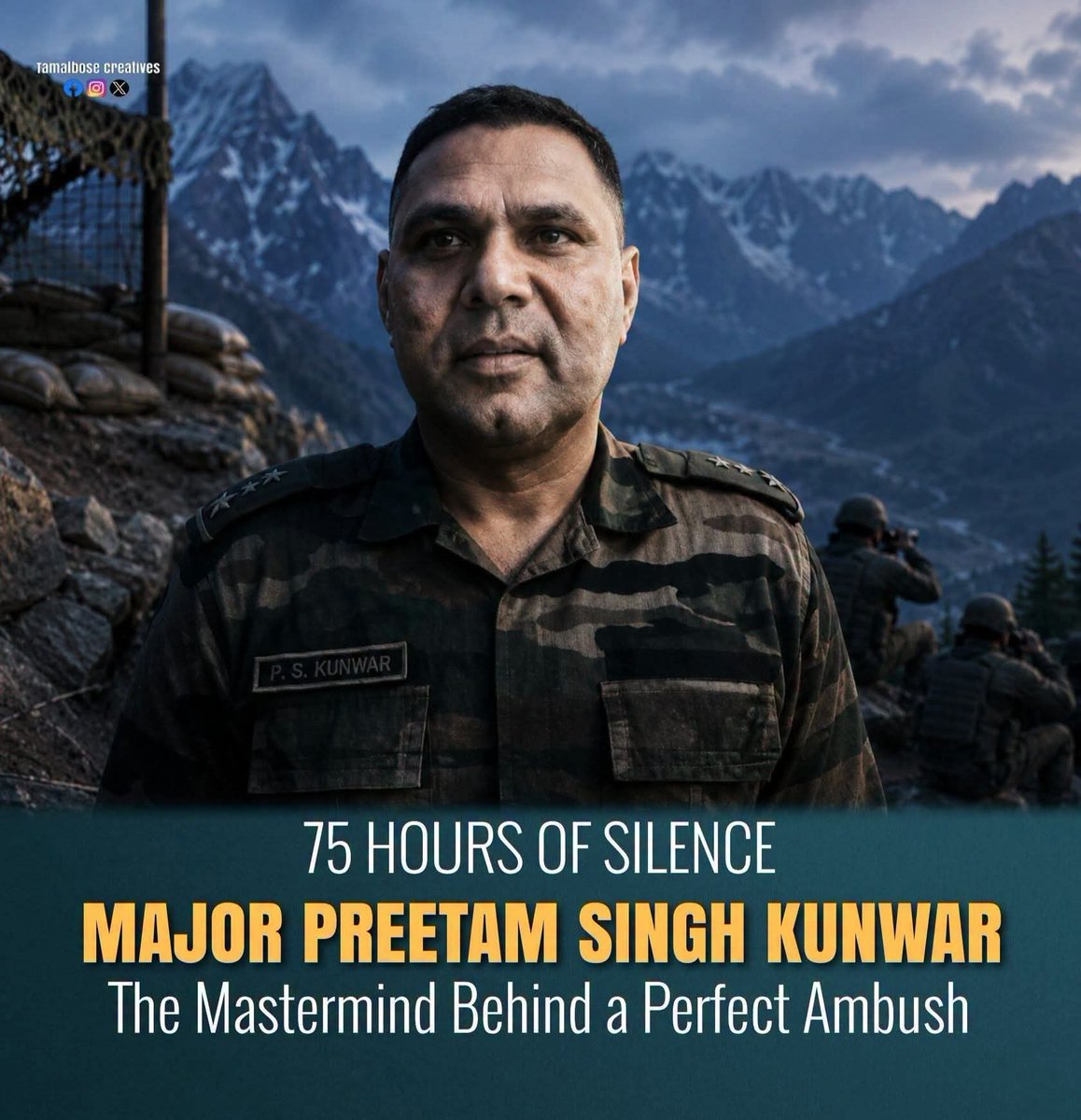
He Waited 75 Hours… Then Ended It in 15 Minutes. The Story of Major Preetam Singh Kunwar.
On 23 May 2017, a thermal imager along the Line of Control detected six suspicious figures near the Badori hills in Pakistan-occupied Kashmir (PoK). They were heavily armed Lashkar-e-Taiba (LeT) terrorists preparing to infiltrate into India for a major attack. It was the first major infiltration attempt since the 2016 surgical strikes.
The operation was led by Major Preetam Singh Kunwar of the 4 Garhwal Rifles.
Many commanders might have opened fire the moment they spotted the terrorists. Major Kunwar didn't. He understood that firing too early might eliminate only a few, allowing the rest to escape. Instead, he chose patience over impulse.
For nearly 75 hours, he and his men tracked the infiltrators through rugged mountains, dense forests, icy streams, and dangerous minefields. To cross one mined stretch safely, they even improvised a bridge using a six-foot log, advancing inch by inch. Every step carried the risk of death, but Major Kunwar refused to compromise either the mission or the safety of his soldiers.
On the evening of 26 May, the terrorists finally crossed into Indian territory, unaware that they had entered a carefully prepared kill zone. Even then, Major Kunwar held his fire until every infiltrator was within range.
At exactly 7:13 p.m., he calmly transmitted a single command over the radio:
"Open Fire."
The silence of the mountains was shattered.
In just 15 minutes, all six terrorists were eliminated. Not one escaped. Even more remarkably, all 17 Indian soldiers involved in the operation returned without a single casualty or injury.
The weapons, ammunition, and supplies recovered from the terrorists revealed they had been preparing for a major strike in Kashmir. By stopping them at the border, Major Kunwar and his team likely prevented a devastating terrorist attack.
For his exceptional courage, leadership, and tactical brilliance, Major Preetam Singh Kunwar was awarded the Kirti Chakra, India's second-highest peacetime gallantry award.
Yet when asked about his actions, his response reflected the humility of a true soldier:
"I didn't do anything extraordinary. I simply did the job I had signed up to do."
Some heroes become legends because they charge into battle. Others become legends because they know exactly when not to pull the trigger.
Major Preetam Singh Kunwar belongs to the second kind.
Copied
Time to go FDE! So the new craze, let's build an FDE business because customers need it. What is an FDE -
1. well versed in AI? - yes
2. Well versed in applying their knowledge to make implementation successful for what I bought from you - yes, Palantir, Frontier Models, now Hyperscalers.
The real question is:
Is the FDE actually building unique product capability in the field that will then be integrated into the product eventually back at the ranch? Or is the FDE building unique capability for my enterprise?
The answer to the question helps determine whether the FDE provider accelerates product development and value capture.
For the customer - higher probability for driving outcomes for sure, but if you have ever worried about vendor reliance - this is the moat of a lifetime.
Use FDEs for sure, but understand the architecture, make sure you understand where the intelligence is being retained in your enterprise:
1. Model weights? Do you have a fine tuned model?
2. Generic model - but organizational memory, context layer and harness?
3. Unique application context and data being leveraged?
No prizes for guessing where the different FDE providers will build that value for you, hence creating the moat for themselves.
Go FDE but tread thoughtfully.
Just finished north of 200 meetings in Europe with customers and technologists. The conversations were primarily around AI, common questions include:
1. Are there examples of organizations who have been able to demonstrate production level systems and do those developments show a return in lower cost, efficiency or better top line?
2. What do you think about agents? How will we discover, govern and stop agents if need be. Perhaps the biggest security concern ATM.
3. The frontier AI models are expensive, what's the business case at these token prices to embed AI in our customer facing products? Where will token prices be in the future.
4. What are the longer term implications of Mythos like models? Do we need to update cyber infrastructure or all IT infrastructure?
5. What do you think of Chinese opensource models? Are they secure and what is the downside of using them if they can be secured and they are cheaper?
The parts that surprised me were:
1. The pausing of Mythos and Fable 5 caused more consternation and concern in Europe both short term and raised longer term concerns on single model reliance or reliance or models not in ones control. I hadn't seen it from their POV.
2. Sovereignity which was always a topic and still is, is getting more nuanced - they want data residency, data localization and local resources, but there seems to be more willingness to accept global services on clouds. Classified systems continue to be an issue.
Net net - we need to ensure we continue to build trust both on our Frontier models and their consistent availability, we need to get the right economics in place and spend more time in Europe communicating and building presence if we want AI adoption to keep pace with the US.
TIME TO RETIRE THE CLASSIC PRD
The PRD is a relic. Time to retire it.
The word "PRD" brings to mind a 10-page Word doc or spreadsheet with a Background section, a Goals section, a Customers section, and 7 pages of feature descriptions. Half of it is throat-clearing. The other half is so vague that engineering and design end up guessing what to build anyway. Nobody reads it twice. Most of the time nobody reads it once.
Replace it with the Product Spec.
A Product Spec is a different kind of artifact, designed for the people who actually consume it (engineers, designers, AI agents)
The Product Spec has four mandatory pieces:
• The problem: who is hurting, what they are doing today, why now
• The bet: a falsifiable hypothesis (if we ship X, then [specific user] will [observable change] within [time], measured by [metric])
• The success criteria: what concrete behaviors we will see when this is working
• The evaluation: how we will measure it, what the kill / scale / graduate thresholds are
The shift from PRD to Product Spec is structural. It is what Coach is designed to enable.
In the PRD era, the bottleneck was getting alignment from a room of humans.
Long docs and exhaustive sections were the price of that alignment.
In the agent era, the bottleneck is giving an agent or an engineer a tight enough specification that it can ship without 12 follow-up questions, ideally using the goal loop in your agent of choice (h/t Peter Yang)
A 10-page PRD fails that test. A 1-page Product Spec with clear acceptance criteria and evals passes it.
Founders and product leaders: stop calling your docs PRDs. Stop writing them like PRDs. The artifact you need is a Product Spec with a falsifiable bet, a specific problem statement, concrete acceptance criteria, and a measurement plan.
Namaskaras.
By the grace of our Gurus, the complete script-assisted (lipi-sahita) recitation edition of the Srimad Bhagavata is now available.
Playlist in the first reply.
We offer this humble effort at the feet of Hari, Vayu, and Guru, with the prayer that it may be useful to Vaishnavas everywhere.
Acknowledgement: Poorna Prajna Samshodhana Mandira, Bengaluru.
India just did something the rest of the world hasn't. On June 26 at Kalpakkam, we switched on the world's first plant that makes hydrogen from nuclear heat. Not electricity. Heat. Built at home. Here's why that's a bigger deal than it sounds
Ok Bangalore Twitter need help.
My cousin is undergoing cancer treatment at HCG (near Mission Road).
He needs blood donations and we have exhausted our family members.
If anyone is willing to donate please ping me - I will share details. Any blood group is fine - the hospital just needs replacement.
(Please RT for karma. We need as much blood as possible)
Let me say this clearly to the UK Once.
For everyone.
We came to Britain by choice.
We integrated. We contributed. We built lives here. We staff your NHS. We pay your taxes. We top your school tables. We own our homes. We vote in your elections.
We are British. Completely. Proudly. Permanently.
AND —
India is our mother.
Not a political position. Not a divided loyalty. Not up for debate.
Our mother.
The land that gave us our language before we learned English.
Our faith before we learned your customs.
Our values before we understood your culture.
Our food that now feeds your nation every Friday night.
You do not stop loving your mother because you built a home somewhere else.
So here is what we will not accept:
You are allowed to talk about India.
Criticise it. Question it. Have opinions about it.
So are we.
The moment you talk rubbish about India — we will reply.
Every time.
Without apology.
Without explanation.
And if that makes you uncomfortable —
Ask yourself why you are comfortable saying it but uncomfortable hearing the response.
We did not leave India behind when we came here.
We brought the best of India WITH us.
That is why Britain is better for having us.
India gave us our roots.
Britain gave us our wings.
We fly with both.
Always. 🙏
🇮🇳🇬🇧 #BritishIndians
Andrej Karpathy: "90% of Claude's mistakes come from missing context, not a weak model."
41% mistake rate without a CLAUDE.md. 11% with the 4-rule baseline. 3% with the 12-rule version below
here are the 12 rules senior engineers settled on:
1. think before coding: state assumptions, don't guess. the model can't read your mind, stop hoping it will
2. simplicity first: minimum code, no speculative abstractions. the moment you let Claude add "for future flexibility," you've added 200 lines you'll delete next quarter
3. surgical changes: touch only what you must. don't let it improve adjacent code, that's how PRs blow up
4. goal-driven execution: define success criteria upfront, loop until verified. without them Claude either loops forever or stops too early
5. use the model only for judgment calls: classification, drafting, summarization, extraction. NOT routing, retries, status-code handling, deterministic transforms. if code can answer, code answers
6. token budgets are not advisory: per-task 4000, per-session 30000. by message 40 of a long debug, Claude is re-suggesting fixes you rejected at message 5
7. surface conflicts, don't average them: two patterns in the codebase? pick one. Claude blending them is how errors get swallowed twice
8. read before you write: read exports, callers, shared utilities. Claude will happily add a duplicate function next to an identical one it never read
9. tests verify intent, not just behavior: a test that can't fail when business logic changes is wrong. all 12 of Claude's tests can pass while the function returns a constant
10. checkpoint every significant step: Claude finished steps 5 and 6 on top of a broken state from step 4. nobody noticed for an hour
11. match the codebase conventions: class components? don't fork to hooks silently. testing patterns assumed componentDidMount, hooks broke them without surfacing
12. fail loud: "completed successfully" with 14% of records silently skipped is the worst class of bug. surface uncertainty, don't hide it
what actually compounds instead of the next framework:
- the CLAUDE.md file as institutional memory across sessions
- eval-driven changes, not vibe-driven
- checkpoints over speed
- explicit conflicts over silent blending
- discipline over framework, every time
- one repo, one rules file, no exceptions
you don't need a better AI
you need better context engineering
complete playbook below ↓
Two-tier CRPF+CISF escort with IAF airlift.
4-layer CCTV with AI surveillance.
Biometric & facial recognition before entry.
Multiple layers of frisking.
Multi-level oversight with direct monitoring from the Prime Minister’s office.
Yes, you read it right. But these are not arrangements to buy high-level, classified, military-grade software. These are the arrangements made by the Ministry of Education for the NEET retest scheduled for 21st June 2026.
Every student would appreciate the government's efforts to prevent paper leaks by implementing additional security measures and enhanced monitoring. But an increase in scrutiny before entry, extended frisking, and an increase in the overall exam time from 180 minutes to 195 minutes will only add to their already ballooning exam pressure.
While the government has taken measures to contain leaks, they have forgotten the additional burden they have imposed on a young student before they take up an assessment, one that they have spent months preparing for, dissolving the entire purpose of our exam system and the NEP 2020’s goal to reduce “Exam Stress”.
Despite all these arrangements for the examination, there are issues with downloading the admit cards, and NTA has assured students that it will resolve them at the earliest.
Yes, there are challenges that demand meaningful solutions. However, I am concerned that the approach devised for the NEET retest may not resolve the issue; instead, it risks creating a new set of problems.
I had an opportunity to prepare for a presentation on Ilaiyaraja's music. I put together the preparation into an article. The article is published in @the_hindu - https://t.co/NWfvEXIlfg
Everyone has been so impressed by Japanese fans cleaning up after themselves but most probably missed this beautiful moment at the post-game (🇳🇱2 - 2🇯🇵) press conference.
Toward the end after reporters were done asking questions, 🇯🇵head coach, Hajime Moriyasu, asked to speak one more time.
🗣️ “May I speak?”
He turned to the Dutch reporters in the room.
🗣️ “I think there are many Dutch reporters here as well, so I’d like to take this opportunity to express my gratitude to the people of the Netherlands once again.”
Moriyasu explained that when he became part of the Japan national team, Japanese football still had no professional league.
🗣️ “I was trained by a Dutch coach named Hans Ooft. It wasn’t just me. Japanese coaches in general were greatly influenced by him, which has led to the development of Japanese soccer today.”
He also mentioned another Dutch figure who shaped his career.
🗣️ “The legendary Dutch coach Wim Jansen served as the manager for J.League’s Sanfrecce Hiroshima and also as a coach for Urawa Reds, contributing to Japanese soccer.”
🗣️ “It’s not just those two. Many other coaches and players have contributed to raising the level of Japanese soccer, so I want to express my thanks. Thank you very much.”
What a masterclass in graciousness and gratitude. Imagine after a high-stakes match, instead of basking in glory and bravado (well-deserved in my opinion), the coach took to the microphone to... thank his opponents publicly and sincerely.
Japan's cultural operating system prizes harmony (wa), respect for precedent, and gratitude as a form of strength, not weakness. Japanese sports culture reflects its broader society where you'll see athletes bow to their opponents, thanking referees, and even crediting rivals or mentors.
Think of sumo wrestlers, Olympic athletes, or even bullet-train staff apologizing for a 30-second delay.
The Japanese have this concept of On (恩) - it is the sense of indebtedness to those who came before or helped you. It's what you'd expect from a culture that truly prizes continuity.
Moriyasu was acknowledging a real debt to Dutch coaches like Hans Ooft (who coached Japan in the early 90s and helped professionalize the game) and Wim Jansen. Japanese football openly credits foreign influences - Dutch "Total Football" philosophy, German organization, Brazilian flair - while building something distinctly their own. Few nations do this with such little ego.
Japan is pure class
Sundar Pichai’s powerful message to the Stanford Class of 2026 🔥
“You have thousands of moments ahead of you.
The important thing isn’t to get them all right;
it’s to find a way to keep moving forward.”
This 2-minute clip is pure motivation.
Save it.
Watch it when you feel stuck.
What’s your biggest takeaway from this? 👇
Follow @aishivamx for more AI + mindset + productivity insights.
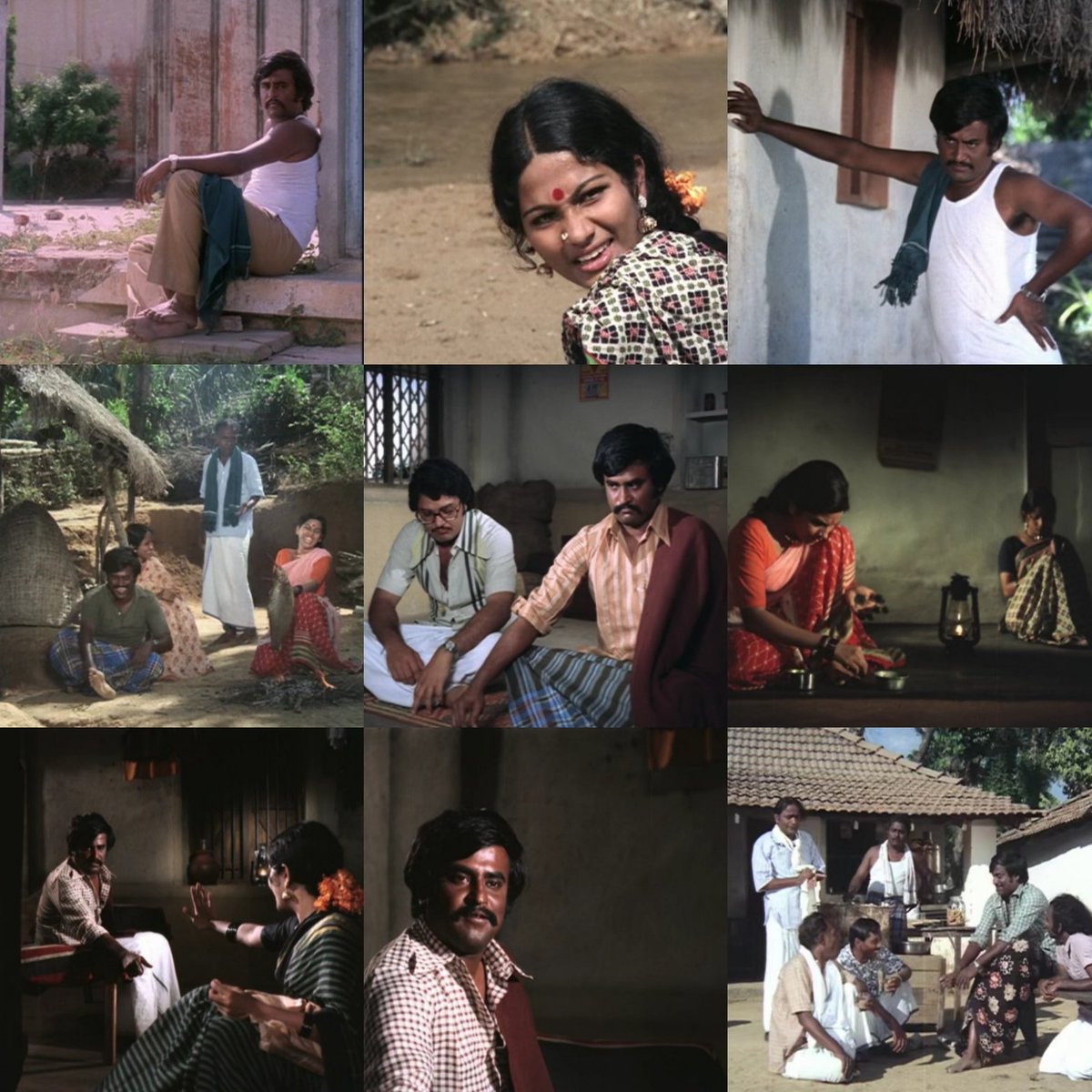
முள்ளும் மலரும் - 61/100
முள்ளும் மலரும் (1978) படத்திற்கு ஆனந்த விகடன் கொடுத்த விமர்சனம்:
விகடன் இந்தப் படத்திற்கு 61/100 மதிப்பெண் கொடுத்தது (அப்போதைய உச்ச மதிப்பெண்களில் ஒன்று). 03.09.1978 தேதியிட்ட விகடன் விமர்சனத்தின் முழு உள்ளடக்கம் (பழைய பதிவுகளிலிருந்து சேகரிக்கப்பட்டது) இங்கே:
தலைப்பிலேயே இலக்கிய மணம் கமழ்கிறது. மேலோட்டமாகப் பார்க்கும்போது, முரடனான அண்ணனையும் பூப்போன்ற தங்கையையும் ‘முள்ளும் மலரும்’ என்ற தலைப்பு குறிப்பிடுவதாகத் தோன்றினாலும், முள்ளைப் போன்ற முரட்டு சுபாவம் கொண்ட அண்ணன் கூட, தன் தங்கைக்காகத் தணிந்து வந்து மலராகிறான் என்பதையே அது குறிக்கிறதோ?
தன்மான உணர்வும், தங்கையிடம் தாய்க்கு நிகரான பாசமும் கொண்ட காளியின் பாத்திரப் படைப்பு தமிழ்த் திரைக்குப் புதிதல்ல என்றாலும், ரஜினிகாந்த் அதைச் செய்திருப்பதில் ஓர் அழுத்தத்தையும் ஆழத்தையும் காண்கிறோம். சிவாஜி ஏற்று நடித்த அண்ணன் வேடத்தை இப்போது சிவாஜி ராவ் (ரஜினி) ஏற்றிருக்கிறார். இவரும் சக்கைப் போடு போடுகிறார்.
மேலதிகாரி மீதிருந்த கோபத்தைத் தங்கை மீது காட்டிவிட்டு பின்னர் மனம் வருந்தி வீடு திரும்பும் காளியைத் தங்கை சாப்பிடக் கூப்பிடும்போது, ”நான் வரமாட்டேன், போ!” என்று குழந்தை போலச் சிணுங்குவதும், பிறகு தங்கையிடம், ”நீ என்னை அடிச்சுடுடா” என்று கெஞ்சுவதும் அருமை.
எஞ்சினீயர் தன்னை மணந்துகொள்ளக் கேட்கும்போது ஏற்படும் மகிழ்ச்சி -சகோதரனின் கை போனதும் ஏற்படும் துக்கம் -கடைசியில் அண்ணனிடமே வந்து அடைக்கலம் புகும் பாசம்… அப்பப்பா! இத்தனையும் கொட்டி நடித்திருக்கிறார் ஷோபா. அவர் நடிப்பு பற்றி ஒரே வார்த்தை: ஷோபிக்கிறார்!
சரத்பாபுவுக்குப் பொருத்தமான எஞ்சினீயர் வேடம். மேல் மட்ட அதிகாரிகளுக்கே உரித்தான கொச்சைத் தமிழில் அவர் பேசுவது எஞ்சினீயர் வேடத்துக்கு ஒரு கம்பீரத்தைத் தருகிறது.
சரியான சாப்பாட்டுராமி மங்கா! அடைக்கலம் புகுந்த இடத்தில் அண்ணியாக பிரமோஷன் கிடைக்கிறது படாபட்டுக்கு! வள்ளியின் வாழ்க்கை கெட்டுவிடக் கூடாதே என்ற அக்கறையில் கணவனிடமே அவர் நடத்தும் தர்மயுத்தம், ஒரு பட்டிக் காட்டு அந்நியோன்னியத்தை மிகைப்படுத்தாமல் வெளிப்படுத்துகிறது.
காலை உதயத்தின் அழகு, வானவில்லின் வர்ணஜாலம், இயற்கையின் எழிற்கோலங்கள் -இவற்றை அற்புதமான முறையில் படமாக்கியிருக்கிறார் பாலு மகேந்திரா. கண்களில் ஐஸ் வைத்துக் கொண்டு படம் பார்ப்பது போல, அத்தனை குளிர்ச்சி!
நான்கே பாடல்கள்தான் என்றாலும், அவற்றை இனிமை இழையோட இசை அமைத்திருக்கிறார் இளையராஜா. ‘ராமன் ஆண்டாலும்’ பாட்டு தொடங்கும் முன்னும், பாட்டின் மத்தியிலும் போட்டிருக்கும் ‘லேலே… லேலே…’ கோரஸ், காதுகளைக் கட்டித் தழுவி முத்தமிடுகிறது. கிளைமாக்ஸ் காட்சியில், வெறும் தாள வாத்தியத்தை மட்டும் வைத்துக் கொண்டு தேவையான ‘மூட்’ உருவாக்கியிருக்கிறார்.
இதுவரை கதை-வசன கர்த்தாவாக மட்டுமே இருந்து வந்த மகேந்திரனுக்கு இந்தப் படத்தில் டைரக்ஷன் ஒரு புதிய பொறுப்பு. வியக்கத்தக்க அளவுக்கு அதில் தன் திறமையை வெளிக் காட்டியிருக்கிறார். ... இனி, அவர் எந்தப்படத்தை இயக்கினாலும், இந்தப் படத்தின் தரத்தை அவரிடமிருந்து எதிர்பார்ப்பார்கள்!
சொந்தக் கிராமத்துக்குச் சென்று இளைப்பாறிவிட்டு வந்த திருப்தி, படம் முடிந்ததும் கிடைக்கிறது. இந்த மலர், தமிழ்த் திரையில் எப்போதோ பூக்கும் ஒரு குறிஞ்சி மலர்!
@avmproductions@ilaiyaraaja@rajinikanth@arunaguhan_ #Mullum_Malarum #முள்ளும்_மலரும்
@ash_rajinikanth@soundaryaarajni
How a made-in-India antibiotic opens new front against superbugs
Wockhardt's Zaynich received FDA approval after 14 years of R&D. A made-in-India antibiotic hitting drug-resistant infections that kill nearly 3 lakh Indians every year (more than cancer, diabetes & kidney disease combined).
With a 97% success rate in clinical trials against the hardest-to-treat hospital infections, this is the breakthrough doctors have been waiting for.
At $10,000–$12,000 per treatment course in the US, Zaynich's India pricing is still unannounced