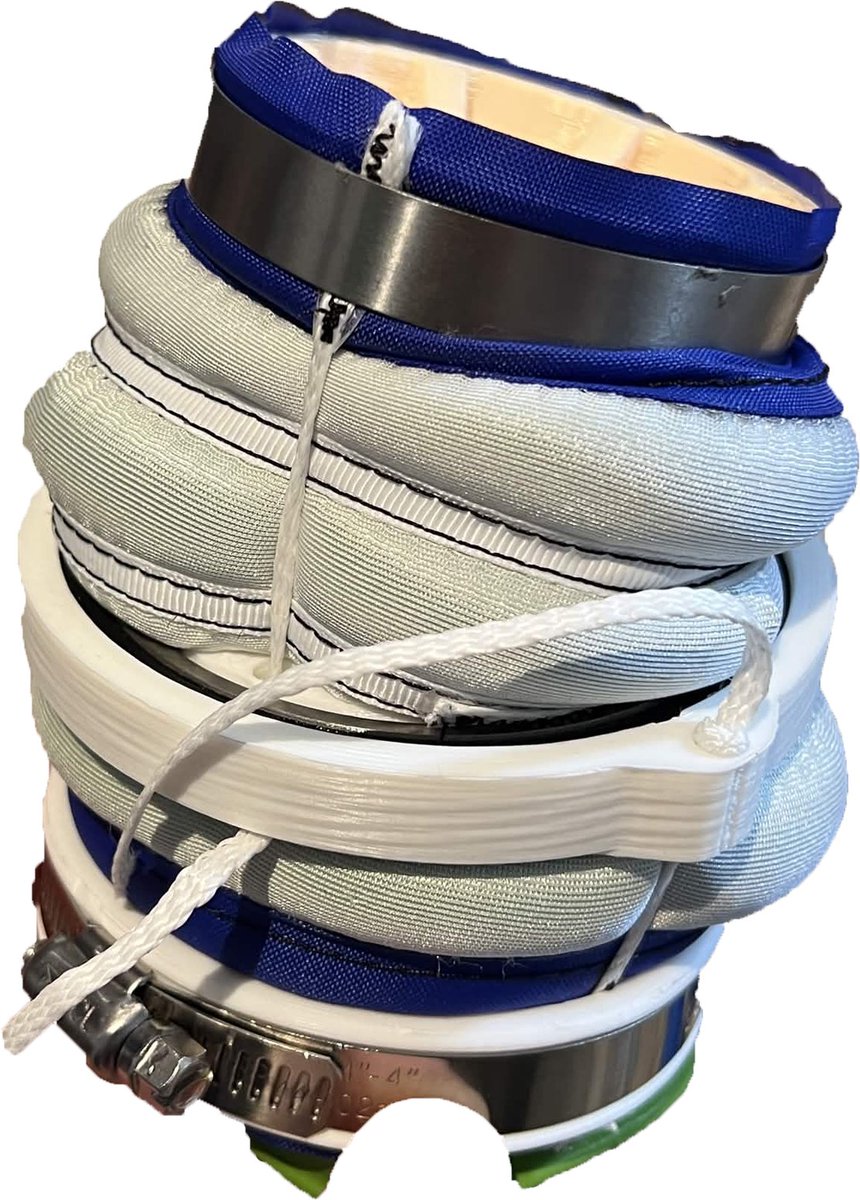
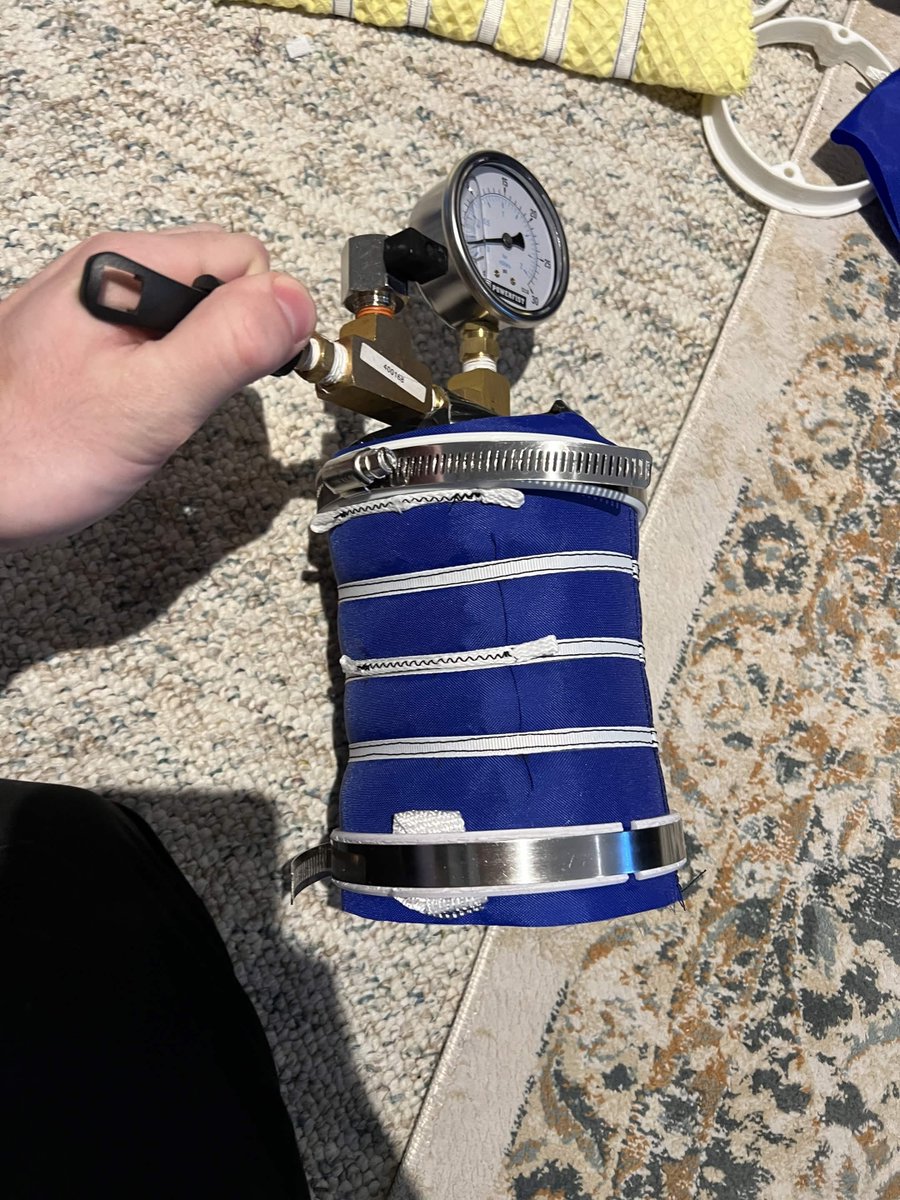
3. (cont) As for the poor convolute formation, I suspect this is caused by 1. bulk trapped between minor diameters, and 2. freedom for the restraints to migrate along the axial restraints (both are, admittedly, to be expected with this design of convolute).
Updates from this week:
1. A test assembly to validate a hybrid (TPU-nylon to neoprene) bladder/restraint architecture.
2. SWL bellows convolute, cut on bias (explored weld-on restraints).
3. SWL bellows convolute, cut on the grain (explored weld-on Spectra restraints).
3. (cont) The idea with the non-full-span circumferential restraints is that they could be welded at a fixed distance from the neutral plane regardless of the shape of the pattern; the restraint strips could be welded at an angle if the pattern of the convolute was conical.
Wrenches down.
Engineers have completed hardware development on NASA’s Lunar Environment Monitoring Station, which will monitor moonquakes and meteorite impacts to prepare astronauts for hazards when they are living and working on the surface of the Moon.
From just today, a flat-pattern SWL finger joint proof of concept. Made from a heat-welded clamshell of TPU-coated 30D nylon ripstop, this joint showed decently low torque at high pressure (>8 PSID), and shows promise for much simpler manufacture/customization.
The glove tested features slashed knuckles that permitted the elastic restraint layer (and bladder) to protrude at the break points, slightly offsetting the neutral axis and (ideally) enabling lower effort bending. The wrist used an elastic convolute and sliding restraint system.
Experiments from this past week: A dual-plane elbow joint; a dual plane soft joint; an external bearing rotary wrist joint for a glove. Further analysis in the comments.
@nicktindle All textiles are sourced from various suppliers. Top Value Fabrics and Ripstop By The Roll are two companies that I frequently purchase from. I'll sometimes pick up fabric from nearby shops where possible. Most pressure suits use common materials, such as nylon and polyester.
@nicktindle Even time and energy is minimal. I can crank out a joint prototype in a couple hours. More complex prototypes might take ~5 hours to fabricate. That involves 3D printing time and sewing time. It is not uncommon to produce multiple (two or more) prototypes in a day.
@nicktindle A single joint prototype like this? Hard to quantify, but I would say probably a few cents. The average joint uses maybe a square foot or two of fabric, uses the same bladder as every other prototype, and the same 3D printed hardware and pneumatics. It's not pricey at all.
Essentially a wrist gimbal for a glove, with an external ball bearing to allow one end of the joint to twist. An elastic convolute and rubber bladder permitted torsional compliance, however torque was very high.
A poor attempt at an all-soft dual-plane convolute. Two sets of diagonal restraints controlled elongation and (ideally) provided bending mobility on two planes. The second set of restraints controlled the stability of the convolute by keeping it closer to the neutral axis.
Happy 250th Birthday, America! We are building essential space infrastructure to ensure U.S. leadership in low-Earth orbit, paving the way for breakthroughs that benefit our planet. We take pride in developing the #AxEMU spacesuit that will feature the American flag, marking our nation's return to the Moon after more than 50 years.