Our new preprint describes a multimodal intracortical brain-computer interface that a man with ALS has used at home, independently, almost every day for >19 months. It decodes both speech and cursor control to enable him to communicate and use his computer. Here’s a quick tour👇
In the research world, Casey Harrell is known by subject name T-15. He’s become a test case, and a point of hope, for people afflicted with ALS to have their voice restored. https://t.co/MJTUs9HASz
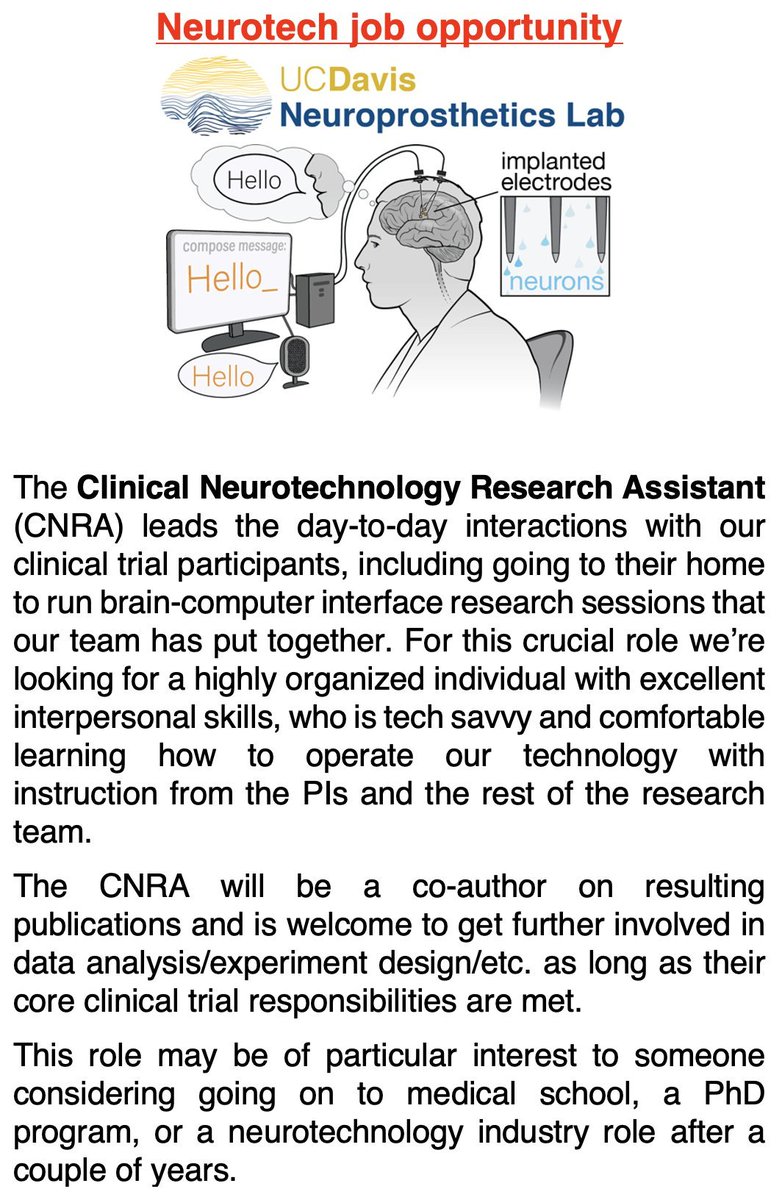
Want to work on intracortical speech and language brain-computer interfaces? We're hiring a Clinical Neurotechnology Research Assistant (CNRA)! Application link in next post. We'll start reviewing applicants after April 25th
Please RT 🔁
We’re hiring: Research Lab Specialist in BCI research. Great fit for a recent BS/MS grad who is a go-getter, enjoys working with people, is flexible with travel/hours, and can start right away. Work includes recruitment, in-home BCI sessions, clinical/engineering research, and lab admin.
Apply: https://t.co/m1hpYq4T8n
I'm really happy to see "brain-to-text" begin crossing over from academia to industry, helping more and more people communicate along the way! And I'm proud that I was able to contribute to this tech during my time at Neuralink.
ALS has gradually taken away Kenneth’s ability to speak. Through Neuralink’s VOICE clinical trial, he’s exploring how a brain-computer interface designed to translate thought to speech could help restore autonomy in his daily life.
Watch to learn more:
Excited to introduce LightBeam, a CTC decoder for speech neuroprostheses that drastically cuts memory load while achieving state-of-the art (SOTA) results
Paper: https://t.co/EQvFMFeMMW
Code: https://t.co/Ux5LMTOOSV
Co-authors: @hu_is_lionel@nrhadidi@JonathanCKao
Thread 🧵
Another brain-computer interface record set in the published record: fastest communication based on hand movements (typing in this case): https://t.co/foO2VGFTmD
Congrats Justin and the rest of the @BrainGateTeam!
We will be re-releasing the competition data in a non-normalized continuous format in the coming weeks.
We'd also like to re-open the leaderboard so it can serve as a public benchmark for future studies, but have not quite decided how best to do that yet. Stay tuned.
A new BBC story covers several different projects related to intracortical speech decoding from our @BrainGateTeam consortium and others’ non-invasive work:
https://t.co/1mceUx91F9
Excited to share our new work on cross-brain transfer of speech and handwriting BCIs! Some studies have required 10+ days of training data for peak BCI performance. Can pooling neural data from other users speed things up? 1/6
https://t.co/1Yjr5tNk7j
Our speech brain-to-text neural decoding competition ends tonight! It's been really fun to see many very high accuracy submissions beating all the previously published SOTA baselines. Some last minute entries just came in...
@jacob_g_martin1@BlackrockNeuro_ And to answer your other question: code can be privately shared under a license if the submitter wishes. The whole point of the private code sharing is just to confirm that the submission is following the competition rules, which is difficult or impossible to ensure otherwise.
There's just one month left for the Brain-to-Text '25 challenge! Submit your neural decoding approach and compete for $9,000 in prizes provided by @BlackrockNeuro_
https://t.co/MKz7WuHjTh
@jacob_g_martin1@BlackrockNeuro_ If you want to be eligible for cash prizes, we want to check that you are not cheating. Otherwise, you are free to use the dataset for whatever you want and keep your code to yourself.
If you think this is all a ploy to steal your code and publish it, feel free to not submit!
@jacob_g_martin1@BlackrockNeuro_ We're trying to get experts involved in this field to solve an important problem. There's no requirement to publicly share your approach. AND we shared a new speech neuroscience dataset that anyone can use for whatever they want. But go off...
POST-DOC JOB POST ALERT!!! 🔥
We are looking for a post-doc candidate to run our flagship clinical trial to restore arm and hand motor function in people with post-stroke hemiparesis using fully implantable spinal cord stimulation!
Send your application to: my email :) #Neurotech