SEND vs STOCKER — A Fair Comparison
I want to make it clear that this is not an attempt to promote $SEND or attack $STOCKER.
I simply want the community to look at the facts and understand the differences between the two platforms.
1. SENDER — A strong platform that made a mistake
There is no doubt that SENDER has built a strong platform. Many tokens chose SENDER as their launch platform.
However, the Hook V4 issue caused serious problems during launches and resulted in a loss of trust from part of the community.
What matters is that SENDER publicly acknowledged the issue and announced plans to fix it, with the expectation that the V2 version will operate more smoothly.
Product failures can happen.
What matters is how a platform responds to its mistakes and whether it remains transparent with its community.
2. STOCKER — A major success driven by ethereum:0x4e67db19044549ff420860834c91b45bad298722
STOCKER has also built a strong platform and handled Hook V4 well.
After Vitalik's post about Novel, the community initially chose SENDER. But following SENDER's issues, attention and activity shifted toward STOCKER.
The result?
ethereum:0x4e67db19044549ff420860834c91b45bad298722 reached more than $15M in market cap.
That is clearly a major success for STOCKER and the community behind it.
But there is one issue I want $STOCKER holders to pay attention to: the Buy Back & Burn mechanism.
3. Is the $STOCKER Buy Back & Burn really automatic?
STOCKER previously stated that:
70% of the platform's revenue would be automatically used to Buy Back & Burn $STOCKER.
If this mechanism is truly automatic, holders should reasonably expect the buyback and burn process to continue regardless of whether the token price is going up or down, or whether the platform is performing well or poorly.
However, based on the on-chain data I have been tracking:
The burn activity stopped around 5 days ago.
The latest burn transaction only burned approximately 1/10 of the $STOCKER held by the burn wallet.
The fees were subsequently transferred to another wallet.
The STOCKER-related dashboards on the platform have also been removed.
This raises a very simple question:
If Buy Back & Burn is truly automatic, why did the process stop when the platform faced difficulties and the token price dropped sharply?
If there is indeed an automated mechanism, I believe STOCKER should clearly explain to the community how it works.
4. Questions for $STOCKER holders
I am not denying STOCKER's success.
In fact, ethereum:0x4e67db19044549ff420860834c91b45bad298722 brought a significant amount of users, volume and attention to STOCKER.
That success deserves to be acknowledged.
But a platform can be successful in terms of product and community while still being accountable for its tokenomics commitments.
If the platform originally promised:
70% of revenue → Buy Back & Burn $STOCKER
then the community deserves clear evidence that this mechanism is actually operating as promised.
If platform revenue and fees are ultimately being transferred to wallets controlled by the team, while the expected burn activity is no longer taking place, then the question becomes:
What value are $STOCKER holders actually receiving from holding the token?
5. Comparing this with $SEND
Interestingly, SENDER has taken a different approach.
SENDER made a serious product mistake — that is undeniable.
But the burn mechanism for $SEND can be tracked on-chain, and SENDER provides Dune and dashboard data that allow the community to verify the numbers.
To me, this highlights an important difference:
One platform made a product mistake, publicly acknowledged it, and provides data that allows the community to verify its token mechanism.
The other achieved significant success through ethereum:0x4e67db19044549ff420860834c91b45bad298722, but its Buy Back & Burn commitment now raises questions that deserve clear answers.
I am not telling anyone to buy $SEND or sell $STOCKER.
I simply think holders should ask the right questions:
Where is the 70% of revenue actually going?
Is the Buy Back & Burn mechanism really automatic?
If it is not automatic, why was it originally presented that way?
And most importantly:
If the platform's fees ultimately go to wallets controlled by the team, what value do $STOCKER holders actually receive from holding the token?
I genuinely regret seeing this situation, because STOCKER had a significant opportunity.
The success generated by ethereum:0x4e67db19044549ff420860834c91b45bad298722 deserves recognition. But for a platform to survive and grow long-term, trust and transparency with the community matter even more.
I will provide the transaction links, burn wallet, and on-chain data below so that everyone can verify the information themselves and reach their own conclusions.
SEND vs STOCKER — A Fair Comparison
I want to make it clear that this is not an attempt to promote $SEND or attack $STOCKER.
I simply want the community to look at the facts and understand the differences between the two platforms.
1. SENDER — A strong platform that made a mistake
There is no doubt that SENDER has built a strong platform. Many tokens chose SENDER as their launch platform.
However, the Hook V4 issue caused serious problems during launches and resulted in a loss of trust from part of the community.
What matters is that SENDER publicly acknowledged the issue and announced plans to fix it, with the expectation that the V2 version will operate more smoothly.
Product failures can happen.
What matters is how a platform responds to its mistakes and whether it remains transparent with its community.
2. STOCKER — A major success driven by ethereum:0x4e67db19044549ff420860834c91b45bad298722
STOCKER has also built a strong platform and handled Hook V4 well.
After Vitalik's post about Novel, the community initially chose SENDER. But following SENDER's issues, attention and activity shifted toward STOCKER.
The result?
ethereum:0x4e67db19044549ff420860834c91b45bad298722 reached more than $15M in market cap.
That is clearly a major success for STOCKER and the community behind it.
But there is one issue I want $STOCKER holders to pay attention to: the Buy Back & Burn mechanism.
3. Is the $STOCKER Buy Back & Burn really automatic?
STOCKER previously stated that:
70% of the platform's revenue would be automatically used to Buy Back & Burn $STOCKER.
If this mechanism is truly automatic, holders should reasonably expect the buyback and burn process to continue regardless of whether the token price is going up or down, or whether the platform is performing well or poorly.
However, based on the on-chain data I have been tracking:
The burn activity stopped around 5 days ago.
The latest burn transaction only burned approximately 1/10 of the $STOCKER held by the burn wallet.
The fees were subsequently transferred to another wallet.
The STOCKER-related dashboards on the platform have also been removed.
This raises a very simple question:
If Buy Back & Burn is truly automatic, why did the process stop when the platform faced difficulties and the token price dropped sharply?
If there is indeed an automated mechanism, I believe STOCKER should clearly explain to the community how it works.
4. Questions for $STOCKER holders
I am not denying STOCKER's success.
In fact, ethereum:0x4e67db19044549ff420860834c91b45bad298722 brought a significant amount of users, volume and attention to STOCKER.
That success deserves to be acknowledged.
But a platform can be successful in terms of product and community while still being accountable for its tokenomics commitments.
If the platform originally promised:
70% of revenue → Buy Back & Burn $STOCKER
then the community deserves clear evidence that this mechanism is actually operating as promised.
If platform revenue and fees are ultimately being transferred to wallets controlled by the team, while the expected burn activity is no longer taking place, then the question becomes:
What value are $STOCKER holders actually receiving from holding the token?
5. Comparing this with $SEND
Interestingly, SENDER has taken a different approach.
SENDER made a serious product mistake — that is undeniable.
But the burn mechanism for $SEND can be tracked on-chain, and SENDER provides Dune and dashboard data that allow the community to verify the numbers.
To me, this highlights an important difference:
One platform made a product mistake, publicly acknowledged it, and provides data that allows the community to verify its token mechanism.
The other achieved significant success through ethereum:0x4e67db19044549ff420860834c91b45bad298722, but its Buy Back & Burn commitment now raises questions that deserve clear answers.
I am not telling anyone to buy $SEND or sell $STOCKER.
I simply think holders should ask the right questions:
Where is the 70% of revenue actually going?
Is the Buy Back & Burn mechanism really automatic?
If it is not automatic, why was it originally presented that way?
And most importantly:
If the platform's fees ultimately go to wallets controlled by the team, what value do $STOCKER holders actually receive from holding the token?
I genuinely regret seeing this situation, because STOCKER had a significant opportunity.
The success generated by ethereum:0x4e67db19044549ff420860834c91b45bad298722 deserves recognition. But for a platform to survive and grow long-term, trust and transparency with the community matter even more.
I will provide the transaction links, burn wallet, and on-chain data below so that everyone can verify the information themselves and reach their own conclusions.
SEND vs STOCKER — A Fair Comparison
I want to make it clear that this is not an attempt to promote $SEND or attack $STOCKER.
I simply want the community to look at the facts and understand the differences between the two platforms.
1. SENDER — A strong platform that made a mistake
There is no doubt that SENDER has built a strong platform. Many tokens chose SENDER as their launch platform.
However, the Hook V4 issue caused serious problems during launches and resulted in a loss of trust from part of the community.
What matters is that SENDER publicly acknowledged the issue and announced plans to fix it, with the expectation that the V2 version will operate more smoothly.
Product failures can happen.
What matters is how a platform responds to its mistakes and whether it remains transparent with its community.
2. STOCKER — A major success driven by ethereum:0x4e67db19044549ff420860834c91b45bad298722
STOCKER has also built a strong platform and handled Hook V4 well.
After Vitalik's post about Novel, the community initially chose SENDER. But following SENDER's issues, attention and activity shifted toward STOCKER.
The result?
ethereum:0x4e67db19044549ff420860834c91b45bad298722 reached more than $15M in market cap.
That is clearly a major success for STOCKER and the community behind it.
But there is one issue I want $STOCKER holders to pay attention to: the Buy Back & Burn mechanism.
3. Is the $STOCKER Buy Back & Burn really automatic?
STOCKER previously stated that:
70% of the platform's revenue would be automatically used to Buy Back & Burn $STOCKER.
If this mechanism is truly automatic, holders should reasonably expect the buyback and burn process to continue regardless of whether the token price is going up or down, or whether the platform is performing well or poorly.
However, based on the on-chain data I have been tracking:
The burn activity stopped around 5 days ago.
The latest burn transaction only burned approximately 1/10 of the $STOCKER held by the burn wallet.
The fees were subsequently transferred to another wallet.
The STOCKER-related dashboards on the platform have also been removed.
This raises a very simple question:
If Buy Back & Burn is truly automatic, why did the process stop when the platform faced difficulties and the token price dropped sharply?
If there is indeed an automated mechanism, I believe STOCKER should clearly explain to the community how it works.
4. Questions for $STOCKER holders
I am not denying STOCKER's success.
In fact, ethereum:0x4e67db19044549ff420860834c91b45bad298722 brought a significant amount of users, volume and attention to STOCKER.
That success deserves to be acknowledged.
But a platform can be successful in terms of product and community while still being accountable for its tokenomics commitments.
If the platform originally promised:
70% of revenue → Buy Back & Burn $STOCKER
then the community deserves clear evidence that this mechanism is actually operating as promised.
If platform revenue and fees are ultimately being transferred to wallets controlled by the team, while the expected burn activity is no longer taking place, then the question becomes:
What value are $STOCKER holders actually receiving from holding the token?
5. Comparing this with $SEND
Interestingly, SENDER has taken a different approach.
SENDER made a serious product mistake — that is undeniable.
But the burn mechanism for $SEND can be tracked on-chain, and SENDER provides Dune and dashboard data that allow the community to verify the numbers.
To me, this highlights an important difference:
One platform made a product mistake, publicly acknowledged it, and provides data that allows the community to verify its token mechanism.
The other achieved significant success through ethereum:0x4e67db19044549ff420860834c91b45bad298722, but its Buy Back & Burn commitment now raises questions that deserve clear answers.
I am not telling anyone to buy $SEND or sell $STOCKER.
I simply think holders should ask the right questions:
Where is the 70% of revenue actually going?
Is the Buy Back & Burn mechanism really automatic?
If it is not automatic, why was it originally presented that way?
And most importantly:
If the platform's fees ultimately go to wallets controlled by the team, what value do $STOCKER holders actually receive from holding the token?
I genuinely regret seeing this situation, because STOCKER had a significant opportunity.
The success generated by ethereum:0x4e67db19044549ff420860834c91b45bad298722 deserves recognition. But for a platform to survive and grow long-term, trust and transparency with the community matter even more.
I will provide the transaction links, burn wallet, and on-chain data below so that everyone can verify the information themselves and reach their own conclusions.
SEND vs STOCKER — A Fair Comparison
I want to make it clear that this is not an attempt to promote $SEND or attack $STOCKER.
I simply want the community to look at the facts and understand the differences between the two platforms.
1. SENDER — A strong platform that made a mistake
There is no doubt that SENDER has built a strong platform. Many tokens chose SENDER as their launch platform.
However, the Hook V4 issue caused serious problems during launches and resulted in a loss of trust from part of the community.
What matters is that SENDER publicly acknowledged the issue and announced plans to fix it, with the expectation that the V2 version will operate more smoothly.
Product failures can happen.
What matters is how a platform responds to its mistakes and whether it remains transparent with its community.
2. STOCKER — A major success driven by ethereum:0x4e67db19044549ff420860834c91b45bad298722
STOCKER has also built a strong platform and handled Hook V4 well.
After Vitalik's post about Novel, the community initially chose SENDER. But following SENDER's issues, attention and activity shifted toward STOCKER.
The result?
ethereum:0x4e67db19044549ff420860834c91b45bad298722 reached more than $15M in market cap.
That is clearly a major success for STOCKER and the community behind it.
But there is one issue I want $STOCKER holders to pay attention to: the Buy Back & Burn mechanism.
3. Is the $STOCKER Buy Back & Burn really automatic?
STOCKER previously stated that:
70% of the platform's revenue would be automatically used to Buy Back & Burn $STOCKER.
If this mechanism is truly automatic, holders should reasonably expect the buyback and burn process to continue regardless of whether the token price is going up or down, or whether the platform is performing well or poorly.
However, based on the on-chain data I have been tracking:
The burn activity stopped around 5 days ago.
The latest burn transaction only burned approximately 1/10 of the $STOCKER held by the burn wallet.
The fees were subsequently transferred to another wallet.
The STOCKER-related dashboards on the platform have also been removed.
This raises a very simple question:
If Buy Back & Burn is truly automatic, why did the process stop when the platform faced difficulties and the token price dropped sharply?
If there is indeed an automated mechanism, I believe STOCKER should clearly explain to the community how it works.
4. Questions for $STOCKER holders
I am not denying STOCKER's success.
In fact, ethereum:0x4e67db19044549ff420860834c91b45bad298722 brought a significant amount of users, volume and attention to STOCKER.
That success deserves to be acknowledged.
But a platform can be successful in terms of product and community while still being accountable for its tokenomics commitments.
If the platform originally promised:
70% of revenue → Buy Back & Burn $STOCKER
then the community deserves clear evidence that this mechanism is actually operating as promised.
If platform revenue and fees are ultimately being transferred to wallets controlled by the team, while the expected burn activity is no longer taking place, then the question becomes:
What value are $STOCKER holders actually receiving from holding the token?
5. Comparing this with $SEND
Interestingly, SENDER has taken a different approach.
SENDER made a serious product mistake — that is undeniable.
But the burn mechanism for $SEND can be tracked on-chain, and SENDER provides Dune and dashboard data that allow the community to verify the numbers.
To me, this highlights an important difference:
One platform made a product mistake, publicly acknowledged it, and provides data that allows the community to verify its token mechanism.
The other achieved significant success through ethereum:0x4e67db19044549ff420860834c91b45bad298722, but its Buy Back & Burn commitment now raises questions that deserve clear answers.
I am not telling anyone to buy $SEND or sell $STOCKER.
I simply think holders should ask the right questions:
Where is the 70% of revenue actually going?
Is the Buy Back & Burn mechanism really automatic?
If it is not automatic, why was it originally presented that way?
And most importantly:
If the platform's fees ultimately go to wallets controlled by the team, what value do $STOCKER holders actually receive from holding the token?
I genuinely regret seeing this situation, because STOCKER had a significant opportunity.
The success generated by ethereum:0x4e67db19044549ff420860834c91b45bad298722 deserves recognition. But for a platform to survive and grow long-term, trust and transparency with the community matter even more.
I will provide the transaction links, burn wallet, and on-chain data below so that everyone can verify the information themselves and reach their own conclusions.
SEND vs STOCKER — A Fair Comparison
I want to make it clear that this is not an attempt to promote $SEND or attack $STOCKER.
I simply want the community to look at the facts and understand the differences between the two platforms.
1. SENDER — A strong platform that made a mistake
There is no doubt that SENDER has built a strong platform. Many tokens chose SENDER as their launch platform.
However, the Hook V4 issue caused serious problems during launches and resulted in a loss of trust from part of the community.
What matters is that SENDER publicly acknowledged the issue and announced plans to fix it, with the expectation that the V2 version will operate more smoothly.
Product failures can happen.
What matters is how a platform responds to its mistakes and whether it remains transparent with its community.
2. STOCKER — A major success driven by ethereum:0x4e67db19044549ff420860834c91b45bad298722
STOCKER has also built a strong platform and handled Hook V4 well.
After Vitalik's post about Novel, the community initially chose SENDER. But following SENDER's issues, attention and activity shifted toward STOCKER.
The result?
ethereum:0x4e67db19044549ff420860834c91b45bad298722 reached more than $15M in market cap.
That is clearly a major success for STOCKER and the community behind it.
But there is one issue I want $STOCKER holders to pay attention to: the Buy Back & Burn mechanism.
3. Is the $STOCKER Buy Back & Burn really automatic?
STOCKER previously stated that:
70% of the platform's revenue would be automatically used to Buy Back & Burn $STOCKER.
If this mechanism is truly automatic, holders should reasonably expect the buyback and burn process to continue regardless of whether the token price is going up or down, or whether the platform is performing well or poorly.
However, based on the on-chain data I have been tracking:
The burn activity stopped around 5 days ago.
The latest burn transaction only burned approximately 1/10 of the $STOCKER held by the burn wallet.
The fees were subsequently transferred to another wallet.
The STOCKER-related dashboards on the platform have also been removed.
This raises a very simple question:
If Buy Back & Burn is truly automatic, why did the process stop when the platform faced difficulties and the token price dropped sharply?
If there is indeed an automated mechanism, I believe STOCKER should clearly explain to the community how it works.
4. Questions for $STOCKER holders
I am not denying STOCKER's success.
In fact, ethereum:0x4e67db19044549ff420860834c91b45bad298722 brought a significant amount of users, volume and attention to STOCKER.
That success deserves to be acknowledged.
But a platform can be successful in terms of product and community while still being accountable for its tokenomics commitments.
If the platform originally promised:
70% of revenue → Buy Back & Burn $STOCKER
then the community deserves clear evidence that this mechanism is actually operating as promised.
If platform revenue and fees are ultimately being transferred to wallets controlled by the team, while the expected burn activity is no longer taking place, then the question becomes:
What value are $STOCKER holders actually receiving from holding the token?
5. Comparing this with $SEND
Interestingly, SENDER has taken a different approach.
SENDER made a serious product mistake — that is undeniable.
But the burn mechanism for $SEND can be tracked on-chain, and SENDER provides Dune and dashboard data that allow the community to verify the numbers.
To me, this highlights an important difference:
One platform made a product mistake, publicly acknowledged it, and provides data that allows the community to verify its token mechanism.
The other achieved significant success through ethereum:0x4e67db19044549ff420860834c91b45bad298722, but its Buy Back & Burn commitment now raises questions that deserve clear answers.
I am not telling anyone to buy $SEND or sell $STOCKER.
I simply think holders should ask the right questions:
Where is the 70% of revenue actually going?
Is the Buy Back & Burn mechanism really automatic?
If it is not automatic, why was it originally presented that way?
And most importantly:
If the platform's fees ultimately go to wallets controlled by the team, what value do $STOCKER holders actually receive from holding the token?
I genuinely regret seeing this situation, because STOCKER had a significant opportunity.
The success generated by ethereum:0x4e67db19044549ff420860834c91b45bad298722 deserves recognition. But for a platform to survive and grow long-term, trust and transparency with the community matter even more.
I will provide the transaction links, burn wallet, and on-chain data below so that everyone can verify the information themselves and reach their own conclusions.
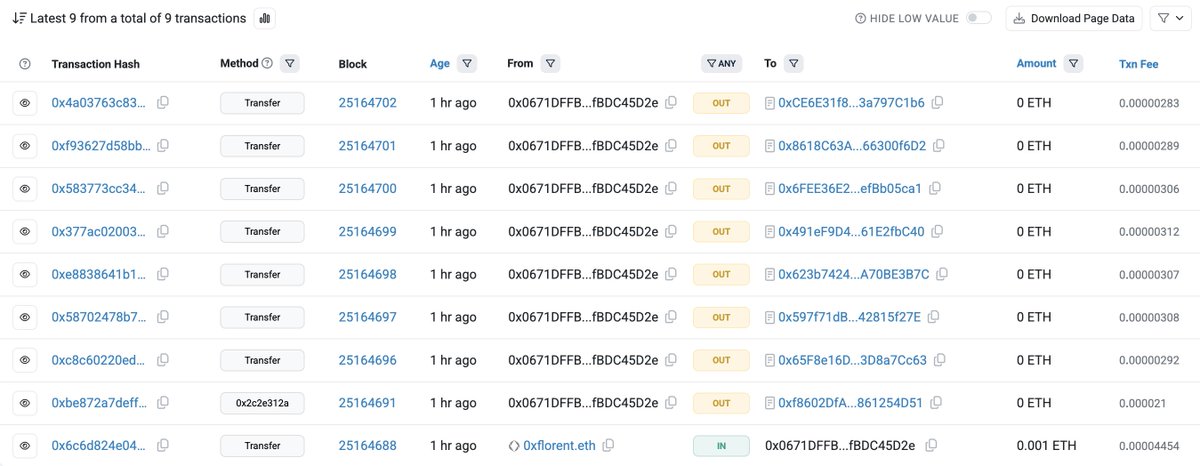
For transparency, here are the wallets so everyone can verify the transactions directly on-chain:
$STOCKER Buyback & Burn Wallet:
https://t.co/tb9CQeKZgv
Wallet receiving/holding platform fees:
https://t.co/pYCAH7xBhk
I encourage everyone to check the on-chain data and draw their own conclusions.
Thank you to everyone who gave Derive a go this week, and to everyone who keeps coming back.
We've been at this for 5+ years, and seeing more of you give us a chance motivates us to keep pushing.
I unlocked 19.329 Ξ (40,590$) on Ethereum and returned them to their original owners.
The funds had been stuck in two old contracts for years, recoverable through public functions that nobody had ever called.