Official Twitter of NUS Department of Food Science and Technology. Featuring our collection of extensive food research done by our research groups in FST.
NUS Researchers found that people with diabetes are more willing to compromise taste and cost for healthier staple foods. Find out more about consumers' attitudes and perceptions towards novel staple foods in multi-ethnic Asian population.
Glad to share our recent work. Thanks
Kappa-carrageenan enhances the gelation and structural changes of egg yolk via electrostatic interactions with yolk protein
https://t.co/XnXgSqUGce
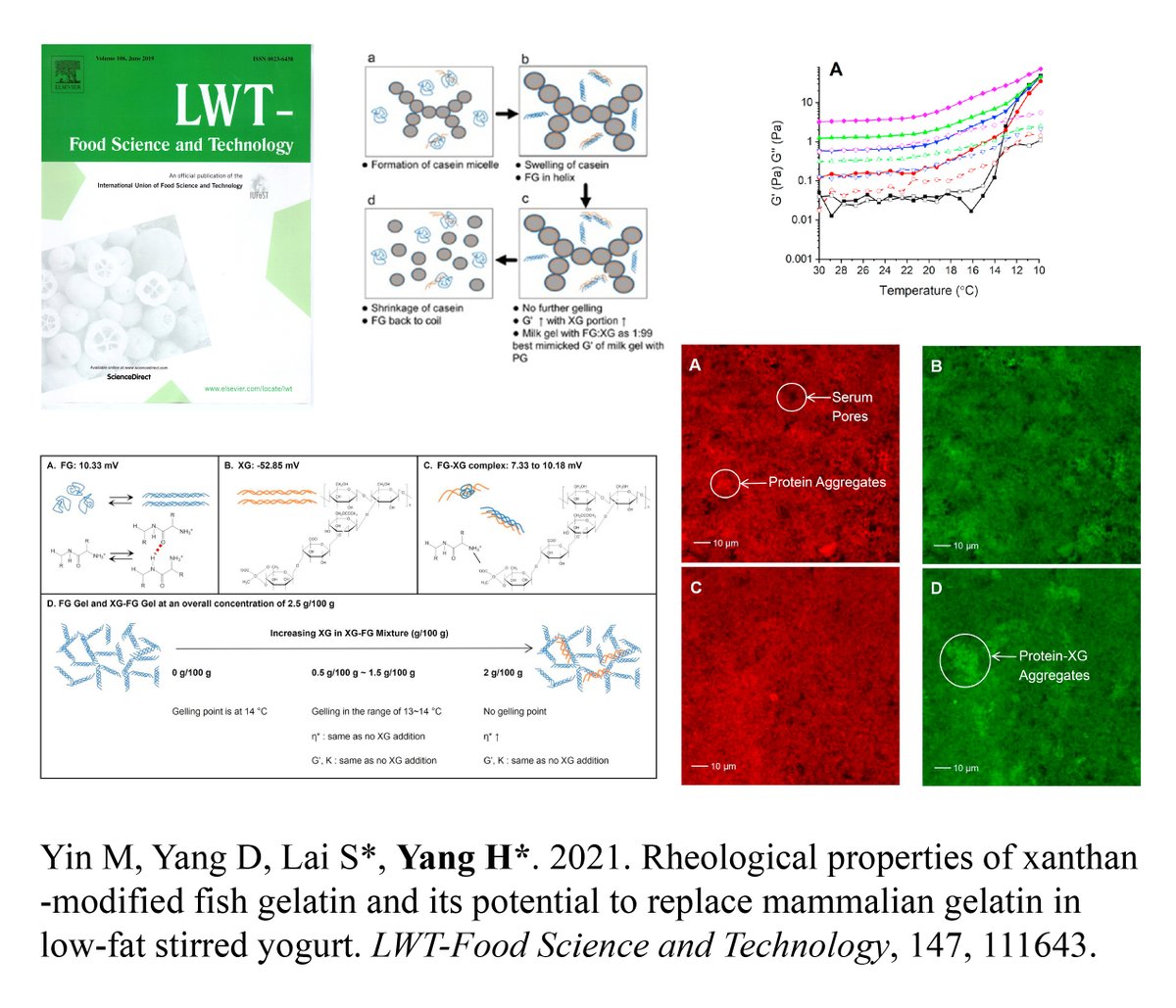
Yin, M., Yang, D., Lai, S., & Yang, H. 2021. Rheological properties of xanthan-modified fish gelatin and its potential to replace mammalian gelatin in low-fat stirred yogurt. LWT-Food Science and Technology, 147, 111643.
https://t.co/nwv1SWyZ5H
Congratulations to my previous students, Li Cheng and Karmaine! We won 2021 Banner Award based on our co-authored paper published in Journal of Food Science in 2018!
FST's progress on writing the 'Singapore Food Story' to strengthen Singapore's food security. This project is funded by NRF Singapore through its CRP funding scheme @ACS4Authors#MyACSCover
NUS scientists discover that LED light intensity can be an efficient tool in regulating leafy vegetable quality in indoor farming. This knowledge can be critical in directing indoor farming practice for improving vegetable nutritional values. #MyACSCover
https://t.co/rHgQMJW5Fh
Huang, M., Zhao, X., Mao, Y., Chen, L., & Yang, H. 2021. Metabolite release and rheological properties of sponge cake after in vitro digestion and the influence of a flour replacer rich in dietary fibre. Food Research International, 144, 110355.
https://t.co/1QOFbyWH1v
He, Y., Zhao, X., Chen, L., Zhao, L., & Yang, H. 2021. Effect of electrolysed water generated by sodium chloride combined with sodium bicarbonate solution against Listeria innocua in broth and on shrimp. Food Control, 127, 108134.
https://t.co/lOheeWGqzX
A method was developed for the separation of 42 common flavonoid glycosides in food by combining advanced mass spectrometry with chromatographic separation. This may be applied to investigate the flavour and bioactivity related to these compounds.
https://t.co/N47joYdUvr
NUS food scientists have demonstrated that grounded wheat bran enables its fortification in Asian wheat noodles by up to 20% without compromising organoleptic acceptance and it can be an effective approach in promoting people’s dietary fibre intake.
https://t.co/459lIc9mha
Spent coffee grounds (SCG) is a low-value solid food waste generated from rising consumption of coffee. The addition of yeast extracts may enhance the transformation of SCG into a potential alcoholic beverage with flavor compound complexity.
https://t.co/1qENXIA25x
In order to answer the question whether coronaviruses (CoVs) can be transmitted via foods, NUS food virologists have made a comparison between CoVs with the most recognized foodborne virus, human noroviruses (NoVs).
Read More: https://t.co/1oihyzkxu2
With the use of an in vivo platform (zebrafish larva), NUS food virologists have found that fucoidan, a naturally occurring carbohydrate from brown algae could be a potential anti-viral candidate for the human norovirus.
https://t.co/cyyOI7byBM
Fancy a #probiotic cuppa? NUS food scientists have created new coffee and tea drinks that are packed with over 1 billion units of gut-friendly live probiotics: https://t.co/7tUUPYM95m #NUSResearch#NUSInnovation