💡 The Power of Compounding — in Money, Work, and Life ⚽️
Last night, I was talking to my 17 year old son about The Psychology of Money by Morgan Housel. After I had read the book I decided that, as part of his life education, it was a really important book for him to read.
We were discussing compounding — how time turns small, consistent actions into something extraordinary.
He connected it immediately to his football.
“Do you think if I focus and train hard I can improve, say 1% per day?” he asked.
"And that would compound into a huge improvement over a year, right?"
Exactly. He's a smart kid.
It’s the same principle that builds wealth, careers, and startups.
You start small.
You stay consistent.
You let time do the heavy lifting.
In money, compounding is easy to see.
You invest, it grows, and the growth earns growth.
Simple. Predictable. Powerful.
But in life and business, it’s harder — because the results don’t show up on a chart.
They show up in how you think.
How you lead.
How you tackle challenges.
When I look back at my own career, nothing magical happened overnight.
The turning points weren’t explosions — they were accumulations.
Years of learning, adapting, showing up, and improving 1% at a time.
It's the same with startups.
It’s never one viral moment that builds a business.
It’s the small, often invisible, compounding of effort — every product tweak, customer email, or marketing campaign quietly adds up over years.
The hard part is staying patient long enough to let the compounding work.
Most people quit before the curve bends.
But when it does, everything changes — seemingly all at once.
So whether it’s your finances, your business, or your skills, remember this:
You don’t need to make giant leaps.
You just need to keep showing up.
Targeting consistent incremental gains and improvements.
Because compounding doesn’t reward intensity.
It rewards consistency.
#compounding #growth #startups #career
You can't cost-cut your way out of a revenue problem.
After more than 15 years as a CFO, I've noticed that most businesses move through three distinct phases.
Growth.
Maturity.
Reinvention.
The first phase is easy to spot.
Revenue is growing.
Margins are healthy.
Everyone is focused on expansion.
The second phase is about optimisation.
Balancing growth, costs, and profitability.
But it's the third phase that catches most businesses out.
Because reinvention usually arrives at exactly the wrong time.
Just as growth starts slowing and margins begin to tighten, the business needs to reinvent and invest.
New products.
New markets.
New capabilities.
New ideas.
And that's when things start to get interesting.
Because the first signs of a slowing business tend to trigger a knee-jerk reaction.
To protect profits, the instinct is to cut costs.
The trouble is that revenue problems rarely announce themselves as revenue problems.
They arrive disguised as cost problems.
Margins come under pressure.
Profits start shrinking.
And suddenly everyone is staring at the expense line.
And to be clear, cutting the right costs isn't a bad thing.
If your cost base has become bloated, there are absolutely opportunities to improve efficiency.
But deep, panicked cuts usually hit the wrong things.
The current product.
The plans needed to reinvent the business.
The team building the future.
The marketing that drives demand.
And for a while, it works.
The savings flow straight through to the bottom line.
The income statement looks healthier.
It feels like progress.
But often you've simply treated the symptom and ignored the disease.
Because the original problem wasn't excessive costs.
It was slowing revenue.
And now you've cut the very things that could have helped reverse it.
That's when the spiral begins.
Revenue declines further.
Margins come under pressure again.
More cuts follow.
Then more.
And before long the business is managing decline instead of funding reinvention.
Cutting costs to solve a revenue problem becomes is a self-fulfilling prophecy.
It solves today's pressure by making tomorrow's challenge even bigger.
So before you reach for the red pen, stop and ask one question:
Is this actually a cost problem?
Or is the real issue declining revenues?
Because most business problems aren't solved by action.
They're solved by diagnosis.
Get the diagnosis wrong, and even the right actions can make things worse.
You can't cost-cut your way out of a revenue problem.
After more than 15 years as a CFO, I've noticed that most businesses move through three distinct phases.
Growth.
Maturity.
Reinvention.
The first phase is easy to spot.
Revenue is growing.
Margins are healthy.
Everyone is focused on expansion.
The second phase is about optimisation.
Balancing growth, costs, and profitability.
But it's the third phase that catches most businesses out.
Because reinvention usually arrives at exactly the wrong time.
Just as growth starts slowing and margins begin to tighten, the business needs to reinvent and invest.
New products.
New markets.
New capabilities.
New ideas.
And that's when things start to get interesting.
Because the first signs of a slowing business tend to trigger a knee-jerk reaction.
To protect profits, the instinct is to cut costs.
The trouble is that revenue problems rarely announce themselves as revenue problems.
They arrive disguised as cost problems.
Margins come under pressure.
Profits start shrinking.
And suddenly everyone is staring at the expense line.
And to be clear, cutting the right costs isn't a bad thing.
If your cost base has become bloated, there are absolutely opportunities to improve efficiency.
But deep, panicked cuts usually hit the wrong things.
The current product.
The plans needed to reinvent the business.
The team building the future.
The marketing that drives demand.
And for a while, it works.
The savings flow straight through to the bottom line.
The income statement looks healthier.
It feels like progress.
But often you've simply treated the symptom and ignored the disease.
Because the original problem wasn't excessive costs.
It was slowing revenue.
And now you've cut the very things that could have helped reverse it.
That's when the spiral begins.
Revenue declines further.
Margins come under pressure again.
More cuts follow.
Then more.
And before long the business is managing decline instead of funding reinvention.
Cutting costs to solve a revenue problem becomes is a self-fulfilling prophecy.
It solves today's pressure by making tomorrow's challenge even bigger.
So before you reach for the red pen, stop and ask one question:
Is this actually a cost problem?
Or is the real issue declining revenues?
Because most business problems aren't solved by action.
They're solved by diagnosis.
Get the diagnosis wrong, and even the right actions can make things worse.
It's rarely a delivery problem. It is, almost always in fact, an expectation problem.
Last week I ordered a laptop for my son’s birthday. His birthday is towards the end of June, but the price was was great so I clicked "Order."
Credit Card payment done, I immediately received a WhatsApp order confirmation and invoice. All looked good so far.
The confirmation included details around shipping. It stated that:
"Orders ship within 1 working day"
Perfect. I genuinely wasn’t in any rush, but that quick delivery was great.
✅ 1 x Happy Customer
It was a busy week.
Then on Saturday I realised… well, nothing.
No update.
No delivery.
No communication.
So I messaged them back on WhatsApp. Their response was:
"Apologies, we’ll check and get back to you.”
And then… silence.
I followed up again on Sunday, to which I got the response:
“We’re closed.”
As of today, the laptop still hasn’t arrived. And I have received no updates or feedback.
Now here’s the interesting thing:
The delay itself isn’t actually a problem.
I am fully aware that things go wrong in business.
Couriers fail.
Suppliers slip.
Systems break.
Customers understand that far more than businesses realise.
The problem was the promise.
The second they said “1 working day” and missed it without a word, my trust disappeared.
When I reached out and got no proper feedback, it compounded.
And once you've started down that slippery slope it’s incredibly difficult to go back. I am pretty sure I won't be ordering from them again.
But what really gets to me is how easy this is to solve. Every company delivering a product has to manage logistics and get the sale into the customer's hands.
Back when I ran EgoAmo Posters, we mapped every step of the delivery process:
packing, collection, transit, last-mile delivery — everything.
Then we looked at the worst-case scenario for every single step.
Not the optimistic timeline.
Not the average.
The worst case.
Then we added two more days.
That became our delivery promise to people ordering on the website.
The result?
Customers expecting delivery in five days often got their orders in two.
Same product.
Same delivery.
Completely different emotional outcome.
When I stepped away from the business, we had a 4.9-star rating from over 500 reviews.
Not because we were perfect.
Because we made promises we knew we could keep…
…and then exceeded them.
If there is one thing all entrepreneurs should work towards, and please excuse the cliche, it's to underpromise and overdeliver.
Because as I said in the beginning, this was never a delivery problem.
It was always an expectation problem.
The AI Reckoning: Hype Has a Price
For two years the narrative around AI has been relentless.
AI replaces workers.
AI cuts costs.
AI runs the business.
But over the last few weeks something interesting has started happening:
The receipts are arriving.
Axios ran a headline recently saying:
“AI can cost more than human workers now.”
The post went viral. Not because people were shocked…
…but I think it aligned with what a lot of people had started to suspect alreay.
And honestly?
The more discussions I have around AI, the more the conversation feels a bit disconnected from reality.
Yes — AI is extraordinary technology.
But the hype cycle has created this strange idea that:
“expensive demos” = “profitable business transformation.”
Unfortunately and realistically I have to point out - They are not the same thing.
The reality is that many companies are discovering:
🔹 compute costs are enormous,
🔹 governance is immature,
🔹 hallucinations are real,
🔹 and human verification still sits underneath almost everything important.
This was highlighted recently by consulting giant EY having to retract a cybersecurity report after researchers revealed that nearly three-quarters of its references were AI hallucinations
Think about that for a second.
If organisations can’t yet fully trust the citations in the report…
…how exactly are we simultaneously arriving at:
“all white collar work disappears in 18 months”?
I posted previously regarding Microsoft AI CEO Mustafa Suleyman suggesting many white-collar jobs could largely disappear within that timeframe.
Clearly he has access to a version of Copilot the rest of us in the trenches haven’t seen yet. I have tried using Copilot for financial analysis - let's just say I have saved that little horror story for a post on another day.
The truth is probably less dramatic than both the hype and the backlash.
AI will absolutely transform work.
But the winners won’t be the companies shouting “replace humans.”
They’ll be the companies quietly figuring out:
➡️ where AI genuinely creates leverage,
➡️ where humans still matter,
➡️ and how to govern the layer in between.
Because in business, the demo is easy.
Consistent, reliable execution - well that's the hard part.
(Check out the link to the Axios report in the comments)
We grew revenue 2.5x. And nearly went broke doing it.
In the early days of EgoAmo we sold posters. Simple. High margin. Easy to ship.
The model worked.
Then customers started asking for frames.
Our supplier had affordable imported frames. Customers wanted them. It seemed like the most obvious next step in the world.
So we added them. And they flew. Average order value jumped 2.5x overnight. Revenue climbed. Every metric we were watching pointed up and to the right.
Then I looked at the unit economics.
Frames cost 5 times what a poster cost. We'd priced them at market rate — which meant a fraction of the margin we made on posters. Every order with a frame now qualified for free shipping. With posters alone, customers needed to buy four to unlock free shipping. Now one framed poster unlocked that discount.
And shipping a framed poster cost three times more than shipping four posters.
We had grown revenue. We had grown average order value. Two metrics every eCommerce business obsesses over.
But we had also quietly destroyed our margin per order, blown our shipping economics, and tied up significant cash in frame inventory — all at the same time.
On the surface the business looked like it was flying. Underneath, we were burning.
Luckily we caught it. We rebuilt the shipping rules. Negotiated better payment terms with the supplier now that our volumes justified it. Found collection options to remove shipping costs on local orders entirely. Turned it into a genuine revenue driver.
Two lessons came out of this that I've never forgotten.
Firstly, revenue growth can hide a multitude of sins. Secondly, and most importantly, it reinforced that the number that tells you the business is healthy isn't the top line. It's what's left after you've paid for everything it cost to generate it.
From then on, before we added a new product or service, or any offers — we modeled the full unit economics first. Not just the price. The cost to acquire it. The cost to store it. The cost to deliver it. The margin that survives in the end.
Because you can grow your way into serious trouble while focussing on revenue.
And unfortunately, going broke with great revenue is still going broke.
You can't save your way into sustainable profit.
I've spent over 15 years as a CFO. That's one of the few absolute truths I've carried out of every boardroom I've sat in.
When businesses come under pressure, the instinct is immediate — cut costs. And cutting the right costs isn't a bad idea. If your cost base is a little bloated - those can definitely go.
But deep, panicked cuts usually hit the wrong things. The product. The team that delivers it. The marketing that sells it.
So you clean up your income statement for a year. The savings drop straight through to the bottom line. It looks like progress.
But you've just made your real problem worse.
Because what triggered the cost-cutting in the first place was almost always a revenue problem. And now you've cut the very things that drive revenue. So revenue drops further. And you cut again (and possibly again.....)
That's the cycle. Cutting costs to solve a revenue problem is a self-fulfilling prophecy — and it moves in one direction only. And spoiler alert, it isn't up.
So, before you reach for the red pen, stop and ask one question:
Is this actually a cost problem — or is the real root of your trouble declining revenues?
Define it correctly before you act. Solving the wrong problem doesn't just waste time — it doubles the pain.
I once had the most obvious business idea in South Africa. It nearly broke us.
Here's what happened.
The Springboks had just won the Rugby World Cup. South Africa was euphoric. I secured the official license to be their global poster supplier. World champions. A country obsessed with rugby. What could go wrong?
We went big. Printed thousands. Built the inventory. Launched hard.
Nobody bought them.
We tried retail — no interest. Corporates as a giveaway — no takers. A full marketing campaign — lots of buzz, almost no sales.
I called a friend. Afrikaans, deep retail knowledge, exactly the demographic I'd been targeting. I asked him two things: why isn't this working, and what did I miss?
His answer was simple. There was too much rugby. Super Rugby, Currie Cup, Varsity Cup, Rugby Championship, end of season tours, World Cup — fans were saturated. They were shelling out big bucks to wear the green and gold. But when it came to decorating their walls, the connection just wasn't deep enough.
I was a CFO. I understood markets, margins, licensing deals. And I'd missed the most basic thing — I'd never actually asked a real customer if they'd buy it.
We recovered. One product saved the deal — a detailed World Cup commemorative poster with tournament results, the squad, and the final details. It sold. It wasn't a bestseller, but we sold enough for us to fight another day.
The lesson I carry from this isn't about inventory or licensing.
It's about the psychology of the sure thing.
The opportunities that feel inevitable are the ones that bypass your critical thinking entirely. The more obvious the idea feels, the more important it is to ask the question you're most tempted to skip:
Have I actually spoken to someone who would buy this?
I hadn't. And it cost us.
Never bet everything on a sure thing. Size your bets so that being wrong is expensive but survivable.
In business, in your career, and in life — I have made calls that failed. The way I see it - It's all part of the game. And every failure is an opportunity to learn something which I couldn't have learned any other way.
My biggest learning? Make sure that no call is so big, that if it fails, it breaks you.
@Dwriteway Creating a life and business for yourself that allows you to generate the money you need and balance your time between your personal and professional life - now that's the flex
@ShepL24 This is so true! Having someone else who is competent and capable adds a level of review and questioning that can only add value. Plus, channel your time and energy where they will give the best ROI.
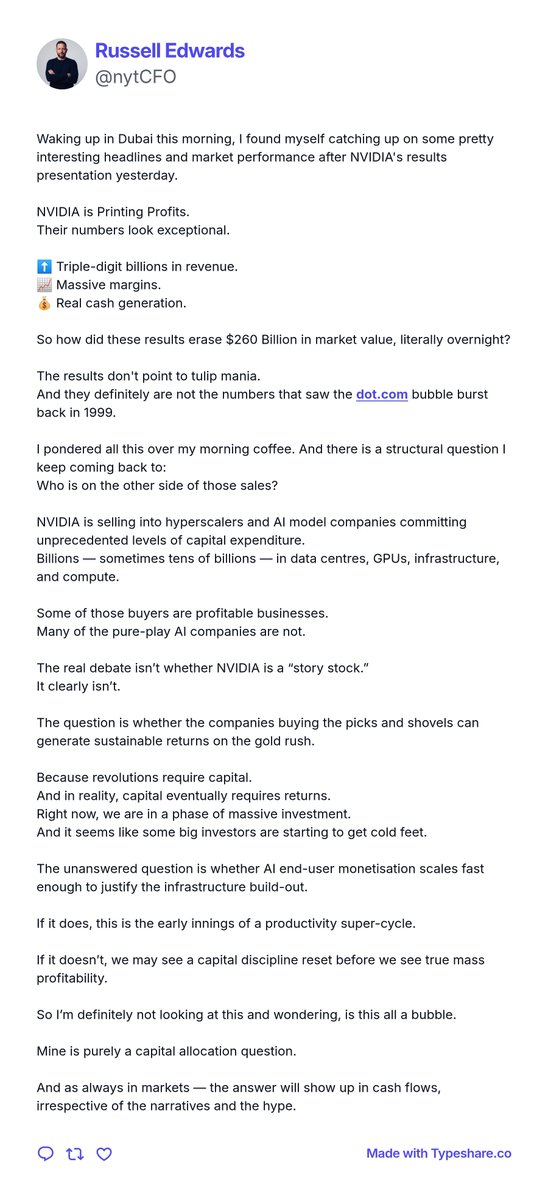
NVIDIA is massively profitable.
That’s not the debate.
The real question is whether the companies buying $100bn+ of AI infrastructure can earn returns above their cost of capital.
This isn’t a bubble call.
It’s a capital allocation question.
Cash flows will decide.
I think its fair to say most people are using or have at least been exposed to AI in one way or another at this point.
I use AI pretty much everyday.
But earlier today I had an interesting experience that really got me thinking. I asked an AI tool that’s positioned as “finance-ready” a pretty basic question:
How long would it take to hit a target capital balance, given starting capital, annual contributions, and an assumed market return roughly in line with the last decade of the S&P 500?
The answer came back quickly.
Neatly formatted.
Confidently delivered.
And… well, absolutely wrong.
It referenced ~13% returns, then told me it would take around 5½ to 6 years to grow the capital base by ~67%.
That’s the moment my finance spidey senses went off.
At ~13% annual compounding, money roughly doubles in about 5½ years (Rule of 72)
If you don't know this little trick please drop "Rule of 72" in the comments and I will send it to you.
It’s not advanced finance.
It’s a basic coherence check most of us carry around in our heads.
So I pushed back.
“How can 13% plus annual contributions only get me 67% growth over the same period where 13% alone roughly doubles?”
To the AI’s credit, it admitted that my logic was right and that it would need to revisit its calculation.
That’s not a small miss.
That’s a basic financial sanity check failing.
And that is a concern. It talks to an uncomfortable feeling I have at the moment with the current AI hype cycle.
I saw an article last week in which the head of AI at Microsoft was quoted saying AI could replace large swathes of white-collar work — including accounting, law, and finance — within the next 12 to 18 months.
Maybe he’s using a different version of Copilot to the rest of us mere mortals.
Because the version we have access to.... I think it's fair to say it isn't replacing any finance jobs any time soon.
So, to circle back — I’m a big believer in AI.
I use it daily.
It’s great at drafting, synthesising, and helping me think faster.
But there’s a growing gap between what AI sounds like it can do and what it can reliably do inside real businesses. This is where real accountability is needed and there are real consequences when things go wrong.
For CFOs, founders, and execs, the takeaway is simple:
Use AI to move faster.
Use it to draft.
Use it to help you think.
But don’t outsource your judgement.
And definitelt don't blindly rely on an AI's output.
Because incorrect numbers don’t work in the real world, no matter the level of confidence with which they are delivered
And accuracy is exponentially more important in finance and business than hype.
I've dropped a link to the article referencing the Microsoft's Head of AI's views on AI replacing White Collar jobs in the comments.