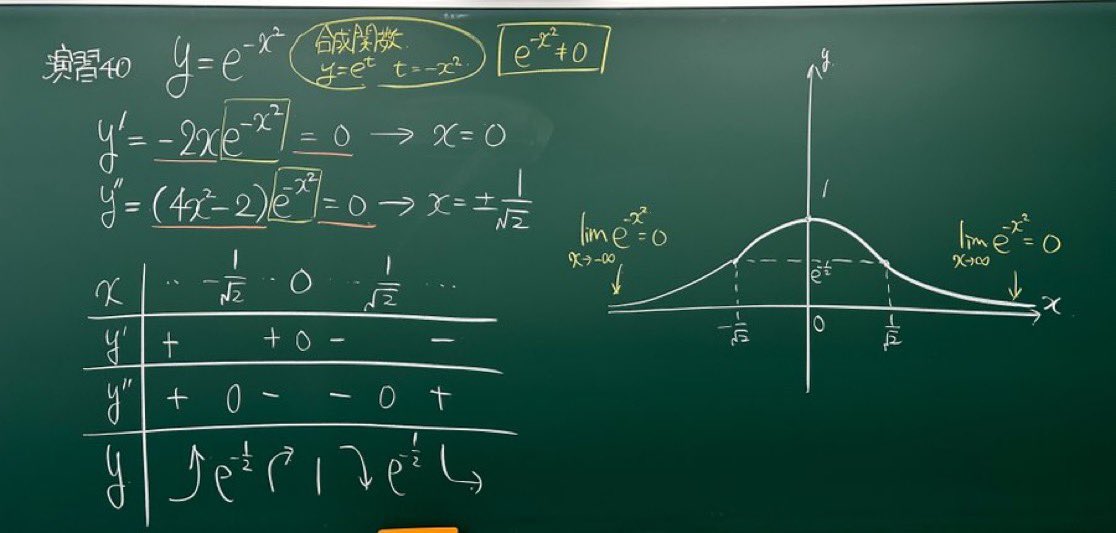
Deriving ∫₀^∞ e^{-x²} dx begins by forming its square as the double integral ¼∬e^{-(x²+y²)} dx dy over the full plane.
Polar coordinates convert the integrand to e^{-r²} with area element r dr dθ, θ from 0 to 2π and r from 0 to ∞. The substitution u = r² (du = 2r dr) turns the radial integral into ½∫₀^∞ e^{-u} du, recognized as ½ via the Gamma function at Γ(1) = 1. Angular integration then yields I² = π/4, solving directly for I = √π/2.
This exact normalization constant for the standard normal distribution enables precise probability calculations for measurement deviations in physics experiments.