Modular Cell-Free Extract Mixing Enables Soluble, Active Biomanufacturing of Difficult-to-Express and Aggregation-Prone Proteins
https://t.co/pPY7b6VZFd
Interested in molecular animation? Give ProteinBlender a try! It's free and open source. https://t.co/HtSCiWAaIl The latest tools include a DNA builder (shown in the tutorial video below). We'd love to hear what you think! We have short tutorials that cover all the features!
We’re sharing a solution to the Navier-Stokes Millennium Prize Problem, one of the deepest problems at the frontier of mathematics.
The proof was produced by a group of agents, using an OpenAI next-generation model significantly more capable than GPT-6 Astra.
The problem concerns whether the description of smooth three-dimensional fluid motion modeled by the Navier-Stokes equations can break down. It has remained unresolved for roughly 90 years.
A single neuron does three things and nothing more: weigh its inputs, bend the result with a
curve, then quietly shrink its own mistakes.
z = Σᵢ wᵢxᵢ + b a = 1/(1 + e⁻ᶻ) ŷ = a
That gentle S-shape is the entire reason deep networks can separate data that no straight line
ever could. The same unit now flags tumors, pilots drones, and predicts markets.
It has one goal: make the average distance between ŷ and truth as small as possible.
Linear algebra, then a nonlinearity. That is the art.
Hawking Radiation ✍️
Hawking Radiation is a theoretical discovery made by physicist Stephen Hawking in 1974 that changed how we think about black holes. Before Hawking, people believed black holes were perfect cosmic traps where nothing could escape, not even light. They thought these holes would exist forever. Hawking proved this idea wrong by combining two major theories in physics: General Relativity, which explains gravity and spacetime, and Quantum Mechanics, which describes the behavior of tiny particles.
The key to understanding his discovery lies in something strange about empty space — it is not really empty. At the quantum level, space is filled with energy that creates pairs of particles. These pairs consist of one particle and one antiparticle. They pop into existence together, exist for a tiny fraction of a second, and then collide and annihilate each other before disappearing. This process occurs everywhere in the universe, all the time, but goes unnoticed.
At the edge of a black hole, known as the event horizon, something extraordinary happens to these particle pairs. Before they can destroy each other, the black hole's intense gravity pulls them apart. One particle gets drawn into the black hole and disappears forever, while the other escapes into space as real radiation. This escaping radiation is what we call Hawking Radiation. The particle that falls into the black hole carries negative energy, meaning it takes a small amount of mass away from the black hole each time this occurs. Over a very long time, this process causes the black hole to gradually shrink and eventually vanish in a final burst of energy.
One surprising result of this discovery is that black holes have a temperature, and the relationship between size and temperature is the opposite of what you might expect: smaller black holes are hotter and evaporate faster, while larger ones are colder and last much longer. A black hole with the mass of our Sun would have a temperature of sixty millionths of a degree above absolute zero and would take about 10^67 years to completely evaporate. This timescale is so vast that the current age of the universe is a tiny fraction of it.
The radiation is also filtered and changed by the curved spacetime around the black hole before it reaches any observer, meaning what we actually detect is a modified version of the original radiation shaped by the geometry of space itself. When black holes are disturbed, like during a collision, they vibrate and ring like cosmic bells at specific frequencies. This sends out gravitational waves that ripple through the universe and can be detected on Earth using instruments like LIGO, which made the first detection of these waves in 2015.
Hawking Radiation has also led to one of the deepest unresolved mysteries in physics, known as the Information Paradox. According to quantum mechanics, information can never be completely destroyed. However, when a black hole evaporates completely, all information about everything that fell into it seems to disappear, which would violate a fundamental law of nature. No one has yet found a complete and satisfying solution to this problem.
Despite being one of the most celebrated predictions in theoretical physics, Hawking Radiation has never been directly detected from a real black hole. The effect is incredibly weak for any known black holes and is completely masked by the background radiation of the universe. However, scientists have conducted lab experiments using flowing fluids and other systems that mimic this physics and have observed a similar effect, lending strong support to the theory.
In the end, Hawking Radiation is more than just a property of black holes; it provides a important clue toward a deeper and more complete theory of the universe that unifies gravity and quantum mechanics.
Alcubierre warp drive ✍️
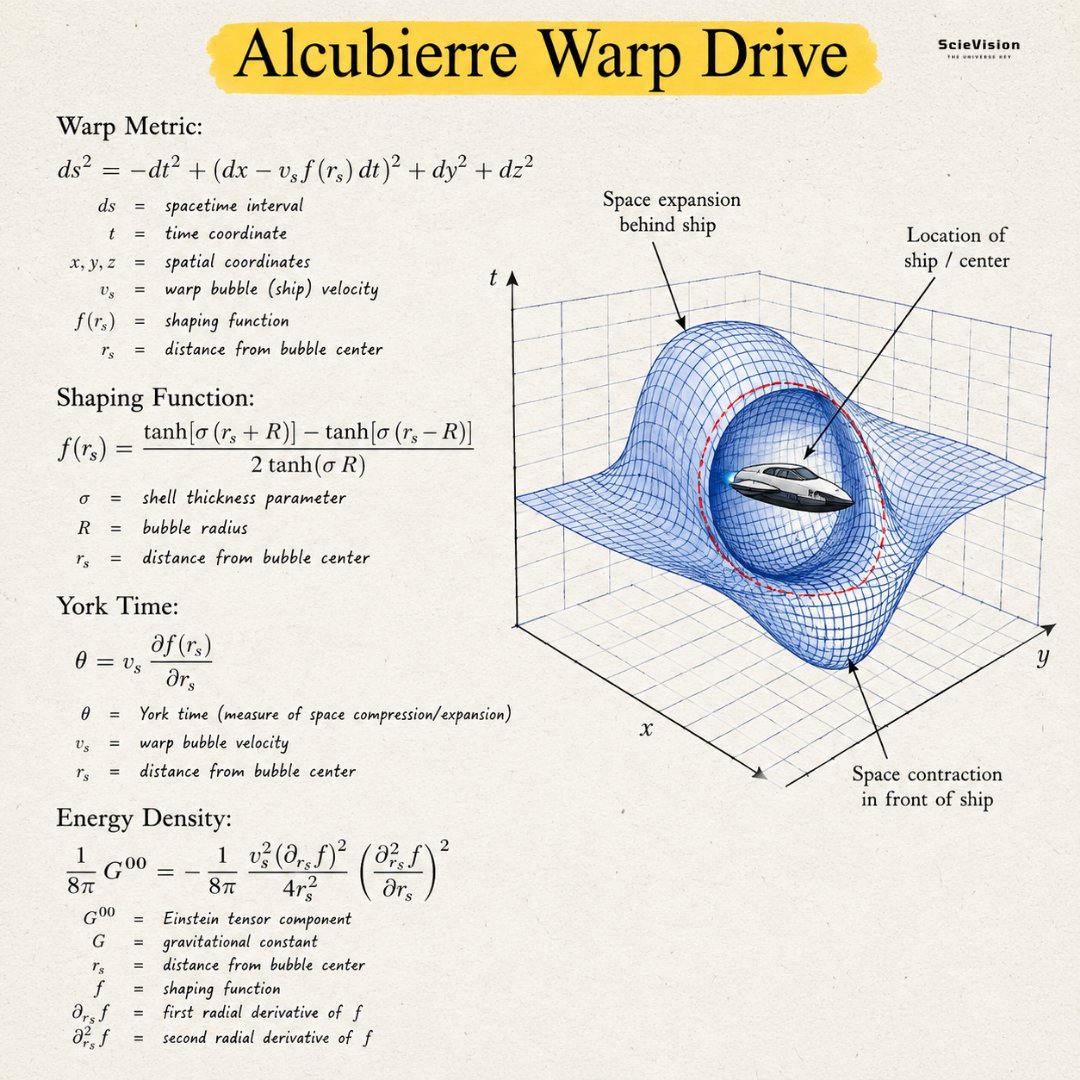
It is one of the most remarkable concepts in theoretical physics. It was proposed in 1994 by a Mexican physicist named Miguel Alcubierre. It outlines a mathematically sound way to travel between two points faster than light without actually breaking Einstein's speed limit. The loophole it uses is as elegant as it is mind-bending.
Einstein's relativity states that nothing can move through space faster than light. However, it does not address the idea of space itself moving. Space is neither matter nor energy; it is the fabric on which everything exists. This fabric can expand or contract at any rate without violating any physical law. We know this is true because distant galaxies are moving away from us faster than light right now. They are being carried by the expansion of space rather than moving through it. Alcubierre posed a simple yet stunning question what if we could create that same expansion and contraction locally, around a spacecraft, on demand?
The idea suggests that a ship remains perfectly still inside a bubble of flat, undisturbed space. Meanwhile, the space in front of it contracts, bringing the destination closer, and the space behind it expands, pushing the starting point farther away. The bubble moves through the universe like a wave carrying a surfer. The surfer does not swim faster than the wave; the wave carries them along. The ship doesn’t move through space at all. The space around it moves, while the ship is just along for the ride.
What makes this particularly interesting is what the passengers would actually experience: nothing unusual. There would be no crushing acceleration, no distortion, and no strange passage of time. They would simply feel like they were sitting still in ordinary space, which is precisely what they would be doing. The bubble wall does all the work while the interior remains calm and flat, much like the quiet eye of a storm.
A diagram beautifully illustrates this concept. The flat grid representing normal spacetime is dramatically distorted around the ship. It compresses into a depression in front and bulges up behind, while the ship sits in a smooth, undisturbed pocket in the middle. The red dashed circle marks the bubble wall where all the dramatic geometry occurs, with ordinary flat space both inside and far outside.
The significant issue, and it is a serious one, is the energy needed to create this warped geometry. The mathematics indicates that the bubble wall must contain negative energy not just a little, not zero, but genuinely less than nothing called exotic matter. This type of matter has never been observed or created in any substantial amount. Early estimates suggested we would need an amount of exotic negative energy similar to the mass-energy of an entire planet like Jupiter, which is far beyond any current technology. This makes the concept feel more like fantasy than physics. Later estimates have lowered this requirement considerably, but the need for exotic matter remains.
There are other deep challenges as well. The ship inside the bubble cannot send signals to the bubble wall to steer it. The wall moves too quickly for any signal from inside to catch up, meaning the entire journey must be pre-programmed before departure with no way to change course. Quantum effects indicate the bubble wall might generate intense radiation that could harm the ship and its passengers during any significant journey. Additionally, the bubble's geometry creates boundaries that may make the entire structure fundamentally unstable.
Genetically encoded biosensors in microbes for Tumor targeting
"...cataloged the expanding repertoire of biosensors for tumor-specific biomarker sensing."
https://t.co/US5tKzxu8x
Synthetic Engineering of Microbes for Production of Terpenoid Food Ingredients
"basic genetic circuits applicable for metabolic and genetic control in E. coli and S. cerevisiae"
https://t.co/7xAzFzHm6I
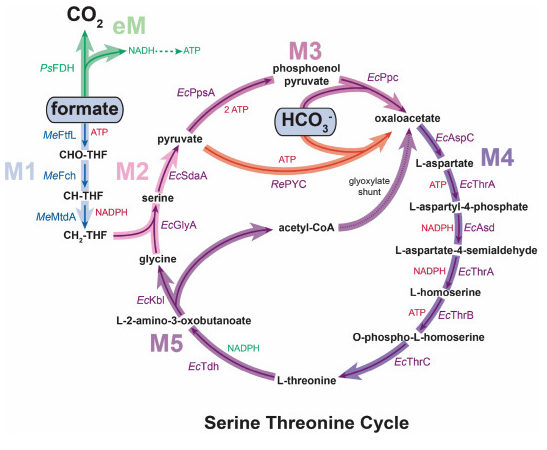
Evolution-assisted engineering of E. coli enables growth on formic acid at ambient CO2 via the Serine Threonine Cycle
"synthetic C1-utilization pathways are engineered into E. coli"
https://t.co/v87gBr300m
PlasmidScope: a comprehensive plasmid database with rich annotations and online analytical tools | Nucleic Acids Research | Oxford Academic https://t.co/cVndeK4LbF
Evolution in microbial microcosms is highly parallel, regardless of the presence of interacting species
@CellSystemsCP by @NittayMeroz et al from @JFriedman_micro
https://t.co/jSM7Tt6g7x