We will try our best to publish ONE report a week. We don’t chase quantity. We chase quality.
Our team: 20+ years deep in China’s financial markets.
Our focus: High-end listed manufacturers with genuine long-term upside.
Our approach: Field research meets data tracking, building a rigorous, fundamentals-first view on China’s industrial champions.
If that sounds like your kind of research, follow us.
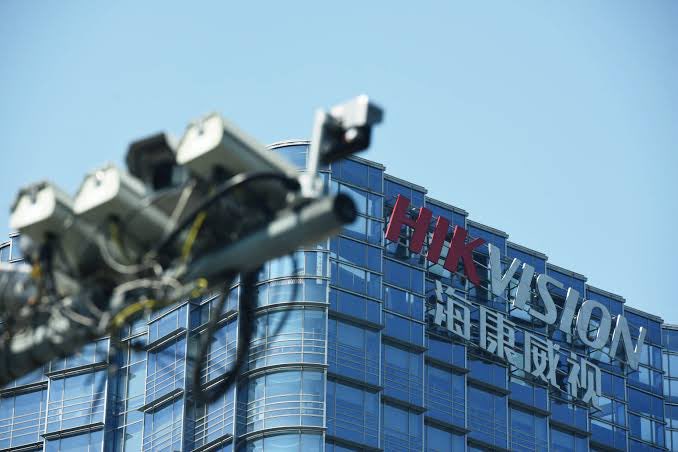
Hikvision 海康威视 (https://t.co/bFn9B6rGgd)
On July 22, the FCC closed the last door: not only Hikvision devices barred from the US, but any device anywhere containing a Hikvision component capable of processing logic, with no transition period. This followed an outright import ban in June. For a company blacklisted in some form since 2019, the striking point is how little either announcement changed the numbers.
That frames everything below. Hikvision’s external ceiling is fixed by forces it cannot negotiate with, so the story has moved inside the company.
Fundamentals: growth without growth
The 2025 result looks like a typo. Revenue ¥92.5B, up 0.01%. Net profit ¥14.2B, up 18.5%, the best in five years. Profit rising while sales stand still is rare in manufacturing and was deliberate: management shifted focus from revenue scale to earnings quality.
Execution has been consistent. Gross margin climbed six straight quarters: 43.83% in 2024, 45.88% in 2025, 49.09% in Q1’26, the highest since 2020. H1’26 revenue reached ¥46.8B (+12.0%) and net profit ¥7.9B (+39.6%), with recurring profit up 40.5%. 2025 ROE hit 17.3%; operating cash flow was ¥25.3B, up 91%.
Two numbers complicate it. Inventory rose 19.1% in a quarter to ¥24.4B, attributed to stockpiling against component price inflation—defensible but capital-consuming. More importantly, H1 operating cash flow fell 39.5% to ¥3.2B even as profit surged 40%. Last year’s cash generation was the best evidence the quality turnaround was real; this year’s is the evidence against it.
The innovation engine
If the core market is capped, growth must come from elsewhere. Eight innovation businesses generated ¥25.4B in 2025, up 13.2%, now 27.5% of revenue: robotics ¥6.45B (+8.8%), Ezviz smart home ¥5.68B (+9.5%), thermal imaging ¥4.44B (+6.0%), storage ¥2.38B (+2.9%), other units ¥1.20B (+27.5%). Seven of the eight are profitable.
A real but partial answer. Most grow at high single digits—faster than the parent, slower than a re-rating requires. Ezviz is listed on the STAR Market; Hikrobot’s ChiNext application has sat in the queue since March 2023, delaying the value crystallization the market has waited on.
Geopolitical reality
The blacklist history is long: Commerce Entity List in 2019, Pentagon CCMC list in 2020, FCC Covered List in 2022, five Xinjiang subsidiaries in 2023, Hikmicro in 2024, then this summer’s import ban and component rule.
The counterintuitive consequence: North America is already effectively zero, so each new restriction removes less than the last. What matters is the composition of what remains. In Q1, developing markets clearly outpaced developed ones, with Latin America, the Middle East and Africa, and Asia-Pacific strong while Europe slowed under oil-driven pressure. Management pre-stocked ahead of Middle East disruption and called that decision vindicated. Its framing: where there is destruction, there is rebuilding.
Hikvision is no longer a global company constrained by US policy. It is a company built for the markets US policy does not reach.
Outlook
At ¥35.49 on July 24, market cap is ¥325B, about 23x 2025 earnings, with ¥10.5B of 2025 dividends implying roughly 3.2% yield. R&D ran ¥11.8B (12.7% of revenue) and ¥59.5B over six years, with nearly half of employees in R&D or technical service.
Bull case: margins still climbing, innovation nearing 30% of revenue, an expanding AI model line across cloud, edge and device, a modest multiple with real cash returns.
Bear case is arithmetic. With revenue flat, margin expansion does all the work, and that road has a finite length. Government demand stays fiscally constrained. The geopolitical ceiling is permanent, not cyclical.
Leaner company or stalled one? Forty percent profit growth argues the first. Cash flow down 40% argues for caution. Only a reacceleration in revenue settles it.
#AIoT #ChinaTech
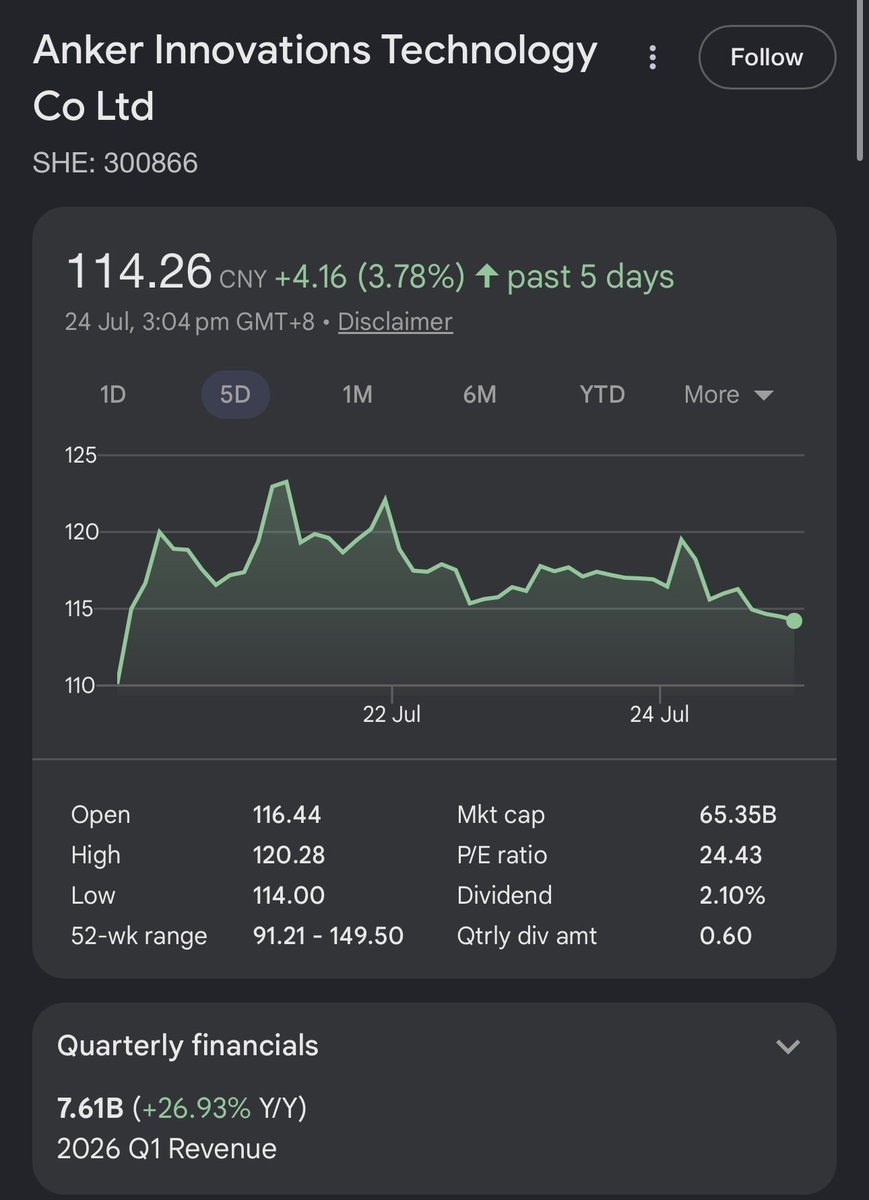
Anker Innovations 安克创新 (https://t.co/R772AE3U8H / https://t.co/SHqV8ihUjO)
In August 2024, Trump was spotted on a livestream using a power bank viewers identified as Anker’s Qi2 MagGo, and the A-shares jumped. Thirteen months later, bipartisan leaders of the US House Select Committee on China asked Commerce to investigate that same company for tariff circumvention. That arc is the whole Anker story.
A “shallow sea” strategy: skip what Apple and Samsung dominate, win the adjacent categories. 180+ countries, 200M+ users, 96.6% of revenue from outside China. Per Frost & Sullivan, the world’s #1 mobile charging brand at 4.8% share.
Fundamentals
FY2025: revenue ¥30.5B (+23.5%), net profit ¥2.55B (+20.4%), recurring ¥2.18B (+15.4%), gross margin 45.07%. Segments: charging and storage ¥15.4B (+21.6%), smart innovation ¥8.27B (+30.5%), audio and video ¥6.83B (+20.1%).
Q1’26 revenue ¥7.61B (+26.9%), reported profit down 4.9% but recurring up 24.4% to ¥547M. The gap is a ¥100M mark-to-market loss on its Southchip stake, not operations. Selling expense ratio fell 2.2pct while gross margin held, widening the spread 2.6pct. That is pricing power.
Watch three: inventory doubled in two years to ¥5.57B, operating cash flow per share at −¥0.84, effective tax rate up from 9.7% to 15.7% partly on OECD Pillar Two.
Beyond the Power Bank
The category that made Anker famous will not decide its future. In 2022 it killed its low-potential lines and concentrated into three.
Anker SOLIX launched in 2023 with balcony solar storage: panels plus battery, plug-and-play, no electrician. It occupied an empty niche rather than inventing a technology. Germany installed ~310,000 balcony systems in 2024 at ~3% apartment penetration; brokers size Western Europe above €6B if it converges. Storage revenue hit roughly ¥4.5B in 2025 on broker estimates.
The eufyMake E1 consumer 3D-texture UV printer closed its Kickstarter in June 2025 at US$46.76M from 17,822 backers, the largest campaign in platform history. Units shipped. The category-creation engine still runs.
Revenue compounded ~34% and profit ~32% from 2016 to 2024, net margin steady at 8 to 10%. Founder Yang Meng and spouse hold 47.04%.
The Recall Reset
Over 2.38M power banks recalled across China, Japan and the US in 2025 after a cell supplier changed materials without authorization. Booked openly: ¥104M warranty provision, ¥365M impairment, ¥392M advanced.
Remediation is measurable: top-five contract manufacturer share cut from 82% to 73%, 22 backup factories, dual-sourced cells, mandatory pre-approval on material changes. Power bank models went from 126 to 39. The Washington inquiry has no reported conclusion, so it stays an open exposure.
Dual-Listing Read
H shares listed July 2 at HK$99.32, top of range, netting HK$4.52B via CICC, Goldman and JPMorgan. Hong Kong retail oversubscribed 27.6x; international books only 10.2x.
The cornerstone book is the tell. Eleven investors took 49.9% with a six-month lock: Schroders, Aspex, Principal, Greenwoods, HACF, UBS AM Singapore, Franklin Templeton Sealand, Jane Street, Taikang Life, WT Asset Management and Value Partners.
Day one the stock broke issue, fell 9.4%, then closed up 15.7% at HK$114.9 while the A shares fell 6.8% to ¥100.41. The next day they swapped directions.
Outlook
Consensus 2026 net profit near ¥3.2B, EPS ~¥6.1, roughly 17x against the July 2 close, versus a 90-day average target of ¥154.69. That discount prices doubt, not disbelief.
Three questions decide it: does European storage scale into a true second engine, does the post-recall rebuild hold the brand premium, and how does Washington end. Amazon still carries 52.3% of revenue with DTC targeted at only 19% by end-2028.
A good business at a reasonable price, carrying unusual unfinished business.
#ConsumerElectronics #EnergyStorage
ChangXin Memory / CXMT 长鑫科技 (https://t.co/lRiw0rB4KF)
CXMT is China’s only at-scale DRAM maker and the world’s #4 by share (7.67%, Q4’25). Founded in 2016 by Zhu Yiming, the Tsinghua-trained founder of GigaDevice, it shipped China’s first domestic DDR4 in 2019. It is now listing in the largest A-share IPO of 2026, second in STAR Market history only to SMIC.
IPO Terms
Price ¥8.66 | 6.69B shares (~10% of post-IPO total) | Proceeds ¥57.9B (up to ¥66.6B with greenshoe) Implied valuation ~¥579B | Trailing P/E: 308.9x (industry avg 76x) Subscribed July 16; listing expected late July.
Fundamental Analysis
Earnings trajectory. One of the steepest V-reversals in A-share history. Net profit: −¥16.3B in 2023, −¥7.1B in 2024, +¥1.9B in 2025, then +¥24.8B in Q1’26 alone on revenue of ¥50.8B (+719% YoY). H1’26 guidance: revenue ¥110–120B, net profit ¥50–57B. Annualized, over ¥100B a year, among the most profitable names in A-shares.
Now decompose those earnings. The profit comes from price, not volume. DRAM prices have multiplied because Samsung, SK Hynix, and Micron are diverting capacity to HBM, starving the commodity market CXMT serves. The prospectus does not split price vs volume, and the same cost structure lost ¥16B at the 2023 trough. That makes trailing earnings nearly useless: 309x P/E is really a bet on mid-cycle earnings.
Margins. 2025 gross margin: 40.99%, above Samsung (39.4%) and Micron (39.8%), behind only SK Hynix. Remarkable for a challenger that cannot buy EUV tools, but it reflects a price cycle layered on cost progress, not structural cost leadership.
Capital and R&D. R&D doubled to ¥9.6B in 2025 (15.5% of revenue). Cumulative losses before the turn exceeded ¥36B, absorbed by Hefei state investors and Big Fund II. The ¥29.5B raise: ¥7.5B line upgrades, ¥13B next-gen process migration, ¥9B “forward-looking DRAM research” through 2028. The market reads that as HBM; the prospectus never uses the word.
The talent engine. 19,298 employees, 6,259 in R&D (32%), 39% with master’s or above. Two pre-IPO stock plans covered 6,760 grants at ¥1.05 and ¥0.108 per unit, already 8x+ paper gains at issue price. Zhu has pledged 768M of his own shares, nearly half his stake, to employees over the 10 years after lockup, and locked the rest for 20 years. This moat has made CXMT the training ground for China’s DRAM ecosystem.
The customer base. A census of Chinese tech: Alibaba Cloud, ByteDance, Tencent, Xiaomi, Honor, OPPO, vivo, Transsion, Lenovo. For these buyers CXMT is supply-chain insurance against a foreign oligopoly, making demand stickier than price alone. LPDDR5 is qualified into flagship phones. One rumor worth watching: reports that Apple explored qualifying CXMT DRAM for China-market devices. Unconfirmed, subject to US approval. If it lands, CXMT graduates from domestic substitute to global qualifier.
Structural cautions. Two of three fabs are consolidated via acting-in-concert agreements with only ~31% direct equity; Big Fund II sits directly on those registers. EUV restrictions cap the roadmap; DUV multi-patterning costs more and yields slower. HBM is aspiration, not revenue: no claims in the prospectus, a media-estimated lag of 2–3 generations, early yields far below commercial threshold.
Listing Outlook
Float mechanics dominate: only ~22% of offered shares, roughly 2% of total capital, trade freely on day one. Thin float plus national-champion sentiment plus peak-cycle earnings means violent price discovery: the subscription announcement alone drove the STAR 50 up 8.4% in a day.
Past listing, the stock is a referendum on two questions. Where do DRAM prices settle once the HBM squeeze normalizes? And does the ¥9B program become a real HBM business by 2028?
The company is real: genuine technology, locked-in talent, customers who need it to exist. The valuation assumes the cycle stays kind and the option pays. Extraordinary company, demanding price. The cycle giveth, and the cycle taketh away.
#DRAM #AI
Tongfu Microelectronics 通富微电 (https://t.co/9B2XXcZQLa)
China’s #2 OSAT, ranked #4 globally (ChipInsights 2025). Its defining asset is a JV partnership with AMD. Per company disclosures, Tongfu handles over 80% of AMD’s packaging/test-related products through its Suzhou and Penang fabs. When AMD sells more CPUs and AI chips, Tongfu packages them.
Fundamentals Snapshot (FY2025, audited)
Revenue: ¥27.92B (+16.9%) | Net profit: ¥1.22B (+79.9%) | Recurring NP: ¥841M (+35.3%) | Gross margin: 14.59% | Net margin: 4.93% | Operating cash flow: ¥6.97B (+79.7%) | Debt/assets: ~65% | Overseas revenue: 66.6% | Packaging/testing: 97.6% of revenue.
Revenue grows steadily while profit grows faster, driven by operating leverage from high utilization and richer product mix. The ¥7B operating cash flow versus ¥1.2B net profit shows earnings are backed by cash, not accruals.
Near-Term (0–12M)
Q1 2026: net profit +224.6% to ¥329M. Fine print: ¥183M came from fair-value gains on financial assets; recurring profit grew 64.8% to ¥172M. Q1 gross margin: 13.32%.
One overhang cleared: IC Big Fund completed its reduction from 11.72% to 5.00% by June 24. The company has stated only that operations are “normal” and has not confirmed chatter about order books extending into H2.
Key near-term fact: the stock trades near ¥78 (early July) while the 90-day average analyst target is ¥56.24. At consensus 2026 estimates, that implies roughly 55–65x forward P/E. Next data point: H1 results on Aug 27.
Medium-Term (1–3Y)
Capacity bet: 2026 capex budget of ¥9.1B (vs ¥6B planned for 2025), with ¥5.6B for TF-AMD fabs focused on large multi-die AI/server products and sub-3nm R&D. A ¥4.4B private placement (pending) funds memory, automotive, and HPC capacity. Revenue target: ¥32.3B (+15.7%).
Technology milestones (per FY2025 annual report): Penang passed 3nm multi-chip packaging validation, with bumping and wafer-test lines live since October 2025 and yields above customer expectations. FCBGA (over 20% of revenue at roughly double legacy margins) reached volume production of oversized multi-die co-packaging. CPO products entered volume introduction.
Beyond AMD: automotive packaging revenue grew over 200% with customer count doubling; subsidiary Tongfu Tongke grew 82%; domestic analog customers continue shifting orders onshore.
Broker 2026–2028 NP forecasts span ¥1.38–1.71B → ¥1.69–2.03B → ¥1.96–2.52B. The wide range reflects uncertainty over gross margin recovery speed.
Long-Term (3–5Y+)
Yole estimates advanced packaging reached $56.9B in 2025, exceeding 51% of the total packaging market for the first time. As transistor scaling slows, performance increasingly comes from 2.5D/3D integration, chiplets, and hybrid bonding— Tongfu’s core capability set.
On HBM: speculative. The company notes HBM packaging remains dominated by international memory IDMs and has made no entry commitment. If outsourcing or localization materializes, Tongfu is positioned to compete in that scenario, not a plan.
Durable risks: AMD concentration, ~65% leverage, receivables of ¥53.6B (~4x annual net profit), and two-thirds of revenue overseas.
Wrap-Up
Real operational momentum, cash-backed earnings, verified 3nm-class capability, and aggressive capacity build. But the price already assumes the next two years execute well, sitting ~40% above the average analyst target. Near-term: scrutinize earnings quality on Aug 27. Medium-term: gross margin repair is the thesis. Long-term: chiplet/CPO is the base case; HBM is optionality, not a promise.
Data as of early July 2026. Not investment advice. BUT, pls follow us if you are interested to know China’s top listed manufacturers! (One post per week)
#Semiconductor #AdvancedPackaging #AI #OSAT
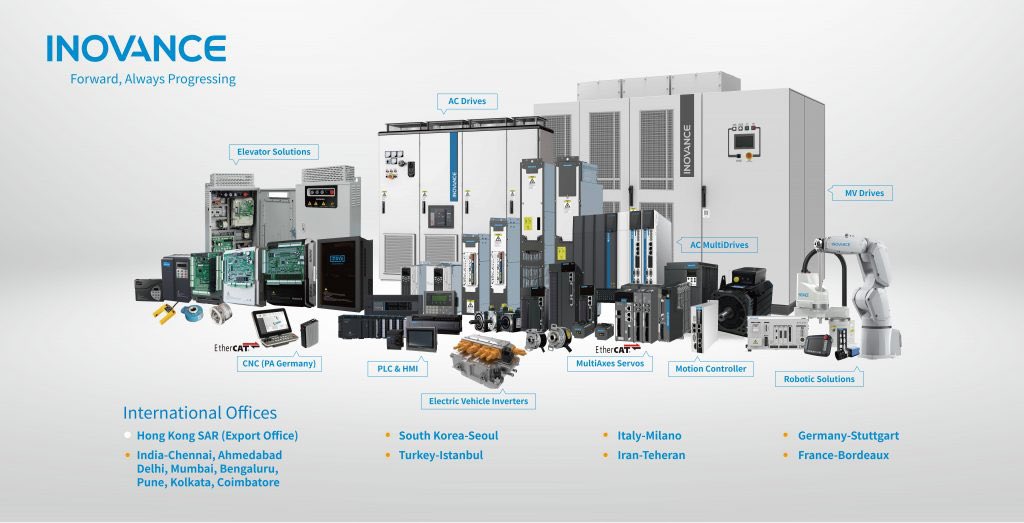
Inovance Technology 汇川技术 (https://t.co/sBzxk2QiwI)
Inovance is China’s leading full-stack industrial automation platform, specializing in high-end AI servo drives, SCARA robots, and humanoid joint actuators. It benefits from domestic substitution against Japanese rivals, intelligent manufacturing retrofits, and dual growth drivers: factory-side industrial AI penetration and humanoid robot industrialization.
Near-Term (0–12M)
Japanese servo suppliers face rigid capacity and lead times of 3–6 months for customized models, while Inovance delivers mainstream servo products within 1–2 weeks.
Per Frost & Sullivan 2025 data, Inovance holds a 31% share of China’s general servo market. Its flagship SV670 AI servo uses a 26-bit absolute encoder, offering ±0.01mm positioning accuracy and 2kHz speed loop bandwidth, with 80% better dynamic response than ordinary servos. It is now in pilot mass shipment to top PV and lithium manufacturers.
Inovance SCARA robots maintain over 92% production yield, certified MTBF ≥20,000 hours, and ±0.01mm repeat positioning precision. Long-term battery OEM framework orders will drive QoQ gross margin improvement in H2 2026.
Transient margin pressure comes mainly from heavy R&D spending (¥4.256B, 9.4% of revenue for AI servo and humanoid R&D), new plant depreciation, and low-margin NEV control business. Core earnings and cash flow remain solid with consistent annual profit growth.
Medium-Term (1–3Y)
Phase-II expansion of the Nanjing Robot Base will complete capacity ramp-up by 2028, with dedicated lines for high-value SV670 servos and humanoid actuators (planned annual capacity: 200k sets). Brokerages forecast notable profit acceleration from 2027.
The firm will slow expansion of low-margin NEV electronic control (gross margin: 16.1%). General automation (40.27% gross margin) and robot divisions will become dual profit pillars. Robots currently account for ~4% of revenue; the company targets raising the high-end product proportion in the robot segment above 35%.
Inovance holds 28% SCARA share in lithium/3C scenarios. Localization policies continue squeezing Japanese incumbents, while automation demand from LEO satellite and energy storage factories brings steady incremental orders.
Long-Term (3–5Y+)
Nationwide smart factory transformation will sustain demand for PLC and precision servos through 2030. AI-integrated smart production lines deliver 2–2.5x hardware value versus traditional equipment.
Over a decade of algorithm iteration builds solid moats; new entrants need 18–24 months for algorithm development and client certification.
Three durable growth engines: factory servo upgrading, new-energy-driven SCARA procurement, and domestic humanoid joint localization. National intelligent manufacturing policies continue lifting sector valuation.
Wrap-Up
Current TTM P/E premium is justified by its full-stack platform moat. Mild margin compression is a temporary structural issue rather than operational deterioration.
Clear staged growth path: near-term margin repair via product mix upgrade; medium-term profit release from new capacity; long-term growth anchored by automation upgrades and technological barriers. Diversified downstream layout provides strong anti-cyclical performance.
#AI #Robotic #ChinaManufacturing
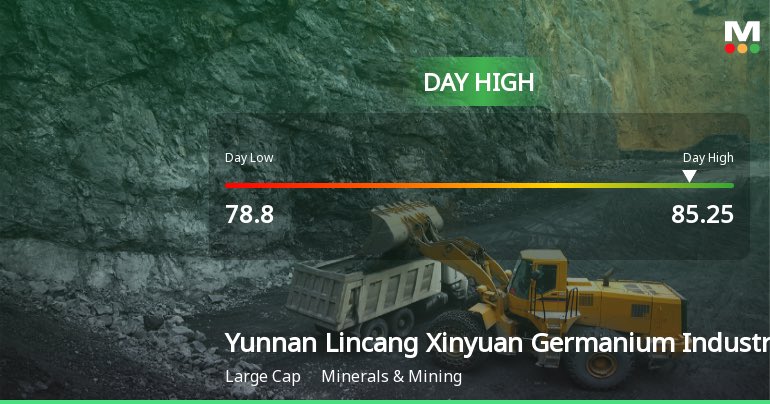
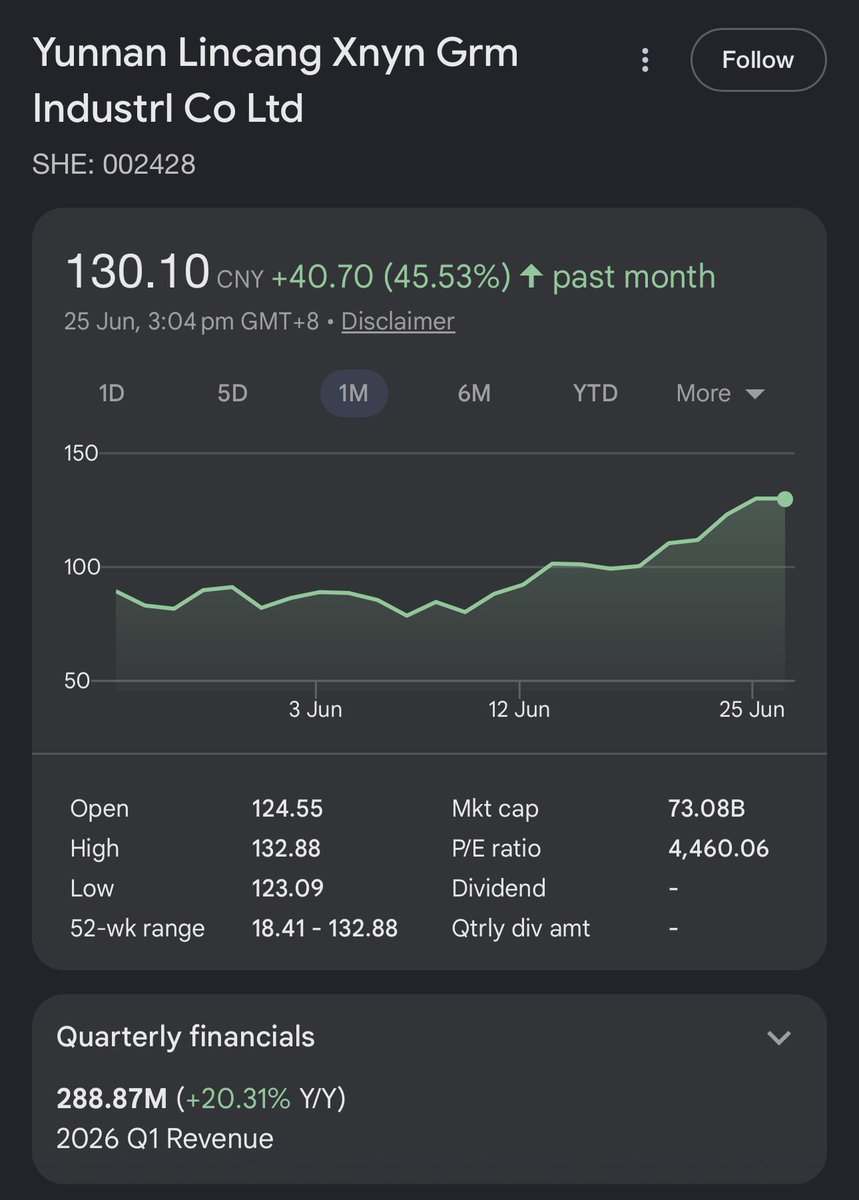
Yunnan Lincang Xinyuan Germanium Industrial Co Ltd 云南锗业(https://t.co/NZtwBczpl0): China’s Only Mass Producer of 6-inch InP Substrates for AI Optics
Indium phosphide (InP) substrates serve as the irreplaceable foundational material for high-end 1.6T/3.2T EML optical chips, accounting for over 27% of optical device material costs. Global supply is tightly monopolized by Japanese and US manufacturers, creating a structural supply deficit above 70%. The company’s strong upside comes from two unmatched high-growth tracks: AI computing InP substrates and germanium wafers for LEO satellite solar panels.
Near-Term (0–12 Months)
Global InP supply remains critically undersupplied. Overseas rivals like Lumentum have sold out production capacity through 2028, with delivery cycles stretched to 24–40 weeks. Its subsidiary Xinyao Semiconductor counts Huawei Hubble as a strategic investor, securing locked long-term orders through late 2027 and supplying tier-1 optical module giants. 6-inch InP yield has stabilized at 70%-80%, and newly renegotiated customer pricing will lift gross margins sequentially in H2 2026.
Temporary weak earnings in 2025 and Q1 2026 stem from heavy R&D spending, surging indium raw material costs, and depreciation from new production lines, all transitional costs during strategic restructuring. Aerospace germanium wafer capacity of 1.25 million pieces per year is fully consumed by large-scale satellite constellation projects.
Medium-Term (1–3 Years)
A ¥189 million InP expansion project launched in April 2026 will triple total wafer capacity to 450,000 pieces (4-inch equivalent) by 2027, with dedicated lines for high-value 6-inch substrates. Brokerages forecast explosive profit growth as high-margin InP shipments ramp up sharply from 2027 onwards. Compound semiconductor revenue will increase from 12.93% to over 60% of total revenue, driving a strategic shift from cyclical germanium metal processing to high-growth, high-margin compound semiconductor manufacturing as core profit driver.
Domestic InP substitution accelerates rapidly. The firm holds over 80% domestic market share for high-value 6-inch InP substrates and gains a clear edge over peer AXT (AXTI) amid strict national indium export controls. The satellite germanium wafer line will reach full capacity of 2.5 million pieces annually to capture demand from global LEO satellite launches.
Long-Term (3–5+ Years)
AI data center expansion and large-scale CPO architecture rollout will fuel multi-fold exponential growth of global InP demand through 2030. Each 1.6T/3.2T optical module consumes 2.7–3 times more InP than 800G versions. China controls over 70% of global indium and germanium reserves, giving the company unrivaled upstream resource advantages and exclusive domestic large-size InP mass-production technology. New competitors need 18–24 months to build and ramp matching lines, creating long-term barriers.
Three enduring high-cycle growth pillars operate simultaneously: AI high-speed optical interconnection, military infrared germanium optics, and commercial aerospace satellite power wafers. National strategic mineral regulation supports consistent industrial valuation re-rating.
Wrap Up
Though current static PE appears elevated due to temporary weak earnings during the business transition, market valuation focuses on its irreplaceable long-term industrial monopoly rather than lagging financials. Yunnan Germanium offers near-term gross margin recovery, explosive medium-term capacity expansion and strategic business upgrade, plus multi-decade structural demand growth protected by strong technical and resource moats. As China’s sole domestic mass supplier of mission-critical AI optical substrates, it ranks as a top core long-term play among A-share specialty semiconductor material firms.
#Astock #AICompute #InP #RareMetal #OpticalModule #SpaceTech
@jukan05 A share is better for long term investment, short term is super easy to lose money. Understand fundamentals and government policy is the first step.
@LinQingV@jukan05 Solid structural analysis. Quick question: Is a lasting valuation recovery already underway for long BOE holders, or still down the line?
Hygon Information Technology Co Ltd (https://t.co/WBESy4fN0X): China’s Vertically Integrated Domestic High-End Compute Silicon Pure Play
Consensus frames Hygon merely as a cyclical IT localization play, ignoring its unmatched dual x86 + CUDA-equivalent DCU structural moat, robust state-backed R&D backbone, and state-owned capital endorsement. This valuation disconnect unlocks multi-year fundamental re-rating upside.
Exclusive x86 IP license → CPU + DCU dual mass production → CAS-Sugon vertical industrial chain → state policy-driven substitution demand → state-funded sustained heavy R&D iteration → national AI datacenter capex re-rating.
Near Term
Geopolitical export curbs have cut off stable supply of overseas high-performance compute chips. Hygon holds China’s sole perpetual full x86 ISA license and self-develops the C86 architecture to slash legacy financial and government system migration costs below 5%, outperforming ARM/RISC-V rivals on legacy compatibility.
DCUs achieve 99% operator coverage for trillion-parameter LLMs, with hardware-embedded national cryptography modules and top-tier Xinchuang security certification. Over 10,000-card AI clusters have been deployed across 300+ industrial verticals. Steady Q3-Q4 order inflows from state-owned banks, telecom carriers, energy conglomerates, and domestic cloud hyperscalers guarantee sequential revenue beats. Financial clients retain >95% renewal rates with 5+ year procurement cycles.
Medium Term
The firm reached peak fixed-asset depreciation in FY2025, with no large-scale wafer capex planned for 2–3 years, locking in a structural gross margin floor above 55%.
Server CPU: Mandatory national industrial localization policies cover 8 core regulated sectors and drive stable volume growth.
DCU AI Accelerator: Core secondary growth engine for domestic large-model industrialization. Chengdu fabs hit full capacity in FY2026, lifting DCU to primary profit contributor.
Proprietary HSL high-speed interconnect enables high-density rack-scale compute and delivers persistent TCO advantages versus domestic ARM/RISC-V competitors.
Long Term
Full Ecosystem & State Research Backing:
Its Photosynthetic Alliance unites 6,000+ upstream/downstream partners with 15,000+ cross-stack hardware and software compatibility validations. Rooted in the Chinese Academy of Sciences computing institute and controlled by Sugon, the firm owns a complete chip-to-cloud vertical supply chain unavailable to independent fabless peers, along with customized hardware-software co-optimization services for industrial clients.
State-Supported R&D Strength:
Over 80% of staff are master’s/PhD R&D engineers. FY2025 R&D expenditure hit ¥41.45bn, with Q1 2026 R&D spending up 58.61% YoY. A ~2,000-item patent portfolio covers CPU architecture, AI acceleration, high-speed interconnection, and hardware security. Annual product iteration cycles continue narrowing performance gaps versus global leading chips.
State Capital & Capital Platform Advantages:
STAR Market listing enables sustainable equity and convertible debt financing to support long-term chip R&D and capacity expansion. Shareholders include CAS institutions, local state capital, and industrial investment funds. Strong state credit endorsement grants priority bidding eligibility for national AI infrastructure central procurement projects.
Wrap Up
Hygon is the only A-share listed domestic firm with mass-production capacity for both x86-native server CPUs and CUDA-parallel DCU accelerators. Underappreciated by investors for its state-backed R&D system, full industrial ecosystem, and stable high-quality state-owned client base, the company stands as the core hardware infrastructure beneficiary of China’s multi-trillion AI compute capex cycle with sustained valuation expansion potential.
#ChinaSemiconductor #AIComputeSilicon #AStockEquityResearch