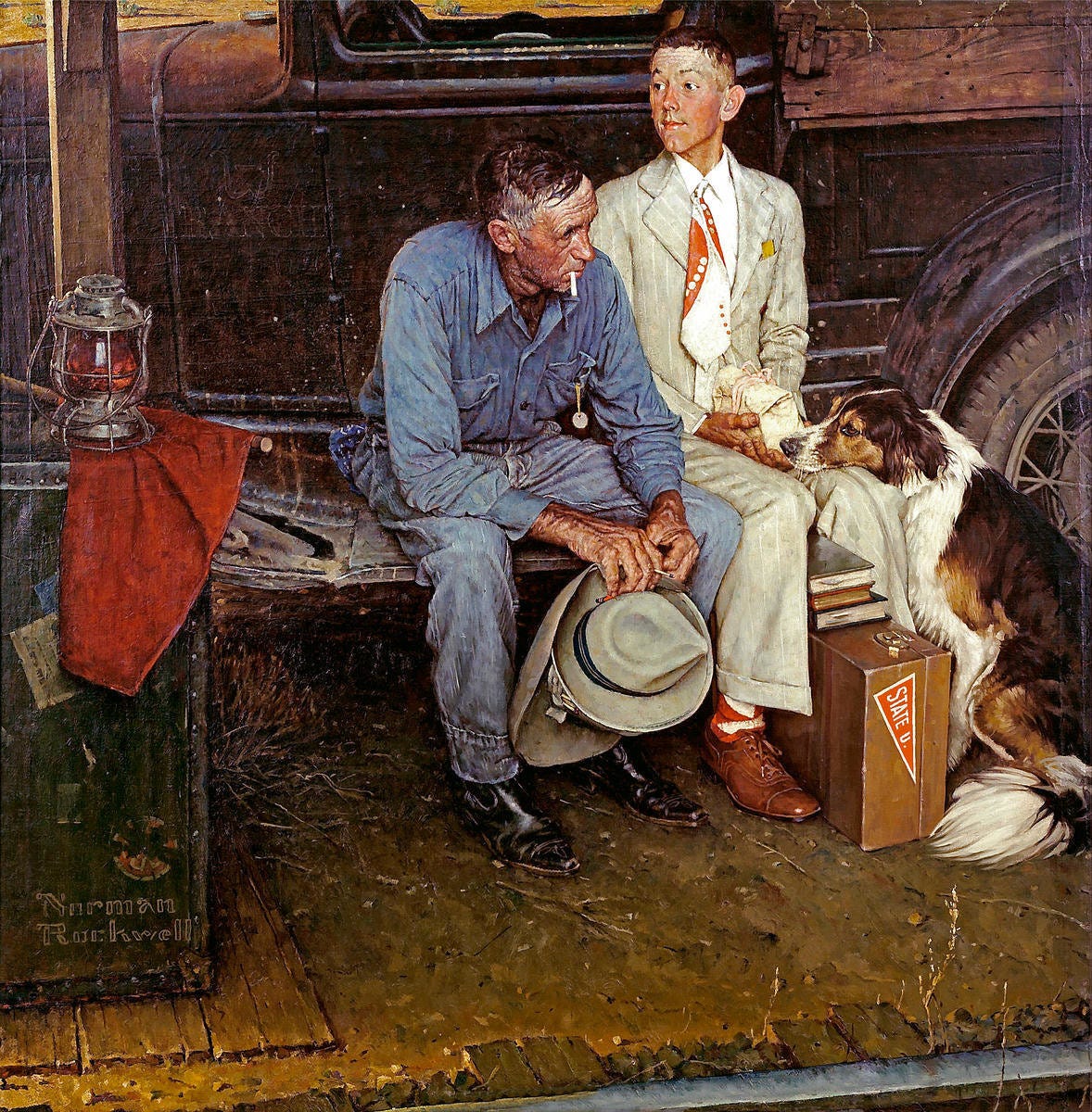
This is one of the most beloved paintings in America, and it puts its finger on something we all pass through, first as the child, and one day as the parent left behind...
The painting is Breaking Home Ties, by Norman Rockwell, on the cover of the Saturday Evening Post in 1954. A father and his teenage son sit side by side on the running board of a battered farm truck, waiting at a railway stop. A single track runs along the bottom of the picture. A ticket pokes from the boy's pocket. His suitcase is stacked with schoolbooks and wears a "State U" pennant. The train is coming to carry him off to college, away from home, for the first time in his life.
Everything is in the way they sit.
The son sits upright, scrubbed and dressed in his best, eyes fixed on the horizon, on the track, on the future rushing toward him. He is already half gone. For him that train is the beginning of everything.
His father sits beside him in worn work clothes and scuffed boots, looking the other way, down the line, as if he cannot bear to watch it arrive. The same train means the opposite thing to him. For the son it is the start of a life. For the father it is the day the house grows quieter, the chair at the table sits empty, and the person he built his world around walks out into a life that no longer has him at its centre.
Look at his hands. He is holding two hats. His own battered one, and resting on top of it, his son's crisp new one, held carefully together, because it is the last small thing he can still do for the boy...
And then the dog, its head laid in the son's lap, gazing up, refusing to look away. Rockwell knew exactly what that was for: "The father couldn't show how he felt about the boy's leaving," he said. "The dog did."
It has moved people for 70 years because every leaving is a beginning for one person and an ending for another. The child steps out into the world, as they should. And someone stays behind, watching them go, and loving them enough to let them go anyway...
Schau dir diese Grafik genau an. Sie erklärt, warum sich in Deutschland Leistung nicht mehr lohnt.
Ein Paar, zwei Kinder, beide arbeiten.
Bei 4.000 Euro brutto bleiben rund 2.700 Euro.
Bei 5.000 Euro brutto bleiben rund 2.650 Euro.
Du liest richtig. Tausend Euro mehr verdient. Weniger im Portemonnaie.
Und jetzt der Teil, der wirklich weh tut: Bei 2.000 Euro brutto stehen dieser Familie etwa 2.350 Euro zur Verfügung.
Bei 5.000 Euro brutto sind es 2.650 Euro.
3.000 Euro mehr erarbeiten. 300 Euro mehr haben.
Das ist kein Rechenfehler. Jeder zusätzlich verdiente Euro zieht Wohngeld, Kinderzuschlag und Freibeträge mit sich in den Abgrund, während Steuern und Sozialabgaben gleichzeitig steigen.
Man nennt es Transferentzugsrate. Ökonomen kennen das Problem seit Jahren. Die Bundesregierung hat Gutachten dazu bestellt.
Passiert ist nichts.
Und dann wundert sich die Politik, warum niemand mehr die Stunden aufstockt. Warum die Zweitverdienerin in Teilzeit bleibt. Warum der Facharbeiter die Beförderung ablehnt.
Die Leute sind nicht faul. Sie rechnen.
Ein System, das Anstrengung und Fleiß nicht belohnt, bekommt am Ende genau das: keine Anstrengung.
1/7 Como nosotros, los abejorros se relamen cuando beben aquello que les gusta
Después de beber una solución azucarada realizan protrusiones de la glosa, pero no con agua. Lo interesante es que esta reacción es flexible
(paper) DOI 10.1073/pnas.2529114123
📆Nuevo mes, nuevo padrino: el Avetorillo común 🐦
La garza más pequeña de Europa ✨
Un auténtico experto en camuflarse entre la vegetación de los humedales en los que habita🌿👀
Su canto profundo recuerda al mugido de un toro ¡de ahí su nombre! 🐂🪶
🎨@retratosdefauna
Discutiendo sobre un texto estoico escrito hace 2000 años en un rollo de papiro que quedó sepultado bajo 20 mts de lava en Herculano en 79 dC, rescatado en el s. XVIII y que finalmente podemos leer, sin abrir el rollo carbonizado, gracias a un sincrotron + machine learning
Google fue muy listo; usan los acelerómetros de miles de teléfonos Android cómo una red global de sismos, toda esa data se envía y Google logró una forma de detectar esas ondas a tiempo y enviar las alertas.
No subimos mucho contenido de crianza aquí porque lo reservamos para Instagram y esta red la usamos más para noticias. Aun así, ya estamos a tope. Como este jovencito que llegó ayer deshidratado y bajísimo de peso, pero, por suerte, come muy bien y tiene muchas ganas de vivir. 😍
Los chistes malos de papá tienen un propósito real, según la ciencia:
Este artículo de The Washington Post explica que esos chistes típicos de los padres -los que provocan vergüenza ajena por lo malos que son- cumplen una función importante en la crianza. Actúan como una forma sencilla y cotidiana de conectar emocionalmente con los hijos, similar a cuando se juega al “cucú-tras” con los bebés: generan risa compartida, relajan el ambiente y fortalecen el vínculo entre padre e hijo.
El psicólogo Paul Silvia, de la Universidad de Carolina del Norte, analizó más de 32.000 chistes de este tipo publicados en internet. Descubrió que los más efectivos suelen basarse en juegos de palabras, en tomar expresiones al pie de la letra o en romper las expectativas de forma graciosa. Los chistes en formato de pregunta-respuesta y los que hablan de la familia, los abuelos o los animales suelen ser los que mejor funcionan.
Según los expertos, este tipo de humor actúa como un “pegamento social divertido”: reduce el estrés, ayuda a regular las emociones y permite a los padres intervenir en momentos tensos de manera ligera y positiva.
Aunque los hijos se quejen de lo malos y vergonzosos que son, estos chistes crean recuerdos agradables, enseñan a los niños a aceptar el humor aunque no sea perfecto y refuerzan la relación padre-hijo de una forma natural y cotidiana.
Estoy muy preocupado.
Esta mañana, al levantarme de la cama y caminar hasta el baño, me dolían mucho las rodillas.
Luego me he comido un bocadillo de jamón ibérico y me ha sentado fatal, aunque eso no me ha impedido ir a clase de ópera.
¿Algún médico me puede decir si es grave?
Te voy a coser el órgano de un cadáver. Y que sea lo que Dios quiera.
¡Hoy 17 de junio, se cumplen 76 gloriosos años de una de la mayor salvajada quirúrgica de la historia!
Chicago, 1950. Ruth Tucker tiene 44 años y unos riñones destrozados por una enfermedad poliquística (por cierto, mi Graná es zona endemica). No hay diálisis moderna que la salve.
Pero… ¡tachan! Entra en escena Richard Lawler.
No tenía fármacos inmunosupresores. Sólo tenía un par de manos muy hábiles y nervios de acero. Decide coger el riñón de una mujer recién fallecida y empalmarlo en el cuerpo de Ruth.
A nivel inmunológico, aquello era como tirar una granada. Rechazo garantizado.
Pero Lawler abre y cose. Cruza los dedos.
El milagro ocurre. El riñón del cadáver se irriga y empieza a producir orina allí mismo.
Ruth toleró el órgano invasor 10 meses. El tiempo exacto que necesitó su otro riñón enfermo para desinflamarse y recuperar algo de función, regalándole cinco años más de vida.
¿Y qué premio recibió Lawler por realizar el primer trasplante de un órgano interno con éxito y abrir una nueva era médica?
El desprecio absoluto.
Sus colegas le hicieron el vacío. Lo acusaron de jugar a ser Dios, de profanar cadáveres. Nunca más volvió a hacer un trasplante.
Hoy salvamos miles de vidas al año gracias a esa misma cirugía.
Porque en la medicina, la línea entre locura y genialidad es MUY FINA. Y se cruza con bisturí. El primero que se atreve… suele llevarse todas las pedradas.
#LaTraumatologaGeek
La caída de la información web es BRUTAL.
El % de españoles que consumió noticias en webs la semana pasada (fuente: @risj_oxford). Se desploma desde 2016 a 2026:
🔻18-24 años: 80% → 38%
🔻Todos: 72% → 44%
1/4 La enorme complejidad de la pesca de algas
Han estudiado en detalle la forma en la que los chimpancés de Guinea pescan las algas. Preparan las herramientas (de hasta 4m) con antelación, y usan 22 técnicas diferentes
(paper) DOI 10.1002/ajp.70164
You have noticed it. ChatGPT feels dumber than it used to. Your prompts that worked six months ago produce worse results now. The writing sounds flatter. The ideas sound safer. The internet itself feels like it is shrinking. Every article reads the same. Every email sounds the same. Every answer sounds like it was written by the same voice.
You thought it was you. It is not you.
Researchers at Oxford and Cambridge published a paper in Nature proving what is happening. They call it Model Collapse.
Here is the mechanism in one sentence. AI trained on AI-generated data gets dumber every generation until it forgets what real human data looked like.
The internet is filling with AI-generated content. Blog posts. Articles. Reviews. Comments. Social media. AI companies scrape the internet to train the next generation of models. Which means the next generation of AI is being trained on the output of the current generation.
Each cycle loses information. Not randomly. It loses the rarest, most unusual, most creative parts first. The researchers call these the "tails of the distribution." The weird ideas. The unexpected perspectives. The things that made the internet feel human. Those disappear first.
What remains is the average. The safe. The expected. The bland.
Then the next generation trains on that. And loses more. And the next generation trains on that. And loses more. The researchers proved this is not a slow decline. Major degradation happens within just a few iterations. Even when some of the original human data is preserved.
They tested it on large language models. On image generators. On statistical models. The pattern was the same every time. The output converges toward a narrow, flattened version of reality that looks nothing like the original data.
The lead researcher put it plainly. "Large language models are like fire. A useful tool. But one that pollutes the environment."
The pollution is invisible. You cannot see which sentence on the internet was written by a human and which was written by AI. Neither can the AI that is about to train on it. And once the tails are gone, they do not come back. The damage is irreversible.
This is not a prediction anymore. It is a diagnosis.
The internet you grew up on was built by humans writing things no algorithm would have written. Strange, personal, imperfect, alive. That internet is being diluted. One generation of AI at a time. And the models trained on what remains are learning a smaller and smaller version of the world.
Model Collapse is not a technical problem. It is a cultural one. The thing that made the internet worth reading is the thing that disappears first.