To add a few clarifications:
There seems to be confusion about whether coins in Genesis address can move or be spent.
The short answer is that the original 50 bitcoins in the Genesis address cannot move (not even by Satoshi, who has the key). But the new coins added to the same address can move or be spent by Satoshi or a party he authorized (unless the private key has been permanently lost).
It is important to know that multiple UTXOs can be associated with a single address. The behavior of coins (whether they can move or not, and how) is determined by the specific UTXO where the coins are held, not by the address.
In other words, there can be two (in fact, many more) UTXOs that belong to the same address. The first UTXO may be a special one created to be unspendable, but the second can be a regular one that is spendable.
This is the case with the first bitcoin address in the Genesis block, which initially had 50 bitcoins. Those 50 bitcoins belonged to a special UTXO, which is not spendable. Satoshi hand-coded it to be unspendable. The Bitcoin nodes software includes a specific rule that excludes the Genesis block's first transaction (the one that yielded the first 50 BTC) from the UTXO set.
As a result, that special UTXO is not even found in the UTXO database to which the mining nodes have access. It's a result of a hardcoded rule within the Bitcoin client software. We can call that special UTXO the anchor UTXO.
However, when a user transfers coins from another address to the Genesis address, the transferred coins do not go to the same anchor UTXO but rather to a new UTXO (which is under the same address as the anchor UTXO).
Nothing prevents the coins in the new UTXO from being spent by the user with the private key corresponding to the Genesis address.
Who transfered the coins, then?
The person or entity who transferred the 26.9 BTC to the Genesis address is most likely Satoshi or someone who is authorized by Satoshi. If it were somebody else, these coins would be permanently lost (and it is hard to imagine what that person is trying to say with such a costly signal).
At the same time, all signs of this peculiar transfer contradict the following hypotheses:
(1) Satoshi is dead without any representation. This transfer strongly signals that Satoshi is alive or at least active through representation.
(2) Satoshi is someone other than Dr. Wright. For if htat were the case, what is Satoshi trying to say here? If he wants to repudiate Dr. Wright, he could have done it a long time ago; and even if he's only doing it now, he would be doing something very different which is effective for his purpose, certainly not something like this, which only lends support (although not a definite proof) to Dr. Wright's Satoshi claim.
This whole thing creates an interesting situation: opponents of Dr. Wright must now torture their minds into believing that this million-dollar transfer with a peculiar destination address was an unfortunate accident. Strange as it may be, they can't find an alternative logical explanation.
Sure, in a world where people don't objectively compute probabilities but rather live on subjective imaginary possibilities, many can find it a tolerable position to attach their minds to.
But it is far more comfortable to move to a different position, the opposite side..
(For the distinction between probabilities and possibilities, see discussions on Bayes theorem in book BIT & COIN: Merging Digitality and Physicality. https://t.co/jq4HkwIzWS)
Many suspect that the 26.9 BTC paid to the Genesis block was a deposit Dr. Wright made to satisfy the court-ordered security for costs of the core developers of BTC. There are good reasons: The total amount is close (the total security deposit proposed by the court was £900,000, about $1.15 million, a very close match to the value of 26.9 BTC at the time of transfer), and the whole incidence has an air of peculiarity that is hard to put aside as accidental or irrelevant.
But here is something to think about.
If this is indeed a security deposit Dr. Wright made for the core developers, it effectively works as a catch-22 for them.
The Catch-22: if the core developers win the case in the courtroom, they must lose the case outside the courtroom.
This is because the security deposit is only relevant if the core developers win the case. But with the security deposit made into the Satoshi addressed in the Genesis block, the core developers will face a dilemma:
Dr. Wright will have to transfer the funds from the Genesis block to them if he loses the case in the courtroom. But if he does, he would effectively overthrow the judgment by showing that he is Satoshi outside the courtroom.
(Unlike Bitcoin transactions with IDs firewalled from the blockchain, a transfer from a Binance account presumably has an associated identity because Binance is now under government supervision. Therefore, this transfer sequence would be proof of identity.)
However, here is the trouble with the above theory:
The manner in which the security deposit is made cannot be unilaterally chosen by Dr. Wright in this case. It must be agreed upon by core developers.
How could the core developers agree to such a deposit, which works as a catch-22 for them? It is like they are hoping to win the case based on untruth but to get the security deposit from the truth that repudiates the untruthful verdict.
It is literally self-repudiating, at least in the moral sense. It would be equivalent to publicly proclaiming, "We know he's Satoshi, but we win and it is the only thing we care!"
They certainly cannot be that hideously cynical, can they?
From a more benign view, perhaps they just wanted it to be a hedge against this particular scenario: Dr. Wright wins the case when he really is not Satoshi. In that case, Dr. Wright would have to take a loss of the coins deposited in the Genesis block because he wouldn't have the keys to access the coins. It's sort of like a penalty for an unjustified win.
But that would be a week hedge. If Dr. Wright wins the case, losing a million dollars will be nothing to him. Besides, if Dr. Wright wins the case, he most likely has the key anyway.
The whole thing makes sense if Dr. Wright initiated it, but makes little sense if the core developers accepted it. It is a mystery.
The Genesis block is not in a wallet and isn't and wasn't spendable. Nothing ever moved. Nothing can move because it is not a valid mined coin but an anchor.
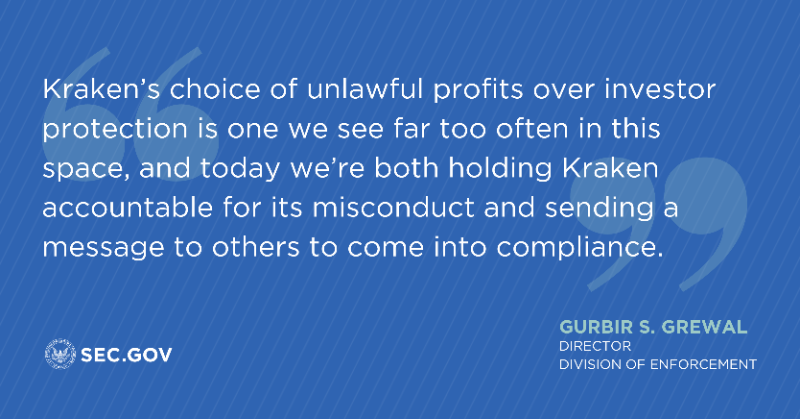
We charged Payward Inc. and Payward Ventures Inc., together known as Kraken, with operating Kraken’s crypto trading platform as an unregistered securities exchange, broker, dealer, and clearing agency.
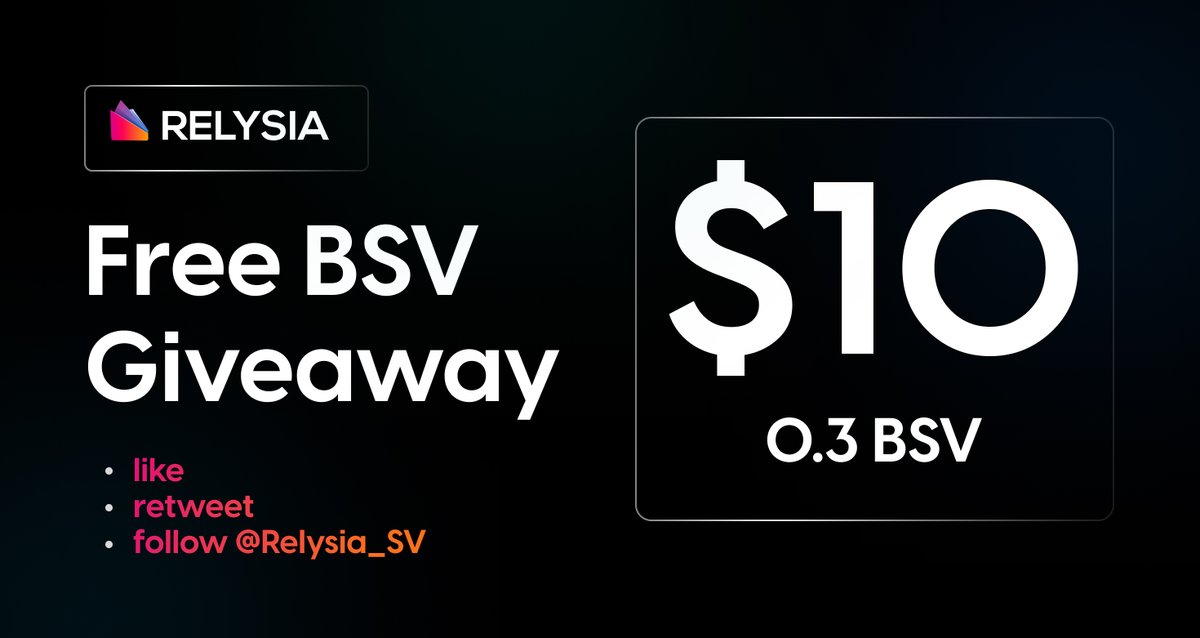
🌟 Ready for an Exciting Giveaway? 🚀 Win 0.3 #BitcoinSV ($10)!
Here's all you need to do:
1️⃣ LIKE ❤️ this tweet
2️⃣ RETWEET 🔁 to spread the word
3️⃣ FOLLOW us @Relysia_SV for updates
Comment with your Relysia paymail to enter! 📩
Winner revealed this Friday! 🎉 #Blockchain
#PewPew Time!
Make sure you:
1: Follow👍
2: Like this post👈
3: Retweet🔁
4: Drop your HandCash Handle below💸
Everyone will get a penny🪙
2 people will get 3 BSV (roughly $100) each💰
Winners will be chosen Saturday September 16.