Happy to share our new review on Neural Mechanisms of Social Hierarchy across Species. We discussed how different individuals in various species, from fish to humans, achieve high social status and the neural circuits supporting each of those strategies.
https://t.co/4mxuXbqbHU
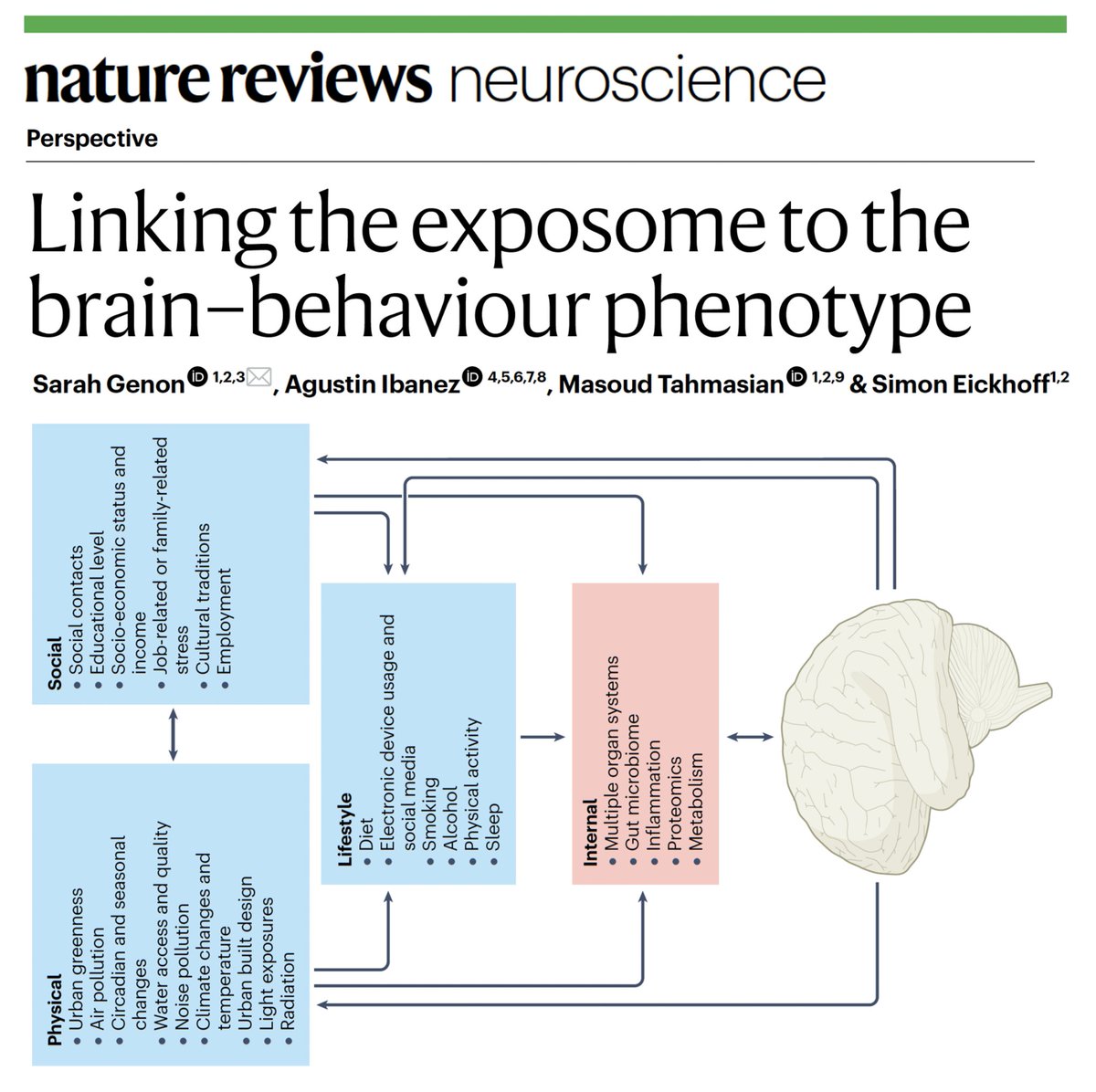
Brain–body-environment interactions must move beyond isolated exposures toward the expotype: the dynamic configuration of physical, social, lifestyle, and internal factors that jointly shape brain–behaviour phenotypes. At @NatRevNeurosci (https://t.co/FIMA1E1dxM), we propose a future agenda to assess the exposome as a complex, time-varying system that requires nonlinear models to capture interactions, thresholds, synergistic effects, and cross-domain buffering mechanisms. Although predictive machine learning can support individual risk estimation, the next frontier is to move from prediction to mechanism, from association to dynamic synergetic inference. Multivariate learning, causal machine learning, aging clocks, longitudinal designs, and generative biophysical digital twins are beginning to provide this bridge. Brain–body–environment diversity can reveal how ecology becomes biologically embedded. We call for a future exposomic neuroscience that integrates nonlinear temporal modeling, generative mechanisms, and population diversity to understand, simulate, and modify trajectories of brain aging and disease. Congrats Sarah Genon, @MasoudTahmasian & @INM7_ISN
Linking the exposome to the brain–behaviour phenotype — a Perspective by Sarah Genon, Agustin Ibanez, Masoud Tahmasian & Simon B. Eickhoff
https://t.co/ztvRmpQ5Os
Rethinking hierarchy: the auditory system as an integrated cortical–subcortical network — a Review by Michael Lohse, Ben D. B. Willmore & Andrew J. King
https://t.co/p5FlxgXTvd
Wired for immunity: neuroimmune control of the lung by sensory neurons — a Review by Anna M. Ehlers, Idaira M. Guerrero-Fonseca, Christophe Altier, Bryan G. Yipp & Sebastien Talbot
https://t.co/CssOaBG8FG
Categorization is ‘baked’ into the brain — a Perspective by Lisa Feldman Barrett & Earl K. Miller
@LFeldmanBarrett@MillerLabMIT
https://t.co/gDGnwN2Iom
Opportunities and pitfalls of data contextualization in neuroimaging — a Roadmap by Jessica Royer, Casey Paquola, Sara Larivière, Justine Y. Hansen, Sofie L. Valk, Bratislav Misic, Robert Leech, Jonathan Smallwood & Boris C. Bernhardt
https://t.co/TghI7st0kU
So excited to share our latest review in @NatRevNeurosci highlighting the role of astroglial calcium in aging and neurodegenerative diseases https://t.co/AgZ8EwL03V
Role of dysregulated calcium homeostasis in astrocytes in neurodegenerative disorders — a Review by Maria V. Sanchez-Mico, Maria Calvo-Rodriguez & Brian J. Bacskai
https://t.co/ljL76BF9ZZ
Clarifying the conceptual dimensions of representation in neuroscience — a Perspective by Stephan Pohl, Edgar Y. Walker, David L. Barack, Jennifer Lee, Rachel N. Denison, Ned Block, Florent Meyniel & Wei Ji Ma
https://t.co/6Tap2kIZgZ
The gatekeeper of ongoing pain: an endogenous analgesic circuit that prioritizes survival — a Journal Club article by Sora Shin
https://t.co/gECZZyiQrj
Neural adaptation to climate change: mechanisms, limits and opportunities — a Comment article by Jan Siemens & Patrick Haggard
https://t.co/NxLO6iRDKK
Warm congratulations to The Brain Prize winners 2026, Professor David Ginty and Professor Patrik Ernfors, for their pioneering work on how the nervous system detects and processes touch and pain.
@hhmi_science#Neuroscience#BrainPrize2026
Mitochondrial dynamics in neurodevelopment and neurodevelopmental disorders — a Review by Carissa L. Sirois, Jiyoun Lee, Audrey L. Chambers & Xinyu Zhao
https://t.co/hJBDJJBbUG
We review studies showing that when brain areas face similar computational demands in social and non-social context, they perform the same computations. We argue that exaptation (repurposing of traits for new functions) played a key role in brain evolution.