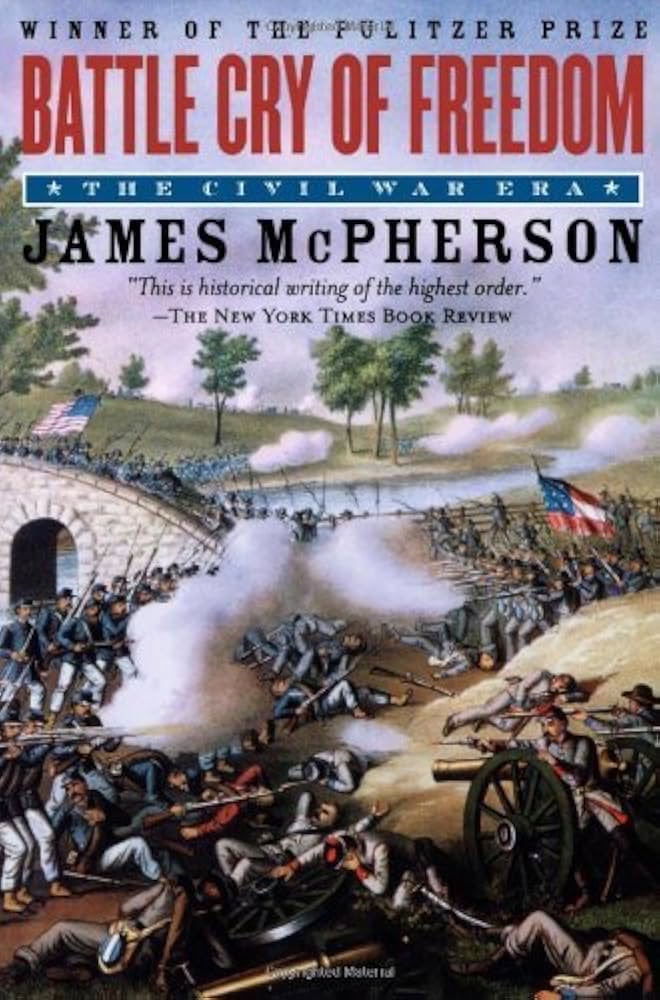
For a long time, I have wondered how the wealthy planter class in the South managed to convince poor Southern whites to fight on their behalf during the American Civil War. I searched for a true one stop book on the war and found one by the esteemed historian James McPherson titled Battle Cry of Freedom. In it, McPherson outlines six key reasons the planter elite were able to mobilize non slaveholding whites to fight for the Confederacy in the 1860s.
👇🏾👇🏾👇🏾
Key points McPherson makes:
1. White supremacy as a unifying ideology
Even poor whites had a powerful psychological stake in slavery. Slavery ensured that no matter how poor a white man was, he still ranked above enslaved Black people. McPherson emphasizes that this racial hierarchy helped override class resentment and align non slaveholders with elite interests.
2. Fear of slave rebellion and social chaos
Planters promoted the idea that Confederate defeat would result in slave uprisings, racial violence, and the destruction of white families. Poor whites were told they were fighting to protect their homes, wives, and children, not planter wealth.
3. Framing the war as defense of home, not slavery
Although secession was fundamentally about preserving slavery, Confederate leaders framed the conflict as a defensive war against Northern invasion. McPherson notes this rhetoric resonated deeply with yeoman farmers and rural whites.
4. Honor, masculinity, and community pressure
Southern culture placed enormous value on honor and manhood. Local enlistment, public shaming of draft resisters, and tight knit rural communities made refusal to fight socially costly.
5. Aspirations to upward mobility
Many non slaveholding whites believed they might one day own slaves themselves. Slavery was not seen solely as an elite institution, but as a system they hoped to eventually enter.
6. Political exclusion of dissent
Planter elites dominated Southern politics, newspapers, and churches, suppressing organized opposition and reinforcing pro Confederate narratives.
⸻
When I look at contemporary America in 2026, where a segment of the population embraces the Great Replacement theory, defends the ultra rich, supports mass deportations, rollbacks of civil rights protections, bans on Black history books, and other efforts to narrow who belongs in this country, I cannot help but see historical parallels.
In many ways, the dynamics McPherson describes among poor Southern whites in the 1860s echo in today’s MAGA movement. Cultural identity and fear are once again being used to override material interests and redirect anger away from economic elites.
History does not repeat itself exactly, but it often rhymes.
What a MESS: The DNC used its headquarters as collateral last year to get a $15 million line of credit to invest in off-year elections.
Federal filings from June showed the DNC had just $16 million in cash and $18 million in debt. By comparison, the RNC reported $128 million in cash and no debt