not intellectual just surfing ,if ur hurt dont take my views seriously
stay away from this profile just a tired person.
dehatis & Sanghi achut suar stay away
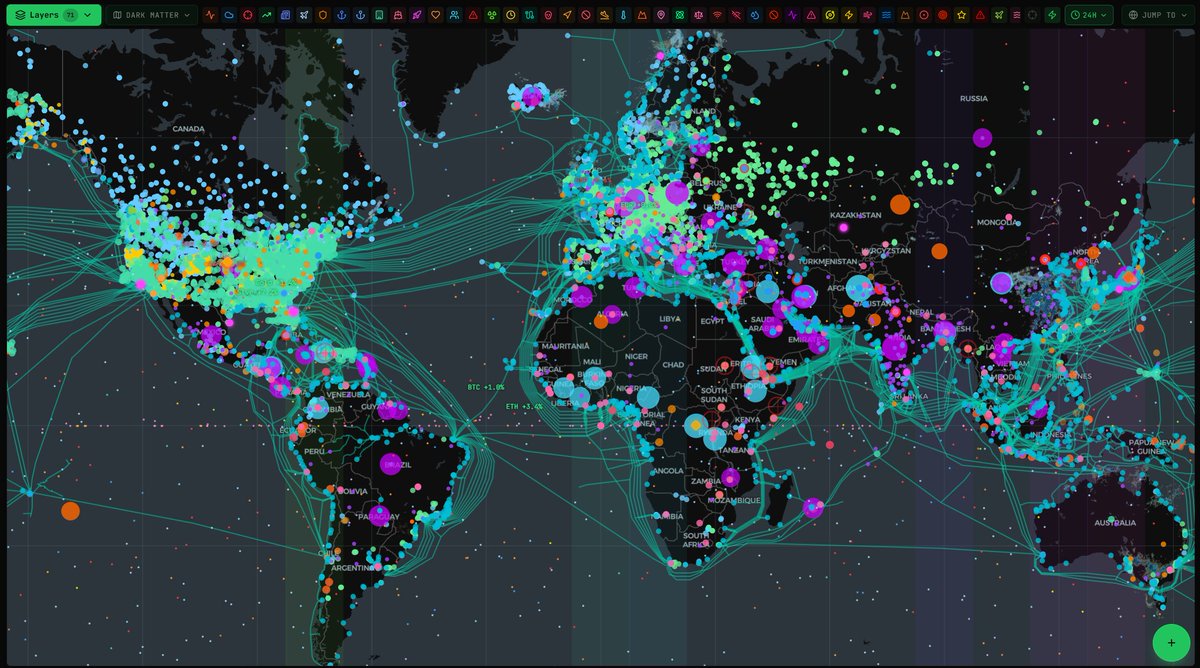
Announcing https://t.co/sD3qL6Ok6k:
A free, real-time, AI-powered OSINT dashboard w/ 180+ data feeds, 55+ widgets, 70+ map layers, alerts & more.
Conflicts. Earthquakes. Flights. Nukes. Cyber threats. Elections.
All live. All in one place.
Monitor the situation. For free.
I always feel like the whole zombie apocalypse hits differently depending on if you live in an urban or rural environment.
Urban environment theres thousands of zombies coming at you and theres no where to go.
Rural environment, you see like one zombie a week, plus the environment is open and empty, and everyone is armed. You're basically picking them off from 200 yards away for fun.
Totally different feel.
@mememandir Unless these people are voted out of power this ethanol madness won't stop. They have become too arrogant knowing they will retain power no matter what
BREAKING: Iran says the US has agreed to pay $300 billion in reconstruction funds directly to Iran as part of the deal Pakistan announced, alongside the release of $24 billion in frozen funds with $12 billion released before negotiations even start, per Mehr News.
This directly contradicts Trump's & Vance's claim that no funds will be transferred to Iran at all.
If Trump denies this is true, there never was a deal. If Trump confirms, the US has fully capitulated to Iran's demands.
@BrianRoemmele TLDR; we have years using optimization and search algorithms (classic AI) to design antennas and other structures https://t.co/jPPSUhdoXj https://t.co/w8uHTgI5AU so for the AI bros / Promp-toddlers talking crap like "what the AI thinks about" this is different.
@BrianRoemmele Not new - the "Coatinguler" Craze in the 1980s and 1990s was a common Australian suburban pastime to bend old metal coat hangers into makeshift car antennas.
AI Designed Antennas That Work But Defy Full Human Understanding
AI systems are designing antennas and electromagnetic structures whose intricate geometries often resist straightforward human interpretation.
These designs deliver superior performance in testing and real world use.
Yet the precise reasons for their effectiveness remain partially opaque even to experts.
The NASA ST5 Evolved Antenna
One of the clearest examples is the X band antenna created for NASA’s Space Technology 5 mission.
Engineers employed an evolutionary algorithm. This computational process mimics natural selection. It explored vast numbers of possible configurations on a supercomputer.
The goal was to meet strict requirements for wide beamwidth, circular polarization, and impedance bandwidth on small spacecraft.
The resulting antenna has a complex, organic looking wire structure. It resembles twisted shapes that human designers would rarely consider.
Expert antenna engineers have noted that they would not have conceived such a form.
Despite its unconventional appearance, the antenna met or exceeded mission requirements. It offered advantages in power efficiency, fabrication simplicity, and performance across elevation angles.
It became one of the first computer evolved hardware objects flown in space.
When mission parameters changed, the evolutionary system produced a revised design quickly. Testing in anechoic chambers confirmed it worked as needed. Paired evolved antennas achieved high efficiency.
The underlying interactions of currents, fields, and resonances in this geometry are not fully explained by simple human derived principles.
Researchers have used inverse design and neural networks to generate compact multi band antennas, filters, and related components for wireless chips.
These AI produced structures frequently appear irregular or random.
The designs are described as unintuitive and complex. Humans struggle to fully grasp why they outperform traditional versions in efficiency, bandwidth, and size.
They enable functionalities that are difficult or impossible with manual methods. The process reduces design time dramatically. Yet the exact mechanisms behind their superior behavior often remain hard to distill into clear explanatory rules.
Antenna performance arises from highly intricate interactions across geometries. Human engineers typically rely on symmetry, established patterns, and physical intuition built from experience.
AI optimization lacks these biases. It uncovers subtle couplings, parasitic effects, or non obvious current paths purely through performance driven search in high dimensional spaces.
The result is designs that function reliably when tested and deployed. Full mechanistic understanding, however, often lags.
Engineers rely on simulation, measurement, and empirical validation rather than complete theoretical insight. This gap highlights a key aspect of AI generated technologies: functionality can precede full comprehension.
These examples show clear practical benefits. Faster iteration, improved performance, and new capabilities benefit satellites, communications devices, radar, and sensing applications.
For independent researchers and garage labs working on hardware, local AI, or custom systems, they demonstrate the value of hybrid approaches.
Optimization explores possibilities while humans set constraints and perform validation.
Challenges remain in domains needing high explainability.
Advances in analysis tools continue to help. The central reality is that AI is producing antennas and related technologies that work effectively.
Their inner workings stretch beyond current human intuition in important ways.
This shifts focus toward responsible integration, testing, and collaboration between human insight and computational discovery.
India will always be humiliated by America and the reason is that we don't have any leverage.
Kids of Netas and Babus are settled there, Americans will blackmail the shit out of both and will make them submit.
Babus and Netas won't even think before selling the nation.