@CostelloWilliam This is a bad study with a misleading abstract.
There were only four variables in their regression, and gender wasn't even in the model!
Some other miscellaneous reasons for skepticism:
1. Data are from a paid online dating site
2. Data are from 2003 (the outcome variable is chances of receiving an email)
3. Dan Ariely is a co-author
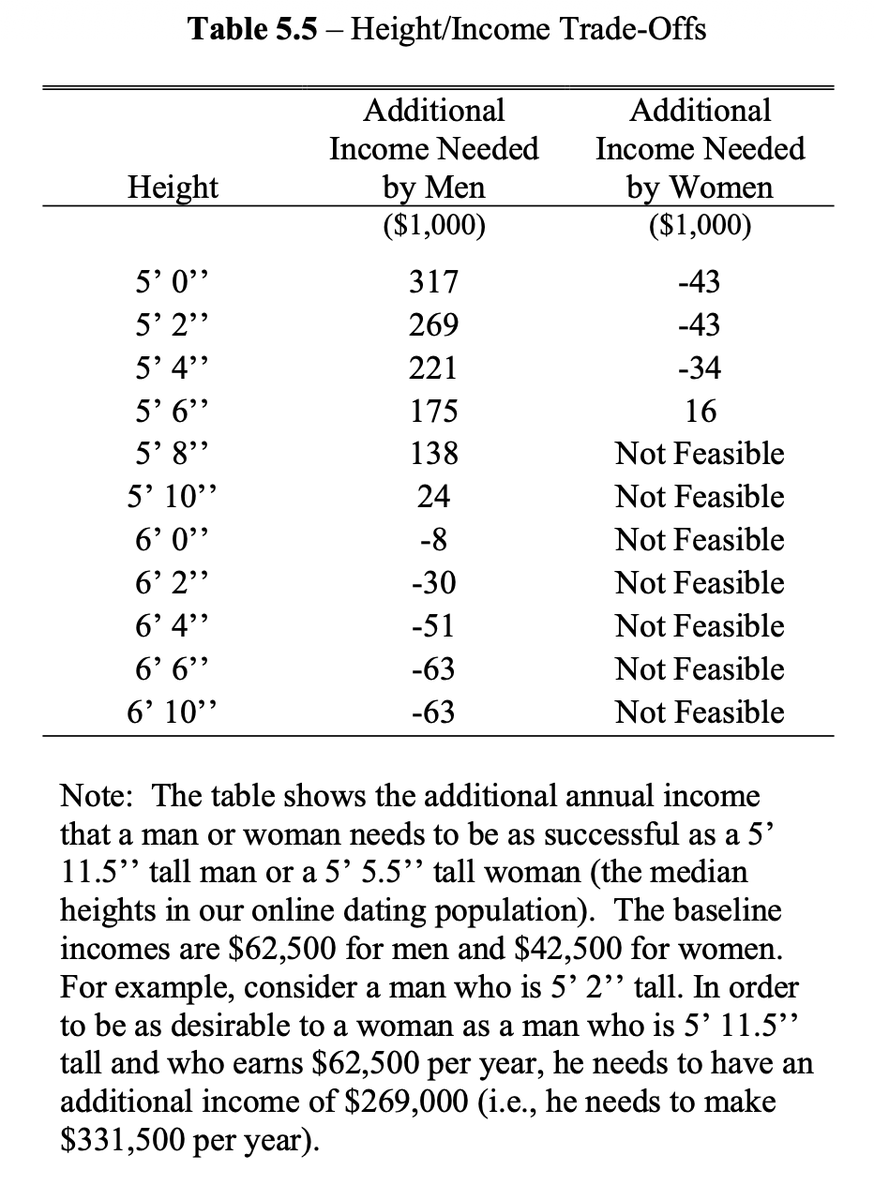
To be equally desirable to women, a 5'6" man has to earn $175,000/yr more than a 6' man. A six foot guy with $62,500 was equal to a 5'6" man on $237,500.
Study: https://t.co/201UUEMHf8
Also, high incomes aren't well-represented: Only 2% of men earned >$200,000
"We find a fair amount of measurement error in the preference coefficients for these income levels."
So the claim that men <5'8" need to earn more than that is based on noisy extrapolation
Sexual disgust…
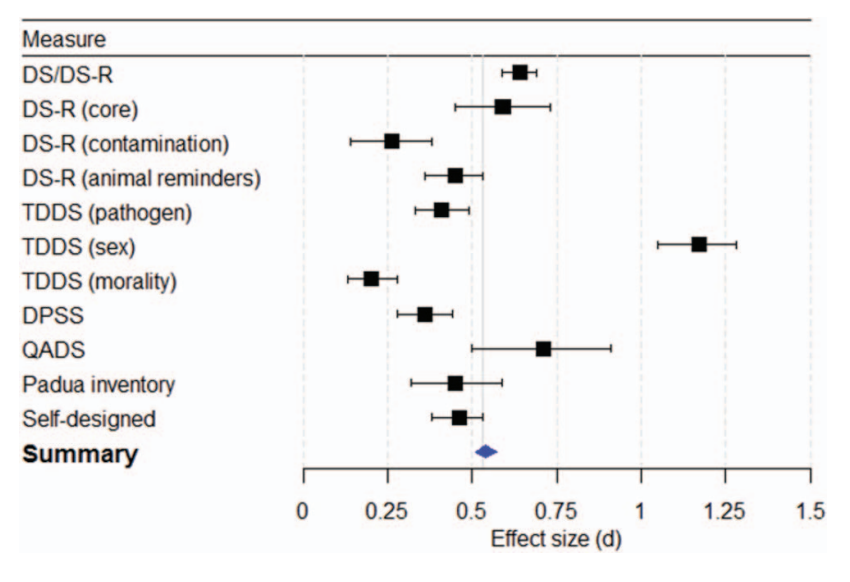
Women score more than a standard deviation higher than men on sexual disgust (d = 1.17 across 25 estimates).
Sex differences are much smaller for pathogen disgust (d = 0.41) and moral disgust (d = 0.20) (Sparks et al., 2018).
In Tybur et al. (2009), women rated all seven scenarios as more disgusting (N = 507, overall d = 1.51).
• An opposite-sex stranger deliberately rubbing your thigh in an elevator (d = 1.83)
• Taking someone you just met home for sex (1.51)
• Anal sex with an opposite-sex partner (1.00)
• Watching porn (0.94)
• Overhearing two strangers have sex (0.80)
• Learning someone you dislike fantasizes about you sexually (0.66)
• Giving oral sex (0.63)
Al-Shawaf et al. (2015) replicated the gap on the same scale (d = 1.54, N = 247, and d = 1.42, N = 280).
@mustardglobal@MyNewsIreland@DonPoker444 The authors also conduct a meta-analysis and find that the sex difference exists across cultures.
"From the above analyses, it is reasonable to assume that the basic sex difference in disgust propensity is a species-typical feature of the mind."
https://t.co/BXcSYYGtwj
There's a famous Harvard study where people say they'd rather earn $50K a year in a country where others earn $100K than $100K where others earn $200K.
Some have used this to argue that people truly care about relative wealth, not absolute wealth.
The problem with this theory is that it's completely inconsistent with how people behave in the real world, namely population flows. There are other possible explanations for the survey results, like a tendency for people to try to give interesting answers, and the fact that relative income is made salient, while what you can buy with extra money isn't.
In other words, when experiments with nothing on the line contradict revealed preferences, you should believe the latter. https://t.co/cfPmpkny1P
A pet peeve of mine:
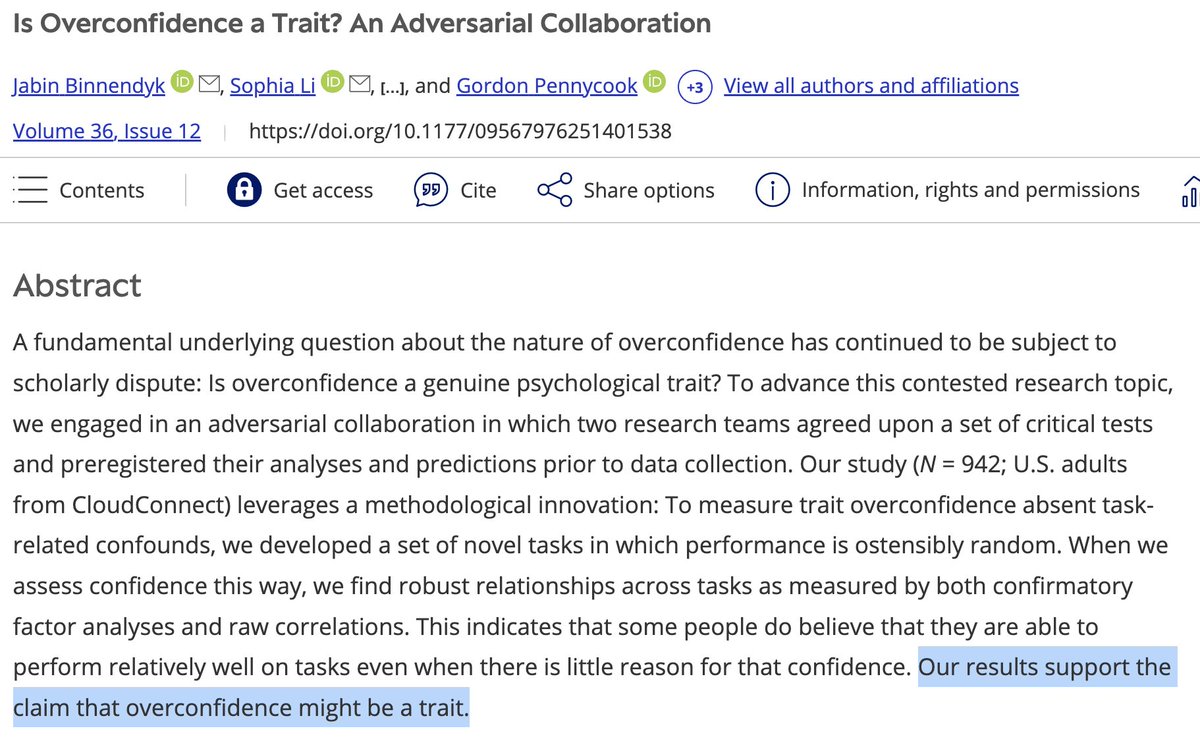
Out of politeness, psychologists sometimes write that something *might* be true.
But no data was needed to know that X *might* be true.
You can instead say something far more interesting! Your evidence supports the claim that X *is* true.
"If four of Gino’s studies are fraudulent, then probably more than four are fraudulent. This post bumps it up from four to five[...]
There needs to be a broader audit of Gino’s work, so that all of the fraudulent studies are identified."
https://t.co/15BEcZfYXs
@RYChappell@corsaren He seems to soften the conclusion towards the end:
"I believe that there are at least some followers of politics who are relatively reliable in their judgments. But people who fit this description may be rarer than we care to admit."